
Sign up to explore more
Create a free account to navigate family trees, view ancestors, and discover connections.
Sign up to explore more
Create a free account to navigate family trees, view ancestors, and discover connections.
Agnew Family Genealogy & History
Discover the Global Legacy of the Agnew Surname
The Agnew surname is a multifaceted name with origins in Norman, Scottish, English, and Irish contexts. It is believed to derive from the place name Agneaux in Normandy, the Anglo-Norman word aignel or aignau meaning "lamb," or from the Irish root "Ó Gnímh," meaning "descendant of Gníomh." The Agnew family tree has deep roots in these regions, reflecting a rich tapestry of cultural and historical influences that have shaped its development over centuries.
Throughout history, the Agnew surname has seen significant geographical spread and cultural evolution. By the 19th century, the majority of Agnew bearers in Great Britain were concentrated in southwest Scotland and northwest England. In Ireland, most were located in Ulster, particularly in County Antrim. The Agnew genealogy expanded further in the 18th and 19th centuries, with families migrating to North America, contributing to a global distribution and interconnected family history.
YourRoots data corroborates the Agnew surname's early presence in Scotland, with records dating back to the early 14th century. This confirms the surname's deep historical roots in the region and highlights the establishment of family branches during the medieval period. The dataset enriches the narrative of the Agnew family tree by documenting its expansion through the centuries, emphasizing the family's growth and migration patterns.
For those researching the Agnew family tree, YourRoots provides valuable genealogy records that illuminate the surname's historical journey and cultural connections. The data offers insights that can aid genealogists and family historians in tracing their lineage and understanding the Agnew family's enduring legacy across generations.
Find the Agnew Family Tree
Search more Agnew trees & genealogy records
Records
-
JAJohn Riley Agnew1828–1910Public Tree PersonParents: William Agnew3 treesScore: AJAJohn Riley Agnew1828–1910Public Tree PersonParents: William Agnew3 treesScore: A
-
JAJohn William Agnew1867–1940Public Tree PersonParents: Lilburn Agnew5 treesScore: AJAJohn William Agnew1867–1940Public Tree PersonParents: Lilburn Agnew5 treesScore: A
-
LALilburn Booker Agnew1839–1916Public Tree PersonParents: William Agnew5 treesScore: ALALilburn Booker Agnew1839–1916Public Tree PersonParents: William Agnew5 treesScore: A
-
JAJohn Chaseau Agnew1896–1971Individual Tree PersonParents: Frederick Agnew & Julia TorodeSpouse: Maud Pady, Margaret McLeanScore: AJAJohn Chaseau Agnew1896–1971Individual Tree PersonParents: Frederick Agnew & Julia TorodeSpouse: Maud Pady, Margaret McLeanScore: A
-
HAHenry Agnew1798–1879Individual Tree PersonParents: John Agnew & Ann MeehanSpouse: Ann MurphyChildren: Terrence, John, Bridget, Matthew, Ann, Patrick, Elizabeth, Mary, Marion, JohnScore: AHAHenry Agnew1798–1879Individual Tree PersonParents: John Agnew & Ann MeehanSpouse: Ann MurphyChildren: Terrence, John, Bridget, Matthew, Ann, Patrick, Elizabeth, Mary, Marion, JohnScore: A
-
WAWilliam Henry Agnew1902–1957Individual Tree PersonParents: Thomas Agnew & Elsie GraySpouse: Levinia PearsonChildren: Cecil, NancyScore: AWAWilliam Henry Agnew1902–1957Individual Tree PersonParents: Thomas Agnew & Elsie GraySpouse: Levinia PearsonChildren: Cecil, NancyScore: A
-
WAWilliam John Clarke (Clarke) Agnew1917–2004Individual Tree PersonParents: Dr. Agnew & Julia LyonsSpouse: Therese WelchScore: AWAWilliam John Clarke (Clarke) Agnew1917–2004Individual Tree PersonParents: Dr. Agnew & Julia LyonsSpouse: Therese WelchScore: A
-
JAJanet Agnew1759–1829Individual Tree PersonParents: James Agnew & Janet CarpenterSpouse: David LockhartChildren: Margaret, Helen, Elizabeth, Helen, Janet, Charles, David, Elisabeth, Elisabeth, Jacobina, James, Charles, Mary, Elizabeth, Helen, Elizabeth, Elizabeth, Elizabeth, MargaretScore: AJAJanet Agnew1759–1829Individual Tree PersonParents: James Agnew & Janet CarpenterSpouse: David LockhartChildren: Margaret, Helen, Elizabeth, Helen, Janet, Charles, David, Elisabeth, Elisabeth, Jacobina, James, Charles, Mary, Elizabeth, Helen, Elizabeth, Elizabeth, Elizabeth, MargaretScore: A
-
JAJohn Agnew1904–1989Individual Tree PersonParents: William Agnew & Mabel BethelSpouse: Hazel AgnewScore: AJAJohn Agnew1904–1989Individual Tree PersonParents: William Agnew & Mabel BethelSpouse: Hazel AgnewScore: A
-
JAJohn D Agnew1923–1943Individual Tree PersonParents: Joseph Agnew & Mary JunodScore: AJAJohn D Agnew1923–1943Individual Tree PersonParents: Joseph Agnew & Mary JunodScore: A
-
TAThomas Henry Agnew1875–1919Individual Tree PersonParents: William Agnew & Cather BellingerSpouse: Elsie GrayChildren: William, Thomas, George, Winifred, ErnestScore: ATAThomas Henry Agnew1875–1919Individual Tree PersonParents: William Agnew & Cather BellingerSpouse: Elsie GrayChildren: William, Thomas, George, Winifred, ErnestScore: A
-
WAWilliam John Clarke Agnew1891–1955Individual Tree PersonParents: William Agnew & Mary StephensScore: AWAWilliam John Clarke Agnew1891–1955Individual Tree PersonParents: William Agnew & Mary StephensScore: A
-
GAGeorge Himmelsbach Agnew1937–2020Individual Tree PersonParents: Hobart Agnew & Alice HimmelsbachSpouse: Lucille D'AnthonyScore: AGAGeorge Himmelsbach Agnew1937–2020Individual Tree PersonParents: Hobart Agnew & Alice HimmelsbachSpouse: Lucille D'AnthonyScore: A
-
WAWilliam Agnew1886–1973Individual Tree PersonParents: William Agnew & Ann AgnewSpouse: Jeannie pollockChildren: Anne, Isobel, Violet, WilliamScore: AWAWilliam Agnew1886–1973Individual Tree PersonParents: William Agnew & Ann AgnewSpouse: Jeannie pollockChildren: Anne, Isobel, Violet, WilliamScore: A
-
WAWilliam Bernard Stanley (Chook) Agnew1909–1985Individual Tree PersonParents: James AGNEW & Amy STANLEYSpouse: May CLARKChildren: Ronald, EnnisScore: AWAWilliam Bernard Stanley (Chook) Agnew1909–1985Individual Tree PersonParents: James AGNEW & Amy STANLEYSpouse: May CLARKChildren: Ronald, EnnisScore: A
-
EAElizabeth Donald Agnew1878–1951Individual Tree PersonParents: Daniel Agnew & Janet CarswellScore: AEAElizabeth Donald Agnew1878–1951Individual Tree PersonParents: Daniel Agnew & Janet CarswellScore: A
-
AAAndrew Ignew Agnew1640–1742Individual Tree PersonParents: Lt Whitehills & Marian BrisbaneSpouse: Mary WadleighChildren: MaryScore: AAAAndrew Ignew Agnew1640–1742Individual Tree PersonParents: Lt Whitehills & Marian BrisbaneSpouse: Mary WadleighChildren: MaryScore: A
-
JAJoel Richardson Agnew1817–1897Individual Tree PersonParents: Samuel Agnew & Susannah PrestonChildren: NovazemblaScore: AJAJoel Richardson Agnew1817–1897Individual Tree PersonParents: Samuel Agnew & Susannah PrestonChildren: NovazemblaScore: A
-
JAJames Agnew1846–1916Individual Tree PersonParents: Charles Agnew & Elizabeth GillespieSpouse: Annie DavidsonChildren: Helen, Elizabeth, Samuel, Elizabeth, Charles, William, Robert, James, AnnieScore: AJAJames Agnew1846–1916Individual Tree PersonParents: Charles Agnew & Elizabeth GillespieSpouse: Annie DavidsonChildren: Helen, Elizabeth, Samuel, Elizabeth, Charles, William, Robert, James, AnnieScore: A
-
DADr. John Robert Agnew1890–1963Individual Tree PersonParents: William Agnew & Mary StephensSpouse: Julia LyonsChildren: William, Helen, AnnaScore: ADADr. John Robert Agnew1890–1963Individual Tree PersonParents: William Agnew & Mary StephensSpouse: Julia LyonsChildren: William, Helen, AnnaScore: A
Search more trees & records for
Agnew for free
Tracing Your Agnew Family Lineage
Origin of the Agnew Family: Where does the Agnew surname come from?
The Agnew surname has its earliest known appearance in Scotland during the early 14th century, marking a significant point in the genealogy of this family line. This initial record reflects the beginnings of the Agnew family tree, establishing a connection to the rich historical tapestry of Scotland. As families began to document their lineages, the Agnew name emerged as part of the socio-cultural landscape of the time.
Genealogy and Early Family History of Agnew
In the following centuries, the Agnew family saw considerable growth and spread throughout Scotland, with notable concentrations in various regions. By the late medieval period, particularly during the 15th century, family branches began to establish themselves, leading to a more interconnected genealogy. This period was crucial for the Agnew family, as they laid down roots that would enable future generations to flourish.
Tracing the Agnew Family Tree Through the Centuries
The trajectory of the Agnew surname expanded significantly across regions from the medieval era to the modern age. By the 17th century, families with the Agnew name had begun to migrate, establishing a presence in new areas including parts of North America. This trend continued into the 18th and 19th centuries, as the Agnew family spread further afield, creating a diverse and global family history that intertwined with various cultures and communities.
Where to Find Agnew Genealogy Records Today
In contemporary times, the Agnew surname is widely represented, particularly in the United States, where families have continued to thrive and evolve. The 20th and 21st centuries have seen a further dissemination of the Agnew name across multiple regions, reflecting the ongoing journey of this family line. Readers interested in exploring their own connections to the Agnew family tree are encouraged to delve into the YourRoots database, where they can uncover valuable genealogy records and trace their ancestral heritage.
Famous People with Agnew (and Their Family Tree)

Spiro Agnew
Spiro Theodore Agnew served as the 39th Vice President of the United States from 1969 to 1973 under President Richard Nixon. Known for his centrist reputation and law-and-order stance, Agnew played a significant role in Nixon's electoral victories. However, his career was marred by scandal, leading to his resignation in 1973 following charges of tax evasion during his tenure as Baltimore County Executive and Governor of Maryland. This made him the second vice president in U.S. history to resign, after John C. Calhoun.
Agnew was born to a Greek immigrant father, Theophrastos Anagnostopoulos, who changed his name to Theodore Agnew upon settling in the U.S. His mother, Margaret Pollard, was an American from Virginia. The family settled in Baltimore, where Theodore Agnew ran a successful restaurant business and became a significant influence on his son's beliefs and upbringing.

Clan Agnew
Clan Agnew, a prominent Scottish clan from Galloway in the Lowlands, boasts a rich history with notable achievements. Sir Andrew Agnew of Lochnaw, 5th Baronet, is renowned for his military service, commanding the 21st Foot in the Battle of Dettingen in 1743 and playing a crucial role during the Jacobite rising of 1745 by defending Blair Castle. The clan has historically held influential positions, including the Sheriff of Wigtown, a title passed down to direct descendants since the 15th century, and representation in the British Parliament, contributing significantly to Scottish and British history.
The Agnew name likely originates from Norman roots, tracing back to the Agneaux family in the Barony d'Agneaux. The lineage suggests possible connections to Alastair, son of Domhnall, linked to the Clan Donald. The Agnews settled in Scotland in the 14th century, with historical ties to the Agnews of Lochnaw, Croach, Sheuchan, and Kilwaughter, among others. This storied heritage underscores the clan's longstanding influence and ties to both Scotland and Northern Ireland.

Jonathan Agnew
Jonathan Philip Agnew, widely known as "Aggers," is a distinguished English cricket broadcaster and former cricketer. Born on April 4, 1960, Agnew had an impressive first-class career as a fast bowler for Leicestershire from 1979 to 1990, taking 666 wickets at an average of 29.25. His international career included three Test caps and three One Day Internationals for England in the mid-1980s. Agnew transitioned to cricket journalism and commentary, becoming a leading voice on BBC Radio's Test Match Special and contributing to the Australian Broadcasting Corporation's Grandstand team. His notable "leg over" comment is celebrated as "the greatest sporting commentary ever" in a BBC poll.
Jonathan Agnew was born in Macclesfield, Cheshire, to Margaret (née McConnell) and Philip Agnew. His paternal grandparents were Mr. and Mrs. Norris M. Agnew of Dukenfield Hall, Mobberley, Cheshire, and his maternal grandparents were Mr. and Mrs. A.F.V. McConnell of Hampton Hall, Worthen, Shropshire. Agnew's family lived at Bainton near Stamford, Lincolnshire, with siblings Christopher and Felicity. His paternal grandmother, Lady Mona Agnew, lived to 110 years, making her one of the 100 longest-lived British individuals. Agnew's first cousin, Mary Duggan, was a women's Test cr
Judy Agnew
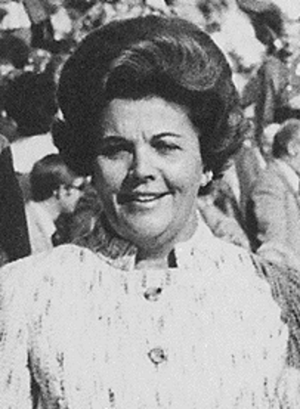
Elinor Isabel "Judy" Agnew, born April 23, 1921, in Baltimore, Maryland, was the Second Lady of the United States from 1969 to 1973, married to Spiro Agnew, the 39th vice president. Despite preferring a private life focused on family, her public remarks about the women's liberation movement and other social issues drew media attention. Judy Agnew was known for her Baltimore accent and distinctive entertaining style. Her husband's resignation in 1973 marked a significant turn in their public lives.
Judy Agnew was born to William Lee Judefind, a chemist, and Ruth Elinor Schafer, both of French-German descent. Her paternal grandfather was a Methodist minister. Her upbringing in Baltimore shaped her early life and professional experiences before marrying Spiro Agnew in 1942.

Rikk Agnew
Rikk Agnew, born Richard Francis Agnew Jr. on December 9, 1958, is a legendary American musician known for his influential role in the Orange County hardcore punk scene. As a multi-instrumentalist, he has been a pivotal member of bands such as the Adolescents and Christian Death, contributing significantly to albums like the Adolescents' "Blue Album" and Christian Death's "Only Theatre of Pain." Agnew's solo career includes notable releases like "All by Myself" and "Emotional Vomit." His work spans decades, with involvement in bands like D.I., 45 Grave, and the Rikk Agnew Band, showcasing his enduring impact on punk and deathrock music.
Rikk Agnew was born in Newport Beach, California, to a family with Irish and Mexican-American heritage. Raised in a blue-collar neighborhood in Fullerton, California, he developed an early interest in music, often playing instruments with his younger brothers, Frank and Alfie, at home.
Agnew Surname Meaning, Origin, and History
The surname "Agnew" has Norman, Scottish, English, and Irish origins, with its etymology linked to the place name Agneaux in Normandy, the Anglo-Norman word for "lamb," or the Irish "descendant of Gníomh." By the late 19th century, the surname was predominantly found in southwest Scotland, northwest England, and Ulster, particularly County Antrim. Notable individuals with this surname have made their mark in diverse fields such as politics, sports, and entertainment.
VIEW MOREWhere to Find Genealogy Records for Agnew
We’ve analyzed YourRoots tree and records data to uncover where genealogists are finding key sources such as census, birth certificates, marriage records, and obituaries for the Agnew family. Explore our most popular genealogy record sources for the Agnew surname to learn more.
VIEW MOREAbout YourRoots
Explore your family tree geographically
Import your GEDCOM file to transform your family tree into an interactive global map. See your roots laid out visually and understand your true geographic heritage.
Powerful tools like "Trace Back To Me" instantly map your family's migration paths from a chosen ancestor all the way back to you.
Discover ancestors beyond "end-of-line" automatically
Import your family tree and let AI expand it for you. AI Ancestor Finder scans "end-of-line" ancestors to uncover their parents across hundreds of family lines at once. AI Deep Research analyzes selected ancestors and family clusters, suggesting relevant records and next steps.
Turn on Auto Research Mode to get new discoveries daily or weekly, so your tree keeps growing even while you're away.
Find more DNA matches across all DNA tests
Combine your DNA data with your family tree to unlock the full power of YourRoots DNA Match. Connect with relatives across major testing services — Ancestry, 23andMe, MyHeritage, and more.
View your matches' maps and trees to identify shared ancestors, and soon you'll be able to add them directly to your own tree and map.
Ancestry DNA analysis that goes deeper than others
Unlock exclusive reports that reveal your deeper origins.
- Deep Ancestry Report — Analyze 130+ ethnicities, sub-regions, and 1,800+ communities in one detailed view.
- Global & Native American Reports — Developed with Stanford researchers to uncover hidden ancestries across all 22 chromosomes.
- Ancient DNA Series — Compare your DNA with 1,000+ ancient genomes from Viking, Celtic, and early American civilizations.
Sign up to explore more
Create a free account to navigate family trees, view ancestors, and discover connections.
Coming Soon
We're actively working on many new features for YourRoots. Features marked v2 are ones we're planning to launch soon.
Have a particular feature request? Let us know below!