
Sign up to explore more
Create a free account to navigate family trees, view ancestors, and discover connections.


Sign up to explore more
Create a free account to navigate family trees, view ancestors, and discover connections.
Bavaria Family Genealogy & History
Discover the Global Legacy of the Bavaria Surname
The Bavaria surname has its origins in Germany, closely linked to the historical and cultural backdrop of the region known as Bavaria. Officially referred to as the Free State of Bavaria, this area is the largest German state and has a rich history dating back to its earliest settlements by Celtic tribes. The name Bavaria itself is tied to the region’s identity and has been carried through generations, creating a longstanding familial legacy within the country and beyond.
Over the centuries, the Bavaria surname evolved alongside the region’s dynamic history. Initially, families bearing the Bavaria name were concentrated in key areas across Germany, including major cities like Munich, Nuremberg, and Augsburg. As Bavaria transitioned through various political and social changes—from its time as a duchy, through the Holy Roman Empire, and eventually as a part of the Federal Republic of Germany—the surname spread, reflecting the adaptability and resilience of its bearers. By the 14th century, the Bavaria name began appearing in neighboring regions, eventually establishing a presence throughout Europe.
YourRoots data enriches our understanding of the Bavaria genealogy by tracing the surname’s earliest known appearances in Germany. The data highlights the surname’s growth during the 11th century, where it began forming intricate family connections that expanded across Germany. This aligns with historical accounts of Bavaria’s development and its cultural significance, providing a robust foundation for exploring family trees associated with this name.
For researchers interested in the Bavaria family tree, YourRoots offers valuable insights into the surname’s evolution and geographical spread. The continuity between historical records and the data available in YourRoots assists genealogists in tracing their ancestry, offering a comprehensive view of the Bavaria genealogy and its enduring legacy. This serves as a rich resource for individuals seeking to understand their familial heritage and connect with their roots.
Find the Bavaria Family Tree
Search more Bavaria trees & genealogy records
Records
-
MBMaximilian II Joseph of BAVARIA1811–1864Individual Tree PersonParents: Ludwig Bavaria & Theresa SAXE-HILDBURGHAUSENSpouse: Maria PRUSSIAChildren: Otto, Ludwig, ElizabethScore: AMBMaximilian II Joseph of BAVARIA1811–1864Individual Tree PersonParents: Ludwig Bavaria & Theresa SAXE-HILDBURGHAUSENSpouse: Maria PRUSSIAChildren: Otto, Ludwig, ElizabethScore: A
-
WBWelf I of Bavaria1037–1101Individual Tree PersonParents: Alberto Milan & Cunegonde WelfenChildren: HenryScore: AWBWelf I of Bavaria1037–1101Individual Tree PersonParents: Alberto Milan & Cunegonde WelfenChildren: HenryScore: A
-
SBSybille von Wittelsbach of Bavaria1489–1519Individual Tree PersonParents: Albrecht Bavaria) & Kunigunde AustriaScore: ASBSybille von Wittelsbach of Bavaria1489–1519Individual Tree PersonParents: Albrecht Bavaria) & Kunigunde AustriaScore: A
-
*B*Wulfhild (Ulfhilde) Billung von Saxony Herzogovina von Bavaria1071–1126Individual Tree PersonParents: *Hugh Billung) & *Sophia SaxonySpouse: *Henry WelfChildren: *Mathilde, Wulfhild, Henry, Konrad, Sophie, Welf, JudithScore: A*B*Wulfhild (Ulfhilde) Billung von Saxony Herzogovina von Bavaria1071–1126Individual Tree PersonParents: *Hugh Billung) & *Sophia SaxonySpouse: *Henry WelfChildren: *Mathilde, Wulfhild, Henry, Konrad, Sophie, Welf, JudithScore: A
-
LBLudwig III BAVARIA1845–1921Individual Tree PersonParents: Luitpold BAVARIA & Auguste TUSCANYChildren: RuprechtScore: ALBLudwig III BAVARIA1845–1921Individual Tree PersonParents: Luitpold BAVARIA & Auguste TUSCANYChildren: RuprechtScore: A
-
LBLouis II of Bavaria Duke of Bavaria1229–1294Individual Tree PersonParents: Otto Bavaria & Agnes BrunswickSpouse: Matilda HabsburgChildren: LouisScore: ALBLouis II of Bavaria Duke of Bavaria1229–1294Individual Tree PersonParents: Otto Bavaria & Agnes BrunswickSpouse: Matilda HabsburgChildren: LouisScore: A
-
MBMaria Anna Victoria Christine Josepha Benedictine Rosalie Petronella Maria Anna Victoria of Bavaria1660–1690Individual Tree PersonParents: Ferdinand Bayern & Henriette SavoyenSpouse: Louis FranceChildren: Felipe, Louis, CharlesScore: AMBMaria Anna Victoria Christine Josepha Benedictine Rosalie Petronella Maria Anna Victoria of Bavaria1660–1690Individual Tree PersonParents: Ferdinand Bayern & Henriette SavoyenSpouse: Louis FranceChildren: Felipe, Louis, CharlesScore: A
-
ABAlbrecht I von Wittelsbach Duke of Bavaria1336–1404Individual Tree PersonParents: Louis Emperor & Margaretha EmpireSpouse: Margaretha Silezië-BriegChildren: MargaretheScore: AABAlbrecht I von Wittelsbach Duke of Bavaria1336–1404Individual Tree PersonParents: Louis Emperor & Margaretha EmpireSpouse: Margaretha Silezië-BriegChildren: MargaretheScore: A
-
ABAnna, Archduchess of Austria Duchess consort of Bavaria1528–1590Individual Tree PersonParents: Ferdinand Archduke & Anna HungarySpouse: Albrecht BavariaChildren: Wilhelm, Ferdinand, Maria, MaximilianaScore: AABAnna, Archduchess of Austria Duchess consort of Bavaria1528–1590Individual Tree PersonParents: Ferdinand Archduke & Anna HungarySpouse: Albrecht BavariaChildren: Wilhelm, Ferdinand, Maria, MaximilianaScore: A
-
HBHeinrich IX (Welf) Duke Of Bavaria1074–1126Individual Tree PersonParents: Guelph Bavaria & Bavaria NoneSpouse: Bavaria NoneChildren: SwabiaScore: AHBHeinrich IX (Welf) Duke Of Bavaria1074–1126Individual Tree PersonParents: Guelph Bavaria & Bavaria NoneSpouse: Bavaria NoneChildren: SwabiaScore: A
-
EBElisabeth zu Bavaria1329–1402Individual Tree PersonParents: Ludwig Wittelsbach & Margaretha d'AvesnesSpouse: Ulrich WÃrttemberg, Cangrande ScalaScore: AEBElisabeth zu Bavaria1329–1402Individual Tree PersonParents: Ludwig Wittelsbach & Margaretha d'AvesnesSpouse: Ulrich WÃrttemberg, Cangrande ScalaScore: A
-
LBLudwig I of Bavaria1786–1868Individual Tree PersonParents: Maximilian BAVARIA & Augusta DARMSTADTSpouse: Theresa SAXE-HILDBURGHAUSEN, Lola MONTEZChildren: Maximilian, Luitpold, Otto, Louis, Hildegarde, MathildaScore: ALBLudwig I of Bavaria1786–1868Individual Tree PersonParents: Maximilian BAVARIA & Augusta DARMSTADTSpouse: Theresa SAXE-HILDBURGHAUSEN, Lola MONTEZChildren: Maximilian, Luitpold, Otto, Louis, Hildegarde, MathildaScore: A
-
CBCatherine Marie De Lorraine-Guise Holy Roman Empress; Archduchess of Holy Roman Empress; Archduchess of Austria AustriaPrinzessin von Bayern Bavaria1551–1596Individual Tree PersonParents: François Lorraine & Anne d'EsteSpouse: *Wilhelm Carinthia)Children: Constantia, Maria, Maria, Anne, Sir, Madeleine, Christine, Kardinal, Ferdinand, Albrecht, Karl, Eleonore, Maria, MaximilianScore: ACBCatherine Marie De Lorraine-Guise Holy Roman Empress; Archduchess of Holy Roman Empress; Archduchess of Austria AustriaPrinzessin von Bayern Bavaria1551–1596Individual Tree PersonParents: François Lorraine & Anne d'EsteSpouse: *Wilhelm Carinthia)Children: Constantia, Maria, Maria, Anne, Sir, Madeleine, Christine, Kardinal, Ferdinand, Albrecht, Karl, Eleonore, Maria, MaximilianScore: A
-
MBMaria Anna Wittelsbach of Bavaria1551–1608Individual Tree PersonParents: Albrecht Bavaria & Anna, BavariaSpouse: Karel OostenrijkChildren: Margaret, Ferdinand, Georgiane, Eleonore, Leopold, Konstanze, Charles, Maria, Ferdinand, Gregoria, Maximilian, MariaScore: AMBMaria Anna Wittelsbach of Bavaria1551–1608Individual Tree PersonParents: Albrecht Bavaria & Anna, BavariaSpouse: Karel OostenrijkChildren: Margaret, Ferdinand, Georgiane, Eleonore, Leopold, Konstanze, Charles, Maria, Ferdinand, Gregoria, Maximilian, MariaScore: A
-
HBHeinrich Xvi Der Reiche Herzog Vbayern Landshut De Bavaria1386–1450Individual Tree PersonParents: Heinrich Beieren-Landshut & Margaretha HabsburgScore: AHBHeinrich Xvi Der Reiche Herzog Vbayern Landshut De Bavaria1386–1450Individual Tree PersonParents: Heinrich Beieren-Landshut & Margaretha HabsburgScore: A
-
ABAlbrecht "Albert" III 'the Pious' von Wittelsbach, Duke of Bavaria1401–1460Individual Tree PersonParents: Ernst Bavaria & Elisabetta ViscontiSpouse: Anna PrincessChildren: Albrecht, Christoph, Wolfgang, Sigismund, Ernst, Anna, Sigmund, Johann, ElisabethScore: AABAlbrecht "Albert" III 'the Pious' von Wittelsbach, Duke of Bavaria1401–1460Individual Tree PersonParents: Ernst Bavaria & Elisabetta ViscontiSpouse: Anna PrincessChildren: Albrecht, Christoph, Wolfgang, Sigismund, Ernst, Anna, Sigmund, Johann, ElisabethScore: A
-
EBErnst von Bayern-München, Duke of Bavaria1373–1438Individual Tree PersonParents: John Munich-Bavaria & Katharine GorzSpouse: Elisabetta ViscontiChildren: Albrecht, Amalie, BeatrixScore: AEBErnst von Bayern-München, Duke of Bavaria1373–1438Individual Tree PersonParents: John Munich-Bavaria & Katharine GorzSpouse: Elisabetta ViscontiChildren: Albrecht, Amalie, BeatrixScore: A
-
CBCharles Karl VII Albert of the Wittelsbach dynasty, Emperor of Holy Roman Empire, prince-elector of Bavaria1697–1745Individual Tree PersonParents: Maximilian 1683 & Teresa PolandSpouse: Maria ÖsterreichChildren: Theresia, Maximilian, MariaScore: ACBCharles Karl VII Albert of the Wittelsbach dynasty, Emperor of Holy Roman Empire, prince-elector of Bavaria1697–1745Individual Tree PersonParents: Maximilian 1683 & Teresa PolandSpouse: Maria ÖsterreichChildren: Theresia, Maximilian, MariaScore: A
-
HBHenry Duke of Saxony En Bavaria1129–1195Individual Tree PersonParents: Henry Bavaria & Gertrude BavariaSpouse: Matilda Bayern., Clementia ZähringenChildren: Gertrude, Richenza, Henry, Mathilde, Henry, Lothar, Otto, William, Eleanor, IngibiorgScore: AHBHenry Duke of Saxony En Bavaria1129–1195Individual Tree PersonParents: Henry Bavaria & Gertrude BavariaSpouse: Matilda Bayern., Clementia ZähringenChildren: Gertrude, Richenza, Henry, Mathilde, Henry, Lothar, Otto, William, Eleanor, IngibiorgScore: A
-
EBElisabeth "Princess of Bavaria-Munich" Bavaria1443–1486Individual Tree PersonParents: Albrecht III & Anna Braunschweig-Grübenhagen-EinbeckSpouse: Ernst SachsenChildren: Friedrich, Johann, Ernst, Margarethe, AdalbertScore: AEBElisabeth "Princess of Bavaria-Munich" Bavaria1443–1486Individual Tree PersonParents: Albrecht III & Anna Braunschweig-Grübenhagen-EinbeckSpouse: Ernst SachsenChildren: Friedrich, Johann, Ernst, Margarethe, AdalbertScore: A
Search more trees & records for
Bavaria for free
Tracing Your Bavaria Family Lineage
Origin of the Bavaria Family: Where does the Bavaria surname come from?
The Bavaria surname traces its earliest known appearance to Germany, establishing a significant historical connection within genealogical records. This earliest mention marks the beginning of a rich familial legacy that has evolved and branched out over centuries. As families with the Bavaria name began to form, they laid the groundwork for intricate family trees that would flourish in subsequent generations.
Genealogy and Early Family History of Bavaria
In the initial centuries following its recorded appearance, the Bavaria surname experienced notable growth throughout Germany. This period saw families establishing roots primarily in key regions of the country, where they began to create distinct branches of their family trees. By the end of the first millennium, the Bavaria lineage had expanded significantly, contributing to a complex tapestry of family connections that would define the surname's legacy.
The 11th century marked a particularly prosperous time for families bearing the Bavaria surname, as their numbers increased and their presence became more established. Various regions across Germany served as focal points for these families, allowing them to develop their genealogical lines and interconnect with other clans. This early expansion laid the foundation for the surname's evolution and its subsequent spread across Europe.
Tracing the Bavaria Family Tree Through the Centuries
As time progressed into the following centuries, the Bavaria surname continued to expand beyond its original German roots. In the 14th century, families began to migrate to neighboring regions and countries, which facilitated the growth of the surname across different landscapes. By the 18th century, the Bavaria name was not only prominent in Germany but also found in various parts of Europe, showcasing its adaptability and resilience through changing times.
The 19th and 20th centuries saw further global dispersion, with families bearing the Bavaria surname establishing themselves in diverse regions around the world. This widespread migration allowed the surname to flourish in various countries, adapting to new cultures while preserving its rich heritage. The ongoing evolution of the Bavaria family tree illustrates a dynamic narrative of connection and continuity that spans multiple generations.
Where to Find Bavaria Genealogy Records Today
In modern times, the Bavaria surname has maintained its presence globally, continuing to be associated with numerous families across different continents. The 20th and 21st centuries have seen a renewed interest in genealogy, encouraging individuals to explore their ancestral roots and connect with their family heritage. Readers are invited to delve into the YourRoots database to discover their own Bavaria genealogy records and trace their unique family narratives.
Famous People with Bavaria (and Their Family Tree)

Princess Sophie of Bavaria
Princess Sophie of Bavaria, born Sophie Friederike Dorothea Wilhelmine, was a significant figure in European nobility, known for her role as Archduchess of Austria through her marriage to Archduke Franz Karl. She was the mother of Emperor Franz Joseph I of Austria and King of Hungary, and Emperor Maximilian I of Mexico. Her influence in Austrian politics was profound, particularly in advancing her son Franz Joseph to the throne during the 1848 Revolution. Despite a strong-willed and authoritative reputation, Sophie was deeply devoted to her family and the Habsburg empire, leaving a lasting impact on Austrian court life.
Born in 1805, Sophie was the fourth child of King Maximilian I Joseph of Bavaria and Caroline of Baden, and had a twin sister, Maria Anna. Her familial connections extended deeply into European royalty, with her half-sister Caroline Augusta married to her father-in-law, Emperor Francis II. Sophie's family roots and connections played a significant role in her life's trajectory and influence within the Austrian empire.

Ludwig II of Bavaria
Ludwig II of Bavaria, known as the Swan King or Fairy Tale King, reigned from 1864 to 1886. Despite being King of Bavaria, Duke of Bavaria, Franconia, and Swabia, and Count Palatine of the Rhine, he is remembered for his patronage of the arts, particularly supporting composer Richard Wagner and commissioning iconic structures like Neuschwanstein Castle. His focus on artistic and architectural projects rather than governance led to financial strain and accusations of insanity, which were used to depose him in 1886. His untimely death remains a topic of controversy, yet his cultural and architectural legacy continues to draw tourists worldwide.
Born at Nymphenburg Palace, Ludwig was the elder son of Maximilian II of Bavaria and Marie of Prussia. His grandfather, Ludwig I, influenced his naming to commemorate their shared birthday. Ludwig's upbringing was strict and controlled, with little closeness to his parents, particularly his father, King Maximilian II, who was unsure how to connect with him. However, Ludwig shared a warmer relationship with his grandfather, and his childhood was marked by time spent at the Gothic-style Hohenschwangau Castle.

Kingdom of Bavaria
The Kingdom of Bavaria was a prominent German state established in 1806, following the ascension of Elector Maximilian IV Joseph of the House of Wittelsbach as its king. Known for its significant role in the German Empire from 1871 to 1918, Bavaria was second only to Prussia in power and wealth. Key achievements include participation in the Confederation of the Rhine and transitioning to a republic post-German Revolution in 1918, evolving into today's Free State of Bavaria. Bavaria's alignment with Napoleonic France and later defection to the Sixth Coalition against Napoleon marked strategic political shifts.
The Kingdom of Bavaria was intricately linked to the House of Wittelsbach, with Maximilian I as a pivotal figure in its establishment. This family lineage played a crucial role in shaping Bavaria's political landscape until 1918.

Princess Ludovika of Bavaria
Princess Ludovika of Bavaria, born Marie Ludovika Wilhelmine on 30 August 1808, was a key figure in European nobility, known for being the mother of Empress Elisabeth of Austria. Despite her own feelings of marital frustration, Ludovika focused on arranging prestigious dynastic marriages for her children. Her marriage to Maximilian Joseph, Duke in Bavaria, was marked by challenges, including his frequent absences. Ludovika's life was deeply rooted in the cultural milieu of Munich, where she was both born and died.
Princess Ludovika was the sixth child of King Maximilian I Joseph of Bavaria and his second wife, Caroline of Baden. Her education was rich in literature, geography, and history, reflecting the intellectual environment fostered by her parents in Bavaria.

Maria Sophie of Bavaria
Maria Sophie of Bavaria, born Maria Sophie Amalie, was the last Queen of the Two Sicilies, married to Francis II. Known as the "warrior queen," she valiantly defended the Kingdom during the Siege of Gaeta in 1860-61 against Giuseppe Garibaldi's forces, though they ultimately capitulated. Her reign was marked by political upheaval, culminating in exile to Rome. Despite personal challenges, including an unconsummated marriage and an illegitimate child, her legacy endures through her resilience during turbulent times.
Maria Sophie was the sixth of ten children of Maximilian Joseph, Duke in Bavaria, and Princess Ludovika of Bavaria. Her notable family included her sister Elisabeth of Bavaria, famously known as "Sisi," who was married to Emperor Franz Joseph I of Austria.
Bavaria Surname Meaning, Origin, and History
The surname "Bavaria" likely originates from the historical and cultural region of Bavaria in southeastern Germany. This area, known for its distinct Catholic heritage and conservative traditions, has a rich history dating back to Celtic tribes in the Iron Age, Roman conquests, and later becoming a significant duchy and kingdom within the Holy Roman Empire and the German Empire. The cultural identity of Bavaria is marked by its unique language, cuisine, and festivals, contributing to the prominence of the name.
VIEW MOREWhere to Find Genealogy Records for Bavaria
We’ve analyzed YourRoots tree and records data to uncover where genealogists are finding key sources such as census, birth certificates, marriage records, and obituaries for the Bavaria family. Explore our most popular genealogy record sources for the Bavaria surname to learn more.
VIEW MOREAbout YourRoots
Explore your family tree geographically
Import your GEDCOM file to transform your family tree into an interactive global map. See your roots laid out visually and understand your true geographic heritage.
Powerful tools like "Trace Back To Me" instantly map your family's migration paths from a chosen ancestor all the way back to you.
Discover ancestors beyond "end-of-line" automatically
Import your family tree and let AI expand it for you. AI Ancestor Finder scans "end-of-line" ancestors to uncover their parents across hundreds of family lines at once. AI Deep Research analyzes selected ancestors and family clusters, suggesting relevant records and next steps.
Turn on Auto Research Mode to get new discoveries daily or weekly, so your tree keeps growing even while you're away.
Find more DNA matches across all DNA tests
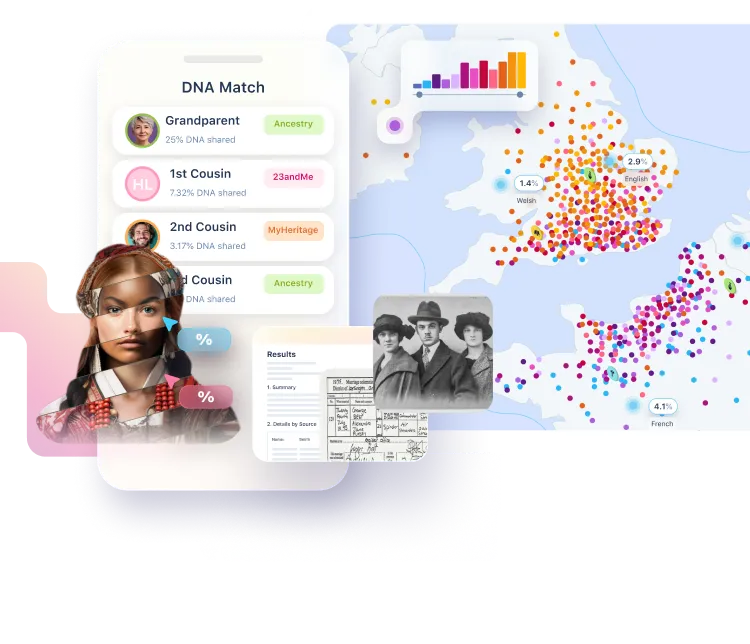
Combine your DNA data with your family tree to unlock the full power of YourRoots DNA Match. Connect with relatives across major testing services — Ancestry, 23andMe, MyHeritage, and more.
View your matches' maps and trees to identify shared ancestors, and soon you'll be able to add them directly to your own tree and map.
Ancestry DNA analysis that goes deeper than others
Unlock exclusive reports that reveal your deeper origins.
- Deep Ancestry Report — Analyze 130+ ethnicities, sub-regions, and 1,800+ communities in one detailed view.
- Global & Native American Reports — Developed with Stanford researchers to uncover hidden ancestries across all 22 chromosomes.
- Ancient DNA Series — Compare your DNA with 1,000+ ancient genomes from Viking, Celtic, and early American civilizations.
Sign up to explore more
Create a free account to navigate family trees, view ancestors, and discover connections.
Coming Soon
We're actively working on many new features for YourRoots. Features marked v2 are ones we're planning to launch soon.
Have a particular feature request? Let us know below!