
Sign up to explore more
Create a free account to navigate family trees, view ancestors, and discover connections.
Sign up to explore more
Create a free account to navigate family trees, view ancestors, and discover connections.
Brunner Family Genealogy & History
Discover the Global Legacy of the Brunner Surname
The Brunner surname is of German origin, derived from the Middle High German word "Brunne," meaning spring or water well. This name was typically given to individuals who lived near a spring or well, or it denoted people from places named Brunn. The Brunner surname holds a rich historical background, with its roots deeply embedded in European culture. Throughout history, notable individuals bearing the Brunner name have made significant contributions in various fields, including architecture, politics, sports, and the arts, reflecting the diverse nature of this family line.
As the Brunner family tree expanded, the surname spread geographically and culturally, particularly in the German-speaking regions of Europe. By the 18th century, members of the Brunner family began to migrate beyond their ancestral homelands. This movement was not limited to Europe; many Brunner families crossed the Atlantic to the United States, where they established new roots and identities. This migration was part of a broader trend of European settlement in North America, allowing the Brunner name to flourish and become part of the American cultural fabric.
According to YourRoots, the Brunner surname first appeared in Switzerland, establishing a strong genealogical foundation. This aligns with historical records indicating a significant presence of Brunner families in Swiss regions during the early centuries. The YourRoots data indicate that the Brunner family maintained their strong connections to their Swiss heritage even as they branched out into new regions. Such insights enrich our understanding of how the Brunner lineage evolved over time, emphasizing the family's adaptability and resilience as they integrated into diverse communities.
Today, Brunner genealogy records are widely accessible, offering rich material for those interested in tracing the Brunner family tree. YourRoots continues to provide valuable data, helping researchers uncover the intricate stories and connections that define this historic surname. With a global distribution, the Brunner name remains a testament to the enduring legacy of its early Swiss origins and the varied paths of its descendants.
Find the Brunner Family Tree
Search more Brunner trees & genealogy records
Records
-
JBJohann Heinrich Brunner1804–1880Public Tree Person3 treesScore: AJBJohann Heinrich Brunner1804–1880Public Tree Person3 treesScore: A
-
CBCaroline Brunner1853–1894Individual Tree PersonParents: Jacob Drum & Anna MillerSpouse: Charles Mehlenbacher, Peter DrumChildren: Lewis, Mary, Edward, Rosina, Sarah, Caroline, Elizabeth, Peter, Minnie, Lydia, William, LydiaScore: ACBCaroline Brunner1853–1894Individual Tree PersonParents: Jacob Drum & Anna MillerSpouse: Charles Mehlenbacher, Peter DrumChildren: Lewis, Mary, Edward, Rosina, Sarah, Caroline, Elizabeth, Peter, Minnie, Lydia, William, LydiaScore: A
-
DBDorothea N. Brunner1923–2019Individual Tree PersonParents: Leo Brunner & Emma BrunnerSpouse: Richard KurtzScore: ADBDorothea N. Brunner1923–2019Individual Tree PersonParents: Leo Brunner & Emma BrunnerSpouse: Richard KurtzScore: A
-
MBMabel Marie Brunner1908–1999Individual Tree PersonParents: George Brunner & Mary BrunnerScore: AMBMabel Marie Brunner1908–1999Individual Tree PersonParents: George Brunner & Mary BrunnerScore: A
-
HBHeinrich F BRUNNER1612–1712Individual Tree PersonParents: Hans GFEab & Anna KuntzSpouse: Christina MEIASSChildren: JohannScore: AHBHeinrich F BRUNNER1612–1712Individual Tree PersonParents: Hans GFEab & Anna KuntzSpouse: Christina MEIASSChildren: JohannScore: A
-
FBFranziska Brunner1866–1939Individual Tree PersonParents: Xaverius Sr & Maria L6QB-JBKScore: AFBFranziska Brunner1866–1939Individual Tree PersonParents: Xaverius Sr & Maria L6QB-JBKScore: A
-
SBSteven Walter Brunner1884–1949Individual Tree PersonParents: Antone Brunner & Mary BrunnerScore: ASBSteven Walter Brunner1884–1949Individual Tree PersonParents: Antone Brunner & Mary BrunnerScore: A
-
PBPaul Brunner1919–1987Individual Tree PersonParents: Walter Brunner & Clara BrunesScore: APBPaul Brunner1919–1987Individual Tree PersonParents: Walter Brunner & Clara BrunesScore: A
-
ABAudrey Meta Brunner1926–2016Individual Tree PersonParents: Leo Brunner & Emma BrunnerSpouse: Kenneth DobratzScore: AABAudrey Meta Brunner1926–2016Individual Tree PersonParents: Leo Brunner & Emma BrunnerSpouse: Kenneth DobratzScore: A
-
HBHelen Elizabeth Brunner1906–1989Individual Tree PersonParents: Augustus Brunner & Clara DanglerSpouse: Joseph Moran, Louis SchiavoChildren: EleanorScore: AHBHelen Elizabeth Brunner1906–1989Individual Tree PersonParents: Augustus Brunner & Clara DanglerSpouse: Joseph Moran, Louis SchiavoChildren: EleanorScore: A
-
JBJulian Ann Brunner1842–1928Individual Tree PersonParents: Peter Bruner & Sarah MusserSpouse: William BaileyChildren: Henrieta, Harriet, Amos, Caroline, Anne, Sarah, Catherine, Ada, John, Henrietta, Amanda, Peter, Virginia, Vajgia, WilliamScore: AJBJulian Ann Brunner1842–1928Individual Tree PersonParents: Peter Bruner & Sarah MusserSpouse: William BaileyChildren: Henrieta, Harriet, Amos, Caroline, Anne, Sarah, Catherine, Ada, John, Henrietta, Amanda, Peter, Virginia, Vajgia, WilliamScore: A
-
CBClara Lavina Brunner1904–1934Individual Tree PersonSpouse: Audie McGinleyChildren: Andie, DonaldScore: ACBClara Lavina Brunner1904–1934Individual Tree PersonSpouse: Audie McGinleyChildren: Andie, DonaldScore: A
-
ABAston Brunner1874–1939Individual Tree PersonParents: Antone Brunner & Mary BrunnerScore: AABAston Brunner1874–1939Individual Tree PersonParents: Antone Brunner & Mary BrunnerScore: A
-
RBRev. Elias Brunner1797–1870Individual Tree PersonParents: John I & Margaret BrunnerSpouse: Jincy young)Children: LouisScore: ARBRev. Elias Brunner1797–1870Individual Tree PersonParents: John I & Margaret BrunnerSpouse: Jincy young)Children: LouisScore: A
-
GBGeorge F Brunner1877–1951Individual Tree PersonParents: Antone Brunner & Mary BrunnerSpouse: Mary BrunnerChildren: George, Mabel, VeraScore: AGBGeorge F Brunner1877–1951Individual Tree PersonParents: Antone Brunner & Mary BrunnerSpouse: Mary BrunnerChildren: George, Mabel, VeraScore: A
-
CBCarl Otto BRUNNER1875–1935Individual Tree PersonParents: David BRUNNER & Julia REEDSpouse: Minnie EAGAN, Clara MillerChildren: Maurice, ZellaScore: ACBCarl Otto BRUNNER1875–1935Individual Tree PersonParents: David BRUNNER & Julia REEDSpouse: Minnie EAGAN, Clara MillerChildren: Maurice, ZellaScore: A
-
WBWalter R (A) Brunner1895–1977Individual Tree PersonParents: Christ BrunnerSpouse: Clara BrunesChildren: Paul, Russell, Marie, Dorothy, Harold, Helen, Walter, RalphScore: AWBWalter R (A) Brunner1895–1977Individual Tree PersonParents: Christ BrunnerSpouse: Clara BrunesChildren: Paul, Russell, Marie, Dorothy, Harold, Helen, Walter, RalphScore: A
-
RBRuth Margaret Brunner1931–1984Individual Tree PersonParents: Lawrence Brunner & Ruth BrunnerSpouse: George BackusScore: ARBRuth Margaret Brunner1931–1984Individual Tree PersonParents: Lawrence Brunner & Ruth BrunnerSpouse: George BackusScore: A
-
RBRalph K Brunner1916–1996Individual Tree PersonParents: Walter Brunner & Clara BrunesScore: ARBRalph K Brunner1916–1996Individual Tree PersonParents: Walter Brunner & Clara BrunesScore: A
-
PBPeter Brunner1870–1895Individual Tree PersonParents: Xaverius Sr & Maria L6QB-JBKScore: APBPeter Brunner1870–1895Individual Tree PersonParents: Xaverius Sr & Maria L6QB-JBKScore: A
Search more trees & records for
Brunner for free
Tracing Your Brunner Family Lineage
Origin of the Brunner Family: Where does the Brunner surname come from?
The Brunner surname first appeared in Switzerland, marking the beginnings of this family's genealogy. This early record connects the Brunner family to the rich historical tapestry of Swiss culture, suggesting that their roots lie deeply intertwined with the local communities of that time. Such origins provide a foundation for exploring the branches and evolution of the Brunner family tree over the centuries.
Genealogy and Early Family History of Brunner
During the early centuries, the Brunner family primarily flourished within Switzerland, establishing a presence that would lay the groundwork for future generations. As families expanded, they began to branch out into key regions, creating distinct family lines that would evolve over time. This expansion reflects the natural progression of family trees, where members sought opportunities and new beginnings while maintaining connections to their Swiss heritage.
By the late centuries, the Brunner name had taken root in various Swiss regions, with families adapting to changing circumstances and contributing to local communities. These developments signify how the Brunner lineage not only persisted but thrived, allowing for diverse branches to emerge as family members navigated the complexities of life and society.
Tracing the Brunner Family Tree Through the Centuries
The Brunner surname experienced significant expansion in the centuries that followed, particularly as families migrated to new regions. By the time of the 18th century, many Brunner families had relocated to the United States, where they continued to grow and establish their identities in a new land. This migration marked a pivotal moment in the family history, allowing the Brunner name to resonate across the Atlantic and into North America.
In subsequent centuries, particularly the 19th and early 20th centuries, the Brunner surname became increasingly prominent in the United States, reflecting the broader trends of immigration and settlement. As families established themselves in various states, the Brunner name became associated with resilience and adaptability, demonstrating the enduring legacy of those early Swiss roots. This journey across continents highlights the global spread of the Brunner family tree and its rich, interconnected history.
Where to Find Brunner Genealogy Records Today
In the modern centuries, the Brunner surname continues to be represented across various regions, with a notable presence in the United States and beyond. Families have embraced their heritage, contributing to a vibrant tapestry of genealogical records that can be explored. Readers are encouraged to delve into the YourRoots database to trace their own Brunner lineage and uncover the stories that connect them to this historic surname.
Famous People with Brunner (and Their Family Tree)

Mary Brunner
Mary Theresa Brunner, born December 17, 1943, in Eau Claire, Wisconsin, is a former member of the infamous "Manson Family." She became entwined with the group after meeting Charles Manson in 1967, eventually becoming one of his earliest recruits. Involved in the 1969 murder of Gary Hinman, Brunner's criminal activities with the Family included credit card theft and armed robbery. Her arrests highlight her tumultuous life, leading to imprisonment at the California Institution for Women and parole in 1977. The Manson Family's notoriety continues to intrigue those interested in true crime and criminal history.
Mary Brunner was born to George and Elsie Brunner in Eau Claire, Wisconsin. After graduating from the University of Wisconsin–Madison in 1965, she moved to California.

Alois Brunner
Alois Brunner, born on 8 April 1912, was an Austrian SS-Hauptsturmführer known for his pivotal role in the Holocaust. As Adolf Eichmann's right-hand man, Brunner orchestrated the deportation of over 100,000 Jews from Austria, Greece, France, and Slovakia to concentration camps. His notorious career included commanding the Drancy internment camp and contributing to the Final Solution. Brunner eluded capture post-World War II, finding asylum in Syria, where he died, reportedly between 2001 and 2010. His actions led to a conviction in absentia for crimes against humanity in France.
Alois Brunner was born in Vas, Austria-Hungary, to parents Joseph Brunner and Ann Kruise. No further familial details are provided in the source.

Christiane Brunner
Christiane Brunner (1947–2025) was a significant figure in Swiss politics, known for her roles as a politician and lawyer. Throughout her career, she held various influential positions, including Deputy of the Great Council of the Canton of Geneva from 1981 to 1990, and later as a member of both the National Council and the Council of States. Brunner also served as president of the Swiss Socialist Party from 2000 to 2004. She was a dedicated advocate for labor rights, leading the FTMH union and chairing the Committee for Social Security and Public Health in the Council of States. Her contributions to Swiss politics and social welfare remain notable.

Emil Brunner
Heinrich Emil Brunner (1889–1966) was a prominent Swiss Reformed theologian, recognized for his significant contributions to neo-orthodoxy and dialectical theology. He was a key figure in 20th-century Protestant theology, known for his works like "The Christian Doctrine of God" and "The Divine Imperative." Brunner served as a professor at the University of Zurich and was involved in the ecumenical movement. He delivered the Gifford Lectures and taught at International Christian University in Tokyo. His theological perspectives emphasized the centrality of Christ and rejected liberal theological views, influencing many through his books and lectures worldwide.

Frank Brunner
Frank Brunner, born February 21, 1949, is a renowned American comics artist and illustrator, celebrated for his work with Marvel Comics in the 1970s. He is best known for his collaboration with Steve Engelhart on Doctor Strange, where they crafted compelling storylines and elevated the character's mystical adventures. Brunner's work also includes Howard the Duck and Conan the Barbarian adaptations, showcasing his versatility in the comic book realm. His transition to Hollywood saw him contribute to animation projects like X-Men and Jonny Quest, solidifying his influence in both comics and animation.
Brunner Surname Meaning, Origin, and History
The surname "Brunner" is of German origin, derived from the Middle High German word "Brunne," meaning spring or water well, and can also denote individuals from places named Brunn. It is associated with various notable individuals across different fields, including politics, sports, and the arts, highlighting its widespread presence and historical significance.
VIEW MOREWhere to Find Genealogy Records for Brunner
We’ve analyzed YourRoots tree and records data to uncover where genealogists are finding key sources such as census, birth certificates, marriage records, and obituaries for the Brunner family. Explore our most popular genealogy record sources for the Brunner surname to learn more.
VIEW MOREAbout YourRoots
Explore your family tree geographically
Import your GEDCOM file to transform your family tree into an interactive global map. See your roots laid out visually and understand your true geographic heritage.
Powerful tools like "Trace Back To Me" instantly map your family's migration paths from a chosen ancestor all the way back to you.
Discover ancestors beyond "end-of-line" automatically
Import your family tree and let AI expand it for you. AI Ancestor Finder scans "end-of-line" ancestors to uncover their parents across hundreds of family lines at once. AI Deep Research analyzes selected ancestors and family clusters, suggesting relevant records and next steps.
Turn on Auto Research Mode to get new discoveries daily or weekly, so your tree keeps growing even while you're away.
Find more DNA matches across all DNA tests
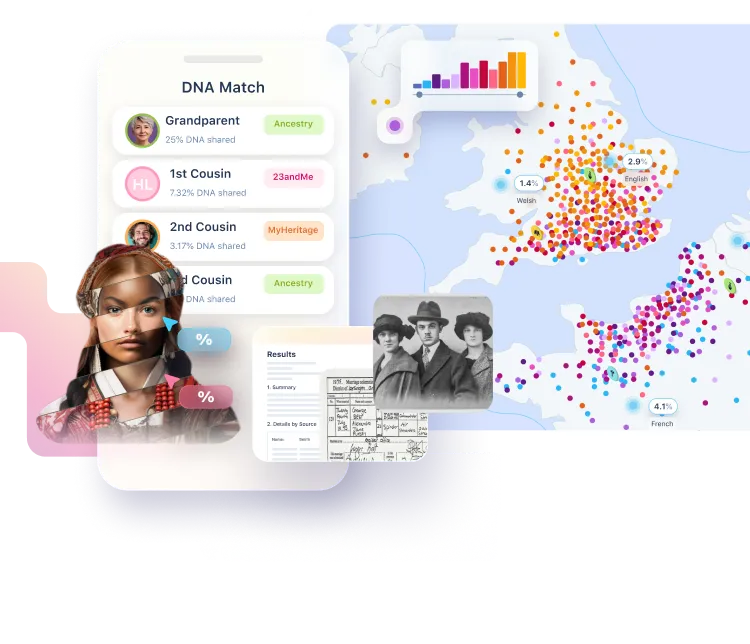
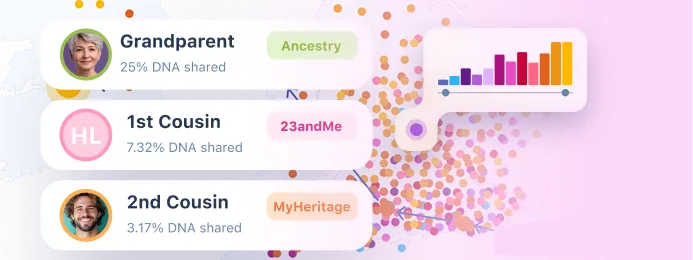
Combine your DNA data with your family tree to unlock the full power of YourRoots DNA Match. Connect with relatives across major testing services — Ancestry, 23andMe, MyHeritage, and more.
View your matches' maps and trees to identify shared ancestors, and soon you'll be able to add them directly to your own tree and map.
Ancestry DNA analysis that goes deeper than others
Unlock exclusive reports that reveal your deeper origins.
- Deep Ancestry Report — Analyze 130+ ethnicities, sub-regions, and 1,800+ communities in one detailed view.
- Global & Native American Reports — Developed with Stanford researchers to uncover hidden ancestries across all 22 chromosomes.
- Ancient DNA Series — Compare your DNA with 1,000+ ancient genomes from Viking, Celtic, and early American civilizations.
Sign up to explore more
Create a free account to navigate family trees, view ancestors, and discover connections.
Coming Soon
We're actively working on many new features for YourRoots. Features marked v2 are ones we're planning to launch soon.
Have a particular feature request? Let us know below!