
Sign up to explore more
Create a free account to navigate family trees, view ancestors, and discover connections.
Sign up to explore more
Create a free account to navigate family trees, view ancestors, and discover connections.
Castro Family Genealogy & History
Discover the Global Legacy of the Castro Surname
Castro is a distinguished surname with roots in the Iberian Peninsula, specifically Portugal and Galicia. The name is derived from the Latin term "castrum," meaning a castle or fortress, and has become prevalent in Spanish and Portuguese-speaking regions. The English equivalent of Castro is Chester, indicating its historical connection to fortified places. The Castro family tree extends back to the 11th century, marking its presence in Spain and establishing a foundation for genealogical exploration.
Over the centuries, the Castro surname has experienced significant geographical distribution. By the 14th and 15th centuries, the name was notably present in Portugal, reflecting its spread and adaptation. As of 2014, Castro is prominently found in Mexico, Colombia, Brazil, the Philippines, and the United States. The surname also has a notable presence in Argentina, Peru, Spain, and several Central and South American countries, demonstrating its broad cultural reach and historical migration patterns.
The YourRoots dataset enriches our understanding of the Castro genealogy, tracing its origins back to the 11th century in Spain. This aligns with the surname's historical emergence in the Iberian Peninsula. The dataset highlights key phases in the Castro lineage's development, from its establishment in Spain and Portugal to its eventual migration to Central America and the United States by the 19th century. This historical trajectory illustrates the resilience and adaptability of the Castro family through the ages.
For genealogy enthusiasts, the YourRoots data offers invaluable insights into the Castro family tree, providing a robust foundation for tracing lineage and uncovering familial connections. Whether seeking ancestors or exploring cultural heritage, these records offer a window into the enduring legacy of the Castro name across continents and centuries.
Find the Castro Family Tree
Search more Castro trees & genealogy records
Records
-
BCBenicio Rodriguez Castro1934–2003Individual Tree PersonParents: Ramón Hernández & Valentina CastroScore: ABCBenicio Rodriguez Castro1934–2003Individual Tree PersonParents: Ramón Hernández & Valentina CastroScore: A
-
FCFrancisca Castro1863–1939Individual Tree PersonSpouse: Eusebio TellezChildren: CarmelitaScore: AFCFrancisca Castro1863–1939Individual Tree PersonSpouse: Eusebio TellezChildren: CarmelitaScore: A
-
JCJuan de BORJA ARAGON CASTRO1532–1606Individual Tree PersonParents: San Borja & Eleonor MenesesScore: AJCJuan de BORJA ARAGON CASTRO1532–1606Individual Tree PersonParents: San Borja & Eleonor MenesesScore: A
-
JCJulia Roldán Castro1923–1990Individual Tree PersonParents: Eleuterio Collazo & María CondeScore: AJCJulia Roldán Castro1923–1990Individual Tree PersonParents: Eleuterio Collazo & María CondeScore: A
-
MCMelchor Escobar GUTIERREZ CASTRO1598–1682Individual Tree PersonParents: Agustin Guillen & Leonor BaezaSpouse: María LaraChildren: Capitán, DiegoScore: AMCMelchor Escobar GUTIERREZ CASTRO1598–1682Individual Tree PersonParents: Agustin Guillen & Leonor BaezaSpouse: María LaraChildren: Capitán, DiegoScore: A
-
VCValentina Castro1896–1982Individual Tree PersonParents: José Valle & Olaya PérezSpouse: Ramón HernándezChildren: Ana, Emma, Mariana, Benicio, Evangelista, Isabela, Cármen, Germán, Cruz, BeatrízScore: AVCValentina Castro1896–1982Individual Tree PersonParents: José Valle & Olaya PérezSpouse: Ramón HernándezChildren: Ana, Emma, Mariana, Benicio, Evangelista, Isabela, Cármen, Germán, Cruz, BeatrízScore: A
-
JCJoe Frank Castro1941–1942Individual Tree PersonParents: Brigido CastroScore: AJCJoe Frank Castro1941–1942Individual Tree PersonParents: Brigido CastroScore: A
-
HCHerminia Carrasquillo Castro1917–2014Individual Tree PersonParents: Maximino Castro & Inés PérezSpouse: Rafael BatistaScore: AHCHerminia Carrasquillo Castro1917–2014Individual Tree PersonParents: Maximino Castro & Inés PérezSpouse: Rafael BatistaScore: A
-
CCCornelia De Castro1800–1882Individual Tree PersonParents: Louis Francisco & Maria AvilesSpouse: Jean IIChildren: Severin, Julia, Theophilus, Feomoere, Felneire, Jean, Francette, Soizette, Theoqulle, Loise, Camille, Catherine, Emille, JohnScore: ACCCornelia De Castro1800–1882Individual Tree PersonParents: Louis Francisco & Maria AvilesSpouse: Jean IIChildren: Severin, Julia, Theophilus, Feomoere, Felneire, Jean, Francette, Soizette, Theoqulle, Loise, Camille, Catherine, Emille, JohnScore: A
-
JCJosefa Dolores de Jesus Aguilar Castro1829–1885Individual Tree PersonParents: Santos Aguilar & Maria CastroSpouse: Pedro Gen.Children: MARÍA, Ramona, JuanaScore: AJCJosefa Dolores de Jesus Aguilar Castro1829–1885Individual Tree PersonParents: Santos Aguilar & Maria CastroSpouse: Pedro Gen.Children: MARÍA, Ramona, JuanaScore: A
-
MCMaria del Refugio Castro1809–1886Individual Tree PersonSpouse: Jose FigueroaChildren: Maria, MartinScore: AMCMaria del Refugio Castro1809–1886Individual Tree PersonSpouse: Jose FigueroaChildren: Maria, MartinScore: A
-
JCJuana Rigual Y Castro1925–2019Individual Tree PersonParents: Luis Rigual & Maria CastroScore: AJCJuana Rigual Y Castro1925–2019Individual Tree PersonParents: Luis Rigual & Maria CastroScore: A
-
MCMaximo Hernandez Castro1898–1982Individual Tree PersonSpouse: Marguerita ArimandoChildren: Juan, DomingoScore: AMCMaximo Hernandez Castro1898–1982Individual Tree PersonSpouse: Marguerita ArimandoChildren: Juan, DomingoScore: A
-
HCHoratio Farnèse Hertog van Castro1531–1553Individual Tree PersonParents: Pier Farnese & Gerolama ParmaScore: AHCHoratio Farnèse Hertog van Castro1531–1553Individual Tree PersonParents: Pier Farnese & Gerolama ParmaScore: A
-
SCSaturna Roman Y Tones De Castro1876–1958Individual Tree PersonSpouse: Aniceto ArceChildren: Cristeto, Rosa, Calisto, Miguela, JuanScore: ASCSaturna Roman Y Tones De Castro1876–1958Individual Tree PersonSpouse: Aniceto ArceChildren: Cristeto, Rosa, Calisto, Miguela, JuanScore: A
-
ACAlvaro Captain-General Of Africa Lord of Morgado do Torrado De Castro1495–1520Individual Tree PersonParents: Medico Abolafin & Dama CastroSpouse: Isabel MenesesChildren: LeonorScore: AACAlvaro Captain-General Of Africa Lord of Morgado do Torrado De Castro1495–1520Individual Tree PersonParents: Medico Abolafin & Dama CastroSpouse: Isabel MenesesChildren: LeonorScore: A
-
SCSegundo Castro1898–1992Individual Tree PersonParents: Silvestre Castro & Rosa FigueroaSpouse: Maria Balagu-GalarzaChildren: Roberto, Aida, RobertoScore: ASCSegundo Castro1898–1992Individual Tree PersonParents: Silvestre Castro & Rosa FigueroaSpouse: Maria Balagu-GalarzaChildren: Roberto, Aida, RobertoScore: A
-
GCGiuseppe Lo Castro1762–1842Individual Tree PersonParents: Gaetano CastroChildren: Angela, Carmela, Antonia, Francesca, ClementeScore: AGCGiuseppe Lo Castro1762–1842Individual Tree PersonParents: Gaetano CastroChildren: Angela, Carmela, Antonia, Francesca, ClementeScore: A
-
MCMinnie Castro1940–2014Individual Tree PersonParents: Jose Castro & Rafaela RivasSpouse: Samuel AndradeScore: AMCMinnie Castro1940–2014Individual Tree PersonParents: Jose Castro & Rafaela RivasSpouse: Samuel AndradeScore: A
-
JCJuan Zayas Castro1735–1805Individual Tree PersonParents: Bernabe Rivera & Ana CastroSpouse: Luisa ColónChildren: TomásScore: AJCJuan Zayas Castro1735–1805Individual Tree PersonParents: Bernabe Rivera & Ana CastroSpouse: Luisa ColónChildren: TomásScore: A
Search more trees & records for
Castro for free
Tracing Your Castro Family Lineage
Origin of the Castro Family: Where does the Castro surname come from?
The Castro surname finds its earliest known appearance in Spain during the 11th century, marking the inception of this family's genealogical journey. This initial record serves as a foundational point for exploring the roots and beginnings of the Castro lineage, connecting families to their ancestral origins in the Iberian Peninsula. As the surname emerged, it laid the groundwork for subsequent generations to build their identities and family trees.
Genealogy and Early Family History of Castro
Throughout the ensuing centuries, the Castro family began to spread across key regions of the Iberian Peninsula, particularly in Spain and Portugal. During the 12th and 13th centuries, family lines can be traced to these areas, where they gradually established themselves, building branches of their family trees that would later flourish. The 14th and 15th centuries saw a notable presence in Portugal, reflecting the evolving nature of the Castro family as they adapted to their environments and expanded their heritage.
As the centuries progressed, the Castro families continued to develop and diversify, with significant growth occurring during the 16th century in Spain. This period marked a transition for many branches, as they began to explore new territories and opportunities, setting the stage for a more expansive familial network. The resilience and adaptability of the Castro lineage contributed to the establishment of a rich and varied family history.
Tracing the Castro Family Tree Through the Centuries
The global spread of the Castro surname became increasingly evident from the 17th century onward, with a remarkable concentration of families in Costa Rica during the 18th century. This shift indicated a significant migration of Castro family members, who sought new prospects in Central America, thereby enriching their genealogical tapestry. By the 19th century, the Castro name had made its way to the United States, where it began to take root in a new cultural landscape.
In the 20th century, the Castro surname continued to evolve, with families establishing themselves in various regions across North America and beyond. The 21st century has seen a continuation of this trend, with modern descendants actively seeking to connect with their ancestral roots and explore their family histories. The global journey of the Castro surname illustrates the enduring legacy of this family line, inviting individuals to delve into their own genealogical connections.
Where to Find Castro Genealogy Records Today
The Castro surname's global presence is reflected in contemporary genealogical records, with notable concentrations in Central America and the United States during the modern centuries. As families continue to search for their unique branches, the YourRoots database serves as an invaluable resource for tracing the heritage of the Castro lineage. Readers are encouraged to explore these records to uncover their own connections and expand their
Famous People with Castro (and Their Family Tree)

Fidel Castro
Fidel Alejandro Castro Ruz was a pivotal figure in 20th-century politics, leading Cuba from 1959 to 2008 as its prime minister and president. Known for his Marxist–Leninist ideology and Cuban nationalism, Castro transformed Cuba into a one-party communist state, nationalizing industries and implementing socialist reforms. He played a significant role in the Cuban Revolution, opposing U.S. influence and aligning with the Soviet Union during the Cold War. Notably, Castro's leadership during the Cuban Missile Crisis and his support for anti-imperialist movements globally marked his tenure as a champion of socialism and a polarizing figure in world politics.
Fidel Castro was born on 13 August 1926 in Birán, Cuba, to Ángel Castro y Argiz and Lina Ruz González. His father, a Spanish immigrant and sugarcane farmer, became prosperous in Oriente Province. After Ángel's first marriage ended, he married Lina, a woman of Canarian descent with whom he had seven children, including Fidel. Castro's early life was influenced by his father's financial success and his education in Jesuit institutions, which shaped his revolutionary ideals and future political path.

Inês de Castro
Inês de Castro, a Galician noblewoman and courtier, is renowned for her tragic love affair with King Pedro I of Portugal. Despite the relationship being forbidden by King Alfonso IV, Inês became Pedro's lover and was posthumously recognized as his wife. Her murder, ordered by Alfonso IV, and Pedro's subsequent revenge on her killers, contribute to her lasting legacy in art, music, and literature. Notably, her alleged post-mortem coronation has become a legendary tale, although modern sources suggest it is a myth. The dramatic circumstances surrounding her life have captivated audiences for centuries, making Inês a prominent figure in Portuguese history.
Inês de Castro was the natural daughter of Pedro Fernández de Castro, Lord of Lemos and Sarria, and Aldonça Lourenço de Valadares. Her lineage intertwined with both Galician and Portuguese nobilities, and she had connections to the Castilian royal family through illegitimate descent. Her stepmother was Infanta Beatriz of Portugal, and her ancestry included members of the Castilian and Leonese royal families, such as Violante Sánchez of Castile and Rodrigo Alfonso de León.

Raúl Castro
Raúl Modesto Castro Ruz, a prominent Cuban political figure, served as the first secretary of the Communist Party of Cuba from 2011 to 2021 and was the President of Cuba from 2008 to 2018, following his brother, Fidel Castro. As a key military leader of the Cuban Revolution, he held the position of minister of the Armed Forces from 1959 to 2008, making him the longest-serving in this role. His leadership extended to being a member of the Politburo from 1965 until 2021, maintaining significant influence in Cuba's political landscape.
Born on June 3, 1931, in Birán, Cuba, Raúl Castro is the son of Spanish immigrant Ángel Castro and Cuban-born Lina Ruz, with Canarian ancestry. He is the youngest of three brothers, including Fidel and Ramón, and has four sisters. His family background includes five half-siblings from his father's first marriage to Maria Argota. The Castro brothers faced early educational challenges but later engaged actively in revolutionary activities, shaping Cuba's history.

Xiomara Castro
Xiomara Castro, also known as Xiomara Castro de Zelaya, is a prominent Honduran politician and businesswoman who became the 39th president of Honduras in January 2022, marking a historic milestone as the country's first female president. Her political journey includes serving as the first lady during her husband Manuel Zelaya's presidency and playing a crucial role in the National Popular Resistance Front after the 2009 coup d'état. Castro has been a key figure in the Liberty and Refoundation (LIBRE) party, running presidential campaigns in 2013 and 2017 before her ultimate victory in 2021. In 2023, Forbes listed her among the World's 100 most powerful women, highlighting her influence on the global stage.
Born on 30 September 1959 in Santa Bárbara, Honduras, Xiomara Castro is the second of five children to Irene de Jesús Castro Reyes and Olga Doris Sarmiento Montoya. She pursued her education in Tegucigalpa before marrying Manuel Zelaya in 1976. Together, they settled in Catacamas, where she engaged in community development, particularly focusing on supporting single-parent families led by women. Her family background and early life in Honduras significantly shaped her political and social endeavors.

Noli de Castro
Noli de Castro, a renowned Filipino broadcaster, journalist, and politician, served as the 12th Vice President of the Philippines from 2004 to 2010 under President Gloria Macapagal Arroyo. Known for his significant influence in Philippine media, de Castro began his career under Ferdinand Marcos, later joining ABS-CBN as an anchor for programs like "TV Patrol" and "Kabayan." His political career started with a successful Senate run in 2001, where he emerged as the top vote-getter. A familiar face in the media for over five decades, de Castro remains a key television figure, noted for his stance on the Philippine drug war during President Rodrigo Duterte's administration.
Born Manuel Leuterio de Castro Jr. on July 6, 1949, in Pola, Oriental Mindoro, Noli de Castro is the fifth child of Manuel de Castro Sr. and Demetria Leuterio. His family background and roots in Oriental Mindoro are integral to his identity, linking him to a lineage that has witnessed the evolution of modern Philippine society. De Castro pursued a Bachelor of Commerce at the University of the East, demonstrating his early inclination toward public service and media involvement.
Castro Surname Meaning, Origin, and History
The surname "Castro" is of Portuguese and Galician origin, derived from the Latin word "castrum," which means a castle or fortress. It is widely found in Spanish and Portuguese-speaking countries, with significant populations in Mexico, Colombia, Brazil, and the United States.
VIEW MOREWhere to Find Genealogy Records for Castro
We’ve analyzed YourRoots tree and records data to uncover where genealogists are finding key sources such as census, birth certificates, marriage records, and obituaries for the Castro family. Explore our most popular genealogy record sources for the Castro surname to learn more.
VIEW MOREAbout YourRoots
Explore your family tree geographically
Import your GEDCOM file to transform your family tree into an interactive global map. See your roots laid out visually and understand your true geographic heritage.
Powerful tools like "Trace Back To Me" instantly map your family's migration paths from a chosen ancestor all the way back to you.
Discover ancestors beyond "end-of-line" automatically
Import your family tree and let AI expand it for you. AI Ancestor Finder scans "end-of-line" ancestors to uncover their parents across hundreds of family lines at once. AI Deep Research analyzes selected ancestors and family clusters, suggesting relevant records and next steps.
Turn on Auto Research Mode to get new discoveries daily or weekly, so your tree keeps growing even while you're away.
Find more DNA matches across all DNA tests
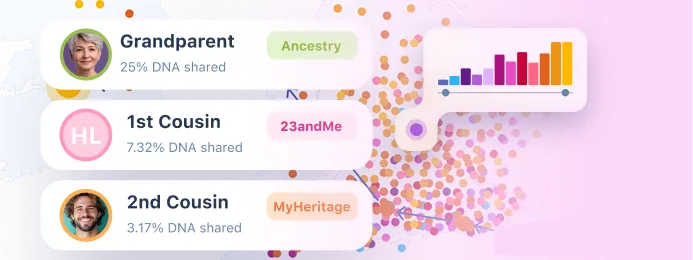
Combine your DNA data with your family tree to unlock the full power of YourRoots DNA Match. Connect with relatives across major testing services — Ancestry, 23andMe, MyHeritage, and more.
View your matches' maps and trees to identify shared ancestors, and soon you'll be able to add them directly to your own tree and map.
Ancestry DNA analysis that goes deeper than others
Unlock exclusive reports that reveal your deeper origins.
- Deep Ancestry Report — Analyze 130+ ethnicities, sub-regions, and 1,800+ communities in one detailed view.
- Global & Native American Reports — Developed with Stanford researchers to uncover hidden ancestries across all 22 chromosomes.
- Ancient DNA Series — Compare your DNA with 1,000+ ancient genomes from Viking, Celtic, and early American civilizations.
Sign up to explore more
Create a free account to navigate family trees, view ancestors, and discover connections.
Coming Soon
We're actively working on many new features for YourRoots. Features marked v2 are ones we're planning to launch soon.
Have a particular feature request? Let us know below!