
Sign up to explore more
Create a free account to navigate family trees, view ancestors, and discover connections.
Sign up to explore more
Create a free account to navigate family trees, view ancestors, and discover connections.
Cave Family Genealogy & History
Discover the Global Legacy of the Cave Surname
The surname Cave has its origins in France during the early medieval period, potentially deriving from local nobility or landowners. Over time, the name Cave became associated with various professions and societal roles, marking it as a significant identifier across generations. Its early adoption in England by the 11th century reflects a rich genealogical history within the region.
As the Cave family expanded, their presence grew notably in England by the 14th century, particularly in the southern regions. The 15th century saw further growth, intertwining the family with significant historical events. This expansion continued across the Atlantic, where by the 17th century, families bearing the Cave name began migrating to the United States, diversifying their lineage and establishing new branches of the family tree.
YourRoots data enriches this narrative by confirming the Cave surname's establishment in England since the 11th century and its subsequent spread to North America. The dataset highlights the family's adaptability and resilience, reflecting the broader narrative of migration and settlement. It supports the understanding of the Cave family tree's expansion across continents, showcasing a global spread that continues to this day.
Today, Cave genealogy records demonstrate a strong international presence, particularly in North America and parts of Europe. The YourRoots database offers a valuable resource for those interested in tracing their ancestry, providing access to detailed records that connect individuals to the expansive Cave family tree. This continuity between historical sources and YourRoots records provides rich material for anyone exploring the Cave genealogy.
Find the Cave Family Tree
Search more Cave trees & genealogy records
Records
-
WCWilliam Henry Edmund Cave1900–1961Individual Tree PersonParents: William Cave & Louisa KinsonSpouse: Florence BurfordScore: AWCWilliam Henry Edmund Cave1900–1961Individual Tree PersonParents: William Cave & Louisa KinsonSpouse: Florence BurfordScore: A
-
MCMary Eleanor Cave1661–1712Individual Tree PersonParents: John Cave & Elizabeth TraversSpouse: JOHN NicholsChildren: WilliamScore: AMCMary Eleanor Cave1661–1712Individual Tree PersonParents: John Cave & Elizabeth TraversSpouse: JOHN NicholsChildren: WilliamScore: A
-
LCLouise F. Cave1924–1975Individual Tree PersonParents: Claude Cave & Hattie DingesSpouse: Merton AshbyScore: ALCLouise F. Cave1924–1975Individual Tree PersonParents: Claude Cave & Hattie DingesSpouse: Merton AshbyScore: A
-
PCPatricia Ann Mooney Cave1938–2013Individual Tree PersonParents: Harry Mooney & Irene MooneyScore: APCPatricia Ann Mooney Cave1938–2013Individual Tree PersonParents: Harry Mooney & Irene MooneyScore: A
-
LCLady Margaret Cave1547–1629Individual Tree PersonParents: Francis Ingerby, & Margaret LisleSpouse: Sir BabingtonChildren: Thomas, Lady, Rev., Edward, Ann, Dorothy, William, Francis, PhilippaScore: ALCLady Margaret Cave1547–1629Individual Tree PersonParents: Francis Ingerby, & Margaret LisleSpouse: Sir BabingtonChildren: Thomas, Lady, Rev., Edward, Ann, Dorothy, William, Francis, PhilippaScore: A
-
JCJane Elizabeth Ninn Cave1869–1935Individual Tree PersonParents: Charles Cave & Henrietta CookeSpouse: James RidingChildren: Elizabeth, James, Martha, Charles, Charlotte, John, Selina, Elsie, Ellen, Henrietta, Thomas, Joseph, Annie, Lucy, ElizabethScore: AJCJane Elizabeth Ninn Cave1869–1935Individual Tree PersonParents: Charles Cave & Henrietta CookeSpouse: James RidingChildren: Elizabeth, James, Martha, Charles, Charlotte, John, Selina, Elsie, Ellen, Henrietta, Thomas, Joseph, Annie, Lucy, ElizabethScore: A
-
WCWilliam Harold Cave1915–1989Individual Tree PersonParents: William Cave & Mary ThomasScore: AWCWilliam Harold Cave1915–1989Individual Tree PersonParents: William Cave & Mary ThomasScore: A
-
ACAnnabella Cave1874–1956Individual Tree PersonParents: William Cave & Susannah A'CourtSpouse: Rechab AndrewsChildren: Leslie, Herbert, Wallace, ClarenceScore: AACAnnabella Cave1874–1956Individual Tree PersonParents: William Cave & Susannah A'CourtSpouse: Rechab AndrewsChildren: Leslie, Herbert, Wallace, ClarenceScore: A
-
JCJohn Brown Cave1757–1812Individual Tree PersonParents: John Cave & Sarah MooreSpouse: Sarah BrownChildren: JohnScore: AJCJohn Brown Cave1757–1812Individual Tree PersonParents: John Cave & Sarah MooreSpouse: Sarah BrownChildren: JohnScore: A
-
TCThomas Cave1497–1558Individual Tree PersonParents: Richard Cave & Margaret SaxbySpouse: Elizabeth CaveChildren: RogerScore: ATCThomas Cave1497–1558Individual Tree PersonParents: Richard Cave & Margaret SaxbySpouse: Elizabeth CaveChildren: RogerScore: A
-
MCMary Sara Cave1661–1712Individual Tree PersonParents: John Cave & Elizabeth TraversSpouse: John EcholsChildren: Richard, Ann, AbrahamScore: AMCMary Sara Cave1661–1712Individual Tree PersonParents: John Cave & Elizabeth TraversSpouse: John EcholsChildren: Richard, Ann, AbrahamScore: A
-
RCRichard Cave1465–1538Individual Tree PersonParents: Thomas Cave & Thomasine PassemerSpouse: Margaret Saxby, Elizabeth MervinChildren: Anthony, Ambrose, Thomas, Dorothy, Clement, Elizabeth, Prudence, Francis, Richard, Sir, Alice, Bridgett, Robert, AugustineScore: ARCRichard Cave1465–1538Individual Tree PersonParents: Thomas Cave & Thomasine PassemerSpouse: Margaret Saxby, Elizabeth MervinChildren: Anthony, Ambrose, Thomas, Dorothy, Clement, Elizabeth, Prudence, Francis, Richard, Sir, Alice, Bridgett, Robert, AugustineScore: A
-
ECElizabeth Cave1823–1872Individual Tree PersonParents: James ReynoldsSpouse: Henry (Reynolds)Children: Jessica, Annie, Ada, Elizabeth, Emma, HenryScore: AECElizabeth Cave1823–1872Individual Tree PersonParents: James ReynoldsSpouse: Henry (Reynolds)Children: Jessica, Annie, Ada, Elizabeth, Emma, HenryScore: A
-
WCWilliam A Cave1535–1614Individual Tree PersonSpouse: **Lady GreyChildren: Mary, Anna, Edward, Anna, Dorothy, John, Thomas, Francis, Robert, RichardScore: AWCWilliam A Cave1535–1614Individual Tree PersonSpouse: **Lady GreyChildren: Mary, Anna, Edward, Anna, Dorothy, John, Thomas, Francis, Robert, RichardScore: A
-
TCThomas Cave1445–1495Individual Tree PersonParents: Peter Cave & Joan BromfleteSpouse: Thomasine PassemerChildren: RichardScore: ATCThomas Cave1445–1495Individual Tree PersonParents: Peter Cave & Joan BromfleteSpouse: Thomasine PassemerChildren: RichardScore: A
-
WCWanda Nova Cave1915–1985Individual Tree PersonParents: John Cave & Alma BettsScore: AWCWanda Nova Cave1915–1985Individual Tree PersonParents: John Cave & Alma BettsScore: A
-
WCWilfred Vere Cave1911–1955Individual Tree PersonParents: John Cave & Ethel EvansSpouse: Janet HowieChildren: Janice, Pamela, JoyScore: AWCWilfred Vere Cave1911–1955Individual Tree PersonParents: John Cave & Ethel EvansSpouse: Janet HowieChildren: Janice, Pamela, JoyScore: A
-
DCDora Cave1875–1951Individual Tree PersonParents: James Cave & Pearl CaveScore: ADCDora Cave1875–1951Individual Tree PersonParents: James Cave & Pearl CaveScore: A
-
TCThelma L. Cave1907–1961Individual Tree PersonParents: Thomas Cave & Berta McGeheeSpouse: Joseph KaneScore: ATCThelma L. Cave1907–1961Individual Tree PersonParents: Thomas Cave & Berta McGeheeSpouse: Joseph KaneScore: A
-
RCRichard Cave1905–1976Individual Tree PersonParents: Thomas Cave & Elizabeth AspinallSpouse: Edith LeechChildren: RichardScore: ARCRichard Cave1905–1976Individual Tree PersonParents: Thomas Cave & Elizabeth AspinallSpouse: Edith LeechChildren: RichardScore: A
Search more trees & records for
Cave for free
Tracing Your Cave Family Lineage
Origin of the Cave Family: Where does the Cave surname come from?
The Cave surname has its earliest recorded appearance in France during the early medieval period, marking the beginning of a rich genealogical history. This initial documentation connects to the family tree's roots, suggesting a lineage that may have evolved from local nobility or landowners in that region. As families began to form and expand, the Cave name would become a significant marker of identity across generations.
Genealogy and Early Family History of Cave
Throughout the subsequent centuries, the Cave family began to spread primarily throughout England, where records indicate substantial growth in the surname's presence. By the 11th century, the Cave name was established in England, and by the 14th century, family branches were flourishing, particularly in the southern regions of the country. As families navigated the changing social and political landscapes, they built extensive branches of their family trees that would eventually link to various parts of society, from agriculture to trade.
During the 15th century, the Cave family continued to expand, with notable increases in population and prominence. This growth coincided with significant historical events that shaped the region, allowing the Cave lineage to intertwine with the fabric of English history. The evolution of the family tree reflects the adaptability and resilience of the Cave families as they established roots in their respective communities.
Tracing the Cave Family Tree Through the Centuries
As time progressed, the Cave surname saw a remarkable expansion across various regions and countries. By the 17th century, families bearing the Cave name began to migrate to the United States, further diversifying their lineage and establishing new branches of the family tree. This migration continued into the early 20th century, where the Cave name became increasingly prevalent in North America, showcasing a global spread that reflects the family’s enduring legacy.
The 18th and early 19th centuries witnessed the Cave surname becoming more established in the United States, as families sought new opportunities and built their lives anew. The evolution of the Cave family tree is a testament to the resilience and adaptability of its members, weaving a complex tapestry of familial connections across continents. Through these transitions, the Cave surname has maintained its significance, reflecting the broader narrative of migration and settlement.
Where to Find Cave Genealogy Records Today
In modern times, the Cave surname continues to be represented globally, with a strong presence in North America and parts of Europe. The 20th century saw further documentation of the Cave family across various regions, highlighting the importance of preserving these genealogical connections. Readers are encouraged to explore the Cave genealogy records in the YourRoots database to uncover their own family history and connect with the expansive family tree that the Cave name represents.
Famous People with Cave (and Their Family Tree)

Nick Cave
Nick Cave, an acclaimed Australian musician, writer, and actor, is renowned for his work with Nick Cave and the Bad Seeds. Known for his distinctive baritone voice and intense music, Cave's career highlights include influential albums like "The Mercy Seat" and collaborations with artists like Kylie Minogue. His creative endeavors extend to film with credits in "The Proposition" and "The Assassination of Jesse James by the Coward Robert Ford." Cave's contributions to music and culture have earned him recognition, including induction into the ARIA Hall of Fame and an Officer of the Order of Australia honor.
Born on September 22, 1957, in Warracknabeal, Victoria, Nick Cave is the son of Dawn Cave, a librarian, and Colin Frank Cave, an English and mathematics teacher. He grew up with two older brothers, Tim and Peter, and a younger sister, Julie. His father introduced him to literature at a young age, fostering Cave's lifelong love for storytelling and music. The family later moved to Melbourne, where Cave's artistic journey began.
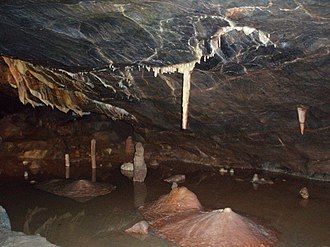
Gough's Cave
Gough's Cave, located in Cheddar Gorge on the Mendip Hills, Somerset, England, is renowned for its archaeological significance, containing evidence of Magdalenian culture from approximately 14,700 years ago. The cave houses the Cheddar Yeo, the largest underground river system in Britain, and features extensive chambers explored since the 19th century by Richard Cox Gough. Notably, it has yielded human remains, including skulls fashioned as drinking cups, suggesting ritualistic cannibalism. The site is a crucial point of interest for understanding prehistoric human life and culture, with important artefacts and remains now held at the Natural History Museum in London.

Turpin's Cave
Dick Turpin, the notorious 18th-century highwayman, is famously associated with Epping Forest in Essex, where he reportedly hid in a location known as Turpin's Cave. Turpin conducted numerous criminal activities from this area, particularly between Loughton Road and Kings Oak Road. His legend grew after he killed Thomas Morris, a servant attempting to capture him, in May 1737. Despite the lack of solid evidence for an actual cave, the site near Wellington Hill at High Beach became legendary, drawing attention and becoming a part of local folklore. The name 'Turpin's Cave' was immortalized in maps by 19th-century surveyors and even inspired a pub name.

Balch Cave
Herbert E. Balch was renowned for his influential role as an explorer of the Mendip Hills caves in Somerset, England. His contributions to speleology are commemorated by naming Balch Cave in his honor. This cave, part of the Fairy Cave Quarry, was discovered following quarry blasting in 1961. The exploration revealed stunning formations, including sparkling flowstone, white stalactites, and impressive "organ pipes." Despite subsequent quarry activities that destroyed significant portions, Balch's legacy in cave exploration endures as a testament to his dedication and achievements in understanding the intricate underground systems of the Mendip Hills.

Wilbur Cave
Wilbur Cave is a distinguished American politician and philanthropist from South Carolina, known for his impactful career in public service. He served as a field representative for Democratic Congressman Butler Derrick and was a member of the South Carolina House of Representatives from 1994 to 2000, representing district 91. Cave's dedication to community service is further exemplified by his tenure as a sheriff and his work in substance abuse prevention. His commitment to improving living conditions in his hometown is demonstrated through his founding of Allendale County Alive, a non-profit organization dedicated to providing housing for impoverished residents. His public service was honored with the passing of Resolution S*0672 in both the House and Senate of South Carolina.
Wilbur Cave was born into an African-American family in Allendale, South Carolina. His family background is rooted in agriculture, as his maternal family owned a cotton farm in Allendale County. His mother contributed to the community as a schoolteacher at the Allendale County Training School, influencing Cave's strong commitment to education and social welfare.
Cave Surname Meaning, Origin, and History
The surname "Cave" has English origins and is associated with a variety of notable individuals across different professions, including politics, sports, literature, and the arts. The name has been borne by figures such as Edward Cave, an English printer and publisher from the 18th century, and Nick Cave, the leader of the Australian rock band Nick Cave and the Bad Seeds.
VIEW MOREWhere to Find Genealogy Records for Cave
We’ve analyzed YourRoots tree and records data to uncover where genealogists are finding key sources such as census, birth certificates, marriage records, and obituaries for the Cave family. Explore our most popular genealogy record sources for the Cave surname to learn more.
VIEW MOREAbout YourRoots
Explore your family tree geographically
Import your GEDCOM file to transform your family tree into an interactive global map. See your roots laid out visually and understand your true geographic heritage.
Powerful tools like "Trace Back To Me" instantly map your family's migration paths from a chosen ancestor all the way back to you.
Discover ancestors beyond "end-of-line" automatically
Import your family tree and let AI expand it for you. AI Ancestor Finder scans "end-of-line" ancestors to uncover their parents across hundreds of family lines at once. AI Deep Research analyzes selected ancestors and family clusters, suggesting relevant records and next steps.
Turn on Auto Research Mode to get new discoveries daily or weekly, so your tree keeps growing even while you're away.
Find more DNA matches across all DNA tests
Combine your DNA data with your family tree to unlock the full power of YourRoots DNA Match. Connect with relatives across major testing services — Ancestry, 23andMe, MyHeritage, and more.
View your matches' maps and trees to identify shared ancestors, and soon you'll be able to add them directly to your own tree and map.
Ancestry DNA analysis that goes deeper than others
Unlock exclusive reports that reveal your deeper origins.
- Deep Ancestry Report — Analyze 130+ ethnicities, sub-regions, and 1,800+ communities in one detailed view.
- Global & Native American Reports — Developed with Stanford researchers to uncover hidden ancestries across all 22 chromosomes.
- Ancient DNA Series — Compare your DNA with 1,000+ ancient genomes from Viking, Celtic, and early American civilizations.
Sign up to explore more
Create a free account to navigate family trees, view ancestors, and discover connections.
Coming Soon
We're actively working on many new features for YourRoots. Features marked v2 are ones we're planning to launch soon.
Have a particular feature request? Let us know below!