
Sign up to explore more
Create a free account to navigate family trees, view ancestors, and discover connections.

Sign up to explore more
Create a free account to navigate family trees, view ancestors, and discover connections.
Cleaver Family Genealogy & History
Discover the Global Legacy of the Cleaver Surname
The Cleaver surname has its roots in England, first appearing in records during the early 16th century. This surname is likely tied to English heritage and culture, marking its bearers as part of the evolving social fabric of the time. The name Cleaver may have originally been associated with an occupation or a notable characteristic of its early bearers, as was common with many surnames that developed during this period.
As the Cleaver surname gained prevalence, it became geographically and culturally significant across England. By the 16th and 17th centuries, different Cleaver family lines were establishing themselves prominently in key regions. This expansion continued into the 18th century as the Cleaver name spread further, adapting to the changing social landscapes. The surname's growth was not confined to England, as the 19th century saw Cleaver families migrate to North America and Australia in search of new opportunities, thus expanding the Cleaver genealogy worldwide.
YourRoots data supports this historical trajectory, highlighting the Cleaver surname's emergence in England during the early 16th century. These records show a marked growth of the Cleaver family tree in England before its branches reached other continents. This confirms the narrative of migration and adaptation, reflecting the family's expansion beyond its original locale. The YourRoots dataset offers a comprehensive view of the Cleavers' journey through time, enriching the understanding of this surname's global spread.
Today, the Cleaver family tree presents a rich tapestry for genealogists and family-history enthusiasts. With extensive Cleaver records available, researchers can delve into the YourRoots database to uncover personal connections and trace their lineage back to the surname's early days. This data serves as a valuable resource for anyone interested in exploring the Cleaver genealogy and its impact across generations.
Find the Cleaver Family Tree
Search more Cleaver trees & genealogy records
Records
-
JCJohn Cleaver1703–1773Individual Tree PersonParents: Peter CleaverSpouse: Elizabeth LeveringChildren: William, Peter, Elizabeth, Sarah, Hannah, Mary, JohnScore: AJCJohn Cleaver1703–1773Individual Tree PersonParents: Peter CleaverSpouse: Elizabeth LeveringChildren: William, Peter, Elizabeth, Sarah, Hannah, Mary, JohnScore: A
-
ECElizabeth Cleaver1737–1835Individual Tree PersonParents: Anthony Cleaver & Margaret HartletSpouse: Richard FrewinChildren: John, RobertScore: AECElizabeth Cleaver1737–1835Individual Tree PersonParents: Anthony Cleaver & Margaret HartletSpouse: Richard FrewinChildren: John, RobertScore: A
-
DCDarlene Cleaver1909–1990Individual Tree PersonParents: Arlo Cleaver & Anna BeroSpouse: Booth BrandChildren: Beatrice, Barbara, Joan, Nancy, Jackie, LloydScore: ADCDarlene Cleaver1909–1990Individual Tree PersonParents: Arlo Cleaver & Anna BeroSpouse: Booth BrandChildren: Beatrice, Barbara, Joan, Nancy, Jackie, LloydScore: A
-
SCSarah Cleaver1807–1868Individual Tree PersonParents: John Cleaver & Mary HughesSpouse: Solomon WinterChildren: Henry, RowlandScore: ASCSarah Cleaver1807–1868Individual Tree PersonParents: John Cleaver & Mary HughesSpouse: Solomon WinterChildren: Henry, RowlandScore: A
-
ECElizabeth Cleaver1814–1888Individual Tree PersonParents: William Cleaver & Jarusha CleaverSpouse: David McClainChildren: Eliza, Hannah, Rebecca, Soloman, Wm, Allen, John, Margaret, Mary, Neil, James, CatherineScore: AECElizabeth Cleaver1814–1888Individual Tree PersonParents: William Cleaver & Jarusha CleaverSpouse: David McClainChildren: Eliza, Hannah, Rebecca, Soloman, Wm, Allen, John, Margaret, Mary, Neil, James, CatherineScore: A
-
NCNaomi Smith Cleaver1896–1981Individual Tree PersonParents: James Smith & Sally ConnerScore: ANCNaomi Smith Cleaver1896–1981Individual Tree PersonParents: James Smith & Sally ConnerScore: A
-
WCWilliam Cleaver1735–1807Individual Tree PersonParents: John Cleaver & Elizabeth LeveringSpouse: Mary KnightChildren: WilliamScore: AWCWilliam Cleaver1735–1807Individual Tree PersonParents: John Cleaver & Elizabeth LeveringSpouse: Mary KnightChildren: WilliamScore: A
-
HCHazel Mavis Cleaver1929–2002Individual Tree PersonParents: Charles Cleaver & Henrietta CleaverSpouse: Ronald WardScore: AHCHazel Mavis Cleaver1929–2002Individual Tree PersonParents: Charles Cleaver & Henrietta CleaverSpouse: Ronald WardScore: A
-
TCThomas Cleaver1723–1779Individual Tree PersonParents: Thomas Blacksmith & Elizabeth ClaridgeSpouse: Elizabeth HarrodChildren: Thomas, Ann, Joseph, LydiaScore: ATCThomas Cleaver1723–1779Individual Tree PersonParents: Thomas Blacksmith & Elizabeth ClaridgeSpouse: Elizabeth HarrodChildren: Thomas, Ann, Joseph, LydiaScore: A
-
GCGilbert Duncan Cleaver1882–1915Individual Tree PersonParents: Amos Cleaver & Ruth MaleScore: AGCGilbert Duncan Cleaver1882–1915Individual Tree PersonParents: Amos Cleaver & Ruth MaleScore: A
-
WCWilliam Cleaver1735–1809Individual Tree PersonParents: John Cleaver & Elizabeth CleaverSpouse: Mary Knight, Hannah Cleaver, Hannah CLARKChildren: Jonathan, Charles, Sarah, Stephen, Hannah, James, David, Benjamin, Elizabeth, William, Charles, CorneliaScore: AWCWilliam Cleaver1735–1809Individual Tree PersonParents: John Cleaver & Elizabeth CleaverSpouse: Mary Knight, Hannah Cleaver, Hannah CLARKChildren: Jonathan, Charles, Sarah, Stephen, Hannah, James, David, Benjamin, Elizabeth, William, Charles, CorneliaScore: A
-
HCHelen Mary Cleaver1903–1986Individual Tree PersonParents: John Cleaver & Margaret ElmesSpouse: Justin SrChildren: John, Gerald, EleanoreScore: AHCHelen Mary Cleaver1903–1986Individual Tree PersonParents: John Cleaver & Margaret ElmesSpouse: Justin SrChildren: John, Gerald, EleanoreScore: A
-
ECElizabeth Marjorie Cleaver1909–1993Individual Tree PersonParents: William Cleaver & Catherine Pryce-JonesScore: AECElizabeth Marjorie Cleaver1909–1993Individual Tree PersonParents: William Cleaver & Catherine Pryce-JonesScore: A
-
JCJob Cleaver1826–1879Individual Tree PersonParents: Isaac Cleaver & Sarah WiltonSpouse: Eliza CullChildren: Alice, John, Eliza, Job, Isaac, Frederick, Albert, Sarah, Edwin, Ellen, EllenScore: AJCJob Cleaver1826–1879Individual Tree PersonParents: Isaac Cleaver & Sarah WiltonSpouse: Eliza CullChildren: Alice, John, Eliza, Job, Isaac, Frederick, Albert, Sarah, Edwin, Ellen, EllenScore: A
-
RCRobert Cleaver1587–1608Individual Tree PersonParents: John Cleaver & Anna DoehneScore: ARCRobert Cleaver1587–1608Individual Tree PersonParents: John Cleaver & Anna DoehneScore: A
-
JCJohn Cleaver1755–1842Individual Tree PersonParents: John Cleaver & Hannah KeenSpouse: Elizabeth NashChildren: GeorgeScore: AJCJohn Cleaver1755–1842Individual Tree PersonParents: John Cleaver & Hannah KeenSpouse: Elizabeth NashChildren: GeorgeScore: A
-
MCMartha Hatfield Cleaver1720–1758Individual Tree PersonParents: John Cleaver & Mary PottsSpouse: John HatfieldChildren: NathanScore: AMCMartha Hatfield Cleaver1720–1758Individual Tree PersonParents: John Cleaver & Mary PottsSpouse: John HatfieldChildren: NathanScore: A
-
SCSarah Cleaver1835–1916Individual Tree PersonParents: John Cleaver & Mary ButcherSpouse: George MaddamsChildren: Eveline, Edith, Charles, George, Walter, Frederick, EmilyScore: ASCSarah Cleaver1835–1916Individual Tree PersonParents: John Cleaver & Mary ButcherSpouse: George MaddamsChildren: Eveline, Edith, Charles, George, Walter, Frederick, EmilyScore: A
-
ACAlice Cull Cleaver1845–1929Individual Tree PersonParents: Job Cleaver & Eliza CullSpouse: James Tanner, George MorseChildren: Eliza, Emily, Albert, Ellen, Edith, William, AliceScore: AACAlice Cull Cleaver1845–1929Individual Tree PersonParents: Job Cleaver & Eliza CullSpouse: James Tanner, George MorseChildren: Eliza, Emily, Albert, Ellen, Edith, William, AliceScore: A
-
ACAnn Cleaver1742–1818Individual Tree PersonParents: John Carburton & Jane EdwardsScore: AACAnn Cleaver1742–1818Individual Tree PersonParents: John Carburton & Jane EdwardsScore: A
Search more trees & records for
Cleaver for free
Tracing Your Cleaver Family Lineage
Origin of the Cleaver Family: Where does the Cleaver surname come from?
The Cleaver surname first appears in YourRoots records during the early 16th century, marking a significant point in the genealogical history of this family name. This initial appearance in England provides a foundational link to the Cleaver family’s beginnings, suggesting a strong connection to English heritage and culture. As families began to form and branch out, the Cleaver name would become more intricately woven into the fabric of English society.
Genealogy and Early Family History of Cleaver
Throughout the 16th and 17th centuries, the Cleaver family saw notable growth, primarily within England, where numerous family lines emerged. Key regions in England became home to Cleaver families, many of whom established roots and expanded their branches during these formative periods. As time progressed, the Cleaver family tree diversified, with various branches forming as families married and settled in different areas.
The 18th century saw continued expansion, with the Cleaver surname becoming more prevalent as families migrated within and beyond England. This era of growth helped solidify the Cleaver name, as families began to spread into different regions and adapt to the changing social landscapes of the time. By the end of the century, the Cleaver family had significantly established its presence across various English locales.
Tracing the Cleaver Family Tree Through the Centuries
As the Cleaver surname evolved, its reach extended beyond England, notably during the 19th century when families began to explore opportunities abroad. This period saw Cleaver families migrating to other countries, including parts of North America and Australia, as they sought new beginnings. By the early 20th century, the Cleaver name had become increasingly recognized in multiple regions, reflecting a global expansion of the family tree.
In the late 20th and early 21st centuries, the Cleaver surname continued to flourish, with descendants tracing their lineage across various continents. The Cleaver family’s journey illustrates a rich tapestry of migration and adaptation, connecting numerous individuals and families worldwide. Today, individuals interested in the Cleaver genealogy can explore the extensive records available in the YourRoots database to uncover their own unique family histories.
Famous People with Cleaver (and Their Family Tree)

Eldridge Cleaver
Leroy Eldridge Cleaver (1935–1998) was a prominent American writer and political activist, best known for his leadership role in the Black Panther Party and his influential book, "Soul on Ice." Cleaver served as the Minister of Information for the Black Panthers, contributing significantly to the party's direction and public image. He was a key figure in the civil rights movement, advocating for racial justice and armed struggle. His career also included a stint as a presidential candidate for the Peace and Freedom Party in 1968. Over time, Cleaver's political views evolved, leading him to become involved with various religious groups and conservative politics.
Eldridge Cleaver was born in Wabbaseka, Arkansas, to parents Leroy Cleaver and Thelma Hattie Robinson. He grew up in a large family with four siblings: Wilhelima Marie, Helen Grace, James Weldon, and Theophilus Henry. His family relocated to Phoenix and later Los Angeles during his childhood. Cleaver's grandfathers were both Protestant preachers, indicating a family background with religious influences.

Kathleen Cleaver
Kathleen Neal Cleaver, born May 13, 1945, in Dallas, Texas, is a distinguished American law professor and activist renowned for her pivotal role in the Black Power movement and the Black Panther Party. As the Communications Secretary for the Black Panther Party, Cleaver significantly influenced the organization by organizing demonstrations, press conferences, and national campaigns, notably to free Huey Newton. Her efforts in the political arena were highlighted by her 1968 candidacy for California's 18th state assembly district. As one of the few prominent women in the Black Panther Party, Cleaver was instrumental in shaping its communications and public outreach strategies, making substantial contributions to civil rights and social justice.
Kathleen Cleaver was born to Ernest Eugene Neal and Pearl Juette Johnson, both graduates of the University of Michigan and activists in their own right. Her father was a sociology professor at Wiley College, and her mother held a master's degree in mathematics. The Neal family traveled extensively due to Ernest's role in the Foreign Service, living in countries like India, Liberia, Sierra Leone, and the Philippines, which exposed Kathleen to diverse cultures and ideologies. This international upbringing, coupled with her family's academic and activist background, profoundly influenced her worldview and future endeavors in activism.

Sue Cleaver
Sue Cleaver, born on September 2, 1963, in Barnet, Hertfordshire, is a celebrated English actress renowned for her long-running role as Eileen Grimshaw on ITV's "Coronation Street" from 2000 to 2025. She has also made notable appearances in "Band of Gold," "Girls' Night," and "The Cops." In addition to her acting career, Cleaver became a panellist on "Loose Women" in 2024 and wrote her first book, "A Work In Progress." Her commitment extends beyond the screen, as she trained as a psychotherapist and is a patron of charities like Prevent Breast Cancer.
Sue Cleaver was adopted and reconnected with her birth mother in her twenties, discovering two half-sisters, actresses Emma and Kate Harbour. She was married to James Quinn, with whom she has a son, Elliot. Later, she married Brian Owen, a lighting technician she met on the set of "Coronation Street."

Emanuel Cleaver
Emanuel Cleaver II is a notable American politician and United Methodist pastor, born on October 26, 1944. He has represented Missouri's 5th congressional district in the U.S. House of Representatives since 2005 and served as Kansas City's first African American mayor from 1991 to 1999. Cleaver, a member of the Democratic Party, chaired the Congressional Black Caucus from 2011 to 2013. He is known for his moral leadership, particularly during the Rodney King verdict, and for bringing federal tax dollars to Kansas City. His career includes roles on the Kansas City Council, and he has been influential in legislative committees such as the Committee on Financial Services.
Emanuel Cleaver is a cousin of Pete O'Neal, an exiled Black Panther leader, and the late Eldridge Cleaver, a prominent figure in the Black Panther Party.

Ward Cleaver
Ward Cleaver Jr. is a fictional character from the classic American TV sitcom "Leave It to Beaver," portrayed by Hugh Beaumont. A quintessential 1950s suburban father, Ward is known for his moral lectures to sons Wally and Theodore "The Beaver" Cleaver. The show, a staple for baby boomers, highlighted Ward's role as a white-collar professional and veteran of World War II. He also appeared in the 1983 reunion movie "Still the Beaver" and the sequel series "The New Leave It to Beaver." The character continued to resonate in the 1997 film adaptation, played by Christopher McDonald, marking Ward Cleaver as an enduring figure in television history.
Cleaver Surname Meaning, Origin, and History
The surname "Cleaver" is associated with a variety of notable individuals across different fields, including politics, sports, and the arts, originating from regions such as the United States, the United Kingdom, and Canada. Additionally, the name gained cultural recognition through the fictional Cleaver family featured in the American television sitcom "Leave It to Beaver."
VIEW MOREWhere to Find Genealogy Records for Cleaver
We’ve analyzed YourRoots tree and records data to uncover where genealogists are finding key sources such as census, birth certificates, marriage records, and obituaries for the Cleaver family. Explore our most popular genealogy record sources for the Cleaver surname to learn more.
VIEW MOREAbout YourRoots
Explore your family tree geographically
Import your GEDCOM file to transform your family tree into an interactive global map. See your roots laid out visually and understand your true geographic heritage.
Powerful tools like "Trace Back To Me" instantly map your family's migration paths from a chosen ancestor all the way back to you.
Discover ancestors beyond "end-of-line" automatically
Import your family tree and let AI expand it for you. AI Ancestor Finder scans "end-of-line" ancestors to uncover their parents across hundreds of family lines at once. AI Deep Research analyzes selected ancestors and family clusters, suggesting relevant records and next steps.
Turn on Auto Research Mode to get new discoveries daily or weekly, so your tree keeps growing even while you're away.
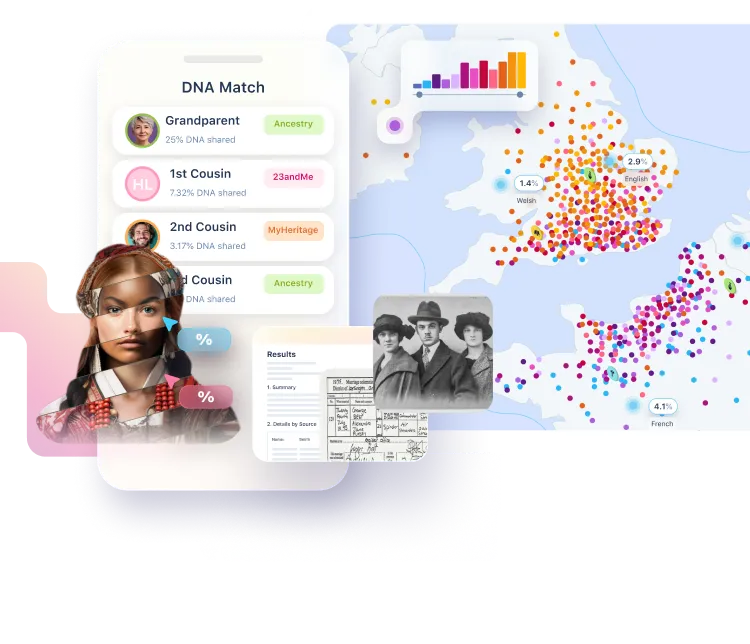
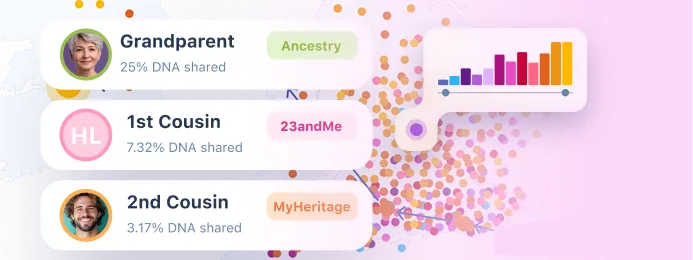
Find more DNA matches across all DNA tests
Combine your DNA data with your family tree to unlock the full power of YourRoots DNA Match. Connect with relatives across major testing services — Ancestry, 23andMe, MyHeritage, and more.
View your matches' maps and trees to identify shared ancestors, and soon you'll be able to add them directly to your own tree and map.
Ancestry DNA analysis that goes deeper than others
Unlock exclusive reports that reveal your deeper origins.
- Deep Ancestry Report — Analyze 130+ ethnicities, sub-regions, and 1,800+ communities in one detailed view.
- Global & Native American Reports — Developed with Stanford researchers to uncover hidden ancestries across all 22 chromosomes.
- Ancient DNA Series — Compare your DNA with 1,000+ ancient genomes from Viking, Celtic, and early American civilizations.
Sign up to explore more
Create a free account to navigate family trees, view ancestors, and discover connections.
Coming Soon
We're actively working on many new features for YourRoots. Features marked v2 are ones we're planning to launch soon.
Have a particular feature request? Let us know below!