
Sign up to explore more
Create a free account to navigate family trees, view ancestors, and discover connections.


Sign up to explore more
Create a free account to navigate family trees, view ancestors, and discover connections.
Dacre Family Genealogy & History
Discover the Global Legacy of the Dacre Surname
The Dacre surname has its origins deeply rooted in England, emerging during the early centuries of the first millennium. Initially appearing in historical records from northern regions, the name Dacre has been associated with significant locations like Dacre, Cumbria, and Dacre, North Yorkshire. This geographic link suggests that the name likely originated as a toponymic surname, reflecting the family's affiliations with these areas. Over time, the Dacre surname became synonymous with a lineage that has endured through centuries, intertwining with England's rich historical tapestry.
As centuries progressed, the Dacre family established itself prominently across England, particularly during the 12th and 13th centuries. This era marked a period of expansion as branches of the Dacre family tree spread geographically and culturally. The family's presence extended beyond England, with Dacre descendants migrating to other regions, including parts of Europe and the colonies across the Atlantic. This widespread dispersion highlights the Dacre family's adaptability and resilience, traits that facilitated their integration into diverse cultural landscapes worldwide.
YourRoots dataset provides a comprehensive view of the Dacre genealogy, confirming the surname's origins in England and tracing its evolution over time. The database highlights the Dacre family's growth during the medieval period, aligning with historical records that indicate an increase in their prominence across northern England. As the Dacre lineage expanded globally, YourRoots records offer valuable insights into the family's migration patterns, detailing their movement to countries such as the United States, Australia, and Canada from the 19th century onward.
For genealogy enthusiasts and family-tree researchers, the YourRoots data serves as a vital resource, offering a detailed account of the Dacre family's historical and contemporary distribution. By exploring these records, individuals can uncover personal connections to the Dacre name, enriching their understanding of their ancestral heritage and contributing to the broader narrative of the Dacre family tree.
Find the Dacre Family Tree
Search more Dacre trees & genealogy records
Records
-
TDThomas D Acre, 6th Baron Dacre1387–1457Individual Tree PersonParents: William DeDacre & Joan DouglasSpouse: Lady NevilleChildren: JoannaScore: ATDThomas D Acre, 6th Baron Dacre1387–1457Individual Tree PersonParents: William DeDacre & Joan DouglasSpouse: Lady NevilleChildren: JoannaScore: A
-
SDSir William 7th Lord Greystoke, 3rd Lord Dacre of Gilsland Dacre1500–1563Individual Tree PersonParents: Thomas The & Lady DacreSpouse: Elizabeth GilslandChildren: Lady, KnightScore: ASDSir William 7th Lord Greystoke, 3rd Lord Dacre of Gilsland Dacre1500–1563Individual Tree PersonParents: Thomas The & Lady DacreSpouse: Elizabeth GilslandChildren: Lady, KnightScore: A
-
LDLady Elizabeth De Greystoke, Baroness Greystoke and Dacre1471–1516Individual Tree PersonParents: Robert Greystoke & Elisabeth GreySpouse: Thomas GilleslandChildren: MabeliaScore: ALDLady Elizabeth De Greystoke, Baroness Greystoke and Dacre1471–1516Individual Tree PersonParents: Robert Greystoke & Elisabeth GreySpouse: Thomas GilleslandChildren: MabeliaScore: A
-
EDElizabeth Dacre1408–1485Individual Tree PersonParents: Thomas Dacre & Philippa NevilleSpouse: Thomas HarringtonChildren: James, Robert, Jane, JohnScore: AEDElizabeth Dacre1408–1485Individual Tree PersonParents: Thomas Dacre & Philippa NevilleSpouse: Thomas HarringtonChildren: James, Robert, Jane, JohnScore: A
-
JDJoan de DACRE1410–1486Individual Tree PersonParents: Thomas DACRE & Philippa NEVILLESpouse: Thomas CliffordChildren: JohnScore: AJDJoan de DACRE1410–1486Individual Tree PersonParents: Thomas DACRE & Philippa NEVILLESpouse: Thomas CliffordChildren: JohnScore: A
-
JDJoan Dacre1433–1486Individual Tree PersonParents: Thomas (Dacre) & Elizabeth NoneChildren: Thomas, ElizabethScore: AJDJoan Dacre1433–1486Individual Tree PersonParents: Thomas (Dacre) & Elizabeth NoneChildren: Thomas, ElizabethScore: A
-
RDRandolph Dacre1240–1286Individual Tree PersonParents: Thomas Dacre & Joan MorleySpouse: Joan LucyChildren: WilliamScore: ARDRandolph Dacre1240–1286Individual Tree PersonParents: Thomas Dacre & Joan MorleySpouse: Joan LucyChildren: WilliamScore: A
-
WDWilliam Dacre1264–1318Individual Tree PersonParents: Randolph Dacre & Joan MoutlonSpouse: Joan GarnetChildren: Joan, Randolph, Ralph, Hugh, Elizabeth, Thomas, RobertScore: AWDWilliam Dacre1264–1318Individual Tree PersonParents: Randolph Dacre & Joan MoutlonSpouse: Joan GarnetChildren: Joan, Randolph, Ralph, Hugh, Elizabeth, Thomas, RobertScore: A
-
EDElizabeth Dacre1564–1639Individual Tree PersonParents: William Howard & Elizabeth NorfolkSpouse: Sir HowardChildren: Sir, Sir, Sir, RobertScore: AEDElizabeth Dacre1564–1639Individual Tree PersonParents: William Howard & Elizabeth NorfolkSpouse: Sir HowardChildren: Sir, Sir, Sir, RobertScore: A
-
TDThomas van Fiennes Lord Dacre1515–1541Individual Tree PersonParents: Sir Dacre & Johanna SuttonSpouse: Mary NevilleChildren: Gregory, MargaretScore: ATDThomas van Fiennes Lord Dacre1515–1541Individual Tree PersonParents: Sir Dacre & Johanna SuttonSpouse: Mary NevilleChildren: Gregory, MargaretScore: A
-
RDRandolf Dacre1412–1461Individual Tree PersonParents: Thomas Dacre & Phillippa NevilleSpouse: Eleanor FitzhughScore: ARDRandolf Dacre1412–1461Individual Tree PersonParents: Thomas Dacre & Phillippa NevilleSpouse: Eleanor FitzhughScore: A
-
ADAnna Dacre1521–1581Individual Tree PersonParents: Sir Dacre & Elisabeth TalbotSpouse: Hendrik CumberlandChildren: George, Frances, Francis, MargaretScore: AADAnna Dacre1521–1581Individual Tree PersonParents: Sir Dacre & Elisabeth TalbotSpouse: Hendrik CumberlandChildren: George, Frances, Francis, MargaretScore: A
-
TDThomas Dacre1467–1525Individual Tree PersonParents: Humphrey Dacre & Mabel ParrSpouse: Elizabeth GreystokeChildren: Anne, William, Mary, MabelScore: ATDThomas Dacre1467–1525Individual Tree PersonParents: Humphrey Dacre & Mabel ParrSpouse: Elizabeth GreystokeChildren: Anne, William, Mary, MabelScore: A
-
EDElizabeth Lady of Gilsland Dacre1564–1639Individual Tree PersonParents: Thomas Gillesland & Elisabeth LeybourneSpouse: William HowardChildren: Philip, Francis, CharlesScore: AEDElizabeth Lady of Gilsland Dacre1564–1639Individual Tree PersonParents: Thomas Gillesland & Elisabeth LeybourneSpouse: William HowardChildren: Philip, Francis, CharlesScore: A
-
RDRandolph Dacre1240–1285Individual Tree PersonParents: Thomas Dacre & Joan MorleySpouse: Joan MoutlonChildren: William, Mary, JoanScore: ARDRandolph Dacre1240–1285Individual Tree PersonParents: Thomas Dacre & Joan MorleySpouse: Joan MoutlonChildren: William, Mary, JoanScore: A
-
SDSir Thomas Van Fiennes 9th Baron Dacre1490–1528Individual Tree PersonParents: Thomas Dacre & Anna BourchierSpouse: Johanna SuttonChildren: ThomasScore: ASDSir Thomas Van Fiennes 9th Baron Dacre1490–1528Individual Tree PersonParents: Thomas Dacre & Anna BourchierSpouse: Johanna SuttonChildren: ThomasScore: A
-
RDRanulph DACRE1246–1286Individual Tree PersonParents: William DACRE & Joan MORLEYSpouse: Joan LUCYChildren: Mary, William, IseudScore: ARDRanulph DACRE1246–1286Individual Tree PersonParents: William DACRE & Joan MORLEYSpouse: Joan LUCYChildren: Mary, William, IseudScore: A
-
SDSir Thomas of Gilsland, Knight of the Order of the Garter and of the Bath, 2nd Lord De Acre Dacre1467–1525Individual Tree PersonParents: Sir Dacre & Mabel NorthSpouse: Lady GreystokeChildren: Sir, Anne, Mary, Joan, Jane, Lord, Anne, Elizabeth, Sir, LadyScore: ASDSir Thomas of Gilsland, Knight of the Order of the Garter and of the Bath, 2nd Lord De Acre Dacre1467–1525Individual Tree PersonParents: Sir Dacre & Mabel NorthSpouse: Lady GreystokeChildren: Sir, Anne, Mary, Joan, Jane, Lord, Anne, Elizabeth, Sir, LadyScore: A
-
EDElisabeth Dacre1564–1639Individual Tree PersonParents: Thomas Dacre & Lady LeybourneSpouse: Lord GreystokeChildren: Sir, Charles, Frances, John, Thomas, Robert, Anne, Margaret, William, Mary, Mary, James, Charles, Francis, CatherineScore: AEDElisabeth Dacre1564–1639Individual Tree PersonParents: Thomas Dacre & Lady LeybourneSpouse: Lord GreystokeChildren: Sir, Charles, Frances, John, Thomas, Robert, Anne, Margaret, William, Mary, Mary, James, Charles, Francis, CatherineScore: A
-
EdElizabeth Talbot Countess of Shrewsbury baroness dacre1502–1581Individual Tree PersonParents: George shrewsbury & Anne hastingsSpouse: Willyam BrowneChildren: Thomas, Dorothy, Anne, Leonard, Magdalene, Edward, Francis, EleanorScore: AEdElizabeth Talbot Countess of Shrewsbury baroness dacre1502–1581Individual Tree PersonParents: George shrewsbury & Anne hastingsSpouse: Willyam BrowneChildren: Thomas, Dorothy, Anne, Leonard, Magdalene, Edward, Francis, EleanorScore: A
Search more trees & records for
Dacre for free
Tracing Your Dacre Family Lineage
Origin of the Dacre Family: Where does the Dacre surname come from?
The Dacre surname has its earliest known appearance in the records from England during the early centuries of the first millennium. This foundational moment marks the genesis of the Dacre family tree, establishing the roots from which future generations would evolve. The historical context of this time period highlights the beginning of a lineage that would span generations and geographies.
Genealogy and Early Family History of Dacre
Throughout the subsequent centuries, the Dacre family began to spread across England, particularly flourishing in the northern regions. The records indicate a notable increase in the presence of Dacre families during the 12th and 13th centuries, suggesting that they were establishing themselves as a significant lineage. This growth allowed various branches of the Dacre family tree to form, as individuals migrated and settled in new areas, expanding their familial connections.
By the late medieval period, the Dacre family had firmly established itself, with numerous branches emerging across England. The family's ability to adapt and thrive in changing social landscapes contributed to their continued prominence, allowing them to forge connections that would enrich their genealogical history. This proliferation laid the groundwork for the Dacre name to resonate through successive generations.
Tracing the Dacre Family Tree Through the Centuries
The Dacre surname experienced significant expansion in the following centuries, reaching beyond England's borders to other regions. In the early modern period, Dacre families began to appear in various parts of Europe, as well as in the emerging colonies across the Atlantic. This global spread highlights the adaptability and resilience of the Dacre lineage as they navigated different cultural landscapes and established new familial ties.
During the 19th and 20th centuries, the Dacre surname continued to evolve, with descendants migrating to countries such as the United States, Australia, and Canada, further diversifying the family tree. The movement of Dacre families across continents illustrates the dynamic nature of genealogical development, as each new location contributed to the rich tapestry of the surname's history. This ongoing evolution underscores the importance of tracing one's lineage to uncover the broader narrative of the Dacre family.
Where to Find Dacre Genealogy Records Today
In the modern centuries, the Dacre surname has maintained a presence across various regions, reflecting the family's historical migrations and contemporary distributions. The records show that Dacre descendants can be found in several countries worldwide, indicating a global lineage that has thrived into the present day. Readers are encouraged to explore the Dacre genealogy records in the YourRoots database to uncover their own connections and contribute to the ever-expanding Dacre family tree.
Famous People with Dacre (and Their Family Tree)

Paul Dacre
Paul Michael Dacre, born on 14 November 1948, is a renowned English journalist known for his long tenure as editor of the Daily Mail, a leading British tabloid. As editor-in-chief of DMG Media, Dacre oversaw publications like the Daily Mail, The Mail on Sunday, and MailOnline. His career highlights include his appointment as editor in July 1992, after turning down a role at The Times, and his significant impact on the Evening Standard's circulation in the early 1990s. Dacre's editorial style is characterized by a disciplined and confrontational approach, earning him significant influence in British journalism.
Paul Dacre was born and raised in Arnos Grove, Enfield, North London, as the eldest of five sons. His father, Peter Dacre, was a journalist at the Sunday Express, while his mother, Joan (née Hill), was a teacher. His brother, Nigel Dacre, followed a similar career path, serving as editor of ITV's news programs from 1995 to 2002. The Dacre family has a strong journalistic lineage, contributing significantly to British media.

Baron Dacre
The title of Baron Dacre has a storied history in the Peerage of England, originating with Ralph Dacre's summons to Parliament in 1321. This title, created three times, once included members who were involved in significant historical events, such as the trial of Anne Boleyn. Notably, the lineage included Thomas Lennard, 15th Baron Dacre, who was also created Earl of Sussex in 1674, although the earldom became extinct upon his death. The Dacre title became synonymous with both the northern and southern lines, known respectively as "Baron Dacre of the North" and "Baron Dacre of the South," until the northern line's abeyance in 1569.
The Dacre lineage began with Ralph Dacre, who married Margaret, 2nd Baroness Multon of Gilsland, bringing vast estates in Cumbria and North Yorkshire into the family. The family saw its fortunes intertwined with those of the Fiennes and Howard families, with estates in Sussex and Cumberland. The title passed through many hands, including Joan, the seventh Baroness, and Sir Richard Fiennes, and continued through descendants like Gregory Fiennes and Margaret Lennard, the eleventh Baroness. The Dacre title has seen periods of abeyance and restoration, reflecting the complexities of English peerage.

Charlotte Dacre
Charlotte Dacre, a prominent British Gothic novelist and poet, is best known for her compelling novels like "Zofloya, or the Moor" (1806), which gained significant attention for its bold themes. Initially writing under the pseudonym "Rosa Matilda," Dacre contributed poetry to The Morning Post, influenced by editor Mary Robinson. Her works, including "The Confessions of the Nun of St. Omer" (1805) and "The Libertine" (1807), garnered admiration from contemporaries such as Percy Bysshe Shelley. Despite her talent, Dacre remained largely obscure for two centuries, yet her literary influence persisted.
Charlotte Dacre was born Charlotte King, one of three legitimate children of John King, originally Jacob Rey, a Jewish moneylender of Portuguese Sephardic origin. Her father, a well-known figure in London society, divorced her mother, Sarah King (née Lara), in 1784. Dacre had a sister, Sophia, also a writer, and a brother, Charles. She married Nicholas Byrne in 1815, with whom she had three children before their marriage.

Mary Fiennes, Baroness Dacre
Mary Fiennes, Baroness Dacre (1524–1578+), was a prominent figure in Tudor England. As the daughter of George Neville, 5th Baron Bergavenny, and Lady Mary Stafford, she became the wife of Thomas Fiennes, 9th Baron Dacre. Despite her husband's execution and the subsequent loss of family titles, Mary was instrumental in restoring the Baron Dacre title to her son Gregory under Elizabeth I. Celebrated in paintings by Hans Eworth, she is known for her legal acumen and resilience, which are memorialized in portraits marking her successful efforts to reclaim family estates.
Mary Fiennes was born to George Neville, 5th Baron Bergavenny, and Lady Mary Stafford, the youngest daughter of Edward Stafford, 3rd Duke of Buckingham, grounding her in a lineage of English nobility.
Richard Fiennes, 7th Baron Dacre
Richard Fiennes, 7th Baron Dacre (1415 – 1483), was an influential English politician and hereditary keeper of Herstmonceux Castle. Known for his role as Lord Dacre, he was accepted into this position by King Henry VI in 1458 and was summoned to Parliament twice. Fiennes's prominence was further solidified in 1473 when a royal award recognized his wife's baronial rights, enhancing his standing. He married Joan Dacre, 7th Baroness Dacre, through whom he held the peerage.
Richard Fiennes was the son of Sir Roger Fiennes, M.P. for Sussex, and Elizabeth Holland, linking him to the notable Holland family. His extended family included James Fiennes, 1st Baron Saye and Sele, highlighting his connections to prominent English nobility.
Dacre Surname Meaning, Origin, and History
The surname "Dacre" is associated with several places, primarily in England, such as Dacre in Cumbria and North Yorkshire, as well as locations in New Zealand and Canada. It is also linked to the English hereditary title of Baron Dacre and has been adopted by various notable individuals, including authors and actors. Additionally, "Dacre" appears in cultural references, such as the Dacre knot in heraldry and a fictional character in literature.
VIEW MOREWhere to Find Genealogy Records for Dacre
We’ve analyzed YourRoots tree and records data to uncover where genealogists are finding key sources such as census, birth certificates, marriage records, and obituaries for the Dacre family. Explore our most popular genealogy record sources for the Dacre surname to learn more.
VIEW MOREAbout YourRoots
Explore your family tree geographically
Import your GEDCOM file to transform your family tree into an interactive global map. See your roots laid out visually and understand your true geographic heritage.
Powerful tools like "Trace Back To Me" instantly map your family's migration paths from a chosen ancestor all the way back to you.
Discover ancestors beyond "end-of-line" automatically
Import your family tree and let AI expand it for you. AI Ancestor Finder scans "end-of-line" ancestors to uncover their parents across hundreds of family lines at once. AI Deep Research analyzes selected ancestors and family clusters, suggesting relevant records and next steps.
Turn on Auto Research Mode to get new discoveries daily or weekly, so your tree keeps growing even while you're away.
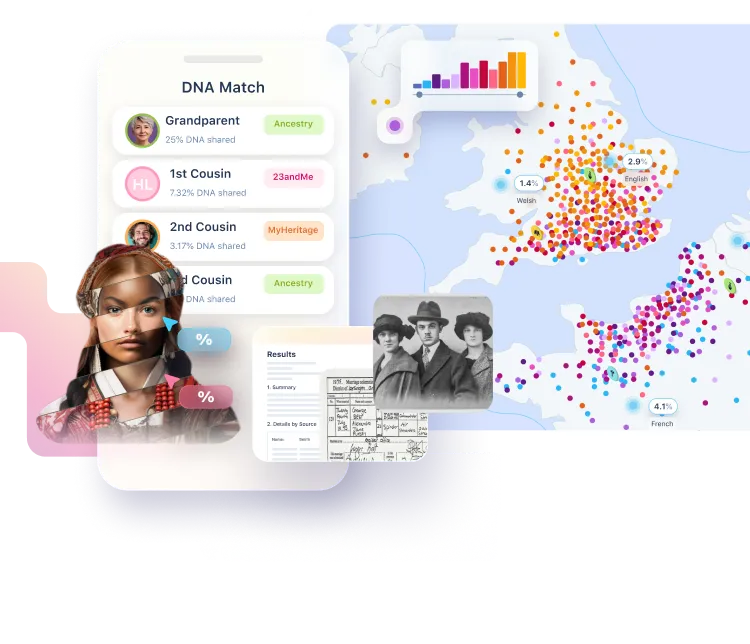
Find more DNA matches across all DNA tests
Combine your DNA data with your family tree to unlock the full power of YourRoots DNA Match. Connect with relatives across major testing services — Ancestry, 23andMe, MyHeritage, and more.
View your matches' maps and trees to identify shared ancestors, and soon you'll be able to add them directly to your own tree and map.
Ancestry DNA analysis that goes deeper than others
Unlock exclusive reports that reveal your deeper origins.
- Deep Ancestry Report — Analyze 130+ ethnicities, sub-regions, and 1,800+ communities in one detailed view.
- Global & Native American Reports — Developed with Stanford researchers to uncover hidden ancestries across all 22 chromosomes.
- Ancient DNA Series — Compare your DNA with 1,000+ ancient genomes from Viking, Celtic, and early American civilizations.
Sign up to explore more
Create a free account to navigate family trees, view ancestors, and discover connections.
Coming Soon
We're actively working on many new features for YourRoots. Features marked v2 are ones we're planning to launch soon.
Have a particular feature request? Let us know below!