
Sign up to explore more
Create a free account to navigate family trees, view ancestors, and discover connections.
Sign up to explore more
Create a free account to navigate family trees, view ancestors, and discover connections.
de Lacy Family Genealogy & History
Discover the Global Legacy of the de Lacy Surname
The de Lacy surname originates from the Norman family that hailed from Lassy in Calvados, France. As participants in the Norman Conquest of England and the subsequent invasion of Ireland, the de Lacy family established a prominent legacy that began with Hugh de Lacy in the 11th century. His sons, Ilbert and Walter, were instrumental in laying the foundations for the family's influence, which extended across England and Ireland, creating distinct branches that played significant roles in the socio-political landscape of medieval Europe.
Following the Norman invasion, the de Lacy family tree branched into northern and southern lines. The northern branch, centered on West Yorkshire and Blackburnshire, was established by Ilbert's descendants, who held significant titles such as the Barons of Pontefract and later the Earls of Lincoln. Meanwhile, the southern branch, linked to Walter's descendants, became influential as Marcher Lords in Herefordshire and Shropshire and gained prominence in Ireland with the Lordship of Meath. This geographical and cultural spread underscores the de Lacy family's adaptability and their strategic marriages and alliances, including ties to the Scottish royal family.
YourRoots data enriches this narrative by confirming the de Lacy family's establishment in England during the 11th century, aligning with historical records of their significant spread and influence. The dataset illustrates how the de Lacy genealogy has developed over time, reflecting the family's expansion across regions and its enduring legacy. By the 18th century, de Lacy family lines can be traced across Europe and beyond, showcasing a migration pattern that carried their heritage into new territories, adapting to diverse environments while maintaining their noble lineage.
Today, de Lacy genealogy records show a continued global presence, with YourRoots highlighting connections that span continents. This integration between historical sources and YourRoots data provides a comprehensive view for researchers delving into the de Lacy family tree, offering insights into how the family has preserved its legacy through centuries of change.
Find the de Lacy Family Tree
Search more de Lacy trees & genealogy records
Records
Search more trees & records for
De Lacy for free
Tracing Your de Lacy Family Lineage
Origin of the De Lacy Family: Where does the De Lacy surname come from?
The De Lacy surname finds its earliest known appearance in records from England, marking the beginning of a rich genealogical history. This early mention connects to the foundational roots of the family, suggesting a lineage that intertwines with the socio-political landscape of the time. As the name emerged, it indicated the establishment of family branches that would evolve over centuries, laying the groundwork for future generations.
Genealogy and Early Family History of De Lacy
During the 11th century, the De Lacy family began to spread across England, establishing significant branches in key regions where their influence and presence were notable. The family continued to grow through the centuries, particularly in the 12th and 13th centuries, as they navigated the complexities of feudal society and forged connections with other noble families. This expansion created a diverse family tree, with various lines of descent emerging throughout England.
The 14th century saw a decline in the number of recorded instances of the surname, yet the De Lacy family remained established in their respective regions, adapting to the changing social dynamics of the time. As new generations emerged, they built upon the family legacy, contributing to the evolution of the De Lacy name and its enduring significance in the annals of history.
Tracing the De Lacy Family Tree Through the Centuries
The De Lacy surname experienced notable expansion across regions from the 11th century through the 20th century, reflecting a broader movement of families in search of new opportunities. By the 18th century, the name had reached various parts of Europe and beyond, indicating a migration of family lines that carried the De Lacy heritage into new territories. This global spread can be traced through diverse records, showcasing the family's adaptability and resilience through the ages.
In the 19th century, the De Lacy family began to establish roots in regions such as Australia, where descendants continued to flourish. This international presence highlights the lasting impact of the De Lacy surname, as families sought to preserve their lineage while embracing new beginnings in distant lands. The evolution of the De Lacy family tree illustrates a complex tapestry woven through time, bridging connections across continents.
Where to Find De Lacy Genealogy Records Today
In modern centuries, the De Lacy surname has continued to thrive, with branches appearing in various countries around the world. The early 21st century has seen a notable interest in genealogy, encouraging descendants of the De Lacy family to explore their roots and connect with long-lost relatives. Readers are encouraged to delve into the YourRoots database to uncover their own family stories and connect to the rich heritage
de Lacy Surname Meaning, Origin, and History
The surname "de Lacy" originates from an old Norman family from Lassy, Calvados, which played a significant role in the Norman Conquest of England and later the invasion of Ireland. This family split into two primary branches: the northern branch, led by Ilbert de Lacy's descendants, who were influential in Yorkshire and Blackburnshire, and the southern branch, led by Walter de Lacy's descendants, who held lands in Herefordshire, Shropshire, and Ireland. The de Lacy family became prominent landholders, with titles such as Barons of Pontefract and Earls of Lincoln, and were connected to the Scottish royal family through marriage.
VIEW MOREWhere to Find Genealogy Records for de Lacy
We’ve analyzed YourRoots tree and records data to uncover where genealogists are finding key sources such as census, birth certificates, marriage records, and obituaries for the de Lacy family. Explore our most popular genealogy record sources for the de Lacy surname to learn more.
VIEW MOREAbout YourRoots
Explore your family tree geographically
Import your GEDCOM file to transform your family tree into an interactive global map. See your roots laid out visually and understand your true geographic heritage.
Powerful tools like "Trace Back To Me" instantly map your family's migration paths from a chosen ancestor all the way back to you.
Discover ancestors beyond "end-of-line" automatically
Import your family tree and let AI expand it for you. AI Ancestor Finder scans "end-of-line" ancestors to uncover their parents across hundreds of family lines at once. AI Deep Research analyzes selected ancestors and family clusters, suggesting relevant records and next steps.
Turn on Auto Research Mode to get new discoveries daily or weekly, so your tree keeps growing even while you're away.
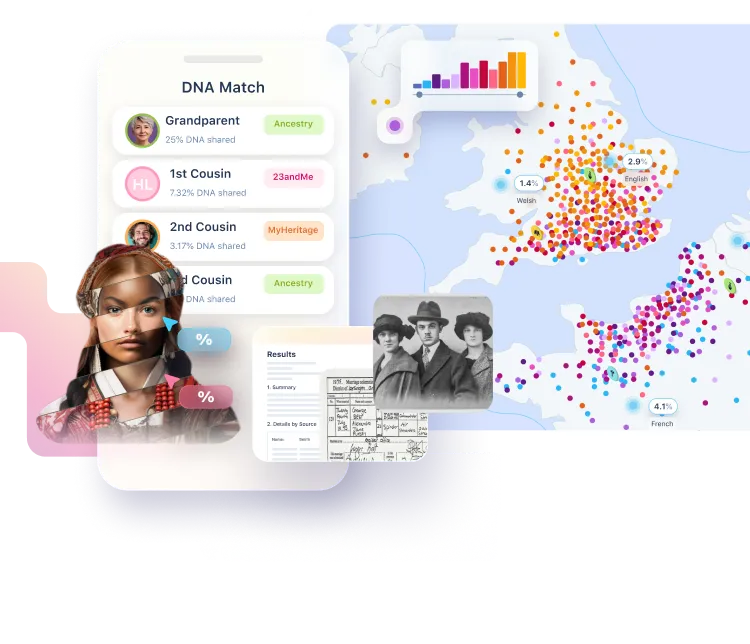
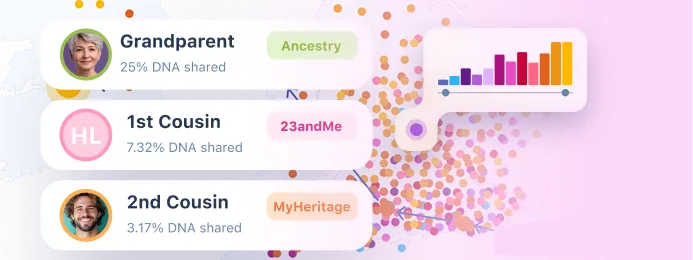
Find more DNA matches across all DNA tests
Combine your DNA data with your family tree to unlock the full power of YourRoots DNA Match. Connect with relatives across major testing services — Ancestry, 23andMe, MyHeritage, and more.
View your matches' maps and trees to identify shared ancestors, and soon you'll be able to add them directly to your own tree and map.
Ancestry DNA analysis that goes deeper than others
Unlock exclusive reports that reveal your deeper origins.
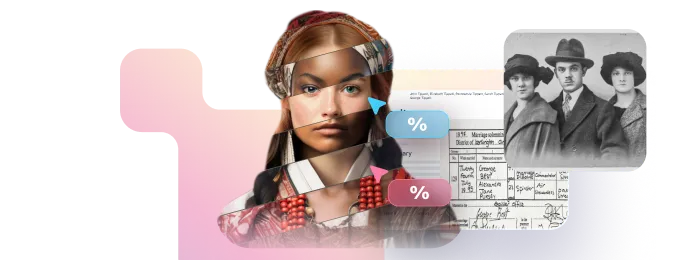
- Deep Ancestry Report — Analyze 130+ ethnicities, sub-regions, and 1,800+ communities in one detailed view.
- Global & Native American Reports — Developed with Stanford researchers to uncover hidden ancestries across all 22 chromosomes.
- Ancient DNA Series — Compare your DNA with 1,000+ ancient genomes from Viking, Celtic, and early American civilizations.
Sign up to explore more
Create a free account to navigate family trees, view ancestors, and discover connections.
Coming Soon
We're actively working on many new features for YourRoots. Features marked v2 are ones we're planning to launch soon.
Have a particular feature request? Let us know below!