
Sign up to explore more
Create a free account to navigate family trees, view ancestors, and discover connections.

Sign up to explore more
Create a free account to navigate family trees, view ancestors, and discover connections.
Dix Family Genealogy & History
Discover the Global Legacy of the Dix Surname
The Dix surname is believed to have first emerged in England during the early 16th century. Its origins are linked to the Anglo-Saxon tradition, with the name likely deriving from a diminutive or pet form of the given name Richard or similar Old English names. Over time, the Dix name established itself as a distinct family surname, marking the beginning of its genealogical journey.
As the Dix surname evolved, its bearers primarily settled within England, with notable presence in regions that supported the surname's eventual migration. The 17th century saw the Dix family tree extend beyond England, with many members seeking new opportunities in North America. By the 19th century, the Dix name had spread across various states in the United States, becoming a recognized part of American genealogy.
YourRoots data corroborates the Dix surname's English origins, noting its first appearance during the 16th century. As outlined in the dataset, the Dix family lines began to branch out significantly in the late 16th century, paving the way for future generations to expand geographically. This expansion is a testament to the Dix family's adaptability, as documented in YourRoots, which highlights their continued global presence into the 20th century.
For those researching the Dix family tree, YourRoots provides a valuable resource, offering insights into the historical and geographical spread of the Dix surname. By exploring Dix genealogy records through YourRoots, individuals can deepen their understanding of their ancestral connections and the enduring legacy of the Dix family name.
Find the Dix Family Tree
Search more Dix trees & genealogy records
Records
-
ZDZachariah Dix1730–1812Individual Tree PersonParents: Nathan Dicks & Deborah ClarkScore: AZDZachariah Dix1730–1812Individual Tree PersonParents: Nathan Dicks & Deborah ClarkScore: A
-
SDSarah Dix1771–1840Individual Tree PersonParents: William (Dicks) & Susannah WILKINSSpouse: John SladeChildren: William, John, William, EdwardScore: ASDSarah Dix1771–1840Individual Tree PersonParents: William (Dicks) & Susannah WILKINSSpouse: John SladeChildren: William, John, William, EdwardScore: A
-
ADAdah Ida Irene Dix1871–1917Individual Tree PersonParents: Clark Dix & Martha (Dix)Spouse: William LarimoreChildren: Marshall, Clark, Florence, Marjorie, Maurice, JohnScore: AADAdah Ida Irene Dix1871–1917Individual Tree PersonParents: Clark Dix & Martha (Dix)Spouse: William LarimoreChildren: Marshall, Clark, Florence, Marjorie, Maurice, JohnScore: A
-
ADAbsalom DIX1839–1840Individual Tree PersonParents: Thomas DIX & Deborah PRATLEYScore: AADAbsalom DIX1839–1840Individual Tree PersonParents: Thomas DIX & Deborah PRATLEYScore: A
-
CDCubbitt Duncan Dix1848–1929Individual Tree PersonParents: William Dix & Eliza AlcockSpouse: Elizabeth WadeChildren: LilyScore: ACDCubbitt Duncan Dix1848–1929Individual Tree PersonParents: William Dix & Eliza AlcockSpouse: Elizabeth WadeChildren: LilyScore: A
-
EDElizabeth "Bettie" Dix1880–1968Individual Tree PersonSpouse: Ambros TaylorChildren: Annie, John, Wildom, Levi, Pearl, Mary, WilfredScore: AEDElizabeth "Bettie" Dix1880–1968Individual Tree PersonSpouse: Ambros TaylorChildren: Annie, John, Wildom, Levi, Pearl, Mary, WilfredScore: A
-
HDHannah Dix1814–1902Individual Tree PersonSpouse: Daniel AllenChildren: Samuel, Sarah, Elizabeth, DanielScore: AHDHannah Dix1814–1902Individual Tree PersonSpouse: Daniel AllenChildren: Samuel, Sarah, Elizabeth, DanielScore: A
-
EDElisabeth Fannie Dix1866–1955Individual Tree PersonParents: James Dix & Elizabeth FlippinSpouse: Benjamin FreemanChildren: Sarah, James, Virginia, William, Rachel, Mary, LeeScore: AEDElisabeth Fannie Dix1866–1955Individual Tree PersonParents: James Dix & Elizabeth FlippinSpouse: Benjamin FreemanChildren: Sarah, James, Virginia, William, Rachel, Mary, LeeScore: A
-
DDDaniel DIX1841–1842Individual Tree PersonParents: Thomas DIX & Deborah PRATLEYScore: ADDDaniel DIX1841–1842Individual Tree PersonParents: Thomas DIX & Deborah PRATLEYScore: A
-
JDJames Dix1745–1801Individual Tree PersonParents: Thomas Dix & Ann ChardSpouse: Mary PhelpsChildren: Betty, Thomas, William, RachelScore: AJDJames Dix1745–1801Individual Tree PersonParents: Thomas Dix & Ann ChardSpouse: Mary PhelpsChildren: Betty, Thomas, William, RachelScore: A
-
HDHannah Dix1768–1782Individual Tree PersonParents: William (Dicks) & Susannah WILKINSScore: AHDHannah Dix1768–1782Individual Tree PersonParents: William (Dicks) & Susannah WILKINSScore: A
-
MDMary Dix1637–1691Individual Tree PersonParents: Edward Dix & Jane DixSpouse: Abraham Jr, Samuel Rice, Thomas farmer, Richard BarnesChildren: Lydia, Thomas, John, Sarah, Alice, Thomas, Elizabeth, Edward, Richard, Rebeccah, Abigail, Jonathan, Richard, John, SarahScore: AMDMary Dix1637–1691Individual Tree PersonParents: Edward Dix & Jane DixSpouse: Abraham Jr, Samuel Rice, Thomas farmer, Richard BarnesChildren: Lydia, Thomas, John, Sarah, Alice, Thomas, Elizabeth, Edward, Richard, Rebeccah, Abigail, Jonathan, Richard, John, SarahScore: A
-
ADAmelia Evelyn Dix1932–2022Individual Tree PersonParents: Dock Dix & Doris PGGM)Spouse: V. RevisScore: AADAmelia Evelyn Dix1932–2022Individual Tree PersonParents: Dock Dix & Doris PGGM)Spouse: V. RevisScore: A
-
WDWalter W Dix1888–1966Individual Tree PersonParents: Julian Dix & Mary RuddScore: AWDWalter W Dix1888–1966Individual Tree PersonParents: Julian Dix & Mary RuddScore: A
-
EDElizabeth Dix1783–1844Individual Tree PersonParents: Nathan Dicks & Mary BrooksSpouse: Ebenezer DoaneChildren: Zachariah, Abigail, Nathan, GeorgeScore: AEDElizabeth Dix1783–1844Individual Tree PersonParents: Nathan Dicks & Mary BrooksSpouse: Ebenezer DoaneChildren: Zachariah, Abigail, Nathan, GeorgeScore: A
-
ADAbigail Dix1676–1753Individual Tree PersonParents: John Dix & Elizabeth BarnardSpouse: Jonathan GroutChildren: ColonelScore: AADAbigail Dix1676–1753Individual Tree PersonParents: John Dix & Elizabeth BarnardSpouse: Jonathan GroutChildren: ColonelScore: A
-
DDDura Mae Dix1900–1987Individual Tree PersonParents: Frank Dix & Katie SextonSpouse: Charles SrChildren: Dorothy, Benjamin, Charles, WilliamScore: ADDDura Mae Dix1900–1987Individual Tree PersonParents: Frank Dix & Katie SextonSpouse: Charles SrChildren: Dorothy, Benjamin, Charles, WilliamScore: A
-
EDElizabeth A Davies Dix1895–1952Individual Tree PersonParents: Elizabeth MorganSpouse: Arthur GriffithsChildren: Oliver, Ronald, John, Miriam, William, LeslieScore: AEDElizabeth A Davies Dix1895–1952Individual Tree PersonParents: Elizabeth MorganSpouse: Arthur GriffithsChildren: Oliver, Ronald, John, Miriam, William, LeslieScore: A
-
MDMargaret Dix1687–1781Individual Tree PersonParents: John Dix & Mary BidwellSpouse: John Hills, John HillsChildren: Pvt., John, Margaret, Hulda, JoannaScore: AMDMargaret Dix1687–1781Individual Tree PersonParents: John Dix & Mary BidwellSpouse: John Hills, John HillsChildren: Pvt., John, Margaret, Hulda, JoannaScore: A
-
JDJohnny Arthur Dix1927–2008Individual Tree PersonParents: Ashford Dix & Alberta DixSpouse: Cathy Arnold-Williams, Ethel CokerScore: AJDJohnny Arthur Dix1927–2008Individual Tree PersonParents: Ashford Dix & Alberta DixSpouse: Cathy Arnold-Williams, Ethel CokerScore: A
Search more trees & records for
Dix for free
Tracing Your Dix Family Lineage
Origin of the Dix Family: Where does the Dix surname come from?
The Dix surname first appeared in England during the early 16th century, marking the beginning of its genealogical lineage. This initial record lays the foundation for family trees, connecting descendants to their ancestral roots in the United Kingdom. The emergence of the Dix name during this time reflects the early establishment of family lines that would evolve and spread over the centuries.
Genealogy and Early Family History of Dix
As the Dix family began to take shape, its members predominantly settled in England, particularly in the regions that would later contribute to the family's migration. During the late 16th century, the Dix family lines began branching out, as individuals sought new opportunities and established their own households. This era saw the formation of various branches of the Dix family tree, laying the groundwork for future generations.
The migration of the Dix surname gained momentum in the following centuries, with family members moving to different regions and countries. This expansion highlights the adaptability of the Dix family as they navigated changing socio-economic landscapes, leading to a richer and more diverse family history.
Tracing the Dix Family Tree Through the Centuries
Throughout the 17th century, the Dix surname experienced significant growth, especially as families migrated to the United States, reinforcing its presence in North America. This transatlantic movement continued into the 18th century, where the Dix family found new opportunities and established roots in various states. By the 19th century, the Dix surname had firmly established itself across multiple regions, contributing to the broader tapestry of American genealogy.
The 20th century marked a further global spread, with the Dix name appearing in diverse locations around the world. Families with the Dix surname continued to evolve, adapting to new environments while maintaining connections to their ancestral heritage. This journey illustrates the dynamic nature of the Dix family tree as it continues to grow and branch out across generations.
Where to Find Dix Genealogy Records Today
In contemporary times, the Dix surname can be found in various regions, reflecting its rich history and ongoing evolution. The 21st century has seen a renewed interest in genealogy, prompting many to explore their family histories and connect with their roots. Readers are encouraged to delve into the YourRoots database to uncover their own Dix genealogy records and further enrich their understanding of their family tree.
Famous People with Dix (and Their Family Tree)

Otto Dix
Otto Dix, renowned German painter and printmaker, is celebrated for his harshly realistic depictions of the Weimar Republic and the brutality of World War I, earning him a prominent place in the Neue Sachlichkeit movement alongside George Grosz and Max Beckmann. His notable works include "Der Krieg," a portfolio of etchings, and the haunting "The War Triptych." Dix's art, characterized by thin oil glazes over tempera underpaintings, often critiqued contemporary German society, exploring themes of Lustmord, prostitution, and violence, as seen in works like "The Trench" and "Sailor and Girl."
Born in Untermhaus, Germany, Otto Dix was the eldest son of Franz Dix, an iron foundry worker, and Louise, a seamstress and poet. His artistic journey was influenced by his cousin, painter Fritz Amann, and encouraged by his primary school teacher. This family background, combined with an apprenticeship under painter Carl Senff, laid the foundation for Dix's future success in the art world.

Dorothea Dix
Dorothea Lynde Dix (1802–1887) was a pioneering American social reformer, renowned for her advocacy on behalf of the mentally ill and her efforts in establishing the first generation of American mental asylums. Through persistent lobbying of state legislatures and the United States Congress, Dix played a crucial role in mental health reform during the 19th century. During the Civil War, she also served as the Superintendent of Army Nurses, contributing significantly to military medical care. Her work and publications, such as "Conversations on Common Things," left a lasting impact on education and social welfare.
Born in Hampden, Maine, Dorothea Dix was the eldest of three children to Joseph Dix, an itinerant bookseller and Methodist preacher, and Mary Bigelow, who had deep ancestral roots in the Massachusetts Bay Colony. Due to her parents' inability to provide a stable home, she was raised by her wealthy grandmother, Dorothea Lynde, in Boston. This familial shift provided her access to education and the means to support her later reform efforts.

Fort Dix
Fort Dix, officially known as the Army Support Activity at Joint Base McGuire-Dix-Lakehurst, is a significant U.S. Army post in New Jersey. Established in 1917 as Camp Dix, it played pivotal roles in training and demobilizing soldiers during both World Wars and has evolved into a joint training site. Known for its historical significance, Fort Dix was the training ground for the 78th Infantry Division, the "Lightning Division," and saw the introduction of female recruits in 1978. The base is currently managed by the U.S. Air Force's 87th Air Base Wing, supporting various military components and services.

Richard Dix
Richard Dix, born Ernst Carlton Brimmer on July 18, 1893, was a prominent American actor renowned for his versatile performances in both silent and sound films. Achieving fame for his rugged, heroic roles, Dix was nominated for the Academy Award for Best Actor for his performance in the Best Picture-winning film "Cimarron" (1931). Over his career, Dix starred in 101 films, including the notable "The Ten Commandments" and "The Whistler" series. Despite his struggles with alcoholism, his contributions to Hollywood earned him a star on the Hollywood Walk of Fame.
Richard Dix was born in Saint Paul, Minnesota, where he initially pursued a career in medicine to fulfill his father's wishes. However, his passion for acting led him to Hollywood, where he eventually signed with Paramount Pictures and adopted his stage name. He was married twice, first to Winifred Coe, with whom he had a daughter, and then to Virginia Webster, with whom he had twin sons and an adopted daughter.

John Adams Dix
John Adams Dix was a prominent American politician and military officer, known for his significant roles as Secretary of the Treasury, Governor of New York, and Union Major General during the Civil War. Dix's notable achievements include preventing Maryland from seceding by arresting its pro-Southern General Assembly and establishing the Dix–Hill Cartel for prisoner exchange with Confederate Major General Daniel Harvey Hill. He served in key positions such as President of the Union Pacific Railroad and Postmaster of New York City, contributing to his enduring legacy in American history.
Born in Boscawen, New Hampshire, on July 24, 1798, John Adams Dix was the son of Timothy Dix and Abigail Wilkins, and had a sister named Marion Dix Sullivan, a composer. He was educated at Phillips Exeter Academy and began his military career serving under his father.
Dix Surname Meaning, Origin, and History
The surname "Dix" is associated with various individuals across different professions, including politics, the arts, and sports, with notable figures such as Dorothea Dix, an American social worker, and Otto Dix, a German expressionist. The name appears in diverse geographical locations, particularly in the United States, with places named Dix in Illinois, Nebraska, and New York, among others.
VIEW MOREWhere to Find Genealogy Records for Dix
We’ve analyzed YourRoots tree and records data to uncover where genealogists are finding key sources such as census, birth certificates, marriage records, and obituaries for the Dix family. Explore our most popular genealogy record sources for the Dix surname to learn more.
VIEW MOREAbout YourRoots
Explore your family tree geographically
Import your GEDCOM file to transform your family tree into an interactive global map. See your roots laid out visually and understand your true geographic heritage.
Powerful tools like "Trace Back To Me" instantly map your family's migration paths from a chosen ancestor all the way back to you.
Discover ancestors beyond "end-of-line" automatically
Import your family tree and let AI expand it for you. AI Ancestor Finder scans "end-of-line" ancestors to uncover their parents across hundreds of family lines at once. AI Deep Research analyzes selected ancestors and family clusters, suggesting relevant records and next steps.
Turn on Auto Research Mode to get new discoveries daily or weekly, so your tree keeps growing even while you're away.
Find more DNA matches across all DNA tests
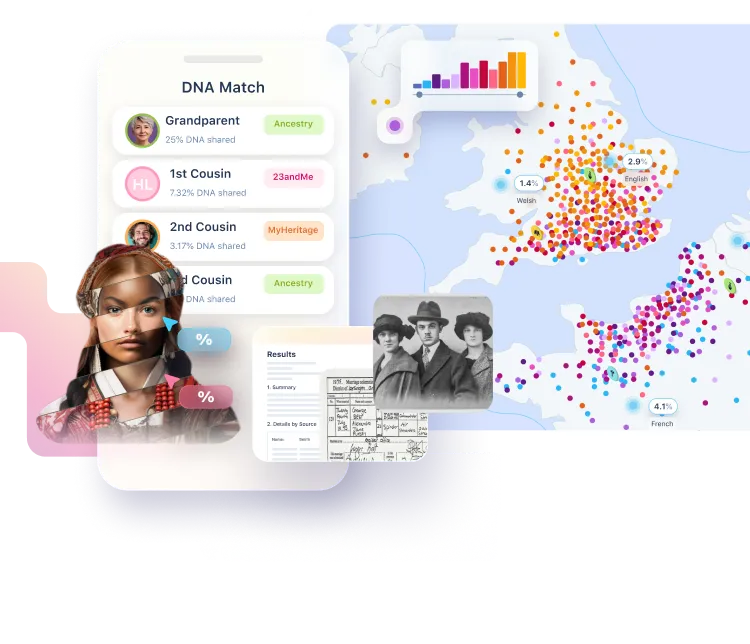
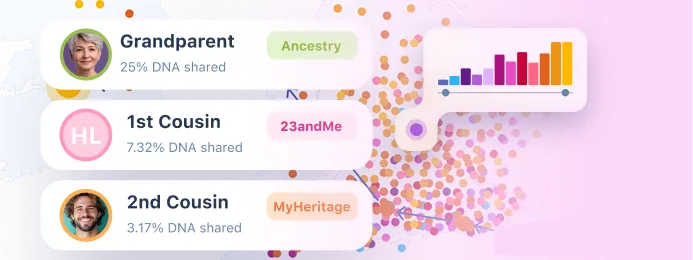
Combine your DNA data with your family tree to unlock the full power of YourRoots DNA Match. Connect with relatives across major testing services — Ancestry, 23andMe, MyHeritage, and more.
View your matches' maps and trees to identify shared ancestors, and soon you'll be able to add them directly to your own tree and map.
Ancestry DNA analysis that goes deeper than others
Unlock exclusive reports that reveal your deeper origins.
- Deep Ancestry Report — Analyze 130+ ethnicities, sub-regions, and 1,800+ communities in one detailed view.
- Global & Native American Reports — Developed with Stanford researchers to uncover hidden ancestries across all 22 chromosomes.
- Ancient DNA Series — Compare your DNA with 1,000+ ancient genomes from Viking, Celtic, and early American civilizations.
Sign up to explore more
Create a free account to navigate family trees, view ancestors, and discover connections.
Coming Soon
We're actively working on many new features for YourRoots. Features marked v2 are ones we're planning to launch soon.
Have a particular feature request? Let us know below!