
Sign up to explore more
Create a free account to navigate family trees, view ancestors, and discover connections.
Sign up to explore more
Create a free account to navigate family trees, view ancestors, and discover connections.
Elder Family Genealogy & History
Discover the Global Legacy of the Elder Surname
The Elder surname is a Scottish name with a storied history that traces its origins back to the 11th century. Its earliest recorded appearance was in the city of Edinburgh, marking it as a name steeped in Scottish heritage. Over time, "Elder" has seen various spellings and pronunciations, reflecting its evolution through different regions and linguistic influences. As an old surname, Elder signifies age, wisdom, or seniority, often associated with a person of respected status within a community or family.
Throughout the centuries, the Elder surname has spread significantly, particularly in England during the 12th and 15th centuries. By the 14th century, families bearing the Elder name had firmly established themselves in various regions, contributing to the rich tapestry of the Elder family tree. The 16th century was a pivotal era of growth, with the Elder lineage expanding through intermarriages and increased presence in England. By the 17th and 18th centuries, the Elder name gained prominence in Scotland and later in the United States, illustrating its adaptability and widespread influence.
YourRoots data enriches this historical narrative by confirming that the Elder surname has origins in France during the 11th century, further broadening our understanding of its geographical roots. This aligns with the historical migration patterns noted in the content, where the Elder family is documented across Europe and eventually the Americas. The YourRoots dataset offers insights into the Elder genealogy, highlighting how the family's movement from France to Scotland and beyond has shaped its legacy.
For genealogy enthusiasts and family tree researchers, the Elder surname provides a fascinating journey through centuries of migration and cultural integration. The YourRoots database serves as a valuable resource, offering comprehensive Elder records that help to uncover the global journey of this storied surname. Whether tracing ancestry in Europe or America, the continuity between historical sources and modern data offers rich material for exploring the Elder family tree.
Find the Elder Family Tree
Search more Elder trees & genealogy records
Records
-
JEJohn Farrar, The Elder1548–1629Individual Tree PersonParents: Sir Ewwodd & Margaret LacySpouse: Cecily KelkeChildren: William, Charles, Henry, Humphrey, John, NicholasScore: AJEJohn Farrar, The Elder1548–1629Individual Tree PersonParents: Sir Ewwodd & Margaret LacySpouse: Cecily KelkeChildren: William, Charles, Henry, Humphrey, John, NicholasScore: A
-
EEElmer Mark Elder1910–1948Individual Tree PersonParents: William Elder & Edith BennettSpouse: Mabel CowenChildren: Lee, Nancy, DonnaScore: AEEElmer Mark Elder1910–1948Individual Tree PersonParents: William Elder & Edith BennettSpouse: Mabel CowenChildren: Lee, Nancy, DonnaScore: A
-
JEJohn Thomas Elder1766–1834Individual Tree PersonParents: George Elder & Sarah VoganSpouse: Margaret ElderChildren: Robert, Samuel, George, Isabelle, JohnScore: AJEJohn Thomas Elder1766–1834Individual Tree PersonParents: George Elder & Sarah VoganSpouse: Margaret ElderChildren: Robert, Samuel, George, Isabelle, JohnScore: A
-
LELloyd Ray Elder1916–1981Individual Tree PersonParents: Vollie Elder & Alice ElderSpouse: Wynona ElderChildren: CharlesScore: ALELloyd Ray Elder1916–1981Individual Tree PersonParents: Vollie Elder & Alice ElderSpouse: Wynona ElderChildren: CharlesScore: A
-
DEDavidson Elder1871–1941Individual Tree PersonParents: H.G. Sr & Sarah MarshallSpouse: Cami Elder, Conm?E ElderChildren: Paul, Effie, Phillip, Johnnie, Eugene, JeanScore: ADEDavidson Elder1871–1941Individual Tree PersonParents: H.G. Sr & Sarah MarshallSpouse: Cami Elder, Conm?E ElderChildren: Paul, Effie, Phillip, Johnnie, Eugene, JeanScore: A
-
LELouwanda Bigham Elder1857–1880Individual Tree PersonParents: Samuel Elder & Sarah BighamScore: ALELouwanda Bigham Elder1857–1880Individual Tree PersonParents: Samuel Elder & Sarah BighamScore: A
-
JEJames Stuart Elder1921–1992Individual Tree PersonParents: George Elder & Cynthia ShumwaySpouse: Wilma ElderScore: AJEJames Stuart Elder1921–1992Individual Tree PersonParents: George Elder & Cynthia ShumwaySpouse: Wilma ElderScore: A
-
RERobert Elder1679–1746Individual Tree PersonParents: John Elder & Janet DavidsonSpouse: Eleanor ElderChildren: JamesScore: ARERobert Elder1679–1746Individual Tree PersonParents: John Elder & Janet DavidsonSpouse: Eleanor ElderChildren: JamesScore: A
-
AEAnn E Elder1754–1814Individual Tree PersonParents: John ELDER & Mary SimpsonScore: AAEAnn E Elder1754–1814Individual Tree PersonParents: John ELDER & Mary SimpsonScore: A
-
HEHelen Verch LLEWELYN the Elder1206–1253Individual Tree PersonParents: Llywelyn Gwynedd & Joan WalesSpouse: John HUNTINGDON, Robert WareChildren: Hawise, Ann, JoanScore: AHEHelen Verch LLEWELYN the Elder1206–1253Individual Tree PersonParents: Llywelyn Gwynedd & Joan WalesSpouse: John HUNTINGDON, Robert WareChildren: Hawise, Ann, JoanScore: A
-
JEJohn Elder1862–1942Individual Tree PersonParents: Wiliam Elder & Nancy ElderScore: AJEJohn Elder1862–1942Individual Tree PersonParents: Wiliam Elder & Nancy ElderScore: A
-
MEMatilda Elder1828–1896Individual Tree PersonParents: Joseph Elder & Nancy ElderSpouse: William ThomasChildren: Doctor, David, William, John, Frances, Kitty, Washington, JamesScore: AMEMatilda Elder1828–1896Individual Tree PersonParents: Joseph Elder & Nancy ElderSpouse: William ThomasChildren: Doctor, David, William, John, Frances, Kitty, Washington, JamesScore: A
-
HEHugh Elder1742–1808Individual Tree PersonParents: Hugh ElderSpouse: Betty CollandwoodChildren: Janet, IsobellScore: AHEHugh Elder1742–1808Individual Tree PersonParents: Hugh ElderSpouse: Betty CollandwoodChildren: Janet, IsobellScore: A
-
GEGlenna Earline Franks Elder1930–1979Individual Tree PersonParents: Roy Franks & Laura WilliamsSpouse: James ElderScore: AGEGlenna Earline Franks Elder1930–1979Individual Tree PersonParents: Roy Franks & Laura WilliamsSpouse: James ElderScore: A
-
FEFay Elizebeth Elder1930–2004Individual Tree PersonParents: Elmus ELDER & Eleanor BerrySpouse: Gene Lafond, William MimnaughChildren: PhillipScore: AFEFay Elizebeth Elder1930–2004Individual Tree PersonParents: Elmus ELDER & Eleanor BerrySpouse: Gene Lafond, William MimnaughChildren: PhillipScore: A
-
LELeroy Elder1905–1968Individual Tree PersonParents: Harry Elder & Elizabeth SpeakmanSpouse: Julia SchrullChildren: AlbertScore: ALELeroy Elder1905–1968Individual Tree PersonParents: Harry Elder & Elizabeth SpeakmanSpouse: Julia SchrullChildren: AlbertScore: A
-
EEElizabeth Sarah Elder1865–1925Individual Tree PersonParents: William Elder & Charity (Corhin?)Spouse: Patrick HarneChildren: Ella, Harry, Richard, Mae, William, Timothy, ElizabethScore: AEEElizabeth Sarah Elder1865–1925Individual Tree PersonParents: William Elder & Charity (Corhin?)Spouse: Patrick HarneChildren: Ella, Harry, Richard, Mae, William, Timothy, ElizabethScore: A
-
EEEdna Benise ELDER1904–1975Individual Tree PersonParents: HILLARD ELDER & Mary GREGORYSpouse: Ottmer Schnee, Schnee NoneScore: AEEEdna Benise ELDER1904–1975Individual Tree PersonParents: HILLARD ELDER & Mary GREGORYSpouse: Ottmer Schnee, Schnee NoneScore: A
-
GEGilbert Wade Elder1860–1943Individual Tree PersonParents: W. Elder & Mary TrustieSpouse: Mary ElderChildren: VerdiScore: AGEGilbert Wade Elder1860–1943Individual Tree PersonParents: W. Elder & Mary TrustieSpouse: Mary ElderChildren: VerdiScore: A
-
CECaptain John Wheatley, the Elder1521–1594Individual Tree PersonParents: Thomas Wheatley & Mary WheatleySpouse: Mary HolteChildren: Sir, Nathaniel, Anne, Olive, Richard, Martha, Samuel, Jane, JohnScore: ACECaptain John Wheatley, the Elder1521–1594Individual Tree PersonParents: Thomas Wheatley & Mary WheatleySpouse: Mary HolteChildren: Sir, Nathaniel, Anne, Olive, Richard, Martha, Samuel, Jane, JohnScore: A
Search more trees & records for
Elder for free
Tracing Your Elder Family Lineage
Origin of the Elder Family: Where does the Elder surname come from?
The Elder surname has its earliest known appearance in France during the 11th century, marking the beginning of a genealogical lineage that would expand across Europe and beyond. This initial record signifies the roots of the Elder family tree, establishing a foundation for future generations. As families began to form and branch out, the Elder name became a point of connection for descendants tracing their ancestry back to these early origins in France.
Genealogy and Early Family History of Elder
Throughout the following centuries, the Elder family began to spread, particularly in England, where significant records appear during the 12th and 15th centuries. By the 14th century, families bearing the Elder name were establishing themselves in various regions, contributing to the growth of their family trees as they settled in new areas. The migration and settlement patterns of the Elder family set the stage for a rich and diverse genealogy that would flourish in subsequent generations.
In the 16th century, the Elder surname experienced notable growth, with families expanding their presence in England. Each generation not only added branches to the family tree but also intermarried with other families, further enriching the Elder lineage and creating a tapestry of connections that would span multiple regions. This period marked a pivotal point in the evolution of the Elder family, solidifying its status in the historical narrative of family lineage.
Tracing the Elder Family Tree Through the Centuries
As the Elder surname continued to evolve, it experienced significant expansion across regions during the 17th and 18th centuries. By the 17th century, the name gained prominence in Scotland, while the 18th century saw a substantial migration to the United States, where the Elder family established new roots. This global spread illustrates the adaptability and resilience of the Elder family, allowing them to thrive in diverse cultural landscapes.
Throughout the 19th century, the Elder surname became increasingly prevalent in the United States, reflecting the broader trends of immigration and settlement during that time. This expansion not only highlights the family's growth but also the connections formed with other immigrant families, enriching the Elder family tree further. The journey of the Elder surname across centuries exemplifies the dynamic nature of genealogy, with each branch contributing to the overall legacy of the family.
Where to Find Elder Genealogy Records Today
In the modern centuries, the Elder surname continues to show a wide global presence, particularly in the United States, where it has become a well-established name. Families carrying the Elder surname can be found across various regions, reflecting the historical migrations and settlements that have shaped their lineage. For those interested in exploring their own connections to the Elder family, the YourRoots database offers a wealth of
Famous People with Elder (and Their Family Tree)

Edward the Elder
Edward the Elder (870s? – 924) was a pivotal figure in English history, reigning as King of the Anglo-Saxons from 899 to 924. As the son of Alfred the Great, Edward played a crucial role in the defense and consolidation of Anglo-Saxon territories against Viking threats. His significant achievements include defeating his cousin Æthelwold's claim to the throne and leading a decisive campaign with his sister Æthelflæd against Viking-controlled southern England. By the end of his reign, he ruled Wessex, Mercia, and East Anglia, setting the stage for a united English kingdom.
Edward was the elder son of Alfred the Great and Ealhswith. His mother hailed from the Mercian royal family, and Edward was one of five children who survived childhood. His siblings included Æthelflæd, Lady of the Mercians, and Ælfthryth, who married Baldwin, Count of Flanders. Edward's family background provided a strong foundation of alliances and influence across Anglo-Saxon England.

Cato the Elder
Cato the Elder, also known as Marcus Porcius Cato, was a prominent Roman soldier, senator, and historian, renowned for his conservatism and opposition to Hellenization. Notable for his roles as military tribune, quaestor, aedile, praetor, consul, and censor, Cato's illustrious career was marked by his commitment to preserving Rome's ancestral customs. His significant contributions include writing "De agri cultura," the oldest existing prose in Latin, and his influential "Origines" on Roman history. Distinguished by his wisdom and eloquence, he was often referred to as Cato the Censor and Cato the Wise.
Cato the Elder was born in Tusculum to an ancient plebeian family known for their military service. His father was celebrated as a brave soldier, while his great-grandfather was honored for his valor in battle. Despite the family's lack of Roman magistracy privileges, Cato's ambition and achievements surpassed those of his predecessors, marking him as the founder of the Porcia gens in Roman society.

Larry Elder
Laurence Allen Elder, born April 27, 1952, is a prominent American conservative political commentator and talk radio host known for "The Larry Elder Show." His career highlights include hosting nationally syndicated radio shows through ABC Radio Networks and Salem Media Group, writing books like "As Goes California," and running for public office in the 2021 California recall election and the 2024 presidential race. With a background in law and media, Elder is also a columnist and has appeared on various television programs, contributing to public discourse on conservative and libertarian ideals.
Larry Elder was born in Los Angeles, the middle of three brothers, to Randolph Elder and Viola Conley. His father, a World War II Marine Corps sergeant from Georgia, moved to California post-war and opened a cafe. His mother, originally from Alabama, worked for the Department of War during the war. The family had a mixed political background, with his father being a Republican and his mother a Democrat, which informed Elder's diverse ideological perspectives.

Judyann Elder
Judyann Elder is a distinguished American actress, director, and writer renowned for her roles in popular television series and theater. She gained widespread recognition playing Nadine Waters on the FOX sitcom "Martin" and as Harriette Winslow in the final season of CBS's "Family Matters." A founding member of the Tony Award-winning Negro Ensemble Company, Elder originated roles in groundbreaking plays like "The Song of the Lusitanian Bogey" and "Kongi's Harvest." Her expansive career includes guest appearances on shows such as "Sanford and Son" and "Murphy Brown," a stage debut in "I Have a Dream," and directorial credits like "The Whipping Man." Elder's contributions to theater and television highlight her versatile talent and enduring influence.

Ann Elder
Ann Elder, born Anna Velders on September 21, 1942, in Cleveland, Ohio, is a distinguished American actress, producer, and screenwriter. She is celebrated for her Emmy Award-winning comedy writing, notably co-writing Lily Tomlin's 1974 CBS special. Elder's career highlights include writing for Mitzi Gaynor's 1960s NBC specials and the comedy series Mama's Family. As an actress, she graced popular 1960s TV shows such as The Farmer's Daughter and Get Smart. Ann Elder was a regular cast member on NBC's Rowan and Martin's Laugh-In and appeared in films like Don't Make Waves. In 1980, she produced HBO's first independent production, A Funny Thing Happened on the Way to the White House.
Elder Surname Meaning, Origin, and History
The surname "Elder" is of Scottish origin, with its earliest recorded instance in Edinburgh in the 11th century. The name has various spellings and has been associated with a wide range of notable individuals across different fields, including politics, sports, arts, and academia.
VIEW MOREWhere to Find Genealogy Records for Elder
We’ve analyzed YourRoots tree and records data to uncover where genealogists are finding key sources such as census, birth certificates, marriage records, and obituaries for the Elder family. Explore our most popular genealogy record sources for the Elder surname to learn more.
VIEW MOREAbout YourRoots
Explore your family tree geographically
Import your GEDCOM file to transform your family tree into an interactive global map. See your roots laid out visually and understand your true geographic heritage.
Powerful tools like "Trace Back To Me" instantly map your family's migration paths from a chosen ancestor all the way back to you.
Discover ancestors beyond "end-of-line" automatically
Import your family tree and let AI expand it for you. AI Ancestor Finder scans "end-of-line" ancestors to uncover their parents across hundreds of family lines at once. AI Deep Research analyzes selected ancestors and family clusters, suggesting relevant records and next steps.
Turn on Auto Research Mode to get new discoveries daily or weekly, so your tree keeps growing even while you're away.
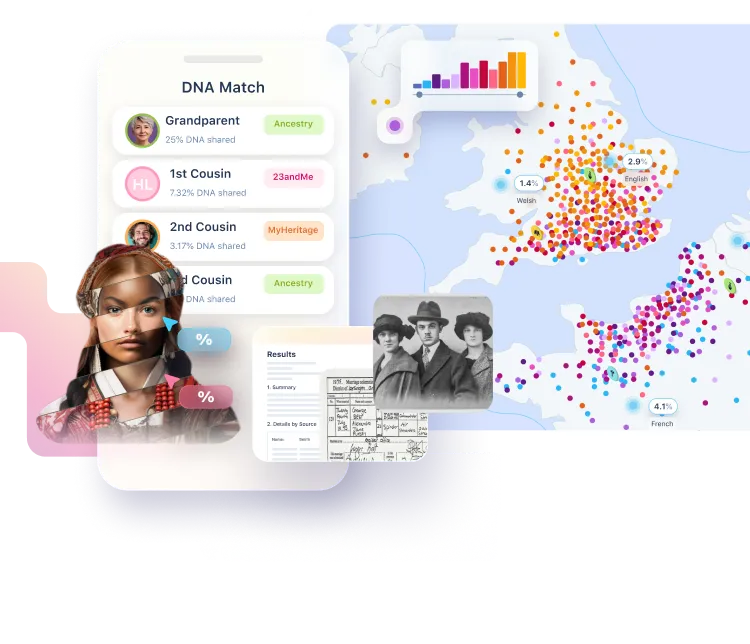
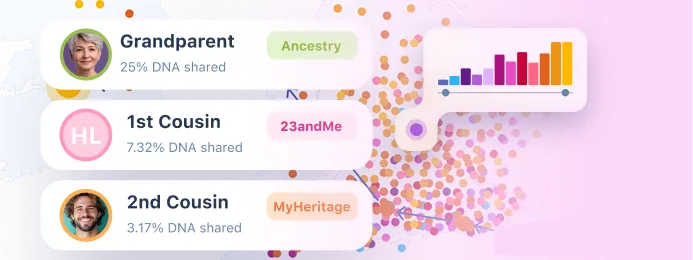
Find more DNA matches across all DNA tests
Combine your DNA data with your family tree to unlock the full power of YourRoots DNA Match. Connect with relatives across major testing services — Ancestry, 23andMe, MyHeritage, and more.
View your matches' maps and trees to identify shared ancestors, and soon you'll be able to add them directly to your own tree and map.
Ancestry DNA analysis that goes deeper than others
Unlock exclusive reports that reveal your deeper origins.
- Deep Ancestry Report — Analyze 130+ ethnicities, sub-regions, and 1,800+ communities in one detailed view.
- Global & Native American Reports — Developed with Stanford researchers to uncover hidden ancestries across all 22 chromosomes.
- Ancient DNA Series — Compare your DNA with 1,000+ ancient genomes from Viking, Celtic, and early American civilizations.
Sign up to explore more
Create a free account to navigate family trees, view ancestors, and discover connections.
Coming Soon
We're actively working on many new features for YourRoots. Features marked v2 are ones we're planning to launch soon.
Have a particular feature request? Let us know below!