
Sign up to explore more
Create a free account to navigate family trees, view ancestors, and discover connections.
Sign up to explore more
Create a free account to navigate family trees, view ancestors, and discover connections.
Finch Family Genealogy & History
Discover the Global Legacy of the Finch Surname
The Finch surname is of English origin, first documented in historical records from the early 13th century. It likely evolved from a nickname associated with the small, lively bird, embodying qualities such as agility and liveliness. This connection to nature reflects the surname's early identity within English society, where names often denoted personal attributes or occupations.
Over the centuries, the Finch surname spread through England, particularly flourishing in the Midlands and South East during the 14th and 15th centuries. This period saw the Finch family expand and establish itself in significant ways, with branches of the family becoming prominent in regions such as Winchilsea, Nottingham, and Aylesford. The Finch name became synonymous with notable titles, including the Earls of Winchilsea, Nottingham, and Aylesford.
YourRoots data corroborates these historical accounts, emphasizing the Finch surname's presence in England since the 13th century. This aligns with the documented growth of the Finch family tree, particularly in the late medieval period, when different branches began migrating and establishing familial connections. As YourRoots highlights, the Finch surname's transatlantic migration in the 17th century marked a significant expansion, with the family becoming well-established in North America by the 18th century.
In contemporary times, the Finch surname continues to be widespread, particularly in the United States. YourRoots data provides a valuable resource for genealogy enthusiasts seeking to trace their Finch ancestry, offering insights into the family's extensive historical journey and its enduring legacy across continents.
Find the Finch Family Tree
Search more Finch trees & genealogy records
Records
-
MFMaige Francis (Fynche) Finch1579–1673Public Tree Person4 treesScore: AMFMaige Francis (Fynche) Finch1579–1673Public Tree Person4 treesScore: A
-
RFRose Fynch Finch1575–1671Public Tree Person3 treesScore: ARFRose Fynch Finch1575–1671Public Tree Person3 treesScore: A
-
CFCalvin R. Finch1818–1902Individual Tree PersonParents: Irvin Finch & Susanna MorganSpouse: Primma CooperChildren: Martha, Franklin, Joe, George, CalvineScore: ACFCalvin R. Finch1818–1902Individual Tree PersonParents: Irvin Finch & Susanna MorganSpouse: Primma CooperChildren: Martha, Franklin, Joe, George, CalvineScore: A
-
DFDaniel Finch1740–1778Individual Tree PersonParents: Isaac Finch & Martha FinchScore: ADFDaniel Finch1740–1778Individual Tree PersonParents: Isaac Finch & Martha FinchScore: A
-
JFJames Ward Finch1782–1858Individual Tree PersonParents: Stephen Sr. & Mindwell MoorSpouse: Harriett TryonChildren: Philinda, StephenScore: AJFJames Ward Finch1782–1858Individual Tree PersonParents: Stephen Sr. & Mindwell MoorSpouse: Harriett TryonChildren: Philinda, StephenScore: A
-
IFIva L Finch1902–1938Individual Tree PersonParents: Henry Finch & Sarah WilsonSpouse: Joseph BennettChildren: MarjorieScore: AIFIva L Finch1902–1938Individual Tree PersonParents: Henry Finch & Sarah WilsonSpouse: Joseph BennettChildren: MarjorieScore: A
-
DFDavid William Finch1938–1981Individual Tree PersonParents: William Finch & barbara hilbyScore: ADFDavid William Finch1938–1981Individual Tree PersonParents: William Finch & barbara hilbyScore: A
-
MFMary Finch1815–1900Individual Tree PersonParents: Petrus Schauermann & Catharina kellerSpouse: Peter FinchChildren: Mary, Delevan, Adeline, Caroline, ReubenScore: AMFMary Finch1815–1900Individual Tree PersonParents: Petrus Schauermann & Catharina kellerSpouse: Peter FinchChildren: Mary, Delevan, Adeline, Caroline, ReubenScore: A
-
MFMelvin Dean Finch1934–2011Individual Tree PersonParents: Ira Finch & Ruth FinchScore: AMFMelvin Dean Finch1934–2011Individual Tree PersonParents: Ira Finch & Ruth FinchScore: A
-
GFGilbert J. "Bert" Finch1887–1960Individual Tree PersonSpouse: Olga DzimbritzkeChildren: Merle, Leo, Arthur, LelaScore: AGFGilbert J. "Bert" Finch1887–1960Individual Tree PersonSpouse: Olga DzimbritzkeChildren: Merle, Leo, Arthur, LelaScore: A
-
EFEula Alice Finch1848–1916Individual Tree PersonParents: Nodding Finch & Sarah HisawScore: AEFEula Alice Finch1848–1916Individual Tree PersonParents: Nodding Finch & Sarah HisawScore: A
-
PFPhillip John Finch1919–1994Individual Tree PersonParents: John Finch & Kathleen DowseScore: APFPhillip John Finch1919–1994Individual Tree PersonParents: John Finch & Kathleen DowseScore: A
-
MFMartha Ann Finch1844–1885Individual Tree PersonParents: Calvin Finch & Primma CooperSpouse: G. AllenChildren: William, George, Elizabeth, Charley, George, Elizabeth, Charley, HedlaScore: AMFMartha Ann Finch1844–1885Individual Tree PersonParents: Calvin Finch & Primma CooperSpouse: G. AllenChildren: William, George, Elizabeth, Charley, George, Elizabeth, Charley, HedlaScore: A
-
CFCharles A Finch1853–1929Individual Tree PersonParents: Charles Finch & Mary GravesSpouse: Adell Finch, Hattie FinchChildren: Delos, Harriet, Bertha, John, LizzieScore: ACFCharles A Finch1853–1929Individual Tree PersonParents: Charles Finch & Mary GravesSpouse: Adell Finch, Hattie FinchChildren: Delos, Harriet, Bertha, John, LizzieScore: A
-
RFRose FINCH1865–1949Individual Tree PersonSpouse: George SHERWOODChildren: Rose, Flora, EvelynScore: ARFRose FINCH1865–1949Individual Tree PersonSpouse: George SHERWOODChildren: Rose, Flora, EvelynScore: A
-
IFIsabella Finch1407–1457Individual Tree PersonParents: Vincent Herbert & Isabelle CralleSpouse: Gervase Clifton, William Scott, William ScottChildren: Catherine, IsobellaScore: AIFIsabella Finch1407–1457Individual Tree PersonParents: Vincent Herbert & Isabelle CralleSpouse: Gervase Clifton, William Scott, William ScottChildren: Catherine, IsobellaScore: A
-
BFBryan Peter Finch1951–2020Individual Tree PersonParents: Gregory Finch & Phoebe RoseScore: ABFBryan Peter Finch1951–2020Individual Tree PersonParents: Gregory Finch & Phoebe RoseScore: A
-
JFJerold “Jerry” Landon Finch1874–1946Individual Tree PersonParents: Milton Finch & Amelia McManusScore: AJFJerold “Jerry” Landon Finch1874–1946Individual Tree PersonParents: Milton Finch & Amelia McManusScore: A
-
MFMelissa Cliff Finch1815–1902Individual Tree PersonParents: Benjamin Finch & Matilda WilsonSpouse: William DavisChildren: Unknown, James, Louisa, David, William, Mary, Caroline, Leonidas, JoshuaScore: AMFMelissa Cliff Finch1815–1902Individual Tree PersonParents: Benjamin Finch & Matilda WilsonSpouse: William DavisChildren: Unknown, James, Louisa, David, William, Mary, Caroline, Leonidas, JoshuaScore: A
-
SFSir Thomas Templeton Finch1595–1700Individual Tree PersonParents: George Templeton & Lady CampbellSpouse: Marion TempletonChildren: ThomasScore: ASFSir Thomas Templeton Finch1595–1700Individual Tree PersonParents: George Templeton & Lady CampbellSpouse: Marion TempletonChildren: ThomasScore: A
Search more trees & records for
Finch for free
Tracing Your Finch Family Lineage
Origin of the Finch Family: Where does the Finch surname come from?
The Finch surname is first documented in historical records originating in England during the early 13th century, marking the beginning of a rich genealogical legacy. This early appearance connects the Finch family to the roots of English society, where names often reflected occupations, characteristics, or geographical origins. The Finch name likely evolved from a nickname related to the small, agile bird, symbolizing qualities such as agility and liveliness, thus establishing the family’s identity in the annals of history.
Genealogy and Early Family History of Finch
As centuries progressed, the Finch family began to flourish and spread throughout England, particularly during the 14th and 15th centuries when the surname saw significant growth in population. Key regions in England, such as the Midlands and the South East, became notable centers for Finch family lines, as records indicate a branching out of families and their descendants during this time. These early Finch families laid the groundwork for extensive family trees, with each branch contributing to the wider genealogical tapestry of the surname.
In the late medieval period, the Finch family continued to expand, with various branches emerging as they settled in differing locales. The establishment of familial ties during this era set in motion a series of migrations and connections that would shape future generations, allowing the Finch name to resonate through time. Over the years, families grew in size and complexity, fostering a multitude of Finch descendants who would carry the name into new regions and contexts.
Tracing the Finch Family Tree Through the Centuries
The Finch surname experienced notable expansion during the 17th century, when many families migrated to the Americas, particularly to what would become the United States. This transatlantic movement contributed to a significant increase in the Finch population across the ocean, establishing a strong presence in North America by the 18th century. As the Finch family tree branched out, it connected with diverse communities, thus intertwining with various cultural heritages across continents.
Throughout the 19th century, the Finch surname continued to thrive in the United States, reflecting the broader trends of migration and settlement. The name became increasingly prevalent, with families moving into new territories and establishing themselves in burgeoning communities. By the 20th century, the Finch family had spread globally, with descendants found in multiple countries, thereby enhancing the surname’s international footprint.
Where to Find Finch Genealogy Records Today
In modern times, the Finch surname remains widespread, particularly in the United States, where it has become a prominent part of the cultural landscape. The 21st century has seen a renewed interest in genealogy, encouraging many individuals to research their Finch lineage and discover their ancestral connections. Those exploring their
Famous People with Finch (and Their Family Tree)

What Remains of Edith Finch
What Remains of Edith Finch is a critically acclaimed first-person exploration video game developed by Giant Sparrow and published by Annapurna Interactive. Released in 2017, the game is celebrated for its immersive narrative, unique storytelling, and artistic presentation, winning prestigious awards such as the British Academy Games Award for Best Game 2017. Players guide Edith Finch, the last surviving family member, through her mysterious ancestral home, uncovering the tragic and enigmatic history of her family through a series of evocative vignettes that explore themes of fate, memory, and death.
Edith Finch's family story begins with her great-great-grandfather Odin Finch, who emigrated from Norway to the United States in 1937 to escape a perceived family curse. Odin, alongside his daughter Edith Sr., her husband Sven, and their daughter Molly, attempted to bring their original house with them, only to lose Odin to the sea. The family settled on Orcas Island, Washington, where tragic and untimely deaths continued to haunt them, leaving Edith Finch as the last living descendant.

Peter Finch
Peter Finch, born Frederick George Peter Ingle Finch, was a distinguished English-Australian actor known for his impactful work in theatre, film, and radio. He gained critical acclaim in British cinema, winning the BAFTA Award for Best Actor in a Leading Role five times and a posthumous Academy Award for his role in the 1976 film "Network." Finch's career began in Australia, where he initially worked in vaudeville and radio before transitioning to film. His diverse roles and exceptional performances solidified his status as one of the most celebrated actors of his time.
Finch was born in London to Alicia Gladys Fisher, who was married to George Finch, a research chemist and war veteran. However, Peter later discovered that his biological father was Wentworth Edward Dallas "Jock" Campbell, an Indian Army officer. Raised by his adoptive paternal grandmother, Laura Finch, Peter spent part of his early childhood in France and India before moving to Australia to live with his great-uncle Edward Herbert Finch.

Atticus Finch
Atticus Finch is a fictional character from Harper Lee's acclaimed novel, "To Kill a Mockingbird." As a lawyer in Maycomb County, Alabama, Finch is renowned for defending Tom Robinson, an African-American man wrongly accused of rape, embodying moral integrity and justice. Immortalized by Gregory Peck's portrayal in the 1962 film, Finch was voted the greatest hero in American cinema by the American Film Institute. His character has influenced the legal profession significantly, with many lawyers citing him as an inspiration. Despite some criticism, Finch remains a symbol of justice and a hero for many in the legal community.
Elisabeth R. Finch
Elisabeth R. Finch, born in March 1978, is an American television writer renowned for her contributions to hit series like True Blood and Grey's Anatomy. Finch's career began with a short film, Looking for My Brother, in 2006, and she gained recognition as a writers' assistant on True Blood. Her work on Grey's Anatomy as a writer and producer, including writing 13 episodes and producing 172, marked significant achievements. However, her career was overshadowed by controversy due to fabrications about her medical history, which led to her resignation in 2022. Her experience inspired the character Dr. Catherine Avery, and she was the subject of the Peacock docuseries Anatomy of Lies in 2024.
Sidd Finch
Sidd Finch, the fictional baseball prodigy, was the centerpiece of George Plimpton's legendary April Fools' Day hoax in the April 1, 1985, issue of Sports Illustrated. Renowned for his unprecedented fastball speed of 168 mph, Finch captivated audiences as a rookie pitcher for the New York Mets. Despite never playing baseball before, Finch's decision to choose between sports and playing the French horn added intrigue to his story. The hoax was a masterful blend of sports journalism and humor, with participation from Mets staff and a convincing portrayal by Joe Berton.
Finch Surname Meaning, Origin, and History
The surname "Finch" is of English origin and has historical ties to nobility, being associated with the Earls of Winchilsea and Nottingham, as well as the Earls of Aylesford. Over time, the surname has been borne by various notable individuals across diverse fields such as sports, politics, arts, and literature.
VIEW MOREWhere to Find Genealogy Records for Finch
We’ve analyzed YourRoots tree and records data to uncover where genealogists are finding key sources such as census, birth certificates, marriage records, and obituaries for the Finch family. Explore our most popular genealogy record sources for the Finch surname to learn more.
VIEW MOREAbout YourRoots
Explore your family tree geographically
Import your GEDCOM file to transform your family tree into an interactive global map. See your roots laid out visually and understand your true geographic heritage.
Powerful tools like "Trace Back To Me" instantly map your family's migration paths from a chosen ancestor all the way back to you.
Discover ancestors beyond "end-of-line" automatically
Import your family tree and let AI expand it for you. AI Ancestor Finder scans "end-of-line" ancestors to uncover their parents across hundreds of family lines at once. AI Deep Research analyzes selected ancestors and family clusters, suggesting relevant records and next steps.
Turn on Auto Research Mode to get new discoveries daily or weekly, so your tree keeps growing even while you're away.
Find more DNA matches across all DNA tests
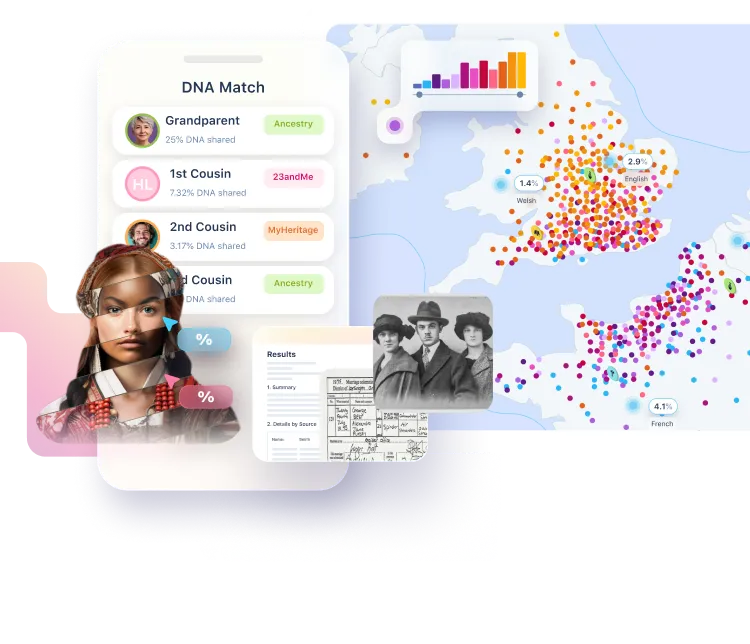
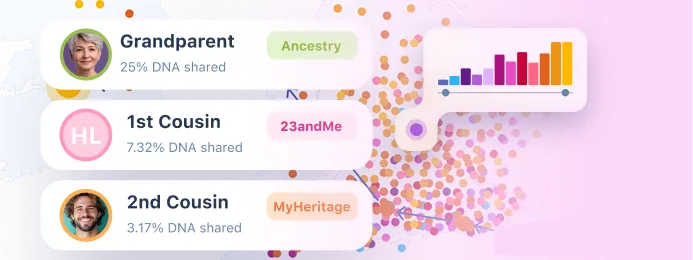
Combine your DNA data with your family tree to unlock the full power of YourRoots DNA Match. Connect with relatives across major testing services — Ancestry, 23andMe, MyHeritage, and more.
View your matches' maps and trees to identify shared ancestors, and soon you'll be able to add them directly to your own tree and map.
Ancestry DNA analysis that goes deeper than others
Unlock exclusive reports that reveal your deeper origins.
- Deep Ancestry Report — Analyze 130+ ethnicities, sub-regions, and 1,800+ communities in one detailed view.
- Global & Native American Reports — Developed with Stanford researchers to uncover hidden ancestries across all 22 chromosomes.
- Ancient DNA Series — Compare your DNA with 1,000+ ancient genomes from Viking, Celtic, and early American civilizations.
Sign up to explore more
Create a free account to navigate family trees, view ancestors, and discover connections.
Coming Soon
We're actively working on many new features for YourRoots. Features marked v2 are ones we're planning to launch soon.
Have a particular feature request? Let us know below!