
Sign up to explore more
Create a free account to navigate family trees, view ancestors, and discover connections.

Sign up to explore more
Create a free account to navigate family trees, view ancestors, and discover connections.
France Family Genealogy & History
Discover the Global Legacy of the France Surname
The surname "France" has intriguing origins and meanings that reflect diverse cultural influences. In French-speaking regions, "France" may serve as a given name, particularly for women, while as a surname, it often denotes an ethnic origin, referring to inhabitants of France. In Slovenia, "France" is a vernacular form of the personal name "Frančišek," related to the Latin "Franciscus" or "Francis." Additionally, the surname may be an Americanized version of the German name "Franz," showcasing its varied roots and significance in different regions.
Throughout history, the France surname has evolved and spread across Europe, with records indicating its presence in France as early as the 5th century. By the 11th century, the France family had established significant social and cultural influence in France, expanding their reach and leaving a lasting legacy. The surname continued to branch out geographically, with notable movements to England by the 17th century and to the United States by the 18th century, marking a period of significant diaspora and growth for the France family tree.
Insights from the YourRoots dataset enrich this historical narrative by tracing the France surname's earliest roots to Germany, highlighting a foundational period of transformation and establishment. The dataset confirms the France family's prominence in France during the early medieval periods and their subsequent expansion to other regions. By the 19th century, the surname had cemented its presence in both France and the United States, illustrating a dynamic and complex genealogical path that YourRoots helps illuminate.
For those interested in uncovering their own connections to the France surname, the YourRoots database offers valuable France genealogy records. These resources provide a comprehensive view of the surname's evolution and can guide researchers in tracing their family history, revealing the rich and interconnected heritage associated with the France family tree.
Find the France Family Tree
Search more France trees & genealogy records
Records
-
HFHenry I King of France1008–1060Public Tree Person3 treesScore: AHFHenry I King of France1008–1060Public Tree Person3 treesScore: A
-
RFRobert France1668–1748Public Tree Person4 treesScore: ARFRobert France1668–1748Public Tree Person4 treesScore: A
-
AFAlice France1905–1990Individual Tree PersonParents: John France & Alice DumvilleSpouse: Henry CarterChildren: Walter, BrianScore: AAFAlice France1905–1990Individual Tree PersonParents: John France & Alice DumvilleSpouse: Henry CarterChildren: Walter, BrianScore: A
-
BFBlanca ( Blanche) Alphonsa De Castile, Consort Of The King Of France1188–1252Individual Tree PersonParents: Alphonso Toledo & Eleanor PlantagenetSpouse: King Capet, King VIIIChildren: King, King, John, King, Alphonse, Saint, Philippe, PhilippeScore: ABFBlanca ( Blanche) Alphonsa De Castile, Consort Of The King Of France1188–1252Individual Tree PersonParents: Alphonso Toledo & Eleanor PlantagenetSpouse: King Capet, King VIIIChildren: King, King, John, King, Alphonse, Saint, Philippe, PhilippeScore: A
-
HFHenry Ford France1904–1974Individual Tree PersonParents: Thomas France & Florence RaikesSpouse: Mona ?Score: AHFHenry Ford France1904–1974Individual Tree PersonParents: Thomas France & Florence RaikesSpouse: Mona ?Score: A
-
PFPhilip III, The Bold, King of France1245–1285Individual Tree PersonParents: King IX & Marguerite BerengerSpouse: Marie DeBrabant, Isabella deAragon, Alice Alan, Marie FranceChildren: Margaret, Louis, Blanche, Marguerite, Robert, LouisScore: APFPhilip III, The Bold, King of France1245–1285Individual Tree PersonParents: King IX & Marguerite BerengerSpouse: Marie DeBrabant, Isabella deAragon, Alice Alan, Marie FranceChildren: Margaret, Louis, Blanche, Marguerite, Robert, LouisScore: A
-
WFWilliam France1841–1898Individual Tree PersonParents: Isaac France & Elizabeth HattonSpouse: Catharine CarterScore: AWFWilliam France1841–1898Individual Tree PersonParents: Isaac France & Elizabeth HattonSpouse: Catharine CarterScore: A
-
QFQueen Consort Mary "Rose" Tudor Duchess of Gloucester, Duchess of Edinburgh, Princess of England, Queen Consort of France, Dowager Queen of France1495–1533Individual Tree PersonParents: Henry Ireland & Elizabeth EnglandSpouse: Charles LisleChildren: LadyScore: AQFQueen Consort Mary "Rose" Tudor Duchess of Gloucester, Duchess of Edinburgh, Princess of England, Queen Consort of France, Dowager Queen of France1495–1533Individual Tree PersonParents: Henry Ireland & Elizabeth EnglandSpouse: Charles LisleChildren: LadyScore: A
-
HFHenri II Duke of Orleans King of France1519–1559Individual Tree PersonParents: Francis Valois & Claude, ValoisSpouse: Catherine Medici, Janet StewartChildren: Elizabeth, Hercule, Claude, Charles, Louis, Francois, Margaret, Francois, Victoria, Henry, Victoria, Marguerite, Hercules, Francois, Francois, Henri, Henri, Henri, Charles, Henri, Charles, Louis, Louis, Diane, François, Hercules, Jeanne, Maugerite, Henri, Elaine, Henri, Henri, Victoire, Francis, DianeScore: AHFHenri II Duke of Orleans King of France1519–1559Individual Tree PersonParents: Francis Valois & Claude, ValoisSpouse: Catherine Medici, Janet StewartChildren: Elizabeth, Hercule, Claude, Charles, Louis, Francois, Margaret, Francois, Victoria, Henry, Victoria, Marguerite, Hercules, Francois, Francois, Henri, Henri, Henri, Charles, Henri, Charles, Louis, Louis, Diane, François, Hercules, Jeanne, Maugerite, Henri, Elaine, Henri, Henri, Victoire, Francis, DianeScore: A
-
EFEliza France1860–1921Individual Tree PersonParents: William France & Elisabeth FarrowSpouse: Gw PattonChildren: Walter, Jessie, HazelScore: AEFEliza France1860–1921Individual Tree PersonParents: William France & Elisabeth FarrowSpouse: Gw PattonChildren: Walter, Jessie, HazelScore: A
-
SFSarah France1868–1948Individual Tree PersonParents: John France & Mary WilliamsScore: ASFSarah France1868–1948Individual Tree PersonParents: John France & Mary WilliamsScore: A
-
PFPhilip Fair France1268–1314Individual Tree PersonParents: Philips Frankrijk & Isabella DeAragonSpouse: Johanna VanNavarraChildren: Charles, Charles, Robert, Blanche, Charles, Isabella, Jeanne, Philip, Louis, Charles, Marguerite, IsabellaScore: APFPhilip Fair France1268–1314Individual Tree PersonParents: Philips Frankrijk & Isabella DeAragonSpouse: Johanna VanNavarraChildren: Charles, Charles, Robert, Blanche, Charles, Isabella, Jeanne, Philip, Louis, Charles, Marguerite, IsabellaScore: A
-
LFLouis Henri Pinguet *, de Tourouvre en France1590–1671Individual Tree PersonParents: Noel Pinguet & Louise LambertSpouse: Louise *Children: Françoise, PierreScore: ALFLouis Henri Pinguet *, de Tourouvre en France1590–1671Individual Tree PersonParents: Noel Pinguet & Louise LambertSpouse: Louise *Children: Françoise, PierreScore: A
-
BFBertha Lee De France1927–2012Individual Tree PersonParents: Henry DeFrance & Gertrude BrazilScore: ABFBertha Lee De France1927–2012Individual Tree PersonParents: Henry DeFrance & Gertrude BrazilScore: A
-
LFLillian Chrisobel Buck La France1926–1995Individual Tree PersonParents: Henry Buck & Laura BuckSpouse: Phillip LaFRANCEScore: ALFLillian Chrisobel Buck La France1926–1995Individual Tree PersonParents: Henry Buck & Laura BuckSpouse: Phillip LaFRANCEScore: A
-
EFEdward France1782–1854Individual Tree PersonParents: James France & Elizabeth PyeSpouse: Lucy Preesall, Margaret HamiltonChildren: Robert, WilliamScore: AEFEdward France1782–1854Individual Tree PersonParents: James France & Elizabeth PyeSpouse: Lucy Preesall, Margaret HamiltonChildren: Robert, WilliamScore: A
-
HFHenri IV de France1553–1610Individual Tree PersonParents: Antoine Bourbon & Jeanne d'AlbretSpouse: Marguerite Valois, Charlotte Essarts, Maria MediciChildren: Henrietta, Louis, Gabrielle, César, Chrétienne, Marie, N, Elisabeth, Gaston, Nicolas, Henri, Antoine, Jeanne-Baptiste, Henriette, N, Catherine, AlexandreScore: AHFHenri IV de France1553–1610Individual Tree PersonParents: Antoine Bourbon & Jeanne d'AlbretSpouse: Marguerite Valois, Charlotte Essarts, Maria MediciChildren: Henrietta, Louis, Gabrielle, César, Chrétienne, Marie, N, Elisabeth, Gaston, Nicolas, Henri, Antoine, Jeanne-Baptiste, Henriette, N, Catherine, AlexandreScore: A
-
JFJean de France1319–1364Individual Tree PersonParents: King VI & Queen BurgundySpouse: Bonne LuxembourgChildren: Philip, CharlesScore: AJFJean de France1319–1364Individual Tree PersonParents: King VI & Queen BurgundySpouse: Bonne LuxembourgChildren: Philip, CharlesScore: A
-
PFPhilippe IV of France1268–1314Individual Tree PersonParents: Phillip Bold & Isabell AragonScore: APFPhilippe IV of France1268–1314Individual Tree PersonParents: Phillip Bold & Isabell AragonScore: A
-
MFMargaret France1877–1941Individual Tree PersonParents: James France & Nancy FrazierSpouse: William OrrChildren: JamesScore: AMFMargaret France1877–1941Individual Tree PersonParents: James France & Nancy FrazierSpouse: William OrrChildren: JamesScore: A
Search more trees & records for
France for free
Tracing Your France Family Lineage
Origin of the France Family: Where does the France surname come from?
The France surname traces its earliest roots back to Germany, where it first appeared in historical records during a time of significant societal transformation. This early record marks the beginning of a family line that would eventually evolve and spread across various regions. The connections established in this foundational period are crucial for understanding the genealogical origins of families carrying the France name.
Genealogy and Early Family History of France
As the centuries progressed, the France family began to flourish significantly in France, especially during the early and high medieval periods. By the 5th century and continuing into the 8th century, the France surname was prominently recorded in France, indicating a consolidation of family lines in this region. Families with the France surname started to build branches of their family trees, creating a legacy that would impact future generations.
In the centuries that followed, particularly by the 11th century, the France surname had established itself as a notable presence in French society, with families expanding their influence and networks. The 13th century saw the France family tree further branching out, as members began to diversify their geographical presence while remaining rooted in their French heritage. This period marked a pivotal time where the France surname began to embody a rich tapestry of family histories intertwined with the cultural evolution of France.
Tracing the France Family Tree Through the Centuries
The spread of the France surname continued into the later centuries, particularly as families began to migrate beyond France. In the 17th century, branches of the France family emerged in England, reflecting broader patterns of movement and settlement during this period. The 18th century marked a significant diaspora as members of the France family began to establish roots in the United States, further expanding the family tree across the Atlantic.
By the 19th century, the France surname was well-established in both the United States and France, showcasing a dynamic evolution of the family tree. The global spread continued into the 20th century as families with the France surname maintained their connections to their ancestral roots while adapting to new environments. This ongoing growth and diversification of the France surname illustrate the rich and complex genealogy that has developed over centuries.
Where to Find France Genealogy Records Today
In the modern era, the France surname is still widely present, with significant populations recorded in France and the United States. The 21st century has seen a continued interest in genealogy, with many individuals seeking to uncover their family histories and connections. Readers are encouraged to explore the France genealogy records available in the YourRoots database to trace their own family tree and connect with the rich heritage associated with the France surname.
Famous People with France (and Their Family Tree)

Henry IV of France
Henry IV of France, also known as Good King Henry, was a pivotal figure in French history, reigning as King of Navarre from 1572 and as the first Bourbon King of France from 1589 to 1610. Known for his pragmatic politics, he played a crucial role in ending the French Wars of Religion by issuing the Edict of Nantes, which granted religious liberties to Protestants. Henry IV's reign marked significant strides in state finance, agriculture, trade, and infrastructure, contributing to France's stability and prominence in European affairs. Despite his initial Protestant faith, he converted to Catholicism to secure his rule, famously declaring, "Paris is well worth a Mass."
Henry IV was born to Jeanne III of Navarre and Antoine de Bourbon, Duke of Vendôme, making him a member of the House of Bourbon. Raised in the Protestant faith by his mother, he was baptized a Catholic. His lineage included influential figures such as his maternal grandfather, King Henry II of Navarre, and he was closely connected to the French royal family. His early life was marked by religious conflicts between his parents, reflecting the broader tensions of the era.

Kingdom of France
The Kingdom of France was a dominant European power from the High Middle Ages until its dissolution in 1848. Known for its colonial expansion, France held territories in Asia, Africa, and North America, notably New France around the Great Lakes. The Capetian dynasty, including the Valois and Bourbon lines, ruled until the 1792 French Revolution abolished the monarchy. France's historical influence is marked by events like the Hundred Years' War and its role in the American Revolutionary War, solidifying its status as a superpower from 1643 to 1815 under King Louis XIV until Napoleon's defeat.
The Kingdom of France traces its origins to the western Frankish realm of the Carolingian Empire, ceded to Charles the Bald in 843 through the Treaty of Verdun. This lineage continued until Hugh Capet's election as king in 987, establishing the Capetian dynasty. Originally known as Francia, the title "King of France" was officially adopted by Philip II in 1204, marking the nation's evolving identity and centralized authority.

Charles X of France
Charles X of France, born Charles Philippe, reigned as King of France from 1824 to 1830. As the last ruler from the senior branch of the House of Bourbon, his reign was marked by conservative policies that favored absolute monarchy and the Catholic Church. His efforts to reimburse former landowners and the controversial July Ordinances led to the July Revolution, resulting in his abdication and subsequent exile. Charles's reign was notable for its unpopularity among liberals, his support for the French conquest of Algeria, and his role in forcing Haiti to pay an indemnity for its independence.
Born in 1757 at the Palace of Versailles, Charles was the youngest son of the Dauphin Louis and Marie Josèphe. After his father's death, Charles's brother, Louis Auguste, became Dauphin, ultimately succeeding as King Louis XVI. Charles married Marie Thérèse of Savoy, with whom he had two sons: Louis Antoine, Duke of Angoulême, and Charles Ferdinand, Duke of Berry. Through his granddaughter Princess Louise of Artois, Charles X is an ancestor of the current Luxembourg grand ducal family.

Regions of France
France's administrative structure is defined by its division into eighteen regions, which include thirteen in metropolitan France and five overseas regions. These regions, established through the 1982 Law of Decentralisation, have no legislative power but levy taxes and manage budgets for education and infrastructure. Notable reforms in 2016 reduced the metropolitan regions from 22 to 13, including mergers such as the creation of Normandy and the renaming of Centre to Centre-Val de Loire. Regions like Île-de-France and Rhône-Alpes are known for their wealth and the high-profile nature of their leadership roles, highlighting their significance in national governance.

John II of France
John II of France, also known as John the Good, was King of France from 1350 to 1364. His reign was marked by significant challenges, including the devastating Black Death, rebellious Jacqueries, and the English aggression that led to his capture at the Battle of Poitiers in 1356. During his captivity, his son Charles served as regent and negotiated the Treaty of Brétigny, which involved territorial losses and a large ransom. Upon his return to France, John introduced the franc to stabilize the currency and attempted to redirect disruptive free companies to a crusade. Ultimately, John voluntarily returned to England, where he died in 1364.
John II was born to Philip VI, who unexpectedly became the King of France after the deaths of Philip IV's sons without male heirs. To solidify his position, Philip VI arranged John's marriage to Bonne of Bohemia, aiming to strengthen political alliances. Philip VI's ascension required consolidating power amidst rival claims, notably from Edward III of England, Philip IV's grandson. John's early life was characterized by his father's strategic maneuvers to maintain the French throne's stability.
France Surname Meaning, Origin, and History
The surname "France" has origins in both French and Slovene cultures. In France, it may refer to an inhabitant of the country, with a variant being "Lafrance." In Slovenia, it is derived from the personal name "France," a form of "Francis." Additionally, "France" can be an Americanized version of the German name "Franz."
VIEW MOREWhere to Find Genealogy Records for France
We’ve analyzed YourRoots tree and records data to uncover where genealogists are finding key sources such as census, birth certificates, marriage records, and obituaries for the France family. Explore our most popular genealogy record sources for the France surname to learn more.
VIEW MOREAbout YourRoots
Explore your family tree geographically
Import your GEDCOM file to transform your family tree into an interactive global map. See your roots laid out visually and understand your true geographic heritage.
Powerful tools like "Trace Back To Me" instantly map your family's migration paths from a chosen ancestor all the way back to you.
Discover ancestors beyond "end-of-line" automatically
Import your family tree and let AI expand it for you. AI Ancestor Finder scans "end-of-line" ancestors to uncover their parents across hundreds of family lines at once. AI Deep Research analyzes selected ancestors and family clusters, suggesting relevant records and next steps.
Turn on Auto Research Mode to get new discoveries daily or weekly, so your tree keeps growing even while you're away.
Find more DNA matches across all DNA tests
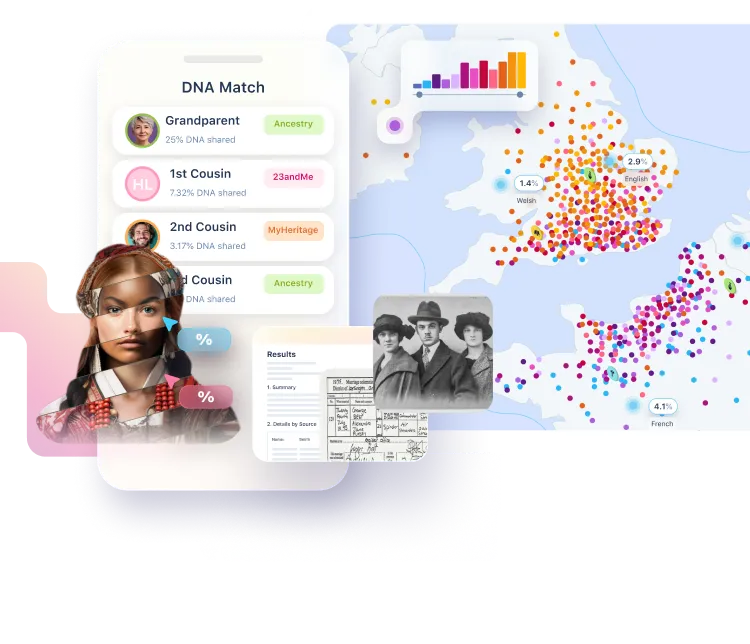
Combine your DNA data with your family tree to unlock the full power of YourRoots DNA Match. Connect with relatives across major testing services — Ancestry, 23andMe, MyHeritage, and more.
View your matches' maps and trees to identify shared ancestors, and soon you'll be able to add them directly to your own tree and map.
Ancestry DNA analysis that goes deeper than others
Unlock exclusive reports that reveal your deeper origins.
- Deep Ancestry Report — Analyze 130+ ethnicities, sub-regions, and 1,800+ communities in one detailed view.
- Global & Native American Reports — Developed with Stanford researchers to uncover hidden ancestries across all 22 chromosomes.
- Ancient DNA Series — Compare your DNA with 1,000+ ancient genomes from Viking, Celtic, and early American civilizations.
Sign up to explore more
Create a free account to navigate family trees, view ancestors, and discover connections.
Coming Soon
We're actively working on many new features for YourRoots. Features marked v2 are ones we're planning to launch soon.
Have a particular feature request? Let us know below!