
Sign up to explore more
Create a free account to navigate family trees, view ancestors, and discover connections.

Sign up to explore more
Create a free account to navigate family trees, view ancestors, and discover connections.
Gibb Family Genealogy & History
Discover the Global Legacy of the Gibb Surname
The surname Gibb is of Scottish origin, emerging as a diminutive form of "Gilbert." This name first appeared in records in the early 15th century, marking the beginning of the Gibb family tree. With its roots deeply intertwined with the historical landscape of England, the surname encapsulates a lineage that has evolved over centuries.
Over time, the Gibb surname expanded beyond its initial presence in England during the 16th century. This period of growth was fueled by social and economic changes that encouraged migration, allowing the Gibb family to establish branches in various regions. By the 18th century, members of the Gibb family had begun to settle in North America, contributing to the family’s expansive reach.
The YourRoots dataset provides significant insights into the Gibb genealogy, confirming the surname's presence in England from the early 15th century. This aligns with the known expansion patterns, highlighting the family's adaptability and resilience as they migrated to the Americas in the 17th and 18th centuries. YourRoots records further illustrate the widespread dispersal of the Gibb surname across regions, reflecting its enduring legacy.
Today, the Gibb family tree is a testament to centuries of migration and adaptation, with Gibb records showing a prominent presence in the United States. For those researching their genealogy, YourRoots offers a comprehensive resource for tracing connections to this storied lineage, reinforcing the historical significance of the Gibb surname.
Find the Gibb Family Tree
Search more Gibb trees & genealogy records
Records
-
EGElizabeth Barr Gibb1894–1986Individual Tree PersonParents: Thomas Gibb & Mary McKinnonSpouse: James GibbChildren: Mary, Agnes, DilysScore: AEGElizabeth Barr Gibb1894–1986Individual Tree PersonParents: Thomas Gibb & Mary McKinnonSpouse: James GibbChildren: Mary, Agnes, DilysScore: A
-
SGSylvia Patricia Gibb1926–2009Individual Tree PersonParents: George Gibb & Lilian SmithSpouse: Arthur JensenScore: ASGSylvia Patricia Gibb1926–2009Individual Tree PersonParents: George Gibb & Lilian SmithSpouse: Arthur JensenScore: A
-
TGThomas Gibb1835–1850Individual Tree PersonParents: Henry Gibb & Agnes HendersonScore: ATGThomas Gibb1835–1850Individual Tree PersonParents: Henry Gibb & Agnes HendersonScore: A
-
GGGeorge H. Gibb1917–2004Individual Tree PersonParents: James Gibb & Elizabeth HaganSpouse: Minerva ColeScore: AGGGeorge H. Gibb1917–2004Individual Tree PersonParents: James Gibb & Elizabeth HaganSpouse: Minerva ColeScore: A
-
JGJames P Gibb1881–1948Individual Tree PersonParents: William Gibb & Elizabeth DeslippeSpouse: Catherine BondyChildren: Greta, Roy, Donald, Francis, Marie, Fredrick, Murray, Georgina, Marvin, Earl, LedaScore: AJGJames P Gibb1881–1948Individual Tree PersonParents: William Gibb & Elizabeth DeslippeSpouse: Catherine BondyChildren: Greta, Roy, Donald, Francis, Marie, Fredrick, Murray, Georgina, Marvin, Earl, LedaScore: A
-
WGWilliam Wesley Gibb1912–2002Individual Tree PersonParents: Samuel Gibb & Ina GibbSpouse: Margaret BishopScore: AWGWilliam Wesley Gibb1912–2002Individual Tree PersonParents: Samuel Gibb & Ina GibbSpouse: Margaret BishopScore: A
-
DGDavid Mackie GIBB1893–1974Individual Tree PersonParents: Peter Gibb & Isabella MackieSpouse: Elizabeth RitchieChildren: Helen, Agnes, David, Alexander, IsabellaScore: ADGDavid Mackie GIBB1893–1974Individual Tree PersonParents: Peter Gibb & Isabella MackieSpouse: Elizabeth RitchieChildren: Helen, Agnes, David, Alexander, IsabellaScore: A
-
AGAdam Hamilton GIBB1870–1951Individual Tree PersonParents: Charles GIBB & Elizabeth GIBBSpouse: Maggie GIBBChildren: Elizabeth, CharlesScore: AAGAdam Hamilton GIBB1870–1951Individual Tree PersonParents: Charles GIBB & Elizabeth GIBBSpouse: Maggie GIBBChildren: Elizabeth, CharlesScore: A
-
RGRobert Gibb1779–1870Individual Tree PersonParents: John Gibb & Margaret HallydaySpouse: Agnes Gibb, Mary ScottChildren: Amelia, George, Anne, Christina, JamesScore: ARGRobert Gibb1779–1870Individual Tree PersonParents: John Gibb & Margaret HallydaySpouse: Agnes Gibb, Mary ScottChildren: Amelia, George, Anne, Christina, JamesScore: A
-
RGRoy Matthew Gibb1933–1994Individual Tree PersonParents: Hugh Sr & Edith YardleySpouse: Annie RowlandsScore: ARGRoy Matthew Gibb1933–1994Individual Tree PersonParents: Hugh Sr & Edith YardleySpouse: Annie RowlandsScore: A
-
GGGavin Gibb1816–1887Individual Tree PersonParents: Andrew Gibb & Agnes HowieScore: AGGGavin Gibb1816–1887Individual Tree PersonParents: Andrew Gibb & Agnes HowieScore: A
-
DGDavid Gibb1896–1940Individual Tree PersonParents: David Gibb & Jane ShepherdSpouse: Elfreide WehrkampChildren: Herbert, AudreyScore: ADGDavid Gibb1896–1940Individual Tree PersonParents: David Gibb & Jane ShepherdSpouse: Elfreide WehrkampChildren: Herbert, AudreyScore: A
-
JGJohn Gibb1808–1882Individual Tree PersonParents: Alexander GIBB & Agnes BrodieSpouse: Agnes Wilson, Jean CLELLANDChildren: David, Jane, Alexander, John, George, WilliamScore: AJGJohn Gibb1808–1882Individual Tree PersonParents: Alexander GIBB & Agnes BrodieSpouse: Agnes Wilson, Jean CLELLANDChildren: David, Jane, Alexander, John, George, WilliamScore: A
-
MGMyrtle Ella Gibb1874–1960Individual Tree PersonParents: Andrew Gibbs & Elizabeth QueenSpouse: William DemondChildren: Maggie, Elizabeth, Lucy, Cordehlia, Juanita, Virgil, Byron, Robert, David, William, Naomi, LeScore: AMGMyrtle Ella Gibb1874–1960Individual Tree PersonParents: Andrew Gibbs & Elizabeth QueenSpouse: William DemondChildren: Maggie, Elizabeth, Lucy, Cordehlia, Juanita, Virgil, Byron, Robert, David, William, Naomi, LeScore: A
-
RGRobin Hugh Gibb1949–2012Individual Tree PersonParents: Hugh Jr & Barbara PassScore: ARGRobin Hugh Gibb1949–2012Individual Tree PersonParents: Hugh Jr & Barbara PassScore: A
-
JGJohn Wilkie Gibb1890–1965Individual Tree PersonParents: George Gibb & Mary WilkieScore: AJGJohn Wilkie Gibb1890–1965Individual Tree PersonParents: George Gibb & Mary WilkieScore: A
-
AGAnne Gibb1842–1888Individual Tree PersonParents: Robert Gibb & Mary ScottScore: AAGAnne Gibb1842–1888Individual Tree PersonParents: Robert Gibb & Mary ScottScore: A
-
HGHoward Norval Gibb1899–1973Individual Tree PersonParents: Samuel Gibb & Margaret GearhartScore: AHGHoward Norval Gibb1899–1973Individual Tree PersonParents: Samuel Gibb & Margaret GearhartScore: A
-
FGFlavius JOSEPHUS Gibb1820–1904Individual Tree PersonParents: George Sr. & Comfort DibrellSpouse: Emma HosierChildren: William, Virginia, Fanny, Mahalia, John, George, Sarah, Mary, AnnieScore: AFGFlavius JOSEPHUS Gibb1820–1904Individual Tree PersonParents: George Sr. & Comfort DibrellSpouse: Emma HosierChildren: William, Virginia, Fanny, Mahalia, John, George, Sarah, Mary, AnnieScore: A
-
AGAgnus Goldie Gibb1893–1990Individual Tree PersonParents: William Pitt & Agnes (Pitt)Spouse: James Sr.Children: James, Jean, Sheilah, AgnesScore: AAGAgnus Goldie Gibb1893–1990Individual Tree PersonParents: William Pitt & Agnes (Pitt)Spouse: James Sr.Children: James, Jean, Sheilah, AgnesScore: A
Search more trees & records for
Gibb for free
Tracing Your Gibb Family Lineage
Origin of the Gibb Family: Where does the Gibb surname come from?
The Gibb surname finds its earliest known appearance in records from England during the early 15th century. This initial presence marks the beginnings of the Gibb family tree, suggesting roots that intertwine with the rich historical tapestry of England. The significance of this period lays the groundwork for understanding the family’s genealogical origins and how they began to spread across different regions.
Genealogy and Early Family History of Gibb
Throughout the subsequent centuries, the Gibb family began to branch out significantly, with a notable concentration in England during the 16th century. This expansion coincided with social and economic changes that encouraged migration and family growth, allowing various branches of the Gibb family to establish themselves in key regions. The continued growth of family lines during this time set the stage for further dispersal in later generations.
As the Gibb surname continued to evolve, families began to migrate more extensively, particularly to the Americas during the 17th and 18th centuries. This migration not only highlighted the adaptability of the Gibb family but also facilitated the establishment of new branches in a variety of regions. The Gibb family tree thus became more complex, intertwining with other families and communities in these new lands.
Tracing the Gibb Family Tree Through the Centuries
The surname Gibb witnessed significant expansion across various regions from the early modern period onward. By the 18th century, Gibb families had proliferated in North America, particularly in the United States, while maintaining a notable presence in England. This global spread continued into the 19th century, with further migration patterns observable in Canada and Australia, demonstrating the Gibb family's enduring legacy and adaptability.
In the 20th century, the Gibb surname maintained its presence primarily in the United States, where it developed into a well-recognized name. The family's story reflects broader migration trends and societal changes, emphasizing how Gibb families contributed to the cultural fabric of their new homes. This ongoing evolution underscores the rich genealogy and family history associated with the Gibb surname.
Where to Find Gibb Genealogy Records Today
As we move into the 21st century, the Gibb surname can be found in various parts of the world, although its highest concentrations remain in the United States. The modern-day dispersion of the Gibb name reflects centuries of migration and adaptation, with connections that span across continents. For those interested in exploring their own genealogy, the YourRoots database offers a wealth of Gibb genealogy records, providing a valuable resource for connecting their family trees to this storied lineage.
Famous People with Gibb (and Their Family Tree)

Barry Gibb
Barry Gibb, a British musician born on 1 September 1946, is renowned for his significant contributions to popular music as a member of the Bee Gees alongside his twin brothers, Robin and Maurice. Known for his wide vocal range and falsetto, Gibb shares a record with John Lennon and Paul McCartney for the most consecutive Billboard Hot 100 number ones. Inducted into both the Songwriters and Rock and Roll Halls of Fame, he ranks second in Guinness World Records as the most successful songwriter. Knighted in 2018, his career spans over 70 years, marking him as an iconic figure in music history.
Barry Gibb was born to Hugh Gibb, a drummer, and Barbara Gibb in Douglas, Isle of Man. Of English, Irish, and Scottish descent, his paternal grandfather hailed from Lanarkshire, Scotland. Gibb's family includes an older sister, Lesley Evans, and his younger fraternal twin brothers, Robin and Maurice. His second name, "Alan," honors his father's deceased younger brother, while "Crompton" was inspired by the mistakenly attributed ancestor Sir Isaac Crompton, who was actually Samuel Crompton.

Robin Gibb
Robin Hugh Gibb, born on 22 December 1949, was a renowned British singer and songwriter, best known as a member of the iconic pop group Bee Gees, alongside his brothers Barry and Maurice Gibb. With a career spanning six decades, Gibb contributed to the Bee Gees' success, achieving over 200 million record sales and earning a CBE for their contribution to music. Known for his soulful, vibrato-laden voice, Gibb also enjoyed a successful solo career and was involved in various music projects, including being president of the UK-based Heritage Foundation. His musical versatility was evident in his work with instruments such as piano, organ, and guitar.
Robin Gibb was born in Douglas, Isle of Man, to English parents Hugh and Barbara Gibb. He had a fraternal twin, Maurice, and siblings Barry, Andy, and Lesley Evans. The family moved from the Isle of Man to Manchester, where Gibb and his brothers began their musical journey, later settling in Australia. Their early family life included various challenges, but the siblings' shared passion for music eventually led to the formation of the Bee Gees, marking the beginning of their remarkable careers.

Maurice Gibb
Maurice Ernest Gibb was a renowned British musician and songwriter, celebrated as a member of the legendary Bee Gees pop group. With his elder brother Barry and twin brother Robin, Maurice contributed to the Bee Gees' status as one of the most successful pop-rock groups ever. Known for songs like "Lay It on Me" and "On Time," Maurice's role extended beyond vocals, as he played guitar and bass. The Bee Gees' groundbreaking music earned them a CBE for their contributions to music. Maurice also explored solo projects, notably releasing the single "Railroad."
Maurice Gibb was born on 22 December 1949 in Douglas, Isle of Man, to Hugh Gibb, a drummer, and Barbara (née Pass). He was Robin Gibb's fraternal twin and had an elder brother, Barry, and a sister, Lesley, with another brother, Andy, born in 1958. The family moved to Manchester, England, in 1955, where Maurice and his brothers began their musical journey. In 1958, they relocated to Queensland, Australia, marking the start of their global musical impact.

Cynthia Gibb
Cynthia Gibb is an acclaimed American actress and former model, celebrated for her versatile performances across film and television. She gained early recognition as a cast member on the musical drama series "Fame" and starred in notable films like "Youngblood" (1986), "Salvador" (1986), and "Gypsy" (1993), earning a Golden Globe nomination for her portrayal of Gypsy Rose Lee. Her television roles include appearances in "Search for Tomorrow," "Diagnosis: Murder," and the sitcom "Madman of the People." Gibb's modeling career began with Ford Modeling Agency, leading to covers on Vogue and Young Miss magazines.

Bobbi Gibb
Bobbi Gibb, born Roberta Louise Gibb on November 2, 1942, is a trailblazing American former runner celebrated for being the first woman to complete the Boston Marathon in 1966. Her historic run defied the Amateur Athletic Union's rules that prohibited women from competing in men's races, challenging societal norms about women's athletic capabilities. Gibb's success in 1966, 1967, and 1968, as recognized by the Boston Athletic Association, paved the way for the inclusion of women in marathon events. Her determination and achievements inspired significant changes in the recognition of female athletes, marking a pivotal moment in sports history.
Gibb was born in Cambridge, Massachusetts, and grew up in the Boston suburbs during the 1940s and 1950s. Her father was a chemistry professor at Tufts University, which influenced her educational path, leading her to study at the Boston Museum of Fine Arts and Tufts University School of Special Studies. Her early life included long-distance running, even commuting eight miles to school daily, highlighting her dedication and passion for the sport from a young age.
Gibb Surname Meaning, Origin, and History
The surname "Gibb" originates from Scotland and dates back to the sixteenth century. It is a diminutive form of the name "Gilbert."
VIEW MOREWhere to Find Genealogy Records for Gibb
We’ve analyzed YourRoots tree and records data to uncover where genealogists are finding key sources such as census, birth certificates, marriage records, and obituaries for the Gibb family. Explore our most popular genealogy record sources for the Gibb surname to learn more.
VIEW MOREAbout YourRoots
Explore your family tree geographically
Import your GEDCOM file to transform your family tree into an interactive global map. See your roots laid out visually and understand your true geographic heritage.
Powerful tools like "Trace Back To Me" instantly map your family's migration paths from a chosen ancestor all the way back to you.
Discover ancestors beyond "end-of-line" automatically
Import your family tree and let AI expand it for you. AI Ancestor Finder scans "end-of-line" ancestors to uncover their parents across hundreds of family lines at once. AI Deep Research analyzes selected ancestors and family clusters, suggesting relevant records and next steps.
Turn on Auto Research Mode to get new discoveries daily or weekly, so your tree keeps growing even while you're away.
Find more DNA matches across all DNA tests
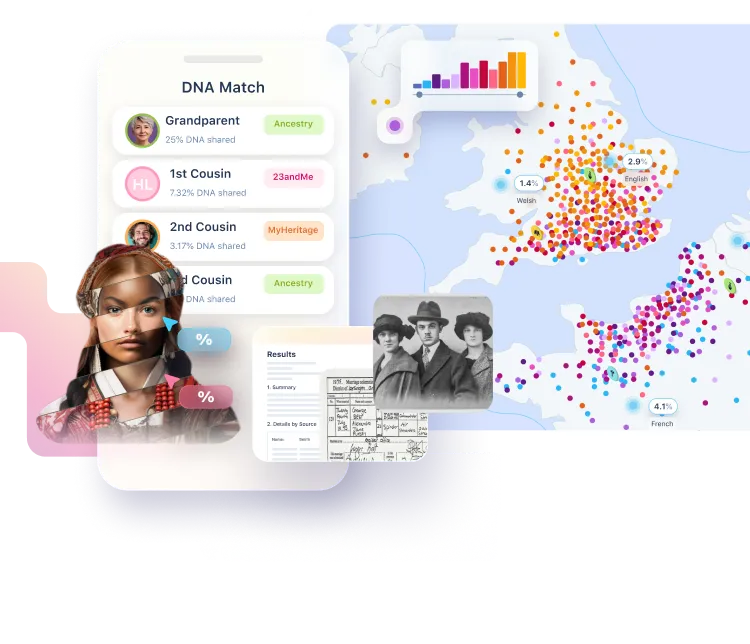
Combine your DNA data with your family tree to unlock the full power of YourRoots DNA Match. Connect with relatives across major testing services — Ancestry, 23andMe, MyHeritage, and more.
View your matches' maps and trees to identify shared ancestors, and soon you'll be able to add them directly to your own tree and map.
Ancestry DNA analysis that goes deeper than others
Unlock exclusive reports that reveal your deeper origins.
- Deep Ancestry Report — Analyze 130+ ethnicities, sub-regions, and 1,800+ communities in one detailed view.
- Global & Native American Reports — Developed with Stanford researchers to uncover hidden ancestries across all 22 chromosomes.
- Ancient DNA Series — Compare your DNA with 1,000+ ancient genomes from Viking, Celtic, and early American civilizations.
Sign up to explore more
Create a free account to navigate family trees, view ancestors, and discover connections.
Coming Soon
We're actively working on many new features for YourRoots. Features marked v2 are ones we're planning to launch soon.
Have a particular feature request? Let us know below!