
Sign up to explore more
Create a free account to navigate family trees, view ancestors, and discover connections.
Sign up to explore more
Create a free account to navigate family trees, view ancestors, and discover connections.
Hallam Family Genealogy & History
Discover the Global Legacy of the Hallam Surname
Hallam is a distinctive surname with origins deeply rooted in England, first appearing in historical records during the early 16th century. The name likely stems from a geographical location, as many English surnames do, suggesting a connection to a place of residence or origin. This foundational period marks the beginning of the Hallam family tree, setting the stage for a lineage that has evolved considerably over the centuries.
Throughout the 17th and 18th centuries, the Hallam surname spread across England, with significant concentrations in regions like Yorkshire and Lancashire. This expansion reflects both the growth of the family and the broader social and economic shifts of the time, as families moved and established new branches. Notable individuals bearing the Hallam name have made their mark in various fields, including sports, the arts, and public service, indicating the diverse contributions of the Hallam family across generations.
The YourRoots dataset provides valuable insights into the Hallam genealogy, confirming the surname's presence in England from the 16th century onward. It highlights the family's migration patterns, particularly during the 19th century, when many Hallams ventured to North America and Australia. This global spread is a testament to the adaptability and resilience of the Hallam family, as they established new roots while maintaining connections to their English heritage.
For those exploring the Hallam family tree, YourRoots offers a treasure trove of records that trace the surname's evolution over time. By connecting with these records, researchers can delve into the Hallam genealogy, uncovering the rich tapestry of ancestry and cultural heritage that continues to resonate today.
Find the Hallam Family Tree
Search more Hallam trees & genealogy records
Records
-
THThomas Sr Hallam1748–1829Individual Tree PersonParents: John Hallam & Isabel FellSpouse: Mary Berkshire, Sarah VoorheesChildren: John, Charles, William, Deborah, Nancy, Thomas, Absolom, Sophia, Samuel, Sarah, David, Sarah, IsabelleScore: ATHThomas Sr Hallam1748–1829Individual Tree PersonParents: John Hallam & Isabel FellSpouse: Mary Berkshire, Sarah VoorheesChildren: John, Charles, William, Deborah, Nancy, Thomas, Absolom, Sophia, Samuel, Sarah, David, Sarah, IsabelleScore: A
-
LHLouise Hilda Hallam1934–1934Individual Tree PersonParents: Frank Hallam & Ethel RunningScore: ALHLouise Hilda Hallam1934–1934Individual Tree PersonParents: Frank Hallam & Ethel RunningScore: A
-
SHSalathiel M. Hallam1833–1897Individual Tree PersonParents: Charles Hallam & Margaret McKeeSpouse: Melinda Mahan, Eliza MyersChildren: Napolean, Charles, John, Iloa, Mary, David, Samuel, Alice, James, George, Basil, HamiltonScore: ASHSalathiel M. Hallam1833–1897Individual Tree PersonParents: Charles Hallam & Margaret McKeeSpouse: Melinda Mahan, Eliza MyersChildren: Napolean, Charles, John, Iloa, Mary, David, Samuel, Alice, James, George, Basil, HamiltonScore: A
-
JHJohn Robert Hallam1895–1949Individual Tree PersonParents: Henry Hallam & Mary BirkettSpouse: Maud HallamScore: AJHJohn Robert Hallam1895–1949Individual Tree PersonParents: Henry Hallam & Mary BirkettSpouse: Maud HallamScore: A
-
JHJoan Hallam1942–2014Individual Tree PersonParents: Ellis Hallam & Alice RichardsonScore: AJHJoan Hallam1942–2014Individual Tree PersonParents: Ellis Hallam & Alice RichardsonScore: A
-
JHJane Hallam1645–1723Individual Tree PersonParents: Godfrey Hallom & Isabella BrowneSpouse: Robert HallChildren: JaneScore: AJHJane Hallam1645–1723Individual Tree PersonParents: Godfrey Hallom & Isabella BrowneSpouse: Robert HallChildren: JaneScore: A
-
BHBetty Mae Hallam1934–2022Individual Tree PersonParents: Melwyn Hallam & Alalia NicholsSpouse: Lee WilkinsonScore: ABHBetty Mae Hallam1934–2022Individual Tree PersonParents: Melwyn Hallam & Alalia NicholsSpouse: Lee WilkinsonScore: A
-
NHNapolean Bonaparte Crawford Hallam1875–1963Individual Tree PersonParents: Salathiel Hallam & Melinda MahanSpouse: Nora DavisChildren: Cenie, MelwynScore: ANHNapolean Bonaparte Crawford Hallam1875–1963Individual Tree PersonParents: Salathiel Hallam & Melinda MahanSpouse: Nora DavisChildren: Cenie, MelwynScore: A
-
HHHannah Hallam1769–1814Individual Tree PersonParents: Thomas Hallam & Elizabeth SimsSpouse: John BrooksChildren: John, James, Thomas, John, Edward, Elizabeth, Anthony, Joseph, George, SarahScore: AHHHannah Hallam1769–1814Individual Tree PersonParents: Thomas Hallam & Elizabeth SimsSpouse: John BrooksChildren: John, James, Thomas, John, Edward, Elizabeth, Anthony, Joseph, George, SarahScore: A
-
OHOliver W. "Jack" Hallam1911–1964Individual Tree PersonParents: George Hallam & Mary HopkinsScore: AOHOliver W. "Jack" Hallam1911–1964Individual Tree PersonParents: George Hallam & Mary HopkinsScore: A
-
CHClarence Hallam1887–1929Individual Tree PersonParents: John Hallam & Mary ValletteSpouse: Rebecca BrisentineChildren: Ursley, Martha, Samuel, John, HenryScore: ACHClarence Hallam1887–1929Individual Tree PersonParents: John Hallam & Mary ValletteSpouse: Rebecca BrisentineChildren: Ursley, Martha, Samuel, John, HenryScore: A
-
MHMarina Ann Hallam1867–1932Individual Tree PersonParents: Thomas Hallam & Helen HallamSpouse: Charles CurtisChildren: MellieScore: AMHMarina Ann Hallam1867–1932Individual Tree PersonParents: Thomas Hallam & Helen HallamSpouse: Charles CurtisChildren: MellieScore: A
-
HHHelen Hallam1835–1869Individual Tree PersonParents: Jacob Marshall & Ann EvansSpouse: Thomas HallamChildren: Jacob, Oswald, MarinaScore: AHHHelen Hallam1835–1869Individual Tree PersonParents: Jacob Marshall & Ann EvansSpouse: Thomas HallamChildren: Jacob, Oswald, MarinaScore: A
-
JHJohn Allen Hallam1778–1860Individual Tree PersonParents: Thomas Hallam & Mary BerkshireSpouse: Anna VoorheesChildren: Charles, Joseph, Mary, William, John, Deborah, Annie, Cynthia, SalathielScore: AJHJohn Allen Hallam1778–1860Individual Tree PersonParents: Thomas Hallam & Mary BerkshireSpouse: Anna VoorheesChildren: Charles, Joseph, Mary, William, John, Deborah, Annie, Cynthia, SalathielScore: A
-
BHBeatrice Hallam1918–1996Individual Tree PersonParents: Charles Hallam & Nellie ColbertScore: ABHBeatrice Hallam1918–1996Individual Tree PersonParents: Charles Hallam & Nellie ColbertScore: A
-
PHPhilip Hallam1828–1894Individual Tree PersonParents: Philip Hallam & Ann TaylorSpouse: Mary DawsonChildren: Henry, Kate, Ann, Alice, Ellen\HelenScore: APHPhilip Hallam1828–1894Individual Tree PersonParents: Philip Hallam & Ann TaylorSpouse: Mary DawsonChildren: Henry, Kate, Ann, Alice, Ellen\HelenScore: A
-
JHJohn Hallam1823–1889Individual Tree PersonParents: Thomas Hallam & Ann (03)Spouse: Jane KnightChildren: John, Jane, Ann, Thomas, Eliza, George, Mary, Harriett, John, AliceScore: AJHJohn Hallam1823–1889Individual Tree PersonParents: Thomas Hallam & Ann (03)Spouse: Jane KnightChildren: John, Jane, Ann, Thomas, Eliza, George, Mary, Harriett, John, AliceScore: A
-
CHCharles Hallam1800–1879Individual Tree PersonParents: John Hallam & Anna VoorheesSpouse: Margaret McKeeChildren: Salathiel, Sarah, Mary, John, Nancy, Thomas, William, David, Samuel, John, George, CharlesScore: ACHCharles Hallam1800–1879Individual Tree PersonParents: John Hallam & Anna VoorheesSpouse: Margaret McKeeChildren: Salathiel, Sarah, Mary, John, Nancy, Thomas, William, David, Samuel, John, George, CharlesScore: A
-
FHFaith C. Hallam1937–2019Individual Tree PersonParents: Frank Hallam & Ethel RunningScore: AFHFaith C. Hallam1937–2019Individual Tree PersonParents: Frank Hallam & Ethel RunningScore: A
-
AHArthur Scott Hallam1931–2011Individual Tree PersonParents: Cleon Hallam & Mabel ArmstrongSpouse: Betty BizzackScore: AAHArthur Scott Hallam1931–2011Individual Tree PersonParents: Cleon Hallam & Mabel ArmstrongSpouse: Betty BizzackScore: A
Search more trees & records for
Hallam for free
Tracing Your Hallam Family Lineage
Origin of the Hallam Family: Where does the Hallam surname come from?
The Hallam surname first made its mark in historical records in England during the early 16th century, serving as a vital entry point into the family tree for countless descendants. This initial appearance signifies the roots of the Hallam family, suggesting a lineage that is deeply intertwined with the social and cultural fabric of England at that time. The emergence of the Hallam surname marks the beginning of a lineage that would evolve and branch out over the subsequent centuries.
Genealogy and Early Family History of Hallam
In the early centuries, the Hallam family began to spread predominantly across England, where the highest concentration of records is found. During the 17th century, the family lines expanded, particularly in regions such as Yorkshire and Lancashire, where many Hallams established their homes. As families grew and intermarried, branches of the Hallam family tree began to flourish, establishing connections that would endure through generations.
By the 18th century, the Hallam surname had further diversified, with families migrating to various parts of England and forming new branches in urban centers and rural areas alike. This period saw an increase in population and the movement of families, which helped to solidify the Hallam name in local histories and community records. The Hallam family, thus, began to create a rich tapestry of genealogical connections across the region.
Tracing the Hallam Family Tree Through the Centuries
As the centuries progressed, the Hallam surname saw an expansion beyond England, reaching other parts of the world, particularly during the 19th century. Families began to migrate to areas such as North America and Australia, establishing new roots and continuing the Hallam legacy in these new lands. This global spread of the Hallam surname illustrates the adaptability and resilience of the family as they navigated changing social landscapes.
In the early 20th century, the Hallam family continued to thrive, with records indicating a sustained presence in both England and its former colonies. This expansion further solidified the Hallam family tree, connecting individuals across continents and cultures. The ongoing evolution of the Hallam surname highlights the importance of tracing one's genealogy to understand these connections fully.
Where to Find Hallam Genealogy Records Today
In modern times, the Hallam surname remains prevalent, with records showing its continued presence across various regions in the 21st century. While the frequency of the surname has waned in England, descendants of Hallam families can still be found globally, tracing back to their rich heritage. Readers are encouraged to explore the Hallam genealogy records in the YourRoots database to connect their own family tree and uncover the fascinating history of their Hallam lineage
Famous People with Hallam (and Their Family Tree)

Arthur Hallam
Arthur Henry Hallam (1811–1833) was a prominent English poet and the key figure in Alfred Tennyson's renowned elegy, "In Memoriam." Known as the "jeune homme fatal" of his era, Hallam significantly influenced peers like future Prime Minister William Ewart Gladstone. A Cambridge Apostles member, Hallam engaged in intellectual debates and collaborated with Tennyson on poetry, although their joint publication plans were thwarted. Hallam's promising literary career was cut short by an untimely death at age 22 due to a stroke, cementing his legacy through Tennyson's work.
Arthur Hallam was born in London to historian Henry Hallam. His family background provided a rich cultural environment that shaped his intellectual pursuits and connections.

Henry Hallam
Henry Hallam (1777–1859) was a renowned English historian known for his comprehensive works such as "View of the State of Europe during the Middle Ages" and "The Constitutional History of England." Educated at Eton and Christ Church, Oxford, Hallam practiced law before fully dedicating himself to historical writing. A fellow of the Royal Society and trustee of the British Museum, he was awarded the gold medal for history by George IV in 1830. Notably associated with the Whig party, Hallam's works often reflected Whig political principles, garnering both acclaim and criticism for perceived partisanship.
Henry Hallam was the only son of Rev John Hallam, who served as the canon of Windsor and dean of Bristol. Upon his father’s death in 1812, Hallam inherited a small estate in Lincolnshire, which allowed him to pursue his literary interests.

David Hallam
David Hallam is a notable British Labour Party politician and writer, known for his tenure as a Member of the European Parliament (MEP) for Herefordshire and Shropshire from 1994 to 1999. A dedicated public servant, Hallam served on several influential committees including Agriculture and Rural Development, and the EU-Slovak Joint Parliamentary Committee. His efforts in promoting EU directives on agriculture and trade, as well as his commitment to peace and international cooperation, have marked his career. Hallam is also a Methodist Local Preacher, a public relations specialist, and a prominent contributor to the Methodist Recorder. His diverse roles and accomplishments highlight his influence in both political and community spheres.

Anthony Hallam
Anthony Hallam, a prominent British geologist and palaeontologist, significantly contributed to the study of the Jurassic Period, focusing on stratigraphy and sea-level changes. His academic journey began at St John's College, Cambridge, and continued with a PhD on Liassic rocks. Hallam's career included positions at the University of Edinburgh, Oxford, and as the Lapworth Professor at the University of Birmingham. He authored over 200 research papers and books such as "Jurassic Environments" and "Great Geological Controversies." Notably, he received the Lyell Medal in 1990 and the Lapworth Medal in 2007, underscoring his influence in geology and palaeontology.

Robert Hallam
Robert Hallam, also known as Alum or Halam, was a prominent English churchman and Bishop of Salisbury, recognized for his role in the Council of Constance. Educated at Oxford University, Hallam served as Chancellor from 1403 to 1405, earning a pardon from King Henry IV. Despite being nominated as Archbishop of York, he became Bishop of Salisbury in 1407 under Pope Gregory XII. Hallam played a crucial role in church reform discussions and was pivotal in the deposition of Antipope John XXIII. His influence was significant during Sigismund's return to Constance in 1417, enhancing English prestige. Hallam's sudden death on 4 September 1417 marked a turning point in the council's proceedings.
Hallam Surname Meaning, Origin, and History
The surname "Hallam" is of English origin and has been associated with various notable figures across different fields, including sports, politics, and the arts. It is represented by individuals such as English cricketer Albert Hallam, British palaeontologist Anthony Hallam, and poet Arthur Hallam, as well as fictional characters in literature and film.
VIEW MOREWhere to Find Genealogy Records for Hallam
We’ve analyzed YourRoots tree and records data to uncover where genealogists are finding key sources such as census, birth certificates, marriage records, and obituaries for the Hallam family. Explore our most popular genealogy record sources for the Hallam surname to learn more.
VIEW MOREAbout YourRoots
Explore your family tree geographically
Import your GEDCOM file to transform your family tree into an interactive global map. See your roots laid out visually and understand your true geographic heritage.
Powerful tools like "Trace Back To Me" instantly map your family's migration paths from a chosen ancestor all the way back to you.
Discover ancestors beyond "end-of-line" automatically
Import your family tree and let AI expand it for you. AI Ancestor Finder scans "end-of-line" ancestors to uncover their parents across hundreds of family lines at once. AI Deep Research analyzes selected ancestors and family clusters, suggesting relevant records and next steps.
Turn on Auto Research Mode to get new discoveries daily or weekly, so your tree keeps growing even while you're away.
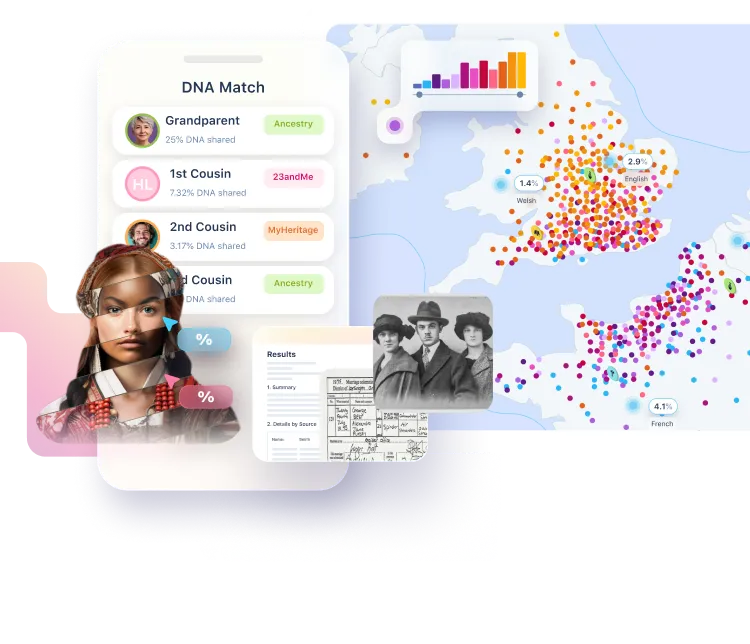
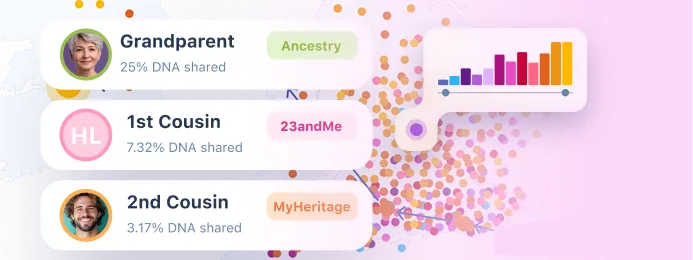
Find more DNA matches across all DNA tests
Combine your DNA data with your family tree to unlock the full power of YourRoots DNA Match. Connect with relatives across major testing services — Ancestry, 23andMe, MyHeritage, and more.
View your matches' maps and trees to identify shared ancestors, and soon you'll be able to add them directly to your own tree and map.
Ancestry DNA analysis that goes deeper than others
Unlock exclusive reports that reveal your deeper origins.
- Deep Ancestry Report — Analyze 130+ ethnicities, sub-regions, and 1,800+ communities in one detailed view.
- Global & Native American Reports — Developed with Stanford researchers to uncover hidden ancestries across all 22 chromosomes.
- Ancient DNA Series — Compare your DNA with 1,000+ ancient genomes from Viking, Celtic, and early American civilizations.
Sign up to explore more
Create a free account to navigate family trees, view ancestors, and discover connections.
Coming Soon
We're actively working on many new features for YourRoots. Features marked v2 are ones we're planning to launch soon.
Have a particular feature request? Let us know below!