
Sign up to explore more
Create a free account to navigate family trees, view ancestors, and discover connections.
Sign up free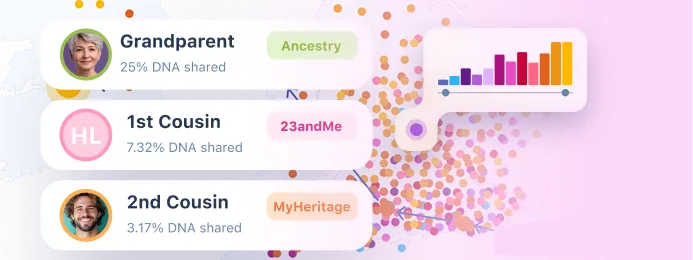

Sign up to explore more
Create a free account to navigate family trees, view ancestors, and discover connections.
Sign up freeHarper Family Genealogy & History
Discover the Global Legacy of the Harper Surname
The surname Harper is deeply rooted in the English, Scottish, and Irish cultures, originally derived from the occupational name for a harp player. With its origins traced back to the Middle English term "harper" or the Norman "le Harpur," the name carries a rich musical heritage. Additionally, the Gaelic derivation, Mac Chruiteir, meaning "son of the harper," further emphasizes its cultural significance. In modern times, Harper has also become a popular unisex given name, especially in the United States.
Throughout history, the Harper surname has evolved and spread across various regions. Initially appearing in Scotland in the late 13th century, it established strong roots in England by the 14th century, growing significantly during the 15th and 16th centuries. The name's reach expanded globally as families migrated, notably to North America during the 17th and 18th centuries. This geographic and cultural spread has made the Harper family tree a diverse and expansive network.
YourRoots data enriches our understanding of Harper genealogy by confirming its early appearance in the United Kingdom. The surname's journey from a local occupational name to a widespread family lineage is well-documented, with records indicating a significant presence in various English counties. The YourRoots database reveals how Harpers adapted and thrived, particularly in the United States, where the name remains prominent today.
For those exploring their Harper family tree, YourRoots offers a comprehensive repository of Harper genealogy records. This data provides valuable insights into the family's migration patterns and cultural integration, making it an essential resource for genealogy enthusiasts seeking to uncover their heritage and connect with the broader Harper legacy.
Find the Harper Family Tree
Search more Harper trees & genealogy records
Records
-
EHEleanor Harper1776–1852Public Tree Person3 treesScore: AEHEleanor Harper1776–1852Public Tree Person3 treesScore: A
-
EHEmma Fern Harper1919–1970Public Tree Person3 treesScore: AEHEmma Fern Harper1919–1970Public Tree Person3 treesScore: A
-
SHSadie Harper1906–1983Public Tree Person3 treesScore: ASHSadie Harper1906–1983Public Tree Person3 treesScore: A
-
AHAlpha Mae Harper1930–2006Public Tree Person3 treesScore: AAHAlpha Mae Harper1930–2006Public Tree Person3 treesScore: A
-
CHCharles Bumper Harper1949–2012Public Tree PersonParents: Albert Jr.3 treesScore: ACHCharles Bumper Harper1949–2012Public Tree PersonParents: Albert Jr.3 treesScore: A
-
PHPhebe Ann Harper1848–1935Public Tree Person3 treesScore: APHPhebe Ann Harper1848–1935Public Tree Person3 treesScore: A
-
THThomas Harper1618–1684Public Tree Person4 treesScore: BTHThomas Harper1618–1684Public Tree Person4 treesScore: B
-
WHWilliam Harper1683–1745Public Tree Person4 treesScore: BWHWilliam Harper1683–1745Public Tree Person4 treesScore: B
-
EHExperience Harper1657–1706Public Tree PersonParents: Deborah Perry4 treesScore: BEHExperience Harper1657–1706Public Tree PersonParents: Deborah Perry4 treesScore: B
-
FHFrances Elizabeth Harper1841–1903Public Tree Person3 treesScore: BFHFrances Elizabeth Harper1841–1903Public Tree Person3 treesScore: B
-
JHJohn HARPER1667–1707Public Tree PersonParents: James (DNA)4 treesScore: BJHJohn HARPER1667–1707Public Tree PersonParents: James (DNA)4 treesScore: B
-
SHSusan Harper1769–1855Public Tree Person3 treesScore: BSHSusan Harper1769–1855Public Tree Person3 treesScore: B
-
MHMary Harper1598–1676Public Tree Person3 treesScore: BMHMary Harper1598–1676Public Tree Person3 treesScore: B
-
PHPhilip Harper1712–1798Public Tree Person3 treesScore: BPHPhilip Harper1712–1798Public Tree Person3 treesScore: B
-
LHL. G. Harper1934–1934Public Tree Person3 treesScore: BLHL. G. Harper1934–1934Public Tree Person3 treesScore: B
-
WHWilliam Harper1600–1665Public Tree Person3 treesScore: BWHWilliam Harper1600–1665Public Tree Person3 treesScore: B
-
SHSarah Elizabeth Harper1717–1786Public Tree Person4 treesScore: CSHSarah Elizabeth Harper1717–1786Public Tree Person4 treesScore: C
-
AHAb Harper1903–1979Individual Tree PersonParents: James Harper & Emily HarrisSpouse: Mable PriceChildren: James, Albert, Dorothy, Alpha, L.Score: AAHAb Harper1903–1979Individual Tree PersonParents: James Harper & Emily HarrisSpouse: Mable PriceChildren: James, Albert, Dorothy, Alpha, L.Score: A
-
AHAbigail Harper1832–1899Individual Tree PersonParents: Benjamin Harper & Sarah NoneSpouse: David ThompsonChildren: PorterScore: AAHAbigail Harper1832–1899Individual Tree PersonParents: Benjamin Harper & Sarah NoneSpouse: David ThompsonChildren: PorterScore: A
-
*H* JAMES YOUNG HARPER1779–1822Individual Tree PersonParents: James Harper & Elizabeth MortinSpouse: Elizabeth YoungChildren: David, James, James, JamesScore: A*H* JAMES YOUNG HARPER1779–1822Individual Tree PersonParents: James Harper & Elizabeth MortinSpouse: Elizabeth YoungChildren: David, James, James, JamesScore: A
-
AHA. Joseph Harper1873–1941Individual Tree PersonParents: Joseph Harper & Harriet WordenScore: AAHA. Joseph Harper1873–1941Individual Tree PersonParents: Joseph Harper & Harriet WordenScore: A
-
AHAda Harper1894–1970Individual Tree PersonParents: William HarperSpouse: Luther StrattonChildren: Alcus, Josephine, Novis, Dewey, Shirley, William, Luther, JosphineScore: AAHAda Harper1894–1970Individual Tree PersonParents: William HarperSpouse: Luther StrattonChildren: Alcus, Josephine, Novis, Dewey, Shirley, William, Luther, JosphineScore: A
-
AHAda Harper1906–1991Individual Tree PersonParents: William Harper & Pattie ColeySpouse: Oran HendersonScore: AAHAda Harper1906–1991Individual Tree PersonParents: William Harper & Pattie ColeySpouse: Oran HendersonScore: A
-
AHAda Pearl Harper1906–1991Individual Tree PersonParents: William Jr. & Pattie ColeySpouse: Oran HendersonScore: AAHAda Pearl Harper1906–1991Individual Tree PersonParents: William Jr. & Pattie ColeySpouse: Oran HendersonScore: A
-
AHAbraham John Harper1886–1947Individual Tree PersonParents: James Harper & Emily HarperScore: AAHAbraham John Harper1886–1947Individual Tree PersonParents: James Harper & Emily HarperScore: A
-
AHAda Lee Harper1923–1994Individual Tree PersonParents: Julius Harper & Nancy BerrySpouse: Thomas NoahScore: AAHAda Lee Harper1923–1994Individual Tree PersonParents: Julius Harper & Nancy BerrySpouse: Thomas NoahScore: A
-
AHAda Emily Harper1905–2005Individual Tree PersonParents: John Harper & Ada OlleyScore: AAHAda Emily Harper1905–2005Individual Tree PersonParents: John Harper & Ada OlleyScore: A
-
AHAbsalom Harper1778–1849Individual Tree PersonParents: Alexander Harper & Martha Harper)Spouse: Elizabeth HugheyChildren: Rev, Mattie, William, Andrew, George, AlexanderScore: AAHAbsalom Harper1778–1849Individual Tree PersonParents: Alexander Harper & Martha Harper)Spouse: Elizabeth HugheyChildren: Rev, Mattie, William, Andrew, George, AlexanderScore: A
-
AHAbsalom Harper1810–1860Individual Tree PersonParents: Absalom Harper & Elizabeth HugheyScore: BAHAbsalom Harper1810–1860Individual Tree PersonParents: Absalom Harper & Elizabeth HugheyScore: B
-
AHAda Harper1907–1991Individual Tree PersonParents: William Harper & Pattie ColeyScore: BAHAda Harper1907–1991Individual Tree PersonParents: William Harper & Pattie ColeyScore: B
-
AHAbraham Harper1836–1896Individual Tree PersonParents: David Harper & Priscilla MarshScore: BAHAbraham Harper1836–1896Individual Tree PersonParents: David Harper & Priscilla MarshScore: B
-
AHAbsolum Griffin Harper1827–1882Individual Tree PersonParents: Edward Jr & Mary *Score: BAHAbsolum Griffin Harper1827–1882Individual Tree PersonParents: Edward Jr & Mary *Score: B
-
AHAaron Dewey Harper1898–1972Individual Tree PersonParents: Joseph Harper & Lavonia WiseScore: BAHAaron Dewey Harper1898–1972Individual Tree PersonParents: Joseph Harper & Lavonia WiseScore: B
-
AHAbigail "Abbie" Florence Harper1863–1956Individual Tree PersonParents: John Harper & Eliza HuntScore: BAHAbigail "Abbie" Florence Harper1863–1956Individual Tree PersonParents: John Harper & Eliza HuntScore: B
-
AHAbigail Harper1745–1784Individual Tree PersonParents: John Harper & Abigail MontgomeryScore: BAHAbigail Harper1745–1784Individual Tree PersonParents: John Harper & Abigail MontgomeryScore: B
-
AHAbel HARPER1775–1777Individual Tree PersonParents: William HARPER & Mary SKINNERScore: BAHAbel HARPER1775–1777Individual Tree PersonParents: William HARPER & Mary SKINNERScore: B
-
AHAbel Harper1867–1950Individual Tree PersonParents: William Harper & Elizabeth SnellScore: BAHAbel Harper1867–1950Individual Tree PersonParents: William Harper & Elizabeth SnellScore: B
Search more trees & records for
Harper for free
SIGNUP
Tracing Your Harper Family Lineage
Origin of the Harper Family: Where does the Harper surname come from?
The Harper surname has its earliest known appearance in Scotland during the late 13th century, marking the beginning of a rich genealogical history. This initial record serves as a foundational point for the Harper family tree, illustrating the roots of families that would later spread across the United Kingdom and beyond. The name is believed to be derived from the occupation of a harp player, reflecting a connection to music and culture in its early origins.
Genealogy and Early Family History of Harper
As the centuries progressed, the Harper family began to establish itself more prominently, particularly in England during the 14th century. Key regions where Harper family lines appeared include various counties in England, which became a central hub for the surname's growth and diversification. Over time, these families developed branches that expanded outward, creating a wider family network throughout the country.
By the 15th and 16th centuries, the Harper surname was increasingly common in England, reflecting a period of significant population growth and social mobility. This era saw families not only solidifying their presence in England but also beginning to reach further across the seas, laying the groundwork for future generations to connect with the wider world.
Tracing the Harper Family Tree Through the Centuries
The expansion of the Harper surname continued into the 17th century, with families migrating to North America, among other regions. This global spread became more pronounced in the 18th century, as the name established a notable presence in the United States, where many Harpers would settle and thrive. The 19th century saw a substantial increase in the Harper lineage, with families planting deep roots across various states, contributing to the rich tapestry of American genealogy.
Throughout the 20th century, the Harper surname maintained its prominence, particularly in the United States, where it became well-established in diverse communities. As families continued to grow and evolve, the branches of the Harper family tree expanded globally, showcasing a dynamic history that reflects migration, adaptation, and cultural integration. The legacy of the Harper surname illustrates how families navigated through time, leaving an enduring mark across several continents.
Where to Find Harper Genealogy Records Today
In the modern centuries, the global spread of the Harper surname can be seen in various regions, particularly in the United States, where the name is still prevalent. The ongoing evolution of the Harper family tree invites individuals to delve into their own genealogical journeys, exploring connections that may span continents. Readers are encouraged to explore the Harper genealogy records in the YourRoots database to uncover their unique family histories and link to the broader Harper legacy.
Famous People with Harper (and Their Family Tree)

Ben Harper
Ben Harper, a renowned American singer-songwriter and multi-instrumentalist, is celebrated for his eclectic musical style that fuses blues, folk, soul, reggae, and rock. With twelve studio albums, mostly via Virgin Records, his career highlights include winning three Grammy Awards, notably for Best Pop Instrumental Performance and Best Traditional Soul Gospel Album in 2004, and Best Blues Album in 2013. Harper's exceptional guitar skills and live performances have earned him international acclaim, and his collaborative composition "No Mercy in This Land" was named Song of the Year at the 40th Blues Music Awards.
Born in Pomona, California, Ben Harper comes from a diverse background. His late father, Leonard Harper, was of African-American descent, while his mother, Ellen Harper Verdries (née Chase), is Jewish, with a maternal great-grandmother of Russian-Lithuanian Jewish ancestry. Raised by his mother's family after his parents’ divorce, Harper's musical foundation was significantly influenced by his maternal grandparents' music store, frequented by notable artists such as Leonard Cohen and Taj Mahal.

Valerie Harper
Valerie Kathryn Harper was a celebrated American actress renowned for her iconic role as Rhoda Morgenstern on "The Mary Tyler Moore Show" and its spinoff "Rhoda." Her portrayal earned her four Emmy Awards and a Golden Globe nomination, establishing her as a leading figure in television comedy during the 1970s. Harper's career spanned Broadway, film, and television, with notable performances in "Freebie and the Bean" and "Chapter Two." She also received a Tony Award nomination for her stage work in "Looped."
Valerie Harper was born on August 22, 1939, in Suffern, New York, to Iva Mildred and Howard Donald Harper. Her mother, originally from Saskatchewan, Canada, was of French-Canadian, Irish, Scottish, and Welsh descent, while her father, of English and French ancestry, worked as a traveling lighting salesman. Raised in a Catholic household, Valerie had a sister, Leanne, and a brother, Merrill, later known as Don. She also had a half-sister, Virginia, from her father's second marriage.

William Jackson Harper
William Jackson Harper, born William Fitzgerald Harper in 1980, is an acclaimed American actor and playwright. He rose to fame as Chidi Anagonye in NBC's "The Good Place," earning an Emmy nomination. Harper's career spans notable stage appearances, including his Broadway debut as Stokely Carmichael in "All the Way" and roles in "Romeo & Juliet" and "Uncle Vanya," the latter earning him a Tony nomination. His film work includes roles in "Midsommar," "Paterson," and "Ant-Man and the Wasp: Quantumania." Harper is also recognized for his work in the Amazon series "The Underground Railroad" and HBO Max's "Love Life."
William Jackson Harper was born in Dallas, Texas, and grew up in Garland. He chose his stage name to honor his mother by using her maiden name, "Jackson." Further family details are not provided in the source text.

Hill Harper
Hill Harper, born Frank Eugene Harper, is an acclaimed American actor and political candidate recognized for his roles in "CSI: NY," "Limitless," and "The Good Doctor." A Harvard Law School graduate, Harper has enjoyed a diverse career, including voice acting and writing several influential books like "Letters to a Young Brother." He is also a political advocate, supporting Barack Obama's campaign and serving as the national spokesman for the Lawyers' Committee for Civil Rights Under Law. In 2023, he announced his candidacy for the 2024 U.S. Senate election in Michigan, championing progressive policies such as universal healthcare.
Hill Harper was born in Iowa City, Iowa, to Harry D. Harper, a psychiatrist, and Marilyn Harper (née Hill), one of the first black practicing anesthesiologists in the U.S. He adopted the name "Hill" in tribute to his maternal and paternal ancestors, reflecting his deep respect for his family heritage. His mother also co-authored a book titled "Wearing Purple."

Jessica Harper
Jessica Harper, born on October 3, 1949, in Chicago, is a renowned American actress and singer, celebrated for her roles in cult classics like Dario Argento's "Suspiria" (1977) and Brian De Palma's "Phantom of the Paradise" (1974). With a career spanning films such as "Love and Death" (1975), "My Favorite Year" (1982), and "Minority Report" (2002), Harper has made significant contributions to cinema. She is also an accomplished author of children's music and books, earning recognition like Parenting magazine's "Parent of the Month" in 2004. Her versatility extends to music with albums like "A Wonderful Life" (1994) and "Inside Out!" (2001), showcasing her multifaceted talent.
Jessica Harper was born to Eleanor, a writer, and Paul Church Harper Jr., a former chairman of Needham Harper Worldwide and a painter. Raised in Chicago, she attended North Shore Country Day School and Sarah Lawrence College. Harper grew up with two sisters, Lindsay Harper duPont, an illustrator, and Diana Harper, a teacher, alongside three brothers, including her twin, William Harper, a composer. Her family background, enriched by diverse artistic and professional pursuits, undoubtedly influenced her own creative endeavors.
Harper Surname Meaning, Origin, and History
The surname "Harper" has origins in England, Scotland, and Ireland, and it is derived from an occupational name referring to a player of the harp, from the Middle English term "harper." In some cases, it also stems from the Norman "le Harpur" or the Gaelic "Mac Chruiteir," meaning "son of the harper." Additionally, "Harper" serves as the Anglicization of the German surname "Härpfer," which also denotes a harp player.
VIEW MOREWhere to Find Genealogy Records for Harper
We’ve analyzed YourRoots tree and records data to uncover where genealogists are finding key sources such as census, birth certificates, marriage records, and obituaries for the Harper family. Explore our most popular genealogy record sources for the Harper surname to learn more.
VIEW MOREAbout YourRoots
Explore your family tree geographically
Import your GEDCOM file to transform your family tree into an interactive global map. See your roots laid out visually and understand your true geographic heritage.
Powerful tools like "Trace Back To Me" instantly map your family's migration paths from a chosen ancestor all the way back to you.
Discover ancestors beyond "end-of-line" automatically
Import your family tree and let AI expand it for you. AI Ancestor Finder scans "end-of-line" ancestors to uncover their parents across hundreds of family lines at once. AI Deep Research analyzes selected ancestors and family clusters, suggesting relevant records and next steps.
Turn on Auto Research Mode to get new discoveries daily or weekly, so your tree keeps growing even while you're away.
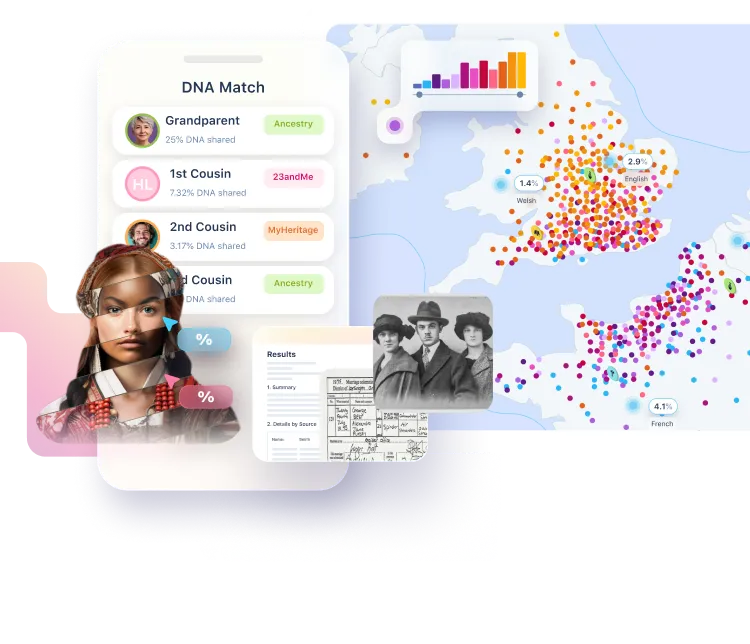
Find more DNA matches across all DNA tests
Combine your DNA data with your family tree to unlock the full power of YourRoots DNA Match. Connect with relatives across major testing services — Ancestry, 23andMe, MyHeritage, and more.
View your matches' maps and trees to identify shared ancestors, and soon you'll be able to add them directly to your own tree and map.
Ancestry DNA analysis that goes deeper than others
Unlock exclusive reports that reveal your deeper origins.
- Deep Ancestry Report — Analyze 130+ ethnicities, sub-regions, and 1,800+ communities in one detailed view.
- Global & Native American Reports — Developed with Stanford researchers to uncover hidden ancestries across all 22 chromosomes.
- Ancient DNA Series — Compare your DNA with 1,000+ ancient genomes from Viking, Celtic, and early American civilizations.
Sign up to explore more
Create a free account to navigate family trees, view ancestors, and discover connections.
Sign up freeAlready have an account? Log in
Coming Soon
We're actively working on many new features for YourRoots. Features marked v2 are ones we're planning to launch soon.
Have a particular feature request? Let us know below!