
Sign up to explore more
Create a free account to navigate family trees, view ancestors, and discover connections.

Sign up to explore more
Create a free account to navigate family trees, view ancestors, and discover connections.
Hine Family Genealogy & History
Discover the Global Legacy of the Hine Surname
The surname Hine finds its origins in Middle English, deriving from the word "hine," which referred to a household servant or farm laborer. Over time, it evolved to also denote a farm manager or a high-status individual serving in a lordly household. This occupational surname has been part of English family history since the early 16th century, providing a window into the social roles and family structures of that era.
By the 19th century, the Hine family name was predominantly found in regions like Devon, England, with the 1881 census recording 2301 bearers. Its spread over the centuries saw the Hine family tree branch out, particularly during the 17th century, when migration patterns carried the name to what would become the United States. This geographical spread reflects cultural shifts and the broadening of the Hine surname's historical narrative.
The YourRoots dataset enriches this history by revealing the Hine surname's presence in England since at least the early 16th century, confirming its deep-rooted origin. As the centuries progressed, particularly in the 17th and 18th centuries, the Hine genealogy expanded significantly, establishing new family lines in North America. This expansion underscores the dynamic nature of family histories and the interconnectedness fostered by migration.
Today, Hine genealogy records indicate a widespread distribution, with the 21st century witnessing continued interest in tracing Hine ancestry. The YourRoots data serves as a valuable resource for genealogy enthusiasts aiming to uncover connections within the Hine family tree, providing insights into the rich tapestry of its historical and geographical journey.
Find the Hine Family Tree
Search more Hine trees & genealogy records
Records
-
MHMary Hine1625–1680Public Tree Person4 treesScore: AMHMary Hine1625–1680Public Tree Person4 treesScore: A
-
EHErnest Walter Hine1885–1959Individual Tree PersonParents: Richard Hine & Rebecca LangSpouse: Harriet HineScore: AEHErnest Walter Hine1885–1959Individual Tree PersonParents: Richard Hine & Rebecca LangSpouse: Harriet HineScore: A
-
PHPaul Hine1942–2019Individual Tree PersonParents: Henry Hine & Annie DuffellScore: APHPaul Hine1942–2019Individual Tree PersonParents: Henry Hine & Annie DuffellScore: A
-
EHEunice Hine1763–1849Individual Tree PersonParents: Hezekiah Hine & Eunice BristolSpouse: Roswell CaulkinsChildren: Lucy, Marcia, Elizabeth, JuliaScore: AEHEunice Hine1763–1849Individual Tree PersonParents: Hezekiah Hine & Eunice BristolSpouse: Roswell CaulkinsChildren: Lucy, Marcia, Elizabeth, JuliaScore: A
-
HHHenry Hine1859–1942Individual Tree PersonParents: William Hine & Ann HallSpouse: Edith LethbridgeChildren: OliveScore: AHHHenry Hine1859–1942Individual Tree PersonParents: William Hine & Ann HallSpouse: Edith LethbridgeChildren: OliveScore: A
-
EHEdith Rose Hine1910–1978Individual Tree PersonParents: John Hine & Mary ConeySpouse: Thomas HutchinsonScore: AEHEdith Rose Hine1910–1978Individual Tree PersonParents: John Hine & Mary ConeySpouse: Thomas HutchinsonScore: A
-
SHSidney C. Hine1879–1914Individual Tree PersonParents: Richard Hine & Rebecca LangSpouse: Mary SambellsChildren: Mahala, Sydney, SusanScore: ASHSidney C. Hine1879–1914Individual Tree PersonParents: Richard Hine & Rebecca LangSpouse: Mary SambellsChildren: Mahala, Sydney, SusanScore: A
-
EHEdith Florence Hine1870–1936Individual Tree PersonParents: Harrison Hine & Lucy FooteSpouse: Farley Rogers, Joseph FoltzChildren: Farley, Adelaide, Edith, MamieScore: AEHEdith Florence Hine1870–1936Individual Tree PersonParents: Harrison Hine & Lucy FooteSpouse: Farley Rogers, Joseph FoltzChildren: Farley, Adelaide, Edith, MamieScore: A
-
RHRebecca Marilla Hine1834–1880Individual Tree PersonParents: Herman Hine & Rebecca PondSpouse: Henry Sackett, Frederick BrinsmadeChildren: Herman, Henry, Flora, Catherine, Mary, ClaraScore: ARHRebecca Marilla Hine1834–1880Individual Tree PersonParents: Herman Hine & Rebecca PondSpouse: Henry Sackett, Frederick BrinsmadeChildren: Herman, Henry, Flora, Catherine, Mary, ClaraScore: A
-
MHMahala Victoria Hine1906–1949Individual Tree PersonParents: Sidney Hine & Mary SambellsSpouse: Frederick ScreachScore: AMHMahala Victoria Hine1906–1949Individual Tree PersonParents: Sidney Hine & Mary SambellsSpouse: Frederick ScreachScore: A
-
DHDorothy Mae Hine1926–2008Individual Tree PersonParents: Rev. Hine & Mabel JordonSpouse: Edgar RoweScore: ADHDorothy Mae Hine1926–2008Individual Tree PersonParents: Rev. Hine & Mabel JordonSpouse: Edgar RoweScore: A
-
SHSamuel Hine1854–1896Individual Tree PersonParents: James Hine & Jane BondScore: ASHSamuel Hine1854–1896Individual Tree PersonParents: James Hine & Jane BondScore: A
-
AHAnne Collins Hine1825–1896Individual Tree PersonParents: Samuel Hine & Elizabeth PettyScore: AAHAnne Collins Hine1825–1896Individual Tree PersonParents: Samuel Hine & Elizabeth PettyScore: A
-
MHMary Hine1844–1922Individual Tree PersonParents: William Heine & Elizabeth HeineSpouse: Leonhardt DüringChildren: John, Emma, Hannah, RebeccaScore: AMHMary Hine1844–1922Individual Tree PersonParents: William Heine & Elizabeth HeineSpouse: Leonhardt DüringChildren: John, Emma, Hannah, RebeccaScore: A
-
JHJames Petty Hine1831–1899Individual Tree PersonParents: Samuel Hine & Elizabeth PettySpouse: Amelia LindleyChildren: Amelia, Kate, James, Charles, ElizabethScore: AJHJames Petty Hine1831–1899Individual Tree PersonParents: Samuel Hine & Elizabeth PettySpouse: Amelia LindleyChildren: Amelia, Kate, James, Charles, ElizabethScore: A
-
DHDruscilla Henrietta Hine1826–1861Individual Tree PersonParents: William Hine & Mary PellSpouse: Henry KendallChildren: Thomas, HenryScore: ADHDruscilla Henrietta Hine1826–1861Individual Tree PersonParents: William Hine & Mary PellSpouse: Henry KendallChildren: Thomas, HenryScore: A
-
PHPhilip Albert Sydney Hine1890–1939Individual Tree PersonParents: Albert Hine & Louisa HendySpouse: Ivy YoleChildren: JoyceScore: APHPhilip Albert Sydney Hine1890–1939Individual Tree PersonParents: Albert Hine & Louisa HendySpouse: Ivy YoleChildren: JoyceScore: A
-
JHJohn Hine1830–1877Individual Tree PersonParents: John Hine & Catherine RiceSpouse: Olive RichardsonChildren: John, Elmer, William, Sarah, Eva, Mahala, NancyScore: AJHJohn Hine1830–1877Individual Tree PersonParents: John Hine & Catherine RiceSpouse: Olive RichardsonChildren: John, Elmer, William, Sarah, Eva, Mahala, NancyScore: A
-
SHSydney C Hine1903–1967Individual Tree PersonParents: Sidney Hine & Mary SambellsSpouse: Florence SpreadboroughScore: ASHSydney C Hine1903–1967Individual Tree PersonParents: Sidney Hine & Mary SambellsSpouse: Florence SpreadboroughScore: A
-
HHHolland Hine1775–1835Individual Tree PersonParents: John Hine & Catherine MarlowSpouse: Mary PallettChildren: Jane, Ann, Caroline, Joseph, HollandScore: AHHHolland Hine1775–1835Individual Tree PersonParents: John Hine & Catherine MarlowSpouse: Mary PallettChildren: Jane, Ann, Caroline, Joseph, HollandScore: A
Search more trees & records for
Hine for free
Tracing Your Hine Family Lineage
Origin of the Hine Family: Where does the Hine surname come from?
The Hine surname is believed to have its origins in England, with the earliest known appearance recorded in the early 16th century. This period marks a pivotal point in the family tree, as it serves as the foundation for future generations. The connections established at this time are crucial for understanding the genealogical roots of families bearing the Hine name.
Genealogy and Early Family History of Hine
Throughout the following centuries, the Hine family began to spread beyond its original borders. During the 17th century, significant instances of the surname emerged, particularly in regions that would later become part of the United States. The migration patterns and settlement of Hine families during this time contributed to the diversification of their family trees, as they established new branches in various locales.
As the Hine family continued to grow, the 18th century saw further expansion, particularly in North America. The establishment of family lines in these new regions allowed for the development of distinct Hine family histories, each shaped by the unique circumstances and environments of their surroundings. This era was characterized by increased mobility, leading to a broader distribution of Hine descendants across different territories.
Tracing the Hine Family Tree Through the Centuries
The Hine surname witnessed remarkable growth and geographical spread in the 19th century, particularly in the United States, where it became increasingly prevalent. Families bearing the Hine name established themselves in various states, contributing to a rich tapestry of genealogical connections that spanned the continent. This period was marked by significant social and economic changes, influencing the family dynamics and the evolution of the Hine family tree.
Moving into the 20th century, the Hine surname maintained its presence, with families continuing to branch out across both the United States and beyond. The global spread of the surname during this era reflects broader migration trends and the interconnectedness of families through marriage and relocation. Each generation added new layers to the family history, enriching the narrative of the Hine lineage.
Where to Find Hine Genealogy Records Today
In modern times, the Hine surname can be found across various regions, reflecting its extensive historical migration and settlement patterns. The 21st century has seen a continued interest in genealogy, with many individuals seeking to trace their Hine ancestry and connect with distant relatives. Exploring the Hine genealogy records in the YourRoots database can provide valuable insights and help individuals uncover their own family tree connections.
Famous People with Hine (and Their Family Tree)

Lewis Hine
Lewis Wickes Hine was a pioneering American sociologist and muckraker photographer, renowned for his role in using documentary photography to advocate for social change. Born on September 26, 1874, in Oshkosh, Wisconsin, Hine's work during the Progressive Era and the Great Depression, especially his powerful images of child labor, significantly contributed to the enactment of the first child labor laws in the United States. As a staff photographer for the Russell Sage Foundation and the National Child Labor Committee, Hine's imagery captured harsh labor conditions, influencing public opinion and policy. He also documented the construction of the Empire State Building and worked for the American Red Cross and Works Progress Administration.
Hine's early life was marked by personal challenges, including the accidental death of his father, which compelled him to support his widowed mother and sisters. Despite these hardships, he pursued an education, aspiring to follow in his mother's footsteps as an educator. His ambition led him to the University of Chicago and eventually to New York City, where he became involved with the Ethical Culture School under the mentorship of Frank Manny.

Ngāti Hine
Ngāti Hine is a prominent Māori iwi located in Northland, New Zealand, and is part of the broader Ngāpuhi iwi. This iwi has produced several notable figures, including Te Ruki Kawiti, a celebrated chief who played a key role in the Flagstaff War against British forces in 1845–46. Other distinguished individuals from Ngāti Hine include politicians like Tau Henare and Shane Reti, All Blacks such as Sid Going and Robin Brooke, and artists like Lisa Reihana. The iwi is actively represented through Te Rūnanga o Ngāti Hine, which engages in resource consent consultations and broadcasting via Ngāti Hine FM.
Ngāti Hine traces its lineage to the female ancestor Hineamaru, a great-granddaughter of Rāhiri, who established roots in the Waiomio Valley. As part of their governance, a tribal parliament called Te Mara a Hineamaru, composed of representatives from 13 marae, oversees the iwi's activities and maintains its cultural heritage.
Hine E Hine
Fanny Howie, also known by her stage name Princess Te Rangi Pai, was a celebrated figure in the early 20th century for her contributions to music, particularly with the Māori lullaby "Hine E Hine." Written around 1907, this iconic piece gained widespread recognition and became an integral part of New Zealand's cultural landscape. An instrumental rendition was notably used as TV2's closedown song from 1975 to 1994. The lullaby's enduring appeal is evidenced by its inclusion in albums by renowned artists like Kiri Te Kanawa and Hayley Westenra, further cementing its place in musical history.

Nick Hine
Vice Admiral Sir Nicholas William Hine, born on 4 February 1966 in Carlisle, England, is a distinguished retired Royal Navy officer. Hine's notable career highlights include serving as Second Sea Lord from 2019 to 2022, where he was pivotal in the 'Navy Transformation' programme and chaired the Royal Navy Digital and Data Board. His commendable service in the Royal Navy includes roles such as commanding officer of HMS Blackwater and HMS Westminster, as well as Defence Policy Advisor to HM Treasury. Recognized for his contributions, Hine was awarded the Bronze Star Medal by the U.S. and appointed Knight Commander of the Order of the Bath (KCB) in 2023.
Hine is married and has one daughter. He was diagnosed with autism in the 2010s and advocates for neurodiversity in the armed forces.
Edward Hine
Edward Hine (1825–1891) was a pivotal figure in the British Israelism movement during the late 19th century. A former bank clerk, Hine was inspired by John Wilson and eventually published influential works like "The British Nation identified with Lost Israel" (1871) and "Forty-seven Identifications" (1878). He founded the British-Israel Identity Corporation and published the journal "Life from the Dead" in the 1870s. Hine's theories linked the Anglo-Saxons to the Lost Tribes of Israel, identifying Germany with Assyria, impacting both British and American Anglo-Israelism movements.
Hine Surname Meaning, Origin, and History
The surname "Hine" originates from Middle English and is derived from the Old English word "hƒ´ne," meaning a household servant or farm laborer. In the Middle English period, it could also refer to a farm manager or high-status individuals serving in a lordly household. The name has been borne by various notable individuals and was most concentrated in Devon, Great Britain, around the late 19th century.
VIEW MOREWhere to Find Genealogy Records for Hine
We’ve analyzed YourRoots tree and records data to uncover where genealogists are finding key sources such as census, birth certificates, marriage records, and obituaries for the Hine family. Explore our most popular genealogy record sources for the Hine surname to learn more.
VIEW MOREAbout YourRoots
Explore your family tree geographically
Import your GEDCOM file to transform your family tree into an interactive global map. See your roots laid out visually and understand your true geographic heritage.
Powerful tools like "Trace Back To Me" instantly map your family's migration paths from a chosen ancestor all the way back to you.
Discover ancestors beyond "end-of-line" automatically
Import your family tree and let AI expand it for you. AI Ancestor Finder scans "end-of-line" ancestors to uncover their parents across hundreds of family lines at once. AI Deep Research analyzes selected ancestors and family clusters, suggesting relevant records and next steps.
Turn on Auto Research Mode to get new discoveries daily or weekly, so your tree keeps growing even while you're away.
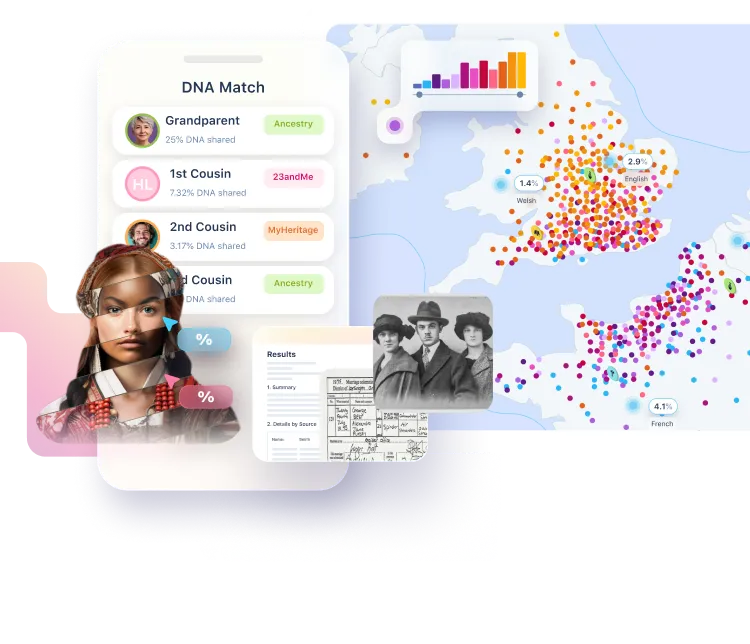
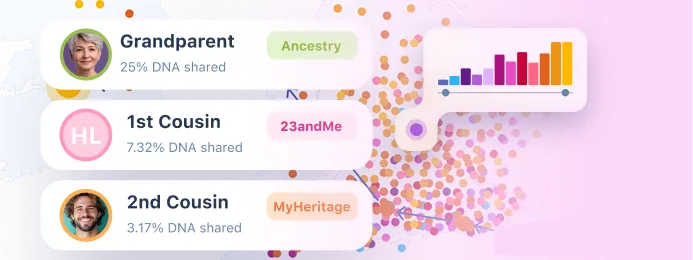
Find more DNA matches across all DNA tests
Combine your DNA data with your family tree to unlock the full power of YourRoots DNA Match. Connect with relatives across major testing services — Ancestry, 23andMe, MyHeritage, and more.
View your matches' maps and trees to identify shared ancestors, and soon you'll be able to add them directly to your own tree and map.
Ancestry DNA analysis that goes deeper than others
Unlock exclusive reports that reveal your deeper origins.
- Deep Ancestry Report — Analyze 130+ ethnicities, sub-regions, and 1,800+ communities in one detailed view.
- Global & Native American Reports — Developed with Stanford researchers to uncover hidden ancestries across all 22 chromosomes.
- Ancient DNA Series — Compare your DNA with 1,000+ ancient genomes from Viking, Celtic, and early American civilizations.
Sign up to explore more
Create a free account to navigate family trees, view ancestors, and discover connections.
Coming Soon
We're actively working on many new features for YourRoots. Features marked v2 are ones we're planning to launch soon.
Have a particular feature request? Let us know below!