
Sign up to explore more
Create a free account to navigate family trees, view ancestors, and discover connections.
Sign up to explore more
Create a free account to navigate family trees, view ancestors, and discover connections.
Libby Family Genealogy & History
Discover the Global Legacy of the Libby Surname
The surname Libby has intriguing roots and meanings that span different cultures. As a diminutive form of the feminine given name Elizabeth, Libby carries the meaning "my heart" in Hebrew, resonating deeply in Israeli culture. The name gained popularity in Israel through its presence in literature and music, notably in works by Hadas Leibowitz and the song "Achoti Haktana." In a familial context, the Libby name also finds its roots in England, where it first appeared as a surname in the 16th century, marking the beginning of its genealogical journey.
Over the centuries, the Libby surname has evolved and spread, primarily through migration patterns. During the 17th century, members of the Libby family began crossing the Atlantic, establishing themselves in the New World, particularly in the United States. As these families adapted to new environments, they contributed to the diverse tapestry of society, with the Libby name branching into various family trees across the country. This geographical dispersion is a testament to the surname's enduring legacy and cultural adaptability.
YourRoots data provides valuable insights into the Libby family tree, confirming its origins in England during the 16th century. This aligns with historical records that trace the surname's emergence and subsequent expansion. By the 18th century, the Libby name had become well-established in the United States, as families settled and thrived across different states. YourRoots records offer a rich source of information for those interested in exploring Libby genealogy further, highlighting connections that span continents and centuries.
For genealogy enthusiasts and family-tree researchers, YourRoots data on the Libby surname reveals a storied history waiting to be unraveled. With its deep roots and widespread branches, the Libby name provides a fascinating case study of cultural migration and familial growth, offering countless opportunities for discovery and connection.
Find the Libby Family Tree
Search more Libby trees & genealogy records
Records
-
FLFrank C \ Charles F LIBBY1851–1926Individual Tree PersonParents: Charles LIBBY & Mary (Libby)Spouse: Mary (Libby)Children: Clida, AugaScore: AFLFrank C \ Charles F LIBBY1851–1926Individual Tree PersonParents: Charles LIBBY & Mary (Libby)Spouse: Mary (Libby)Children: Clida, AugaScore: A
-
MLMartha Libby1826–1904Individual Tree PersonParents: Daniel Libby & Elsey MortonSpouse: Abijah ReedChildren: HenryScore: AMLMartha Libby1826–1904Individual Tree PersonParents: Daniel Libby & Elsey MortonSpouse: Abijah ReedChildren: HenryScore: A
-
DLDeborah Libby1789–1859Individual Tree PersonParents: John Libby & Hannah VarrellScore: ADLDeborah Libby1789–1859Individual Tree PersonParents: John Libby & Hannah VarrellScore: A
-
SLSusan Clara Libby1879–1939Individual Tree PersonParents: Ebenezer Libby & Mary GloverSpouse: Alexander MCDAVID, Melvin DownsChildren: Bruce, Earl, Doris, Franklin, Margaret, Nelson, Elizabeth, Hilda, Wesley, John, Henrietta, EileenScore: ASLSusan Clara Libby1879–1939Individual Tree PersonParents: Ebenezer Libby & Mary GloverSpouse: Alexander MCDAVID, Melvin DownsChildren: Bruce, Earl, Doris, Franklin, Margaret, Nelson, Elizabeth, Hilda, Wesley, John, Henrietta, EileenScore: A
-
MLMiles Elbridge Libby1867–1942Individual Tree PersonParents: William Libby & Margaret LibbySpouse: Vesta TurnerChildren: Owen, Hazel, Miles, Emma, Kenneth, Glenn, MargaretScore: AMLMiles Elbridge Libby1867–1942Individual Tree PersonParents: William Libby & Margaret LibbySpouse: Vesta TurnerChildren: Owen, Hazel, Miles, Emma, Kenneth, Glenn, MargaretScore: A
-
LLLouisana Libby1838–1916Individual Tree PersonSpouse: James WaggChildren: JamesScore: ALLLouisana Libby1838–1916Individual Tree PersonSpouse: James WaggChildren: JamesScore: A
-
ELErwin Elwood Libby1897–1989Individual Tree PersonParents: Erwin Libby & Medora CoppSpouse: Rose HallChildren: Pauline, Mary, Florence, EvansScore: AELErwin Elwood Libby1897–1989Individual Tree PersonParents: Erwin Libby & Medora CoppSpouse: Rose HallChildren: Pauline, Mary, Florence, EvansScore: A
-
ELEbenezer Hawkes Libby1822–1868Individual Tree PersonParents: Elias Libby & Elizabeth HawkesSpouse: Marietta MesserChildren: LizzieScore: AELEbenezer Hawkes Libby1822–1868Individual Tree PersonParents: Elias Libby & Elizabeth HawkesSpouse: Marietta MesserChildren: LizzieScore: A
-
ELElla C. Libby1855–1873Individual Tree PersonParents: Freeman Libby & Mariam LowellScore: AELElla C. Libby1855–1873Individual Tree PersonParents: Freeman Libby & Mariam LowellScore: A
-
WLWilliam LIBBY1809–1889Individual Tree PersonSpouse: Eliza MALLETTChildren: Maria, Emma, William, Elizabeth, JohnScore: AWLWilliam LIBBY1809–1889Individual Tree PersonSpouse: Eliza MALLETTChildren: Maria, Emma, William, Elizabeth, JohnScore: A
-
ELElizabeth Ann Libby1847–1915Individual Tree PersonParents: William Libby & Harriett CornwallSpouse: William CurtisChildren: Agnes, Philippa, Elizabeth, William, Clara, Agnes, ElizabethScore: AELElizabeth Ann Libby1847–1915Individual Tree PersonParents: William Libby & Harriett CornwallSpouse: William CurtisChildren: Agnes, Philippa, Elizabeth, William, Clara, Agnes, ElizabethScore: A
-
DLDeacon Benjamin Libby1682–1768Individual Tree PersonParents: John Libby & Agnes LibbySpouse: None NoneChildren: Mary, Joseph, Charles, Daniel, Sarah, Agnes, Benjamin, Jermiah, Anna, ElishaScore: ADLDeacon Benjamin Libby1682–1768Individual Tree PersonParents: John Libby & Agnes LibbySpouse: None NoneChildren: Mary, Joseph, Charles, Daniel, Sarah, Agnes, Benjamin, Jermiah, Anna, ElishaScore: A
-
JLJosiah Hanson Libby1848–1921Individual Tree PersonParents: Aaron Libby & Mercy D.Spouse: LUELLA FROSTChildren: ELMER, Alice, Ada, Almeda, Leroy, Alzada, Alberta, AmyScore: AJLJosiah Hanson Libby1848–1921Individual Tree PersonParents: Aaron Libby & Mercy D.Spouse: LUELLA FROSTChildren: ELMER, Alice, Ada, Almeda, Leroy, Alzada, Alberta, AmyScore: A
-
ALAaron Libby1818–1918Individual Tree PersonParents: Josiah Libby & Lydia HarmonSpouse: Mercy D.Children: Josiah, Willie, Ada, SarahScore: AALAaron Libby1818–1918Individual Tree PersonParents: Josiah Libby & Lydia HarmonSpouse: Mercy D.Children: Josiah, Willie, Ada, SarahScore: A
-
PLPhilemon Libby1796–1846Individual Tree PersonParents: Rufus Libby & Dorcas StroutScore: APLPhilemon Libby1796–1846Individual Tree PersonParents: Rufus Libby & Dorcas StroutScore: A
-
PLPhillip Libby1733–1774Individual Tree PersonParents: Philip Libby & Agnes MinardsSpouse: Mary ClementsChildren: PhilipScore: APLPhillip Libby1733–1774Individual Tree PersonParents: Philip Libby & Agnes MinardsSpouse: Mary ClementsChildren: PhilipScore: A
-
PLPhebe J. Libby1844–1884Individual Tree PersonParents: Darius Libby & Phebe SmallSpouse: William ColeChildren: Cora, Lillian, Morris, LydonScore: APLPhebe J. Libby1844–1884Individual Tree PersonParents: Darius Libby & Phebe SmallSpouse: William ColeChildren: Cora, Lillian, Morris, LydonScore: A
-
RLRalph Wyman Libby1923–1991Individual Tree PersonParents: Fred Libby & Mabel CassScore: ARLRalph Wyman Libby1923–1991Individual Tree PersonParents: Fred Libby & Mabel CassScore: A
-
ALAddie Emma Libby1853–1891Individual Tree PersonParents: Freeman Libby & Mariam LowellSpouse: Alpheus ParkerChildren: Charles, BerthaScore: AALAddie Emma Libby1853–1891Individual Tree PersonParents: Freeman Libby & Mariam LowellSpouse: Alpheus ParkerChildren: Charles, BerthaScore: A
-
JLJohn Libby1668–1751Individual Tree PersonParents: John Libby & Agnes LibbySpouse: Eleanor KirkeChildren: EleanorScore: AJLJohn Libby1668–1751Individual Tree PersonParents: John Libby & Agnes LibbySpouse: Eleanor KirkeChildren: EleanorScore: A
Search more trees & records for
Libby for free
Tracing Your Libby Family Lineage
Origin of the Libby Family: Where does the Libby surname come from?
The earliest known appearance of the Libby surname can be traced back to England during the early 16th century. This period marks the beginning of the Libby family's genealogical origins, signifying the establishment of family ties and connections that would echo through generations. As the Libby name emerged in historical records, it laid the foundation for subsequent family trees and branches that would expand over time.
Genealogy and Early Family History of Libby
In its formative years, the Libby family began to spread primarily throughout England, where the name first took root. During the 17th century, this family line started to find its way across the Atlantic, with many members migrating to the New World, particularly to the United States. As families established themselves in these new regions, the Libby name began to branch out, creating diverse family trees that reflected the changing landscapes of society.
Tracing the Libby Family Tree Through the Centuries
As the centuries progressed, the Libby surname continued to expand significantly, particularly in the United States during the 18th century. During this time, the name became increasingly prominent, with families settling in various states and contributing to the social fabric of their communities. By the 19th century, the Libby name had firmly established itself across many regions, showcasing a global spread that included areas in North America and beyond.
Where to Find Libby Genealogy Records Today
The modern centuries have seen the Libby surname maintain its presence in various regions, especially in North America and parts of Europe. As families continue to grow and evolve, the Libby genealogy remains rich with history and connections waiting to be discovered. Readers are encouraged to explore the YourRoots database to delve into Libby genealogy records, helping them connect their own family trees to this storied surname.
Famous People with Libby (and Their Family Tree)

Willard Libby
Willard Frank Libby was a distinguished American physical chemist recognized for pioneering radiocarbon dating, a groundbreaking advancement in archaeology and paleontology. A 1931 graduate and 1933 doctorate holder from the University of California, Berkeley, Libby contributed significantly to the Manhattan Project during World War II and later developed carbon-14 dating methods. His illustrious career included winning the Nobel Prize in Chemistry in 1960, serving as a commissioner on the Atomic Energy Commission, and advocating for environmental standards in California. His work in radioactive element studies and his leadership in nuclear and environmental sciences cement his legacy as a transformative figure in his field.
Willard Libby was born on December 17, 1908, in Parachute, Colorado, to farmers Ora Edward Libby and Eva May (née Rivers). He was raised alongside two brothers, Elmer and Raymond, and two sisters, Eva and Evelyn. His early education began in a Colorado schoolhouse before his family relocated to Santa Rosa, California, where he attended Analy High School in Sebastopol. Libby's familial roots in farming and his upbringing in rural Colorado provided a foundational backdrop to his later achievements in science.
Libby Surname Meaning, Origin, and History
The surname "Libby," which can also be spelled "Libbey," has origins as a diminutive form of the feminine given name Elizabeth, and more recently, as a shortened version of Liberty. The name carries the meaning "my heart" in Hebrew and gained popularity in Israel due to cultural influences such as literature and music.
VIEW MOREWhere to Find Genealogy Records for Libby
We’ve analyzed YourRoots tree and records data to uncover where genealogists are finding key sources such as census, birth certificates, marriage records, and obituaries for the Libby family. Explore our most popular genealogy record sources for the Libby surname to learn more.
VIEW MOREAbout YourRoots
Explore your family tree geographically
Import your GEDCOM file to transform your family tree into an interactive global map. See your roots laid out visually and understand your true geographic heritage.
Powerful tools like "Trace Back To Me" instantly map your family's migration paths from a chosen ancestor all the way back to you.
Discover ancestors beyond "end-of-line" automatically
Import your family tree and let AI expand it for you. AI Ancestor Finder scans "end-of-line" ancestors to uncover their parents across hundreds of family lines at once. AI Deep Research analyzes selected ancestors and family clusters, suggesting relevant records and next steps.
Turn on Auto Research Mode to get new discoveries daily or weekly, so your tree keeps growing even while you're away.
Find more DNA matches across all DNA tests
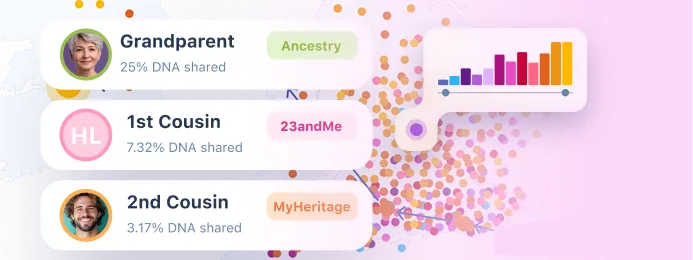
Combine your DNA data with your family tree to unlock the full power of YourRoots DNA Match. Connect with relatives across major testing services — Ancestry, 23andMe, MyHeritage, and more.
View your matches' maps and trees to identify shared ancestors, and soon you'll be able to add them directly to your own tree and map.
Ancestry DNA analysis that goes deeper than others
Unlock exclusive reports that reveal your deeper origins.
- Deep Ancestry Report — Analyze 130+ ethnicities, sub-regions, and 1,800+ communities in one detailed view.
- Global & Native American Reports — Developed with Stanford researchers to uncover hidden ancestries across all 22 chromosomes.
- Ancient DNA Series — Compare your DNA with 1,000+ ancient genomes from Viking, Celtic, and early American civilizations.
Sign up to explore more
Create a free account to navigate family trees, view ancestors, and discover connections.
Coming Soon
We're actively working on many new features for YourRoots. Features marked v2 are ones we're planning to launch soon.
Have a particular feature request? Let us know below!