
Sign up to explore more
Create a free account to navigate family trees, view ancestors, and discover connections.
Sign up to explore more
Create a free account to navigate family trees, view ancestors, and discover connections.
Lovelace Family Genealogy & History
Discover the Global Legacy of the Lovelace Surname
The Lovelace surname is deeply rooted in English heritage, first appearing in historical records during a time of significant transformation in England. This surname, which holds both familial and individual significance, reflects a lineage that has contributed to the region's social and political development. Over the centuries, the Lovelace name has become associated with notable figures such as Ada Lovelace, an English mathematician, and Richard Lovelace, an English poet, further solidifying its place in history.
As the Lovelace family tree expanded, the surname spread geographically and culturally across England. By the medieval period, Lovelace families established branches in various counties, intertwining with other lineages and enhancing their societal presence. The name gained recognition and prominence, particularly during the late medieval period, as it became associated with noble houses and significant societal roles. This expansion set the stage for the Lovelace name to flourish globally, especially during the colonial era when many families migrated to the Americas.
YourRoots dataset insights confirm the deep historical connections of the Lovelace surname within England, tracing its origins back to medieval times. The dataset reveals that the Lovelace family made significant contributions to local communities and established prominent positions in English society. This aligns with historical accounts of the family's spread and influence, highlighting the adaptability and resilience of the Lovelace lineage as it expanded beyond England to regions such as North America and Australia.
For researchers interested in Lovelace genealogy, YourRoots offers a valuable resource for exploring familial ties and enriching personal family histories. By providing comprehensive Lovelace records, YourRoots helps illuminate the enduring legacy and global presence of the Lovelace surname, offering rich insights into the family tree's evolution across centuries.
Find the Lovelace Family Tree
Search more Lovelace trees & genealogy records
Records
-
WLWilliam Lovelace1561–1628Public Tree Person3 treesScore: AWLWilliam Lovelace1561–1628Public Tree Person3 treesScore: A
-
FLFrancis William Lovelace1618–1675Individual Tree PersonParents: William Lovelace & Anne BarneSpouse: Blanche TalbotChildren: Edward, William, John, WilliamScore: AFLFrancis William Lovelace1618–1675Individual Tree PersonParents: William Lovelace & Anne BarneSpouse: Blanche TalbotChildren: Edward, William, John, WilliamScore: A
-
ELEthel Irene Lovelace1919–1977Individual Tree PersonParents: Edgar Mann & Frances RayfieldSpouse: Lyman LovelaceScore: AELEthel Irene Lovelace1919–1977Individual Tree PersonParents: Edgar Mann & Frances RayfieldSpouse: Lyman LovelaceScore: A
-
ELEllie Lovelace1901–1988Individual Tree PersonParents: George Lovelace & Mary SHIRLEYScore: AELEllie Lovelace1901–1988Individual Tree PersonParents: George Lovelace & Mary SHIRLEYScore: A
-
WLWILLIAM LOVELACE1583–1627Individual Tree PersonParents: WILLIAM LOVELACE & ELIZABETH AUCHERSpouse: ANNE BARNESChildren: ANN, Francis, Lovelace, Richard, Charles, DudleyScore: AWLWILLIAM LOVELACE1583–1627Individual Tree PersonParents: WILLIAM LOVELACE & ELIZABETH AUCHERSpouse: ANNE BARNESChildren: ANN, Francis, Lovelace, Richard, Charles, DudleyScore: A
-
MLMerian Hart "Betsy's Bettina" Lovelace1931–1997Individual Tree PersonParents: Delos Lovelace & Maud LovelaceSpouse: Englebert KirchnerScore: AMLMerian Hart "Betsy's Bettina" Lovelace1931–1997Individual Tree PersonParents: Delos Lovelace & Maud LovelaceSpouse: Englebert KirchnerScore: A
-
RLRobert W Lovelace1922–1968Individual Tree PersonParents: William Lovelace & Lizzie HallScore: ARLRobert W Lovelace1922–1968Individual Tree PersonParents: William Lovelace & Lizzie HallScore: A
-
ALAnne Lovelace1610–1652Individual Tree PersonParents: William Lovelace & Anne BarneSpouse: John GorsuchChildren: Elizabeth, Ruth, Daniel, Frances, Katherine, John, Robert, Anne, RichardScore: AALAnne Lovelace1610–1652Individual Tree PersonParents: William Lovelace & Anne BarneSpouse: John GorsuchChildren: Elizabeth, Ruth, Daniel, Frances, Katherine, John, Robert, Anne, RichardScore: A
-
HLHenderson Lovelace1853–1885Individual Tree PersonParents: George Lovelace & Polly LovelaceSpouse: Rebecca ClarkChildren: Mary, George, IdaScore: AHLHenderson Lovelace1853–1885Individual Tree PersonParents: George Lovelace & Polly LovelaceSpouse: Rebecca ClarkChildren: Mary, George, IdaScore: A
-
JLJoseph Leonard Lovelace1858–1934Individual Tree PersonParents: Commodore Lovelace & Louisa NoneSpouse: Lucinda HughsChildren: Baby, Blufard, Claude, Edgar, Edgar, Edward, Howard, Clorinda, McKinley, William, Perry, Baby, Alberta, Elsie, Mary, Emon, ElsieScore: AJLJoseph Leonard Lovelace1858–1934Individual Tree PersonParents: Commodore Lovelace & Louisa NoneSpouse: Lucinda HughsChildren: Baby, Blufard, Claude, Edgar, Edgar, Edward, Howard, Clorinda, McKinley, William, Perry, Baby, Alberta, Elsie, Mary, Emon, ElsieScore: A
-
JLJames B Lovelace1816–1896Individual Tree PersonParents: Asa Lovelace & Susannah HardinSpouse: Judith HamrickChildren: Dury, Hannah, Louisa, AmeliaScore: AJLJames B Lovelace1816–1896Individual Tree PersonParents: Asa Lovelace & Susannah HardinSpouse: Judith HamrickChildren: Dury, Hannah, Louisa, AmeliaScore: A
-
NLNathaniel Lovelace1810–1868Individual Tree PersonParents: Asa Lovelace & Susannah HardinSpouse: Louisa McSwainChildren: Margaret, Mary, Perry, Judith, Rosannah, William, Cinthia, Thomas, Asa, Susanna, Susannah, JamesScore: ANLNathaniel Lovelace1810–1868Individual Tree PersonParents: Asa Lovelace & Susannah HardinSpouse: Louisa McSwainChildren: Margaret, Mary, Perry, Judith, Rosannah, William, Cinthia, Thomas, Asa, Susanna, Susannah, JamesScore: A
-
RLRobert Lovelace1398–1466Individual Tree PersonParents: John III & Johanna WentworthSpouse: Robert LovelaceChildren: WilliamScore: ARLRobert Lovelace1398–1466Individual Tree PersonParents: John III & Johanna WentworthSpouse: Robert LovelaceChildren: WilliamScore: A
-
CLClorinda Lovelace1892–1982Individual Tree PersonParents: Joseph Lovelace & Lucinda HughsSpouse: W. AshfordChildren: Elwyn, LivingScore: ACLClorinda Lovelace1892–1982Individual Tree PersonParents: Joseph Lovelace & Lucinda HughsSpouse: W. AshfordChildren: Elwyn, LivingScore: A
-
CLCharlotte Lovelace1932–2019Individual Tree PersonParents: Carles Rich & Artie cookSpouse: William Fidler, Carl LovelaceScore: ACLCharlotte Lovelace1932–2019Individual Tree PersonParents: Carles Rich & Artie cookSpouse: William Fidler, Carl LovelaceScore: A
-
JLJames Beverly Lovelace1905–1997Individual Tree PersonParents: James Lovelace & Rosa KellamSpouse: Erma WoodScore: AJLJames Beverly Lovelace1905–1997Individual Tree PersonParents: James Lovelace & Rosa KellamSpouse: Erma WoodScore: A
-
TLThomazine Mary Lovelace1463–1501Individual Tree PersonParents: William Lovelace & Anne LewesSpouse: Thomas,(Sir) (Honywood)Children: JohnScore: ATLThomazine Mary Lovelace1463–1501Individual Tree PersonParents: William Lovelace & Anne LewesSpouse: Thomas,(Sir) (Honywood)Children: JohnScore: A
-
WLWilliam Lovelace1583–1627Individual Tree PersonParents: Sir IV & Elizabeth IVSpouse: Anne BarneChildren: Francis, Thomas, Dudley, Joane, Richard, William, Anne, Elizabeth, AnneScore: AWLWilliam Lovelace1583–1627Individual Tree PersonParents: Sir IV & Elizabeth IVSpouse: Anne BarneChildren: Francis, Thomas, Dudley, Joane, Richard, William, Anne, Elizabeth, AnneScore: A
-
SLSallie Wilmouth Lovelace1880–1971Individual Tree PersonParents: William III & Anne LewisSpouse: Benjamin HackworthScore: ASLSallie Wilmouth Lovelace1880–1971Individual Tree PersonParents: William III & Anne LewisSpouse: Benjamin HackworthScore: A
-
CLCathleen Lovelace1911–1977Individual Tree PersonParents: Hamp Lovelace & Caroline ParksScore: ACLCathleen Lovelace1911–1977Individual Tree PersonParents: Hamp Lovelace & Caroline ParksScore: A
Search more trees & records for
Lovelace for free
Tracing Your Lovelace Family Lineage
Origin of the Lovelace Family: Where does the Lovelace surname come from?
The Lovelace surname first appears in historical records during a time of significant social and political transformation in England. This early mention serves as a foundational point for the Lovelace family tree, marking the beginning of genealogical connections that would evolve over centuries. The roots of this surname are deeply embedded in the English heritage, reflecting the lineage of families that contributed to the development of the region.
Genealogy and Early Family History of Lovelace
Throughout the ensuing centuries, the Lovelace family began to spread across England, particularly in regions where noble houses flourished. The YourRoots database reveals that during the medieval era, the family established branches in various counties, contributing to the development of local communities. As these families expanded, they intertwined with other lineages, creating a rich tapestry of connections that helped shape the Lovelace family history.
By the late medieval period, the Lovelace surname was increasingly recognized, reflecting a growing presence in English society. Families bearing this name began to establish themselves in significant positions, thus enhancing their visibility within the historical narrative of England. This period set the stage for future generations, allowing them to carry forward the Lovelace name and its associated legacy.
Tracing the Lovelace Family Tree Through the Centuries
As the Lovelace surname progressed into the early modern period, its reach extended beyond England. During the colonial era, many Lovelace families migrated to the Americas, particularly to what would become the United States, marking a significant point in the family’s global expansion. In the ensuing centuries, the Lovelace name became prominent in various regions across North America, showcasing the adaptability and resilience of its descendants.
In later centuries, the Lovelace family lineage continued to flourish, with branches appearing in diverse settings such as Australia and Canada. This global movement illustrates the dynamic nature of the Lovelace surname and its ability to thrive in new environments, while still maintaining connections to its English origins. The evolution of the Lovelace family tree highlights a rich narrative of migration, adaptation, and the enduring legacy of the name across generations.
Where to Find Lovelace Genealogy Records Today
In modern times, the Lovelace surname has a notable presence across various regions, reflecting its historical migration and expansion. In the 20th and 21st centuries, the Lovelace name can be found in numerous countries, indicating a continued global presence and the ongoing development of family connections. For those interested in tracing their own Lovelace lineage, the YourRoots database offers a wealth of genealogy records that can assist in uncovering familial ties and enriching personal family
Famous People with Lovelace (and Their Family Tree)

Ada Lovelace
Ada Lovelace, an English mathematician and writer, is renowned for her work on Charles Babbage's Analytical Engine, a precursor to modern computers. Recognized as the first computer programmer, Lovelace's visionary "Notes" on the Engine outlined an algorithm, showcasing her groundbreaking perspective on computing's potential beyond calculations. Her unique approach, termed "poetical science," influenced the development of computer science, and her legacy endures with the programming language Ada named in her honor. Lovelace collaborated with key figures like Charles Babbage, significantly impacting the early history of computers.
Born on 10 December 1815, Ada Lovelace was the only legitimate child of the famous poet Lord Byron and reformer Anne Isabella Milbanke. Following a troubled marriage, her parents separated a month after her birth, with Lord Byron leaving England and dying in Greece in 1824. Raised primarily by her mother, Lady Byron, Ada's upbringing focused on mathematics to counteract her father's perceived insanity. Despite a strained relationship with her mother, Lovelace's formative years were enriched by the support of her maternal grandmother, Judith, Hon. Lady Milbanke.

Linda Lovelace
Linda Lovelace, born Linda Susan Boreman, gained fame as a pornographic actress through her role in the 1972 film "Deep Throat," a landmark in adult film history. Despite its massive success, grossing over $600 million, Lovelace's personal earnings were minimal, as her abusive husband, Chuck Traynor, coerced her into the industry. Later, she became a born-again Christian and a vocal anti-pornography advocate. Lovelace's tumultuous career also included starring in "Deep Throat II" and engaging in a brief theater stint, alongside posing for notable magazines like Playboy.
Born in The Bronx, New York, Lovelace came from a working-class background. Her father, John Boreman, was a police officer, and her mother, Dorothy Boreman, worked as a waitress. Linda's family life was marked by an unhappy upbringing and a move to Florida during her teenage years. Her early life was further complicated by a coerced adoption of her first child.

Jonathan Bell Lovelace
Jonathan Bell Lovelace (1895–1979) was a prominent American businessman known for founding Capital Group Companies, a leading investment management firm. His career spanned various roles, including a football coach and investor, with significant time spent at a Detroit banking firm in the 1920s. Lovelace's strategic foresight allowed him to anticipate the 1929 stock market crash, leading him to sell his interests and relocate to California. In 1931, he established Capital Research and Management Company, which evolved into a powerhouse in investment management. Lovelace's legacy continues through his family's involvement in the company, underscoring his impact on the financial world.
Amanda Lovelace
Amanda Lovelace is an acclaimed American poet renowned for her feminist poetry, which gained popularity on platforms like Tumblr and Instagram. Her notable works include the "women are some kind of magic" series, with "the princess saves herself in this one" winning the Goodreads Choice Award. Lovelace's poetry often reinterprets traditional tales and addresses themes like trauma, healing, and empowerment. She is also known for her "Things That H(a)unt" duology and "you are your own fairy tale" series. Lovelace's work has been published by Andrews McMeel, and she resists the "Instapoet" label, viewing it as a form of literary snobbery.
Maud Hart Lovelace
Maud Hart Lovelace, an influential American writer, is celebrated for her notable Betsy-Tacy series, which vividly captures the journey from childhood to adulthood. Her literary career began with the publication of "The Black Angels" in 1926, followed by several historical novels and children's books that remain popular. Lovelace's works, often set in fictional Deep Valley, Minnesota, are cherished for their charming depiction of early 20th-century life. Her legacy continues through the Maud Hart Lovelace Book Award, honoring her contribution to children's literature.
Born in Mankato, Minnesota, Maud Hart Lovelace was the daughter of Tom Hart, a shoe store owner, and Stella Palmer. She was the middle child, with sisters Kathleen and Helen, who inspired characters in her books. Her family roots and childhood experiences deeply influenced her writing career.
Lovelace Surname Meaning, Origin, and History
The surname "Lovelace" has English origins and is associated with various notable individuals across different fields. It has been borne by figures such as Ada Lovelace, an English mathematician from the 19th century, and Richard Lovelace, a 17th-century English poet. The name is also used as a given name, seen in individuals like Lovelace Watkins, an American singer.
VIEW MOREWhere to Find Genealogy Records for Lovelace
We’ve analyzed YourRoots tree and records data to uncover where genealogists are finding key sources such as census, birth certificates, marriage records, and obituaries for the Lovelace family. Explore our most popular genealogy record sources for the Lovelace surname to learn more.
VIEW MOREAbout YourRoots
Explore your family tree geographically
Import your GEDCOM file to transform your family tree into an interactive global map. See your roots laid out visually and understand your true geographic heritage.
Powerful tools like "Trace Back To Me" instantly map your family's migration paths from a chosen ancestor all the way back to you.
Discover ancestors beyond "end-of-line" automatically
Import your family tree and let AI expand it for you. AI Ancestor Finder scans "end-of-line" ancestors to uncover their parents across hundreds of family lines at once. AI Deep Research analyzes selected ancestors and family clusters, suggesting relevant records and next steps.
Turn on Auto Research Mode to get new discoveries daily or weekly, so your tree keeps growing even while you're away.
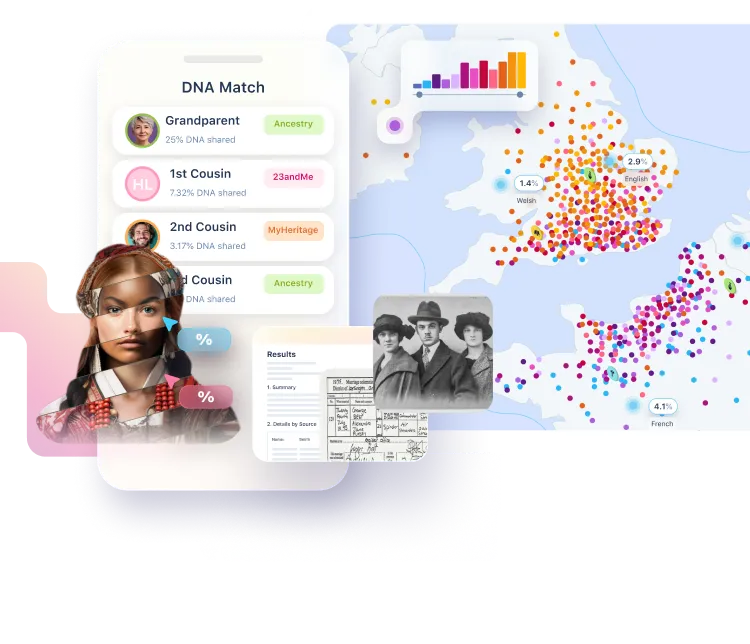
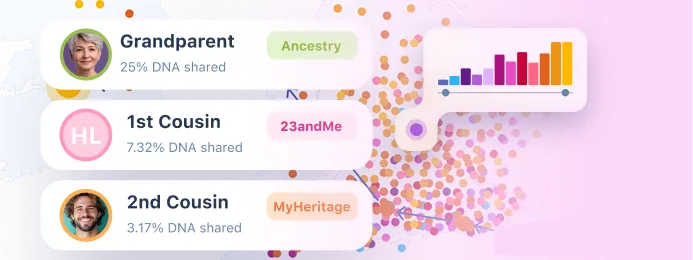
Find more DNA matches across all DNA tests
Combine your DNA data with your family tree to unlock the full power of YourRoots DNA Match. Connect with relatives across major testing services — Ancestry, 23andMe, MyHeritage, and more.
View your matches' maps and trees to identify shared ancestors, and soon you'll be able to add them directly to your own tree and map.
Ancestry DNA analysis that goes deeper than others
Unlock exclusive reports that reveal your deeper origins.
- Deep Ancestry Report — Analyze 130+ ethnicities, sub-regions, and 1,800+ communities in one detailed view.
- Global & Native American Reports — Developed with Stanford researchers to uncover hidden ancestries across all 22 chromosomes.
- Ancient DNA Series — Compare your DNA with 1,000+ ancient genomes from Viking, Celtic, and early American civilizations.
Sign up to explore more
Create a free account to navigate family trees, view ancestors, and discover connections.
Coming Soon
We're actively working on many new features for YourRoots. Features marked v2 are ones we're planning to launch soon.
Have a particular feature request? Let us know below!