
Sign up to explore more
Create a free account to navigate family trees, view ancestors, and discover connections.

Sign up to explore more
Create a free account to navigate family trees, view ancestors, and discover connections.
Moor Family Genealogy & History
Discover the Global Legacy of the Moor Surname
The Moor surname is deeply rooted in English history, with its earliest documented appearance dating back to the early 14th century. The name likely derives from geographical features or occupations associated with moorlands, marking it as a toponymic surname. As a result, the Moor surname holds a significant place in family history, representing a lineage that has been integral to English society for centuries.
Throughout history, the Moor surname has seen considerable geographical and cultural evolution. By the 15th century, the name had established a strong presence across various English counties. The 17th and 18th centuries were pivotal as the Moor family tree branched out further, with descendants settling in new regions and even migrating to the United States. This transatlantic movement highlighted the family's adaptability and laid the groundwork for the Moor genealogy to flourish in diverse cultural landscapes.
The YourRoots dataset provides valuable insights into the Moor family's historical journey. It confirms the surname's origins in England during the 14th century, aligning with historical records. As the centuries progressed, YourRoots data highlights the Moor family's expansion across England and its eventual migration to North America in the 18th century. This expansion is a testament to the family's resilience and adaptability in the face of changing social and economic circumstances.
Today, Moor genealogy records, enriched by YourRoots data, offer a comprehensive view of the family's global distribution. These records serve as a valuable resource for genealogy enthusiasts eager to explore their connection to the Moor lineage, uncovering familial ties that span continents and centuries.
Find the Moor Family Tree
Search more Moor trees & genealogy records
Records
-
VMVictoria Josephine Moor1846–1885Public Tree PersonParents: Abigail Franklin16 treesScore: AVMVictoria Josephine Moor1846–1885Public Tree PersonParents: Abigail Franklin16 treesScore: A
-
KMKatharine M Moor1899–1995Individual Tree PersonParents: Wyman Moor & Agnes McCormickSpouse: Mark SchlegelChildren: MarkScore: AKMKatharine M Moor1899–1995Individual Tree PersonParents: Wyman Moor & Agnes McCormickSpouse: Mark SchlegelChildren: MarkScore: A
-
MMMargaret Moor1790–1865Individual Tree PersonParents: James Moor & Sarah CollodenSpouse: Robert MillerChildren: John, Robert?, Jemima\Gemima, Martha, Elizabeth, LorettaScore: AMMMargaret Moor1790–1865Individual Tree PersonParents: James Moor & Sarah CollodenSpouse: Robert MillerChildren: John, Robert?, Jemima\Gemima, Martha, Elizabeth, LorettaScore: A
-
GMGulielmi "Gulielmus" Moor1685–1685Individual Tree PersonParents: Josephi Moor & Gratia MerchantSpouse: Anna StephensChildren: AnnaScore: AGMGulielmi "Gulielmus" Moor1685–1685Individual Tree PersonParents: Josephi Moor & Gratia MerchantSpouse: Anna StephensChildren: AnnaScore: A
-
DMDr. Omar G. Moor1886–1955Individual Tree PersonParents: Bird Moor & Mary MoorSpouse: Essie MooreChildren: MaryScore: ADMDr. Omar G. Moor1886–1955Individual Tree PersonParents: Bird Moor & Mary MoorSpouse: Essie MooreChildren: MaryScore: A
-
LMLady Alice Moor1458–1498Individual Tree PersonParents: Sir Moor & Lady ChamberlainSpouse: Edward WATSONChildren: JohnScore: ALMLady Alice Moor1458–1498Individual Tree PersonParents: Sir Moor & Lady ChamberlainSpouse: Edward WATSONChildren: JohnScore: A
-
DMDudley Watson Moor1836–1900Individual Tree PersonParents: Wyman Moor & Clara CookSpouse: Ann HuntChildren: Harriet, Jane, Wyman, Grace, Daniel, William, Dudley, Lewis, Clara, AnnieScore: ADMDudley Watson Moor1836–1900Individual Tree PersonParents: Wyman Moor & Clara CookSpouse: Ann HuntChildren: Harriet, Jane, Wyman, Grace, Daniel, William, Dudley, Lewis, Clara, AnnieScore: A
-
MMMildred Dorothy Moor1908–1998Individual Tree PersonParents: Aaron Moor & Amelia FarrowScore: AMMMildred Dorothy Moor1908–1998Individual Tree PersonParents: Aaron Moor & Amelia FarrowScore: A
-
NMNathaniel Moor1687–1759Individual Tree PersonParents: Samuel Moore & Mary ReedSpouse: Joanna PruddenChildren: Abigail, Benjamin, Samuel, John, PhoebeScore: ANMNathaniel Moor1687–1759Individual Tree PersonParents: Samuel Moore & Mary ReedSpouse: Joanna PruddenChildren: Abigail, Benjamin, Samuel, John, PhoebeScore: A
-
VMVictoria Josephine Moor1846–1885Individual Tree PersonParents: Hiram Moor & Abigail FranklinSpouse: John CoolidgeChildren: John, AbigailScore: AVMVictoria Josephine Moor1846–1885Individual Tree PersonParents: Hiram Moor & Abigail FranklinSpouse: John CoolidgeChildren: John, AbigailScore: A
-
CMCaroline Cook Moor1842–1865Individual Tree PersonParents: Wyman Moor & Clara CookSpouse: Francis HeathChildren: Edward, ClaraScore: ACMCaroline Cook Moor1842–1865Individual Tree PersonParents: Wyman Moor & Clara CookSpouse: Francis HeathChildren: Edward, ClaraScore: A
-
WMWm Moor1873–1809Individual Tree PersonParents: Wm Moor & Elizth MooreScore: AWMWm Moor1873–1809Individual Tree PersonParents: Wm Moor & Elizth MooreScore: A
-
MMMiriam Moor1888–1901Individual Tree PersonParents: Edmund Moore & Emma CowlingSpouse: Harold PooleScore: AMMMiriam Moor1888–1901Individual Tree PersonParents: Edmund Moore & Emma CowlingSpouse: Harold PooleScore: A
-
WMWilliam Moor1703–1777Individual Tree PersonParents: Wm Moor & Jane DarwinSpouse: Elizabeth HebdenChildren: William, Robert, AnnScore: AWMWilliam Moor1703–1777Individual Tree PersonParents: Wm Moor & Jane DarwinSpouse: Elizabeth HebdenChildren: William, Robert, AnnScore: A
-
WMWyman Bradbury Seavey Moor1811–1869Individual Tree PersonParents: Daniel Moor & Rebecca SpringSpouse: Clara CookChildren: Dudley, Maria, CarolineScore: AWMWyman Bradbury Seavey Moor1811–1869Individual Tree PersonParents: Daniel Moor & Rebecca SpringSpouse: Clara CookChildren: Dudley, Maria, CarolineScore: A
-
SMSir Richard Ellithorpe I, of Spaulding Moor1560–1597Individual Tree PersonParents: Sir Yorkshire* & Madame ColeSpouse: Isabel WatsonChildren: ThomasScore: ASMSir Richard Ellithorpe I, of Spaulding Moor1560–1597Individual Tree PersonParents: Sir Yorkshire* & Madame ColeSpouse: Isabel WatsonChildren: ThomasScore: A
-
RMRhosanna Moor1716–1803Individual Tree PersonParents: Aaron Crawford & Agnes Wilson-Score: ARMRhosanna Moor1716–1803Individual Tree PersonParents: Aaron Crawford & Agnes Wilson-Score: A
-
BMBenjamin Gibbs Moor1884–1967Individual Tree PersonParents: Benjamin Moor & Matilda MoorSpouse: Lilian NealeScore: ABMBenjamin Gibbs Moor1884–1967Individual Tree PersonParents: Benjamin Moor & Matilda MoorSpouse: Lilian NealeScore: A
-
HMHannah Moor1829–1909Individual Tree PersonParents: William Moor & Hannah BayneSpouse: Thomas Knowles, John Wetherhead, William PadgetChildren: George, James, Joseph, Harriet, Hannah, WilliamScore: AHMHannah Moor1829–1909Individual Tree PersonParents: William Moor & Hannah BayneSpouse: Thomas Knowles, John Wetherhead, William PadgetChildren: George, James, Joseph, Harriet, Hannah, WilliamScore: A
-
PMPolly Moor1881–1953Individual Tree PersonParents: William Thackray & Hannah HannamSpouse: Alfred MoorChildren: Harold, Beatrice, George, Doris, Mabel, Nellie, Ivy, Evelyn, Janet, Richard, RobertScore: APMPolly Moor1881–1953Individual Tree PersonParents: William Thackray & Hannah HannamSpouse: Alfred MoorChildren: Harold, Beatrice, George, Doris, Mabel, Nellie, Ivy, Evelyn, Janet, Richard, RobertScore: A
Search more trees & records for
Moor for free
Tracing Your Moor Family Lineage
Origin of the Moor Family: Where does the Moor surname come from?
The earliest known appearance of the Moor surname is documented in England during the early 14th century. This initial record marks a significant starting point for genealogists tracing the family's roots. The connection to England establishes a foundational context for exploring the Moor family's lineage and tree development over the centuries.
Genealogy and Early Family History of Moor
The Moor family began to spread primarily throughout England in its formative centuries, with a notable presence in various regions. During the 15th century, the family lines began to branch out, establishing connections in multiple counties as they adapted to changing social and economic circumstances. By the 17th century, the Moor surname had expanded significantly, leading to further diversification within family trees as branches moved into new areas and settled into various communities.
Throughout the 18th century, the Moor family continued to flourish, with many descendants maintaining their ties to their English heritage while exploring opportunities elsewhere. This period saw the emergence of new branches, as families began to explore life beyond England, laying the groundwork for future generations. The ability to adapt and grow in changing landscapes was a hallmark of the Moor family's early history.
Tracing the Moor Family Tree Through the Centuries
As the Moor surname evolved, it experienced significant expansion across different regions and countries. In the 18th century, many members of the family began migrating to the United States, establishing a notable presence in their new homeland. This transatlantic movement marked a crucial turning point, as the 19th century saw even greater growth and establishment of Moor family lines in North America.
The 19th century was characterized by a notable increase in the Moor family's presence in the United States, with descendants contributing to the rich tapestry of American society. By the early 20th century, the surname had become established across various states, showcasing the family's adaptability and resilience. This global spread illustrates the ongoing evolution of the Moor family tree, connecting diverse branches across continents.
Where to Find Moor Genealogy Records Today
In modern centuries, the Moor surname has continued to be prevalent in various regions across the globe. In the 20th century, families with the Moor name contributed to communities in both the United States and England, with many descendants still tracing their roots back to their ancestral beginnings. Readers are encouraged to explore the Moor genealogy records in the YourRoots database to uncover connections within their own family trees and continue the legacy of the Moor lineage.
Famous People with Moor (and Their Family Tree)

Bodmin Moor

Drew Moor
Drew Moor, born January 15, 1984, in Dallas, is a distinguished former American professional soccer player recognized for his role as a center-back in Major League Soccer (MLS). Moor’s career highlights include winning the MLS Cup with Colorado Rapids in 2010 and Toronto FC in 2017. Starting his professional journey with FC Dallas, Moor later became a pivotal player for Toronto FC, contributing to their 2016 and 2017 MLS Cup Finals appearances. Known for his defensive prowess, he was named an MLS All-Star in 2015 and also served briefly as a player-coach during a COVID-19 outbreak in 2020.

David Moor
John David Moor (1947 – 14 October 2000) was a renowned British general practitioner based in Fenham, Newcastle upon Tyne. Moor gained notoriety for being the first doctor in Britain to face trial solely for the mercy killing of a patient, a case that sparked significant media attention. Although he was found not guilty, his admission in a press interview to assisting up to 300 patients in dying brought widespread controversy. The trial, held at Newcastle Crown Court, highlighted the complex ethical and legal issues surrounding euthanasia in the UK.

Dmitry Moor
Dmitry Moor, born Dmitry Stakhievich Orlov, was a renowned Russian artist best known for his impactful propaganda posters, which played a pivotal role in Soviet visual culture. Born on November 3, 1883, in Novocherkassk, Moor adopted his professional pseudonym from the main characters in Friedrich Schiller's play, "The Robbers." As the chief artist for the influential magazine Bezbozhnik, Moor's work was instrumental in shaping Soviet-era artistic propaganda, leaving a lasting legacy on the art form.
James H. Moor
James Haller Moor (1942 – September 11, 2024) was a distinguished American ethicist and moral philosopher, best known for his pioneering contributions to computer ethics. He served as the Daniel P. Stone Professor of Intellectual and Moral Philosophy at Dartmouth College, where he spent most of his career. Moor's influential 1985 paper, "What is Computer Ethics?", established him as a leading figure in the field. As editor-in-chief of the journal Minds and Machines from 2001 to 2010, he explored artificial intelligence, philosophy, and cognitive science. His accolades include the SIGCAS Making a Difference Award (2003), the Barwise Prize (2006), the Weizenbaum Award (2017), and the Future of Life Award (2024).
Moor Surname Meaning, Origin, and History
The surname "Moor" is associated with a diverse array of individuals across various professions and nationalities, including musicians, athletes, writers, and politicians. While the content provides a list of notable people with the surname, it does not specify the origin or meaning of the surname itself.
VIEW MOREWhere to Find Genealogy Records for Moor
We’ve analyzed YourRoots tree and records data to uncover where genealogists are finding key sources such as census, birth certificates, marriage records, and obituaries for the Moor family. Explore our most popular genealogy record sources for the Moor surname to learn more.
VIEW MOREAbout YourRoots
Explore your family tree geographically
Import your GEDCOM file to transform your family tree into an interactive global map. See your roots laid out visually and understand your true geographic heritage.
Powerful tools like "Trace Back To Me" instantly map your family's migration paths from a chosen ancestor all the way back to you.
Discover ancestors beyond "end-of-line" automatically
Import your family tree and let AI expand it for you. AI Ancestor Finder scans "end-of-line" ancestors to uncover their parents across hundreds of family lines at once. AI Deep Research analyzes selected ancestors and family clusters, suggesting relevant records and next steps.
Turn on Auto Research Mode to get new discoveries daily or weekly, so your tree keeps growing even while you're away.
Find more DNA matches across all DNA tests
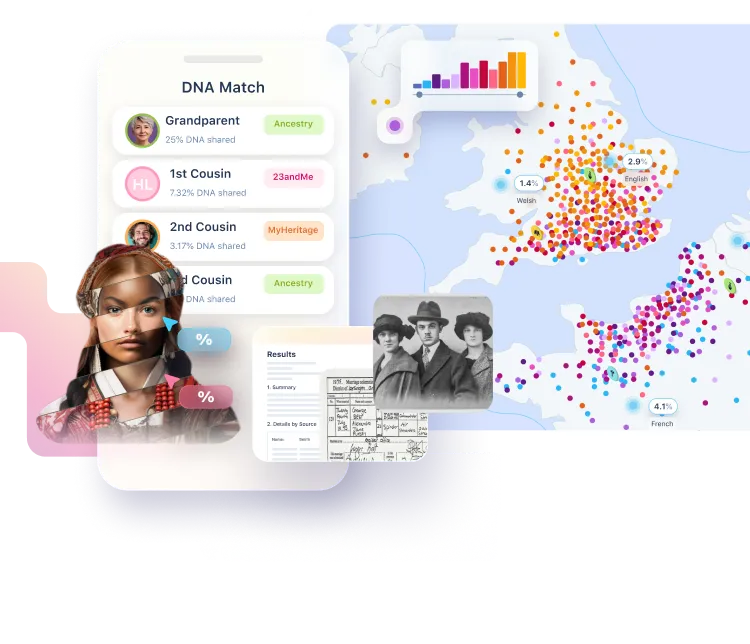
Combine your DNA data with your family tree to unlock the full power of YourRoots DNA Match. Connect with relatives across major testing services — Ancestry, 23andMe, MyHeritage, and more.
View your matches' maps and trees to identify shared ancestors, and soon you'll be able to add them directly to your own tree and map.
Ancestry DNA analysis that goes deeper than others
Unlock exclusive reports that reveal your deeper origins.
- Deep Ancestry Report — Analyze 130+ ethnicities, sub-regions, and 1,800+ communities in one detailed view.
- Global & Native American Reports — Developed with Stanford researchers to uncover hidden ancestries across all 22 chromosomes.
- Ancient DNA Series — Compare your DNA with 1,000+ ancient genomes from Viking, Celtic, and early American civilizations.
Sign up to explore more
Create a free account to navigate family trees, view ancestors, and discover connections.
Coming Soon
We're actively working on many new features for YourRoots. Features marked v2 are ones we're planning to launch soon.
Have a particular feature request? Let us know below!