
Sign up to explore more
Create a free account to navigate family trees, view ancestors, and discover connections.

Sign up to explore more
Create a free account to navigate family trees, view ancestors, and discover connections.
Mure Family Genealogy & History
Discover the Global Legacy of the Mure Surname
The Mure surname is steeped in Scottish history, originating in the early 12th century. This name is intertwined with the cultural and historical tapestry of Scotland, signifying both aristocratic and common roots. As a family history expert, exploring the Mure family tree unveils a lineage that has thrived over centuries, establishing a formidable presence throughout the Scottish landscape.
Over time, the Mure name expanded beyond its Scottish origins, particularly during the 14th and 15th centuries. This period marked a significant geographical evolution, as branches of the Mure family migrated to neighboring regions. By the 16th century, the Mure genealogy had spread into England and Ireland, reflecting broader migration patterns. This expansion continued into the 18th and 19th centuries, with family members seeking opportunities across continents, including North America and Australia.
YourRoots data enriches our understanding of the Mure family by confirming its Scottish roots in the 12th century. It highlights the surname's widespread presence across Scotland and documents its growth during the medieval period. This data complements existing records, illustrating how the Mure name became integral to both Scottish nobility and common society, and it underscores the family's resilience and adaptability through the centuries.
For genealogists and family-tree researchers, YourRoots offers a valuable resource for tracing the Mure genealogy. By providing comprehensive Mure records, it helps uncover the rich history and global connections of the Mure family tree, offering insights into the enduring legacy of a name that has traversed time and geography.
Find the Mure Family Tree
Search more Mure trees & genealogy records
Records
-
WMWilliam Mure1265–1346Individual Tree PersonParents: Archibald Mure & Margaret MontgomerySpouse: Margaret LindsayChildren: Adam, Reginald, Reynold, MargaretScore: AWMWilliam Mure1265–1346Individual Tree PersonParents: Archibald Mure & Margaret MontgomerySpouse: Margaret LindsayChildren: Adam, Reginald, Reynold, MargaretScore: A
-
MMMungo Muir Mure1500–1547Individual Tree PersonParents: Mungo MURE & Lady MoraySpouse: Lady CampbellChildren: Robarte, Margaret, ThomasScore: AMMMungo Muir Mure1500–1547Individual Tree PersonParents: Mungo MURE & Lady MoraySpouse: Lady CampbellChildren: Robarte, Margaret, ThomasScore: A
-
JMJanet Joan, Lady Danzielstour, Heiress Polkelly, Cunningham Mure1290–1330Individual Tree PersonParents: Gilchrist Mure & Joanna MureSpouse: Sir MureChildren: Elizabeth, Sir, John, Christiana, Jean, Agnes, Moira, N, Elizabeth, AndrewScore: AJMJanet Joan, Lady Danzielstour, Heiress Polkelly, Cunningham Mure1290–1330Individual Tree PersonParents: Gilchrist Mure & Joanna MureSpouse: Sir MureChildren: Elizabeth, Sir, John, Christiana, Jean, Agnes, Moira, N, Elizabeth, AndrewScore: A
-
LMLady Janet Mure1295–1330Individual Tree PersonSpouse: Lord MureChildren: Elizabeth, Moira, AdamScore: ALMLady Janet Mure1295–1330Individual Tree PersonSpouse: Lord MureChildren: Elizabeth, Moira, AdamScore: A
-
CMChristian Mure1456–1523Individual Tree PersonParents: Archibald Mure & Isabel MontgomerySpouse: Archibald BoydChildren: Janet, Elizabeth, Patrick, Margaret, Robert, Janet, BOYD, Janet, JanetScore: ACMChristian Mure1456–1523Individual Tree PersonParents: Archibald Mure & Isabel MontgomerySpouse: Archibald BoydChildren: Janet, Elizabeth, Patrick, Margaret, Robert, Janet, BOYD, Janet, JanetScore: A
-
EMElizabeth Mure1320–1355Individual Tree PersonParents: Adam Mure & Joanna DanzielstourSpouse: Robert Scotland, King IIChildren: Elizabeth, RobertScore: AEMElizabeth Mure1320–1355Individual Tree PersonParents: Adam Mure & Joanna DanzielstourSpouse: Robert Scotland, King IIChildren: Elizabeth, RobertScore: A
-
EMElizabeth Mure1320–1355Individual Tree PersonParents: Sir Mure & Joanna ScotlandSpouse: King IIChildren: RobertScore: AEMElizabeth Mure1320–1355Individual Tree PersonParents: Sir Mure & Joanna ScotlandSpouse: King IIChildren: RobertScore: A
-
SMSir Robert Mure1547–1615Individual Tree PersonParents: Sir Mure & Margaret ColquhounScore: ASMSir Robert Mure1547–1615Individual Tree PersonParents: Sir Mure & Margaret ColquhounScore: A
-
AMAlicia Elizabeth Mure1320–1366Individual Tree PersonParents: Robert Cowdams & Sibilla GrahamSpouse: John RalstonChildren: Marjory, Katherine, Isabella, Egidia, Walter, Margaret, ElizabethScore: AAMAlicia Elizabeth Mure1320–1366Individual Tree PersonParents: Robert Cowdams & Sibilla GrahamSpouse: John RalstonChildren: Marjory, Katherine, Isabella, Egidia, Walter, Margaret, ElizabethScore: A
-
SMSir Adam Rowallan Mure1290–1380Individual Tree PersonParents: William Mure & Margaret LindseySpouse: Johanna CunninghamChildren: Elizabeth, Andrew, Adam, Christiana, Alexander, Archibald, James, Jean, Reginald, Rankine, John, Andrew, Elizabeth, MoiraScore: ASMSir Adam Rowallan Mure1290–1380Individual Tree PersonParents: William Mure & Margaret LindseySpouse: Johanna CunninghamChildren: Elizabeth, Andrew, Adam, Christiana, Alexander, Archibald, James, Jean, Reginald, Rankine, John, Andrew, Elizabeth, MoiraScore: A
-
JMJames Mure1657–1715Individual Tree PersonParents: William (Mure) & Euphemia (Mure)Spouse: Elizabeth HutchisonChildren: ThomasScore: AJMJames Mure1657–1715Individual Tree PersonParents: William (Mure) & Euphemia (Mure)Spouse: Elizabeth HutchisonChildren: ThomasScore: A
-
EMElizabeth Mure1320–1355Individual Tree PersonParents: Lord Mure & Lady MureSpouse: Robert ScotlandChildren: Joan, Robert, Robert, RobertScore: AEMElizabeth Mure1320–1355Individual Tree PersonParents: Lord Mure & Lady MureSpouse: Robert ScotlandChildren: Joan, Robert, Robert, RobertScore: A
-
EMElizabeth Mure1320–1354Individual Tree PersonParents: Adam I & Janet MureSpouse: Robert IIChildren: Johanna, Margaret, Robert, Walter, Robert, Alexander, Elizabeth, Isabell, Marjory, KatherineScore: AEMElizabeth Mure1320–1354Individual Tree PersonParents: Adam I & Janet MureSpouse: Robert IIChildren: Johanna, Margaret, Robert, Walter, Robert, Alexander, Elizabeth, Isabell, Marjory, KatherineScore: A
-
WMWilliam (Sir) Lord of Rowallen Mure1265–1348Individual Tree PersonParents: Archibald Rowallen & Margaretha MontgomerySpouse: Margaretha LindsayChildren: AdamScore: AWMWilliam (Sir) Lord of Rowallen Mure1265–1348Individual Tree PersonParents: Archibald Rowallen & Margaretha MontgomerySpouse: Margaretha LindsayChildren: AdamScore: A
-
EMElizabeth Mure1320–1355Individual Tree PersonParents: Adam More & Joanna CunninghamSpouse: Robert StewartChildren: King, Robert, Alexander, Walter, Margaret, AlexanderScore: AEMElizabeth Mure1320–1355Individual Tree PersonParents: Adam More & Joanna CunninghamSpouse: Robert StewartChildren: King, Robert, Alexander, Walter, Margaret, AlexanderScore: A
-
JMJohn Mure1405–1490Individual Tree PersonParents: John Caldwell & Marjory MureSpouse: Elizabeth LindsayChildren: MarjoryScore: AJMJohn Mure1405–1490Individual Tree PersonParents: John Caldwell & Marjory MureSpouse: Elizabeth LindsayChildren: MarjoryScore: A
-
MMMargaret Boyd Mure1552–1597Individual Tree PersonParents: Sir Mure & Margaret ColquhounScore: AMMMargaret Boyd Mure1552–1597Individual Tree PersonParents: Sir Mure & Margaret ColquhounScore: A
-
SMSir William Lord of Rowallen Mure1265–1348Individual Tree PersonParents: Archibald Mure & Margaret DeMontgomerieSpouse: Margaret LindseyChildren: Adam, Reynold, Adam, IsabelScore: ASMSir William Lord of Rowallen Mure1265–1348Individual Tree PersonParents: Archibald Mure & Margaret DeMontgomerieSpouse: Margaret LindseyChildren: Adam, Reynold, Adam, IsabelScore: A
-
CMChristine Mure1456–1523Individual Tree PersonParents: Archibald III & Euphame KennedySpouse: Archibald Bonshaw, Archibald Bonshaw, Sir BoydChildren: Marion, Margaret, Robert, Patrick, Janet, BoydScore: ACMChristine Mure1456–1523Individual Tree PersonParents: Archibald III & Euphame KennedySpouse: Archibald Bonshaw, Archibald Bonshaw, Sir BoydChildren: Marion, Margaret, Robert, Patrick, Janet, BoydScore: A
-
EMElizabeth Mure1320–1354Individual Tree PersonParents: Sir Mure & Joanna DanzielstourChildren: James, John, Isabel, Marjory, Robert, Catherine, Thomas, Jean, Lady, Princess, Sir, Isabella, John, King, Alexander, Robert, Egidia, Alexander, Marjorie, Elizabeth, WalterScore: AEMElizabeth Mure1320–1354Individual Tree PersonParents: Sir Mure & Joanna DanzielstourChildren: James, John, Isabel, Marjory, Robert, Catherine, Thomas, Jean, Lady, Princess, Sir, Isabella, John, King, Alexander, Robert, Egidia, Alexander, Marjorie, Elizabeth, WalterScore: A
Search more trees & records for
Mure for free
Tracing Your Mure Family Lineage
Origin of the Mure Family: Where does the Mure surname come from?
The Mure surname first emerged in Scotland during the early 12th century, marking the beginning of a rich genealogical heritage. This early appearance connects the Mure family to the historical fabric of Scotland, establishing roots that would grow into a diverse family tree over the centuries. The significance of this surname in the context of Scottish history highlights the importance of lineage and ancestry for families carrying the Mure name.
Genealogy and Early Family History of Mure
Throughout the 12th and 13th centuries, the Mure family began to establish itself across various regions in Scotland, with a notable presence in both rural and urban areas. As families grew, they branched out, creating multiple lines within the Mure family tree, which began to reflect the complexities of Scottish society during that time. By the late medieval period, the Mure surname had solidified its place within the Scottish aristocracy and common folk alike, leading to a diverse lineage.
During the 14th and 15th centuries, the Mure family continued to flourish, adapting to the changing political and social landscapes of Scotland. This period saw the Mure name spread geographically, as family members migrated to neighboring regions and established new branches of the family tree. The evolution of the Mure lineage during these centuries illustrates a dynamic history intertwined with the broader events of Scotland.
Tracing the Mure Family Tree Through the Centuries
As the Mure surname progressed into the 16th century, the family began to appear in various other regions, showcasing its expansion beyond Scotland. The 17th century marked a period of further geographic growth, with Mure families establishing roots in parts of England and Ireland, reflecting the waves of migration occurring during that time. This expansion continued into the 18th and 19th centuries, as Mure descendants sought new opportunities and spread their branches across continents.
In the 20th century, the Mure surname had a notable presence across several countries, including the United States, Canada, and Australia, as families sought to forge new lives in diverse environments. This global dispersal reflects the adaptability and resilience of the Mure lineage, as descendants maintained connections to their Scottish origins while embracing new cultural identities. The story of the Mure family tree is one of growth and transformation, showcasing the enduring nature of family heritage.
Where to Find Mure Genealogy Records Today
In the modern centuries, the Mure surname can be found in various parts of the world, illustrating its widespread presence and the ongoing interest in family history. Researching Mure genealogy records has become more accessible, especially in the 21st century, with
Famous People with Mure (and Their Family Tree)

Elizabeth Mure
Elizabeth Mure, a significant figure in Scottish history, was the first wife of Robert, High Steward of Scotland, who ascended to the throne as King Robert II. Born around 1320, she entered into a secular marriage with Robert Stewart around 1336, which was later formalized through a papal dispensation in 1349. Despite initial controversies regarding their marriage, Elizabeth bore him at least ten children, thereby playing a crucial role in the royal lineage. Her son, John Stewart, later known as King Robert III, was officially declared heir to the Scottish crown in 1371.
Elizabeth was born at Rowallan Castle to Sir Adam Mure of Rowallan and Janet Mure of Pokelly. She belonged to Clan Muir, which claimed descent from notable figures such as Fergus of Galloway and King Fergus Mór of Dál Riata. Her ancestry possibly includes Elizabeth FitzRoy, the illegitimate daughter of King Henry I of England, linking her to the House of Normandy.
Pierre La Mure
Pierre La Mure was a renowned French author, born on June 15, 1909, in Nice, Alpes-Maritimes. He is best known for his 1950 novel "Moulin Rouge," which vividly depicted the life of the French artist Henri de Toulouse-Lautrec and inspired the classic 1952 film of the same name. La Mure also explored the lives of notable historical figures through his works, including "Beyond Desire," a book about Cécile and Felix Mendelssohn, and "Claire de Lune," focused on Claude Debussy's struggles. His play "Monsieur Toulouse" highlighted Toulouse-Lautrec's interactions with Marie Charlet and Vincent van Gogh. La Mure passed away in California at 67.
G. R. G. Mure
Geoffrey Reginald Gilchrist Mure was a distinguished British idealist philosopher and Oxford academic, renowned for his expertise in Hegelian philosophy. Educated at Eton and Merton College, Oxford, Mure served with distinction in both World Wars, earning accolades such as the Military Cross. He held significant academic roles, including Warden of Merton College and Pro-Vice-Chancellor at Oxford. Mure authored numerous influential works on philosophy, notably on Aristotle and Hegel, contributing extensively to academic literature.
Geoffrey Mure was born on April 8, 1893, to Reginald James Mure and Anna Charlotte Neave. His familial legacy, coupled with an illustrious academic background, positioned him as a leading figure in philosophical circles of his time.

Benoît Jules Mure
Benoît Jules Mure was a pioneering French homeopath, naturalist, and anarcho-communist, born on May 15, 1809, in Lyon. Despite not completing his medical studies at the University of Montpellier, Mure traveled across Europe and embraced homeopathy while battling tuberculosis. He significantly advanced homeopathy in Sicily, Malta, Brazil, and Egypt. In Brazil, he founded the Instituto Homeopático de Saí and the Instituto Homeopático do Brasil, aiming to combat diseases in underprivileged communities. His efforts in Brazil were inspired by Charles Fourier's utopian socialism, leading to the creation of a Phalanstère, though it did not last. Mure later took his expertise to Egypt, continuing his homeopathic mission until his death in Cairo on March 4, 1858.
Reginald de Mure
Reginald de Mure, a distinguished Scottish noble, served twice as the Lord Chamberlain of Scotland, first from 1329 to 1333, and again from 1334 until his death in 1340. Known for his strategic roles and political influence, Mure was appointed as a commissioner to negotiate a truce with England. His marriage to Sybilla de Graham brought him the Abercorn estate, and he was also granted the lands of Tullibardine after the forfeiture of Andrew Murray in 1333. These positions and acquisitions highlight his prominence in Scottish nobility.
Reginald de Mure married Sybilla, the daughter of John de Graham of Dalkeith, Abercorn, and Eskdale, and his wife Isabella. Their union produced notable descendants, including William de Mure of Abercorn, Gilchrist de Mure of Cowdams, and Alicia de Mure, who married into the Herch and Stewart families, respectively. This lineage connects the Mure family to the Lindsay and Stewart families, extending their influence and legacy within Scottish noble circles.
Mure Surname Meaning, Origin, and History
The surname "Mure" is associated with individuals from various backgrounds, including French, Scottish, and Canadian heritage. It has historical ties to notable figures such as Elizabeth Mure, the first wife of Scottish King Robert II, and spans professions from politics to philosophy and literature.
VIEW MOREWhere to Find Genealogy Records for Mure
We’ve analyzed YourRoots tree and records data to uncover where genealogists are finding key sources such as census, birth certificates, marriage records, and obituaries for the Mure family. Explore our most popular genealogy record sources for the Mure surname to learn more.
VIEW MOREAbout YourRoots
Explore your family tree geographically
Import your GEDCOM file to transform your family tree into an interactive global map. See your roots laid out visually and understand your true geographic heritage.
Powerful tools like "Trace Back To Me" instantly map your family's migration paths from a chosen ancestor all the way back to you.
Discover ancestors beyond "end-of-line" automatically
Import your family tree and let AI expand it for you. AI Ancestor Finder scans "end-of-line" ancestors to uncover their parents across hundreds of family lines at once. AI Deep Research analyzes selected ancestors and family clusters, suggesting relevant records and next steps.
Turn on Auto Research Mode to get new discoveries daily or weekly, so your tree keeps growing even while you're away.
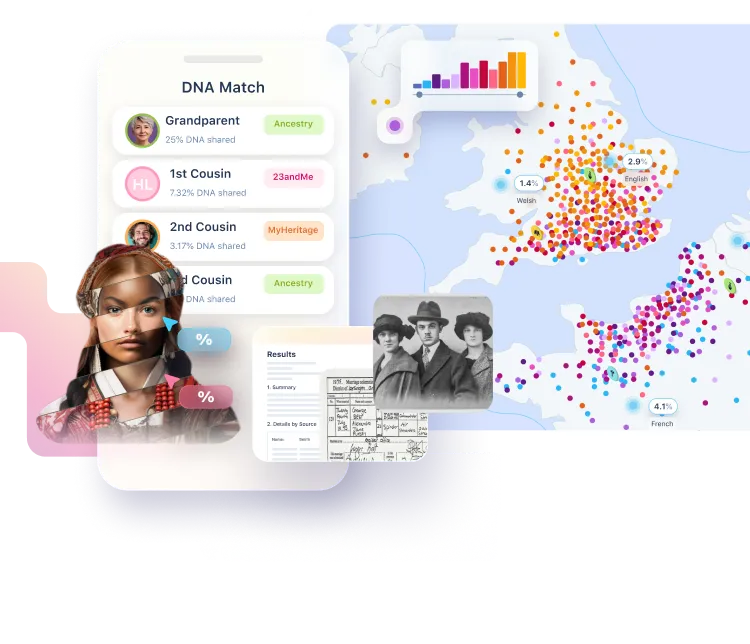
Find more DNA matches across all DNA tests
Combine your DNA data with your family tree to unlock the full power of YourRoots DNA Match. Connect with relatives across major testing services — Ancestry, 23andMe, MyHeritage, and more.
View your matches' maps and trees to identify shared ancestors, and soon you'll be able to add them directly to your own tree and map.
Ancestry DNA analysis that goes deeper than others
Unlock exclusive reports that reveal your deeper origins.
- Deep Ancestry Report — Analyze 130+ ethnicities, sub-regions, and 1,800+ communities in one detailed view.
- Global & Native American Reports — Developed with Stanford researchers to uncover hidden ancestries across all 22 chromosomes.
- Ancient DNA Series — Compare your DNA with 1,000+ ancient genomes from Viking, Celtic, and early American civilizations.
Sign up to explore more
Create a free account to navigate family trees, view ancestors, and discover connections.
Coming Soon
We're actively working on many new features for YourRoots. Features marked v2 are ones we're planning to launch soon.
Have a particular feature request? Let us know below!