
Sign up to explore more
Create a free account to navigate family trees, view ancestors, and discover connections.
Sign up to explore more
Create a free account to navigate family trees, view ancestors, and discover connections.
Philip Family Genealogy & History
Discover the Global Legacy of the Philip Surname
The surname Philip, also spelled as Phillip, originates from the Greek name Philippos, meaning "horse-loving" or "fond of horses." This name became widely recognized through its association with historical figures such as the kings of Macedonia and Philip the Apostle from early Christianity. Over time, the surname has evolved into various forms, including Phillips, and has maintained its presence across different cultures and languages. Diminutive forms such as Phil, Lip, and Pip, along with feminine variations like Philippine and Philippa, further demonstrate the name's adaptability and enduring popularity.
Throughout history, the Philip surname has seen considerable geographical and cultural evolution. Initially prominent in regions influenced by Greek and Roman cultures, the name spread throughout Europe. The Philip family tree expanded significantly during the medieval period, especially in Wales, where it became a notable marker of Welsh heritage. By the 17th and 18th centuries, the surname had crossed the Atlantic, establishing roots in North America, illustrating the family's pursuit of new opportunities and adaptability in diverse environments.
The YourRoots dataset offers valuable insights into the Philip surname, confirming its early presence in Wales during the medieval period. This aligns with historical records indicating the name's significance in Welsh heritage and its gradual spread to neighboring regions. The dataset highlights the family's growth over the centuries, particularly in the 13th century, reflecting their ability to establish new branches and thrive in changing times. By the 19th century, the surname had become prominent in the United States, further enriching its genealogical history.
For genealogy and family-tree researchers, the YourRoots data provides a comprehensive resource for exploring the Philip family tree and genealogy. It reveals a rich tapestry of connections, underscoring the enduring legacy of the Philip surname. With a global presence today, the Philip genealogy records offer descendants the opportunity to delve into their ancestral roots and uncover the intricate history of their family lineage.
Find the Philip Family Tree
Search more Philip trees & genealogy records
Records
-
APAnna Frances Philip1919–2009Individual Tree PersonParents: John Philip & Bessie RowandScore: AAPAnna Frances Philip1919–2009Individual Tree PersonParents: John Philip & Bessie RowandScore: A
-
MPMargaret Philip1812–1900Individual Tree PersonParents: James Philip & Jean WalkerScore: AMPMargaret Philip1812–1900Individual Tree PersonParents: James Philip & Jean WalkerScore: A
-
JPJacob Petrus Philip1724–1800Individual Tree PersonParents: Johann Phillips & Magdelena HaberSpouse: Anna GroatChildren: Peter, Jacobus, Johannes, Wilhelmus, Annetje, Elizabeth, Eva, Magdalena, Caspar, MarietjeScore: AJPJacob Petrus Philip1724–1800Individual Tree PersonParents: Johann Phillips & Magdelena HaberSpouse: Anna GroatChildren: Peter, Jacobus, Johannes, Wilhelmus, Annetje, Elizabeth, Eva, Magdalena, Caspar, MarietjeScore: A
-
CPCharley Dee Philip1927–1988Individual Tree PersonParents: John Phillips & Florence PhillipsScore: ACPCharley Dee Philip1927–1988Individual Tree PersonParents: John Phillips & Florence PhillipsScore: A
-
APAndrew Philip1753–1798Individual Tree PersonParents: Andrew Phillips & Christian AdamScore: AAPAndrew Philip1753–1798Individual Tree PersonParents: Andrew Phillips & Christian AdamScore: A
-
EPElizabeth Jane Philip1920–2011Individual Tree PersonParents: Robert Philip & Janet StillSpouse: Vincent LindquistScore: AEPElizabeth Jane Philip1920–2011Individual Tree PersonParents: Robert Philip & Janet StillSpouse: Vincent LindquistScore: A
-
TPThomas Philip1827–1895Individual Tree PersonParents: Thomas Philp & Mary PatrickSpouse: Agnes SteinChildren: Elizabeth, Catherine, Mary, AgnesScore: ATPThomas Philip1827–1895Individual Tree PersonParents: Thomas Philp & Mary PatrickSpouse: Agnes SteinChildren: Elizabeth, Catherine, Mary, AgnesScore: A
-
GPGwenllian Verch verch Philip1388–1411Individual Tree PersonParents: Philip Llewelyn & Nest SaisSpouse: Dafydd GwilymChildren: Morgan, Gwenllian, Gwilym, RawlingScore: AGPGwenllian Verch verch Philip1388–1411Individual Tree PersonParents: Philip Llewelyn & Nest SaisSpouse: Dafydd GwilymChildren: Morgan, Gwenllian, Gwilym, RawlingScore: A
-
MPMary Philip1746–1814Individual Tree PersonParents: George Philip & Jeals AndersonSpouse: James HarveyChildren: George, Alexander, Peter, Robert, Jane, James, William, John, Isabella, Francis, Adam, Mary, CharlesScore: AMPMary Philip1746–1814Individual Tree PersonParents: George Philip & Jeals AndersonSpouse: James HarveyChildren: George, Alexander, Peter, Robert, Jane, James, William, John, Isabella, Francis, Adam, Mary, CharlesScore: A
-
JPJenkyn Ap Philip1410–1441Individual Tree PersonParents: Philip ApMorgan & Gwenllian NorrisSpouse: Cecily WelshChildren: MorganScore: AJPJenkyn Ap Philip1410–1441Individual Tree PersonParents: Philip ApMorgan & Gwenllian NorrisSpouse: Cecily WelshChildren: MorganScore: A
-
MPMary Philip1901–1978Individual Tree PersonParents: James Philip & Jane NoneSpouse: John Hodgson, William HallChildren: William, James, AnthonyScore: AMPMary Philip1901–1978Individual Tree PersonParents: James Philip & Jane NoneSpouse: John Hodgson, William HallChildren: William, James, AnthonyScore: A
-
JPJohn Matthew Chisholm Philip1916–1995Individual Tree PersonParents: John Philip & Jane ChisholmScore: AJPJohn Matthew Chisholm Philip1916–1995Individual Tree PersonParents: John Philip & Jane ChisholmScore: A
-
JPJenkin Ap Philip1377–1441Individual Tree PersonParents: Philip Morgan & Gwenllian NorrisSpouse: Cecily Welsh, Cecilia WelshChildren: Morgan, William, Morgan, WilliamScore: AJPJenkin Ap Philip1377–1441Individual Tree PersonParents: Philip Morgan & Gwenllian NorrisSpouse: Cecily Welsh, Cecilia WelshChildren: Morgan, William, Morgan, WilliamScore: A
-
GPGladis Verch Philip1220–1280Individual Tree PersonParents: Phillip Bach & Gladis ApRhysSpouse: Elidir Rhys, Cadwallon ApMadog, Elder NoneChildren: Elidir, Gronwy, Lleucu, Eladir, Catrin, Elydyr, elidar, MawdScore: AGPGladis Verch Philip1220–1280Individual Tree PersonParents: Phillip Bach & Gladis ApRhysSpouse: Elidir Rhys, Cadwallon ApMadog, Elder NoneChildren: Elidir, Gronwy, Lleucu, Eladir, Catrin, Elydyr, elidar, MawdScore: A
-
JPJohn (Jack) Philip1881–1954Individual Tree PersonParents: Robert Philip & Sophia MelvilleSpouse: Agnes GrahamChildren: Agnes, Melville, Graham, DouglasScore: AJPJohn (Jack) Philip1881–1954Individual Tree PersonParents: Robert Philip & Sophia MelvilleSpouse: Agnes GrahamChildren: Agnes, Melville, Graham, DouglasScore: A
-
OPOhniel Philip1794–1882Individual Tree PersonParents: David Phelps & Mary SperrySpouse: Sally WeaverChildren: WilliamScore: AOPOhniel Philip1794–1882Individual Tree PersonParents: David Phelps & Mary SperrySpouse: Sally WeaverChildren: WilliamScore: A
-
EPElisabeth Philip1829–1890Individual Tree PersonParents: George Philp & Alison LornieSpouse: John NessChildren: John, Robert, Alison, Alice, Philip, AlexanderScore: AEPElisabeth Philip1829–1890Individual Tree PersonParents: George Philp & Alison LornieSpouse: John NessChildren: John, Robert, Alison, Alice, Philip, AlexanderScore: A
-
JPJames Gibson Philip1870–1952Individual Tree PersonParents: James Philip & Mary GibsonScore: AJPJames Gibson Philip1870–1952Individual Tree PersonParents: James Philip & Mary GibsonScore: A
-
RPRobert Philip1844–1905Individual Tree PersonParents: Thomas Philp & Mary PatrickSpouse: Sophia MelvilleChildren: John, Robert, Thomas, David, Joan, MaryScore: ARPRobert Philip1844–1905Individual Tree PersonParents: Thomas Philp & Mary PatrickSpouse: Sophia MelvilleChildren: John, Robert, Thomas, David, Joan, MaryScore: A
-
MPMargaret Verch PHILIP1368–1407Individual Tree PersonParents: John Sir & John SirSpouse: Thomas LiangaqtegChildren: Elsbeth, DenisScore: AMPMargaret Verch PHILIP1368–1407Individual Tree PersonParents: John Sir & John SirSpouse: Thomas LiangaqtegChildren: Elsbeth, DenisScore: A
Search more trees & records for
Philip for free
Tracing Your Philip Family Lineage
Origin of the Philip Family: Where does the Philip surname come from?
The Philip surname first appeared in historical records during the early medieval period in Wales, marking the beginning of its genealogical journey. This early mention connects to the foundational roots of the family, suggesting a lineage that has persisted for centuries. As families began to establish their identities, the Philip surname became a significant marker in the fabric of Welsh heritage.
Genealogy and Early Family History of Philip
Throughout the early centuries, the Philip family experienced growth primarily in Wales, where the name was notably prevalent. By the medieval period, family branches began to emerge, with records indicating a steady increase in the population bearing the surname. This expansion laid the groundwork for future generations, as families began to establish their own unique lineages and connections.
As the centuries progressed, the Philip family continued to spread, reinforcing their presence in Wales and gradually branching out into neighboring regions. The flourishing of the name during the 13th century particularly highlights the family's ability to adapt and thrive in changing times, further diversifying their genealogical lines. These early migrations and the establishment of new branches were crucial in shaping the family’s history.
Tracing the Philip Family Tree Through the Centuries
The surname Philip saw remarkable expansion across various regions in the following centuries, transitioning from its Welsh roots to broader locales. By the 17th century, the family began to establish itself in England, while the 18th century witnessed a significant migration across the Atlantic to North America. This movement illustrates the adaptability of the Philip family, as they sought new opportunities and continued to grow their family trees.
In the 19th century, the Philip surname reached new heights in the United States, becoming increasingly prominent and leading to a diverse array of family branches. During the 20th century, this trend continued, as descendants of the Philip family spread across various parts of the globe, further enriching the surname's history. Each generation contributed to a complex tapestry of connections, encapsulating the enduring legacy of the Philip name.
Where to Find Philip Genealogy Records Today
In modern centuries, the Philip surname has established a global presence, with significant populations in the United States and beyond. The ongoing evolution of this name offers descendants a chance to explore their rich heritage and connect with their ancestral roots. Readers are encouraged to delve into the Philip genealogy records in the YourRoots database to uncover their own family histories and discover the intricacies of their family trees.
Famous People with Philip (and Their Family Tree)

David Butt Philip
David Butt Philip, a distinguished British operatic tenor born on 12 March 1980, has earned acclaim for his performances at prestigious venues like the Royal Opera House and English National Opera. Notable roles include Rodolfo in "La Bohème," Grigori in "Boris Godunov," and Pinkerton in "Madama Butterfly." He transitioned from baritone to tenor with guidance from conductor Vladimir Jurowski and won the Glyndebourne's John Christie Award in 2011. His training includes the Royal Academy of Music and the National Opera Studio in London, and he is represented by Ingpen and Williams.

Lotte Brand Philip
Lotte Brand Philip was a distinguished German art historian renowned for her expertise in Netherlandish art, particularly the 14th and 15th centuries. A student of Erwin Panofsky, she made significant contributions through her research and writings on artists like Jan van Eyck and Hieronymus Bosch. Despite the challenges posed by her Christian-Jewish heritage during Nazi rule, she eventually emigrated to the United States in 1941. Brand Philip's career flourished, leading her to prominent teaching positions at New York University and Queens College, where she served for 25 years. Her groundbreaking research on the Ghent Altarpiece and her monograph on Bosch are key highlights of her career.
Born Lotte Johanna Friederike Brand in Altona, Hamburg, Germany, on May 27, 1910, she was the daughter of Friedrich Wilhelm Brand and Anna Majud. Raised in a culturally rich environment, she later pursued her academic interests in art history at prestigious institutions, including the Technische Hochschule in Munich and the University of Heidelberg, before completing her doctorate at the University of Freiburg.
Philip Surname Meaning, Origin, and History
The surname "Philip" originates from the Greek name Philippos, meaning "horse-loving" or "fond of horses." This name combines the elements "philos," meaning "dear" or "loved," and "hippos," meaning "horse." The name was popularized by notable figures such as Macedonian kings and an apostle from early Christianity. Over time, variations like Phillips have become common as surnames.
VIEW MOREWhere to Find Genealogy Records for Philip
We’ve analyzed YourRoots tree and records data to uncover where genealogists are finding key sources such as census, birth certificates, marriage records, and obituaries for the Philip family. Explore our most popular genealogy record sources for the Philip surname to learn more.
VIEW MOREAbout YourRoots
Explore your family tree geographically
Import your GEDCOM file to transform your family tree into an interactive global map. See your roots laid out visually and understand your true geographic heritage.
Powerful tools like "Trace Back To Me" instantly map your family's migration paths from a chosen ancestor all the way back to you.
Discover ancestors beyond "end-of-line" automatically
Import your family tree and let AI expand it for you. AI Ancestor Finder scans "end-of-line" ancestors to uncover their parents across hundreds of family lines at once. AI Deep Research analyzes selected ancestors and family clusters, suggesting relevant records and next steps.
Turn on Auto Research Mode to get new discoveries daily or weekly, so your tree keeps growing even while you're away.
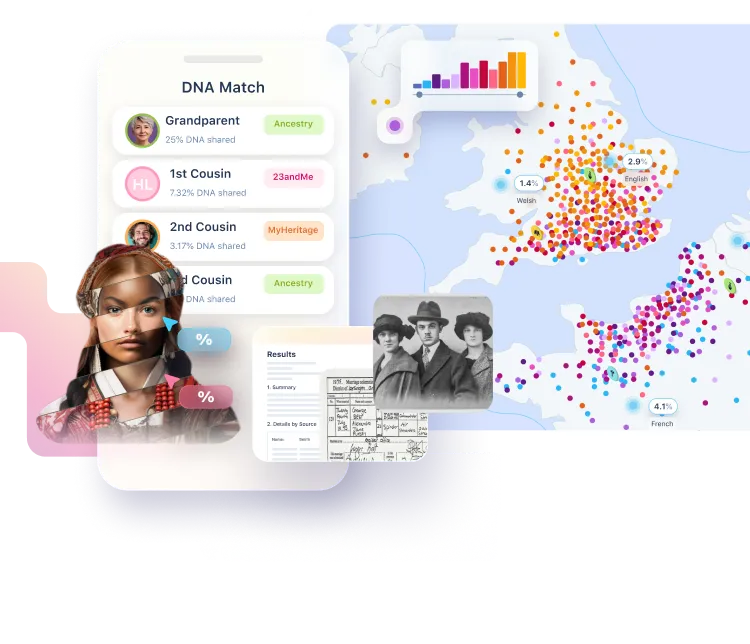
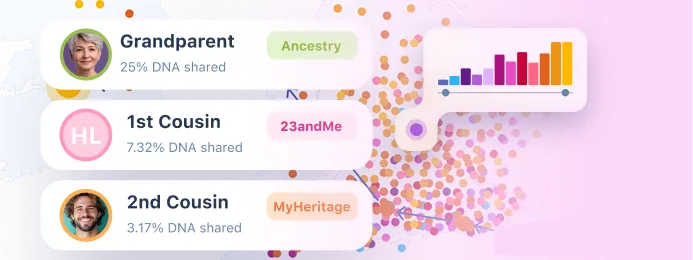
Find more DNA matches across all DNA tests
Combine your DNA data with your family tree to unlock the full power of YourRoots DNA Match. Connect with relatives across major testing services — Ancestry, 23andMe, MyHeritage, and more.
View your matches' maps and trees to identify shared ancestors, and soon you'll be able to add them directly to your own tree and map.
Ancestry DNA analysis that goes deeper than others
Unlock exclusive reports that reveal your deeper origins.
- Deep Ancestry Report — Analyze 130+ ethnicities, sub-regions, and 1,800+ communities in one detailed view.
- Global & Native American Reports — Developed with Stanford researchers to uncover hidden ancestries across all 22 chromosomes.
- Ancient DNA Series — Compare your DNA with 1,000+ ancient genomes from Viking, Celtic, and early American civilizations.
Sign up to explore more
Create a free account to navigate family trees, view ancestors, and discover connections.
Coming Soon
We're actively working on many new features for YourRoots. Features marked v2 are ones we're planning to launch soon.
Have a particular feature request? Let us know below!