
Sign up to explore more
Create a free account to navigate family trees, view ancestors, and discover connections.
Sign up to explore more
Create a free account to navigate family trees, view ancestors, and discover connections.
Post Family Genealogy & History
Discover the Global Legacy of the Post Surname
The surname Post is of Low German and Dutch origin, with roots that can be traced back to both toponymic and occupational sources. It signifies either proximity to a post or marker, or relates to the occupation of a messenger or courier. Those bearing the Post surname have made significant contributions across various fields and countries, such as German politician Achim Post, American author on etiquette Emily Post, and Dutch painter Frans Post, illustrating the diverse legacy of the Post name throughout history.
The Post surname has seen considerable geographical and cultural evolution over time. Initially emerging in the Netherlands, the name expanded to England during the 15th century and later reached the United States by the 17th century, as families migrated in search of new opportunities. Over the centuries, the Post family tree spread across North America, with notable presences in the 18th and 19th centuries, reflecting the broader patterns of migration and settlement that characterized those eras.
YourRoots data corroborates the origins of the Post surname, first appearing in the Netherlands, which aligns with the historical migration patterns seen in the surname's distribution. The records highlight the expansion of the Post family during the 15th century in England and into the United States by the 17th century, thus enhancing our understanding of the surname's historical trajectory. The YourRoots database serves as a valuable resource for individuals seeking to uncover their connections to the Post family tree and explore the rich tapestry of Post genealogy.
In conclusion, the comprehensive records available through YourRoots provide a detailed view of the Post surname's journey through time and across continents. For genealogy enthusiasts and family-tree researchers, these insights offer a deeper understanding of their heritage and the opportunities to connect with their lineage within the broader context of Post records and genealogy.
Find the Post Family Tree
Search more Post trees & genealogy records
Records
-
JPJohannes Adrian Post1690–1783Public Tree Person4 treesScore: AJPJohannes Adrian Post1690–1783Public Tree Person4 treesScore: A
-
SPSamuel Post1668–1735Public Tree Person5 treesScore: ASPSamuel Post1668–1735Public Tree Person5 treesScore: A
-
KPKathleen Beryl Post1910–2001Individual Tree PersonParents: John Rodgers & Jean RodgersSpouse: George PostScore: AKPKathleen Beryl Post1910–2001Individual Tree PersonParents: John Rodgers & Jean RodgersSpouse: George PostScore: A
-
HPHarold Lloyd Post1922–1981Individual Tree PersonParents: Ira Post & Bessie ReynoldsSpouse: Phyllis CoppScore: AHPHarold Lloyd Post1922–1981Individual Tree PersonParents: Ira Post & Bessie ReynoldsSpouse: Phyllis CoppScore: A
-
MPMatilda Ann Post1858–1933Individual Tree PersonParents: John Post & Maria SmithSpouse: William PerryChildren: BurtisScore: AMPMatilda Ann Post1858–1933Individual Tree PersonParents: John Post & Maria SmithSpouse: William PerryChildren: BurtisScore: A
-
RPRuth Elfleta Post1860–1949Individual Tree PersonParents: Warren Post & Deborah BrownScore: ARPRuth Elfleta Post1860–1949Individual Tree PersonParents: Warren Post & Deborah BrownScore: A
-
CPCharlotte Post1862–1948Individual Tree PersonParents: Lemuel Post & Hannah SmithSpouse: Peter RogersChildren: Lovisa, LesterScore: ACPCharlotte Post1862–1948Individual Tree PersonParents: Lemuel Post & Hannah SmithSpouse: Peter RogersChildren: Lovisa, LesterScore: A
-
HPHilda M Post1895–1981Individual Tree PersonParents: Arthur Post & Annie CurteoysScore: AHPHilda M Post1895–1981Individual Tree PersonParents: Arthur Post & Annie CurteoysScore: A
-
CPClarence J. Post1911–1930Individual Tree PersonParents: Edward Post & blanch stoneScore: ACPClarence J. Post1911–1930Individual Tree PersonParents: Edward Post & blanch stoneScore: A
-
EPElizabeth June Post1924–1983Individual Tree PersonParents: Harvey Post & Alma HaynesSpouse: Gabriel OlveraChildren: William, Richard, GabrielScore: AEPElizabeth June Post1924–1983Individual Tree PersonParents: Harvey Post & Alma HaynesSpouse: Gabriel OlveraChildren: William, Richard, GabrielScore: A
-
HPHerbert Arthur Post1896–1961Individual Tree PersonParents: Arthur Post & Annie CurteoysSpouse: Amy HuntChildren: Eileen, Kenneth, ArthurScore: AHPHerbert Arthur Post1896–1961Individual Tree PersonParents: Arthur Post & Annie CurteoysSpouse: Amy HuntChildren: Eileen, Kenneth, ArthurScore: A
-
JPJosiah C POST1848–1852Individual Tree PersonParents: Jacobus POST & Mary ConklinScore: AJPJosiah C POST1848–1852Individual Tree PersonParents: Jacobus POST & Mary ConklinScore: A
-
RPRobert Woodrow Post1913–1987Individual Tree PersonParents: Lewis Post & Lotta NullSpouse: Doris SmithChildren: RobertScore: ARPRobert Woodrow Post1913–1987Individual Tree PersonParents: Lewis Post & Lotta NullSpouse: Doris SmithChildren: RobertScore: A
-
JPJune Marion Post1933–2024Individual Tree PersonParents: Harvey Post & Alma HaynesSpouse: Milford GroffScore: AJPJune Marion Post1933–2024Individual Tree PersonParents: Harvey Post & Alma HaynesSpouse: Milford GroffScore: A
-
MPMaria Mockers (Moockers) Post1649–1695Individual Tree PersonParents: *Capt. Post & *Claretje (Moockers)Score: AMPMaria Mockers (Moockers) Post1649–1695Individual Tree PersonParents: *Capt. Post & *Claretje (Moockers)Score: A
-
APAbram L Post1914–1988Individual Tree PersonParents: Abram Post & Etola CureSpouse: Madeline Mickle, Freda MickleChildren: PearlScore: AAPAbram L Post1914–1988Individual Tree PersonParents: Abram Post & Etola CureSpouse: Madeline Mickle, Freda MickleChildren: PearlScore: A
-
RPRobert Dean Post1941–1941Individual Tree PersonParents: George Sr & Marjorie SnellingScore: ARPRobert Dean Post1941–1941Individual Tree PersonParents: George Sr & Marjorie SnellingScore: A
-
GPGerald Claude Post1915–1982Individual Tree PersonParents: Claude Post & Henrietta SyversenSpouse: Anne PerryScore: AGPGerald Claude Post1915–1982Individual Tree PersonParents: Claude Post & Henrietta SyversenSpouse: Anne PerryScore: A
-
MPMatilda Jane Post1870–1949Individual Tree PersonParents: Manly Rogers & Lucy PostScore: AMPMatilda Jane Post1870–1949Individual Tree PersonParents: Manly Rogers & Lucy PostScore: A
-
WPWilliam Post1857–1923Individual Tree PersonParents: William POST & Margaret PostSpouse: Minnie ShorrockChildren: Myrtle, Edna, Egbert, EthelScore: AWPWilliam Post1857–1923Individual Tree PersonParents: William POST & Margaret PostSpouse: Minnie ShorrockChildren: Myrtle, Edna, Egbert, EthelScore: A
Search more trees & records for
Post for free
Tracing Your Post Family Lineage
Origin of the Post Family: Where does the Post surname come from?
The Post surname first appeared in the records of YourRoots in the Netherlands, marking the beginning of its genealogical journey. This early mention connects to the foundational roots of the Post family, establishing a legacy that would branch out over centuries. The historical context of this surname's emergence highlights the significance of family names during this period, often tied to geographical or occupational origins.
Genealogy and Early Family History of Post
During the 15th century, the Post family began to proliferate, particularly in England, where they established strong familial lines that would contribute to the surname's enduring legacy. The subsequent centuries saw the Post family tree expanding further, with branches sprouting across various regions, including the United States by the 17th century. These families often settled in key areas, building their legacies and connecting with other families, thereby enriching the genealogical tapestry of the Post name.
Tracing the Post Family Tree Through the Centuries
The Post surname experienced significant growth in the United States during the 18th and 19th centuries, reflecting broader migration patterns and the search for new opportunities. This expansion was not limited to one region, as Post families established roots in various states, contributing to the surname's widespread presence in North America. Additionally, the 20th century saw a continuation of this trend, as Post families further diversified and spread globally, creating a complex web of genealogical connections.
Where to Find Post Genealogy Records Today
In modern times, the Post surname remains prevalent, especially within the United States, where it has maintained a consistent presence into the 21st century. The global spread of the surname can be traced through various records, encouraging individuals to explore their own familial connections. Readers are invited to delve into the YourRoots database, where they can uncover the rich history of the Post family and connect with their own family tree.
Famous People with Post (and Their Family Tree)

The Washington Post
The Washington Post, established in 1877, is a leading American daily newspaper with a strong focus on political reporting. Known for its in-depth coverage of the White House and Congress, The Post gained national prominence through landmark investigations like the Pentagon Papers and the Watergate scandal. With 76 Pulitzer Prizes, it stands as a newspaper of record in the U.S., boasting a significant digital audience and maintaining foreign bureaus in major cities worldwide. Owned by Jeff Bezos' Nash Holdings since 2013, The Post remains influential in shaping public discourse.
The Washington Post was revitalized after its purchase by financier Eugene Meyer in 1933, and its legacy was continued by his daughter Katharine Graham and son-in-law Phil Graham, who greatly expanded its reach and reputation.
New York Post
The New York Post is a conservative daily tabloid newspaper published in New York City, originally founded in 1801 by Alexander Hamilton, a prominent Federalist and the first Secretary of the Treasury. Over the centuries, the paper evolved from the New York Evening Post into a widely circulated tabloid, currently ranking as the fourth-largest U.S. newspaper by print circulation as of 2023. The Post has seen influential figures like William Cullen Bryant, William Leggett, and Oswald Garrison Villard in editorial roles, and underwent significant transformations under owners such as Rupert Murdoch, who acquired it in 1976.
Alexander Hamilton, the founder of the New York Post, was a key figure in American history, known for his role as a Founding Father and his service under President George Washington. His initiative to create the newspaper was supported by fellow Federalists like Robert Troup and Oliver Wolcott, reflecting the political landscape of the early 19th century.

Markie Post
Markie Post, born Marjorie Armstrong Post, was a celebrated American actress best known for her roles on iconic TV shows such as "Night Court," where she played public defender Christine Sullivan, and "The Fall Guy" as bail bondswoman Terri Michaels. Her career spanned various genres, including comedy and drama, with notable appearances in series like "Chicago P.D." and films like "There's Something About Mary." Post's engaging performances and diverse roles, from sitcoms to animated series like "Transformers: Prime," highlight her versatility and enduring appeal in the entertainment industry.
Born in Palo Alto, California, Markie Post was raised in a family with a strong academic background. Her father, Richard F. Post, was a physicist, and her mother, Marylee (Armstrong) Post, was a poet. She grew up alongside two siblings in Stanford and Walnut Creek, illustrating a well-rounded upbringing that combined science and the arts. Post's early education included attending Las Lomas High School and Lewis & Clark College, setting the stage for her successful career in acting.

Marjorie Merriweather Post
Marjorie Merriweather Post was a pioneering American businesswoman, socialite, and philanthropist, renowned for her significant influence in the food industry and art world. As the owner of General Foods Corporation, Post played a pivotal role in expanding the company, acquiring major brands like Hellmann's and Jell-O. Her foresight in frozen foods led to the acquisition of Birdseye's company, marking a turning point in food preservation. Post was also a keen art collector, especially of Russian art, and her philanthropic efforts included funding a U.S. Army hospital in France and supporting the Boy Scouts of America.
Born on March 15, 1887, in Springfield, Illinois, Marjorie Merriweather Post was the only child of C. W. Post and Ella Letitia Merriweather. Following her father's death in 1914, she inherited the Postum Cereal Company and a fortune of $20 million, paving the way for her illustrious career. Her father's legacy and her own business acumen established the foundation for the Post family's influence in American industry and philanthropy.

C. W. Post
C. W. Post, born Charles William Post, was a pioneering American innovator and cereal magnate, known for founding Post Consumer Brands. He revolutionized the prepared-food industry with iconic products like Grape-Nuts and Post Toasties. Post's career highlights include his transition from agricultural machinery to real estate development in Texas, and eventually to the creation of the Postum Cereal Co. His ventures were not without controversy, facing accusations of recipe theft from Kellogg and a notable libel lawsuit concerning his health claims. Despite his opposition to trade unions, Post was recognized for providing high wages and benefits to employees.
Born in Springfield, Illinois, C. W. Post was the son of Charles Rollin Post and Caroline Lathrop Post. His family ties included a close relationship with his daughter, Marjorie, from his first marriage to Ella Letitia Merriweather. Marjorie remained devoted to her father even after his controversial second marriage to his secretary, Leila Young. These familial connections deeply influenced his personal and professional life.
Post Surname Meaning, Origin, and History
The surname "Post" originates from Low German and Dutch regions and can be either toponymic, referring to someone living near a post or marker, or occupational, indicating a messenger or courier. It is associated with a diverse group of individuals across various fields, including politics, sports, the arts, and academia.
VIEW MOREWhere to Find Genealogy Records for Post
We’ve analyzed YourRoots tree and records data to uncover where genealogists are finding key sources such as census, birth certificates, marriage records, and obituaries for the Post family. Explore our most popular genealogy record sources for the Post surname to learn more.
VIEW MOREAbout YourRoots
Explore your family tree geographically
Import your GEDCOM file to transform your family tree into an interactive global map. See your roots laid out visually and understand your true geographic heritage.
Powerful tools like "Trace Back To Me" instantly map your family's migration paths from a chosen ancestor all the way back to you.
Discover ancestors beyond "end-of-line" automatically
Import your family tree and let AI expand it for you. AI Ancestor Finder scans "end-of-line" ancestors to uncover their parents across hundreds of family lines at once. AI Deep Research analyzes selected ancestors and family clusters, suggesting relevant records and next steps.
Turn on Auto Research Mode to get new discoveries daily or weekly, so your tree keeps growing even while you're away.
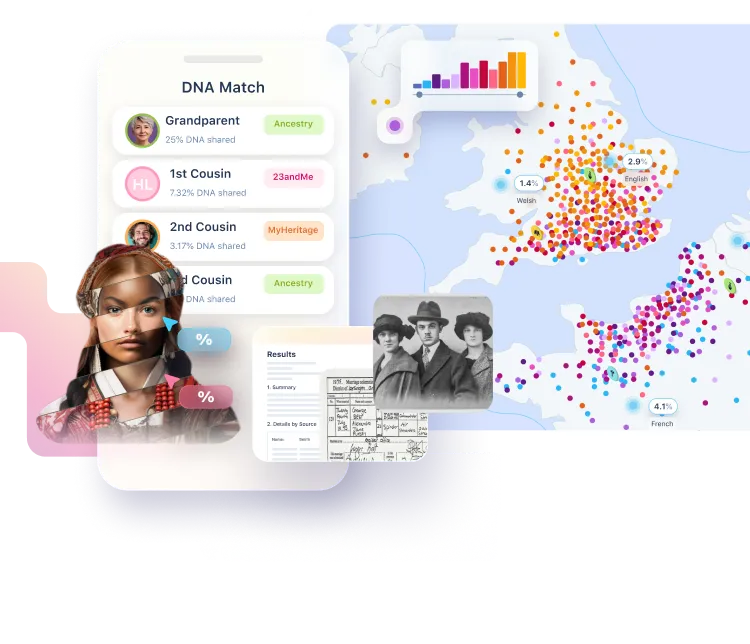
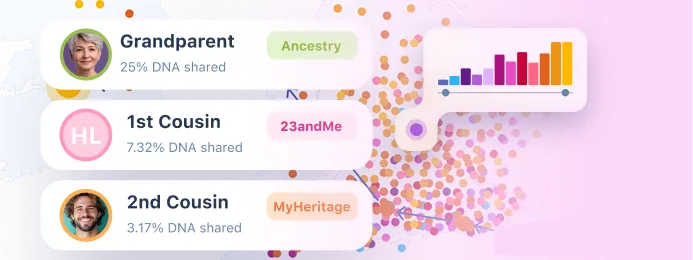
Find more DNA matches across all DNA tests
Combine your DNA data with your family tree to unlock the full power of YourRoots DNA Match. Connect with relatives across major testing services — Ancestry, 23andMe, MyHeritage, and more.
View your matches' maps and trees to identify shared ancestors, and soon you'll be able to add them directly to your own tree and map.
Ancestry DNA analysis that goes deeper than others
Unlock exclusive reports that reveal your deeper origins.
- Deep Ancestry Report — Analyze 130+ ethnicities, sub-regions, and 1,800+ communities in one detailed view.
- Global & Native American Reports — Developed with Stanford researchers to uncover hidden ancestries across all 22 chromosomes.
- Ancient DNA Series — Compare your DNA with 1,000+ ancient genomes from Viking, Celtic, and early American civilizations.
Sign up to explore more
Create a free account to navigate family trees, view ancestors, and discover connections.
Coming Soon
We're actively working on many new features for YourRoots. Features marked v2 are ones we're planning to launch soon.
Have a particular feature request? Let us know below!