
Sign up to explore more
Create a free account to navigate family trees, view ancestors, and discover connections.

Sign up to explore more
Create a free account to navigate family trees, view ancestors, and discover connections.
Saxony Family Genealogy & History
Discover the Global Legacy of the Saxony Surname
The name Saxony has a rich and storied history, deeply rooted in the geographical and political landscape of Germany. Historically, Saxony referred to a region known for its duchy and later as an electorate within the Holy Roman Empire. The name embodies connections to the Saxon tribes of the early medieval period, and it has evolved through various historical phases, including the Kingdom of Saxony and modern-day Free State of Saxony. This historical depth provides a complex backdrop for the Saxony family tree, reflecting a legacy intertwined with the broader narrative of European history.
Over the centuries, the Saxony region has served as a pivotal cultural and political hub, influencing the spread of its name across the continent. The Saxony family tree, much like the region itself, expanded through a series of dynamic historical events that saw the name migrate southward due to political and territorial changes. With Saxony's historical ties to regions such as Thuringia, and its interactions with neighboring states like Poland and the Czech Republic, the Saxony genealogy reveals a tapestry of cultural and familial connections that extend beyond its original borders.
The YourRoots dataset provides insights into the Saxony surname, tracing its origins back to Germany during a period when familial connections were vital for community survival. This aligns with the historical context of Saxony as a significant region within the Holy Roman Empire and later periods. According to YourRoots, the Saxony family established roots across various German regions, contributing to the diversification and intertwining of family branches. This historical spread, documented in Saxony records, enhances the understanding of how the Saxony lineage developed over the centuries.
For those tracing the Saxony family tree, the YourRoots data offers a valuable resource, highlighting the global presence of the Saxony surname today. By exploring Saxony genealogy records, researchers can uncover familial ties that extend across continents, providing a richer understanding of their ancestry. This continuity between historical narratives and genealogical data underscores the enduring legacy of the Saxony name, making it a significant area of interest for family history enthusiasts.
Find the Saxony Family Tree
Search more Saxony trees & genealogy records
Records
-
SSSophie von Mecklenburg-Schwerin, Duchess of Mecklenburg by birth and by marriage Electoral Princess of Saxony1481–1503Individual Tree PersonParents: Magnus of & Sophia StettinSpouse: Johann 1527Children: JohannScore: ASSSophie von Mecklenburg-Schwerin, Duchess of Mecklenburg by birth and by marriage Electoral Princess of Saxony1481–1503Individual Tree PersonParents: Magnus of & Sophia StettinSpouse: Johann 1527Children: JohannScore: A
-
MSMary Saxony1533–1609Individual Tree PersonParents: Johann Saxony & Sibylle KleefSpouse: Edmund CrosmanChildren: AliceScore: AMSMary Saxony1533–1609Individual Tree PersonParents: Johann Saxony & Sibylle KleefSpouse: Edmund CrosmanChildren: AliceScore: A
-
SSSophia Eleonora Princess of Saxony1609–1671Individual Tree PersonParents: John Meissen & Magdalena PrussiaSpouse: Prince Hessen-DarmstadtChildren: LandgravineScore: ASSSophia Eleonora Princess of Saxony1609–1671Individual Tree PersonParents: John Meissen & Magdalena PrussiaSpouse: Prince Hessen-DarmstadtChildren: LandgravineScore: A
-
KSKatharina Princess of Saxony1421–1476Individual Tree PersonParents: Friedrich Sachsen & Princess Braunschweig-LüneburgSpouse: Achilles III, Frederick Hohenzollern, Heinrich SchwerinChildren: Dorothea, Ursula, Erasmus, Johann, Lady, Margaretha, Dorothea, Margarethe, DorotheaScore: AKSKatharina Princess of Saxony1421–1476Individual Tree PersonParents: Friedrich Sachsen & Princess Braunschweig-LüneburgSpouse: Achilles III, Frederick Hohenzollern, Heinrich SchwerinChildren: Dorothea, Ursula, Erasmus, Johann, Lady, Margaretha, Dorothea, Margarethe, DorotheaScore: A
-
ASAugustus II of Poland & SAXONY1670–1733Individual Tree PersonParents: John SAXONY & Anna DENMARKChildren: FrederickScore: AASAugustus II of Poland & SAXONY1670–1733Individual Tree PersonParents: John SAXONY & Anna DENMARKChildren: FrederickScore: A
-
GSGertrude Gertrude Billung Saxony1028–1113Individual Tree PersonParents: Bernhard Saxony & Elika SchweinfurtSpouse: Florent FrieslandChildren: BerthaScore: AGSGertrude Gertrude Billung Saxony1028–1113Individual Tree PersonParents: Bernhard Saxony & Elika SchweinfurtSpouse: Florent FrieslandChildren: BerthaScore: A
-
DSDuchess Marie Magdalena of Saxony1507–1534Individual Tree PersonParents: Georg Sachsen-Meissen & Barbara JAGELLONSpouse: King IIChildren: Johan, Barbara, Albert, Élisabeth, Frédéric, Georges, PaulScore: ADSDuchess Marie Magdalena of Saxony1507–1534Individual Tree PersonParents: Georg Sachsen-Meissen & Barbara JAGELLONSpouse: King IIChildren: Johan, Barbara, Albert, Élisabeth, Frédéric, Georges, PaulScore: A
-
JSJohn Frederick I Magnanimous Elector Saxony1503–1554Individual Tree PersonParents: Edmund Dudley & Elizabeth PlantagenetSpouse: Queen childr, Jane Dudley, Sybille KleefChildren: Johann, Johann, Guildford, Robert, Ambrose, KatherineScore: AJSJohn Frederick I Magnanimous Elector Saxony1503–1554Individual Tree PersonParents: Edmund Dudley & Elizabeth PlantagenetSpouse: Queen childr, Jane Dudley, Sybille KleefChildren: Johann, Johann, Guildford, Robert, Ambrose, KatherineScore: A
-
BSBernhard II of Saxony1000–1059Individual Tree PersonParents: Bernard Saxony & Hildegard StadeSpouse: Elika SchweinfurtChildren: Ida, GertrudeScore: ABSBernhard II of Saxony1000–1059Individual Tree PersonParents: Bernard Saxony & Hildegard StadeSpouse: Elika SchweinfurtChildren: Ida, GertrudeScore: A
-
USUthildis Of Saxony1046–1093Individual Tree PersonParents: Friedrich IIISpouse: Dirk VChildren: FlorisScore: AUSUthildis Of Saxony1046–1093Individual Tree PersonParents: Friedrich IIISpouse: Dirk VChildren: FlorisScore: A
-
*S*Ordulf (Otto) Billung von Sachsen Duke von Saxony1020–1072Individual Tree PersonParents: *Bernard Saxony & *Eilika SchweinfurtSpouse: *Ulvhilde NorwayChildren: *HughScore: A*S*Ordulf (Otto) Billung von Sachsen Duke von Saxony1020–1072Individual Tree PersonParents: *Bernard Saxony & *Eilika SchweinfurtSpouse: *Ulvhilde NorwayChildren: *HughScore: A
-
CSChristina Wettin of Saxony1461–1521Individual Tree PersonParents: Ernst Saxony & Elisabeth Bayern-MünchenSpouse: John SwedenChildren: Christian, JohannScore: ACSChristina Wettin of Saxony1461–1521Individual Tree PersonParents: Ernst Saxony & Elisabeth Bayern-MünchenSpouse: John SwedenChildren: Christian, JohannScore: A
-
ASAmalia Augusta Wettin & Wittelsbach von Bayern, Queen consort of Saxony1801–1877Individual Tree PersonParents: Maximilian Wittelsbach & Frederica BavariaSpouse: John NoneScore: AASAmalia Augusta Wettin & Wittelsbach von Bayern, Queen consort of Saxony1801–1877Individual Tree PersonParents: Maximilian Wittelsbach & Frederica BavariaSpouse: John NoneScore: A
-
USUlfhide of Saxony1079–1126Individual Tree PersonParents: Magnus Billung & Sophie DeHungarySpouse: Henry daniel.derigal.free.frChildren: Judith, Mathilde, HeinrichScore: AUSUlfhide of Saxony1079–1126Individual Tree PersonParents: Magnus Billung & Sophie DeHungarySpouse: Henry daniel.derigal.free.frChildren: Judith, Mathilde, HeinrichScore: A
-
GSGertrude of Saxony1028–1113Individual Tree PersonParents: Duke Saschen & Dutchess SchweinfurtSpouse: Floris Holland, Count IChildren: Bertha, GertrudeScore: AGSGertrude of Saxony1028–1113Individual Tree PersonParents: Duke Saschen & Dutchess SchweinfurtSpouse: Floris Holland, Count IChildren: Bertha, GertrudeScore: A
-
MSMaurice House of Wettin, Elector of Saxony1521–1553Individual Tree PersonParents: Hendrik Saxony & Catherine Mecklenburg-SchwerinSpouse: Agnes HesseChildren: August, AlbrechtScore: AMSMaurice House of Wettin, Elector of Saxony1521–1553Individual Tree PersonParents: Hendrik Saxony & Catherine Mecklenburg-SchwerinSpouse: Agnes HesseChildren: August, AlbrechtScore: A
-
WSWulfhilde —?— of Saxony1075–1126Individual Tree PersonParents: Magnus —?— & Sophia —?—Spouse: Henry Bavaria✔️Children: Judith, HenryScore: AWSWulfhilde —?— of Saxony1075–1126Individual Tree PersonParents: Magnus —?— & Sophia —?—Spouse: Henry Bavaria✔️Children: Judith, HenryScore: A
-
ASAlbrecht "Der Beherzte" Of Saxony1443–1500Individual Tree PersonParents: Friedrich Sachsen & Margarethe HabsburgScore: AASAlbrecht "Der Beherzte" Of Saxony1443–1500Individual Tree PersonParents: Friedrich Sachsen & Margarethe HabsburgScore: A
-
GSGeorge The Bearded, Duke of Saxony1471–1539Individual Tree PersonParents: Albrecht Duke & Sidonia Bohemen)Spouse: Barbara Habsburg)Children: Magdalena, Kristina, Johan, FrederikScore: AGSGeorge The Bearded, Duke of Saxony1471–1539Individual Tree PersonParents: Albrecht Duke & Sidonia Bohemen)Spouse: Barbara Habsburg)Children: Magdalena, Kristina, Johan, FrederikScore: A
-
JSJohn George III, Elector Of Saxony1647–1691Individual Tree PersonParents: Johann SACHSEN & Magdalena HOHENZOLLERNSpouse: Anna DENEMARKENChildren: Friedrich, JohannScore: AJSJohn George III, Elector Of Saxony1647–1691Individual Tree PersonParents: Johann SACHSEN & Magdalena HOHENZOLLERNSpouse: Anna DENEMARKENChildren: Friedrich, JohannScore: A
Search more trees & records for
Saxony for free
Tracing Your Saxony Family Lineage
Origin of the Saxony Family: Where does the Saxony surname come from?
The earliest known appearance of the Saxony surname can be traced back to Germany during a time when familial ties were essential for community and survival. This initial appearance marks the beginning of the Saxony family's genealogical journey, establishing roots that would grow into a complex family tree over centuries. The historical context of this era illustrates a landscape where names often represented geographical origins or familial bonds, setting the stage for the Saxony lineage to flourish.
Genealogy and Early Family History of Saxony
As the Saxony family spread during its early centuries, they began to establish themselves in various regions across Germany. Key areas noted in the YourRoots database include regions where communities were forming and expanding, allowing branches of the Saxony family to develop and intertwine with others. Over time, these families built extensive family trees, merging with local populations and adapting to the changing socio-political landscape.
During the following centuries, the Saxony surname continued to evolve and spread, reflecting the dynamic nature of family lineage. The records show that the family established significant ties in various German regions, contributing to the diversification of their family branches and enhancing their familial connections. This growth period was crucial for the Saxony surname, as it laid the groundwork for future generations to explore their heritage.
Tracing the Saxony Family Tree Through the Centuries
The expansion of the Saxony surname across regions can be observed from one century to another, illustrating a rich tapestry of genealogy. In subsequent centuries, the surname began to spread beyond Germany into other parts of Europe, showcasing a migration of families seeking new opportunities and connections. The global spread of the Saxony name not only highlights their adaptability but also emphasizes the interconnectedness of families across borders.
Throughout the centuries, families with the Saxony surname contributed to the cultural and social fabric of the regions they inhabited. They established themselves in various countries, creating a legacy that intertwines with the broader narrative of migration and settlement. This expansion reflects the dynamic nature of the Saxony family tree, where connections were formed through marriage, commerce, and community engagement.
Where to Find Saxony Genealogy Records Today
In modern centuries, the Saxony surname has seen a notable global presence, with descendants spread across multiple continents. The rich history and genealogy associated with the Saxony name remain accessible, allowing descendants to trace their lineage back through time. Readers are encouraged to explore the Saxony genealogy records available in the YourRoots database to uncover their own family connections and further enrich their understanding of their ancestry.
Famous People with Saxony (and Their Family Tree)

Lower Saxony
Lower Saxony is a prominent German state known for its expansive geography and diverse cultural heritage. Located in northwestern Germany, it is the second-largest state by land area and ranks fourth in population among the 16 Länder of the Federal Republic of Germany. With major cities like Hanover, Braunschweig, and Oldenburg, Lower Saxony plays a significant role in Germany's economy. The state is unique in encompassing both maritime and mountainous regions, featuring popular tourist attractions such as the East Frisian Islands and the Lüneburg Heath. Its rich history is reflected in its adoption of symbols from the historic Kingdom of Hanover.

Kingdom of Saxony
The Kingdom of Saxony was a prominent German monarchy from 1806 to 1918, transitioning from the Electorate of Saxony after the Holy Roman Empire's dissolution. Notable for joining the Confederation of the Rhine and later the German Confederation, it became part of the German Empire in 1871. Saxony's capital was Dresden, and it played a significant role during the Napoleonic era and the Austro-Prussian War, siding with Austria. Following World War I, King Frederick Augustus III abdicated, and Saxony became a free state within the Weimar Republic.
The Kingdom of Saxony originated from the Electorate of Saxony, ruled by the House of Wettin for centuries. This lineage included Frederick Augustus I, who became its first king in 1806.

Electorate of Saxony
The Electorate of Saxony, known as Electoral Saxony or Kurfürstentum Sachsen, was a key territory of the Holy Roman Empire from 1356 to 1806. It played a crucial role as an electorate, contributing significantly to Protestant principalities' protection until Brandenburg-Prussia took over. Originating as the Duchy of Saxe-Wittenberg, it was one of the seven electorates that chose the Holy Roman Emperor. Saxony's notable achievements include a diversified economy, cultural prosperity in the 18th century, and becoming the Kingdom of Saxony in 1806 after aligning with Napoleon.
The Electorate's origins trace back to the House of Ascania, with Bernhard III as its first Saxon duke after Henry the Lion's fall in 1180. The duchy later divided into Saxe-Wittenberg and Saxe-Lauenburg under Albert I's sons, John I and Albert II. The House of Wettin inherited the electoral privilege in 1422, with the Ernestine and Albertine lines emerging from the Treaty of Leipzig in 1485.

Duchy of Saxony
The Duchy of Saxony, a significant German stem duchy, emerged in the early Middle Ages, heavily influenced by its incorporation into the Carolingian Empire post-Saxon Wars. Notably, Duke Henry the Fowler, elected as German king in 919, marked a major leadership milestone. After the deposition of Duke Henry the Lion in 1180, the House of Ascania took over the ducal title, leading to territorial divisions, including the Principality of Anhalt and Brunswick-Lüneburg. By 1356, Saxe-Wittenberg dukes gained the Electorate of Saxony title, showcasing the duchy's evolving political landscape.
The Saxon lineage traces back to influential figures like Count Liudolf, a likely progenitor of the Ottonian dynasty, and his son Bruno, who fought against Viking invasions. These connections underscore Saxony's robust noble heritage.

Frederick Augustus III of Saxony
Frederick Augustus III of Saxony, born on 25 May 1865, was the last King of Saxony, reigning from 1904 to 1918. His military career began at a young age, advancing rapidly to Generalfeldmarschall. Known for his humility and connection with his subjects, he abdicated voluntarily following World War I. Frederick Augustus's legacy includes his leadership in the Royal Saxon Army and his popular reign, marked by his refusal to suppress uprisings during the German Revolution of 1918.
Frederick Augustus was the eldest son of King George of Saxony and Maria Anna of Portugal. His marriage to Archduchess Louise of Austria produced seven children, including Friedrich August Georg and Friedrich Christian. His family ties extended through European royalty, influencing Saxony's historical narrative.
Saxony Surname Meaning, Origin, and History
The surname "Saxony" is derived from the historical region and state in Germany, known for its rich medieval history as a duchy, electorate, and kingdom within the Holy Roman Empire. The name has been used for various political entities over the centuries, including the medieval Duchy of Saxony and the modern Free State of Saxony, reconstituted after German reunification in 1990. The region's name moved southward due to historical developments, and it is distinct from Old Saxony, the original homeland of the Saxon tribes.
VIEW MOREWhere to Find Genealogy Records for Saxony
We’ve analyzed YourRoots tree and records data to uncover where genealogists are finding key sources such as census, birth certificates, marriage records, and obituaries for the Saxony family. Explore our most popular genealogy record sources for the Saxony surname to learn more.
VIEW MOREAbout YourRoots
Explore your family tree geographically
Import your GEDCOM file to transform your family tree into an interactive global map. See your roots laid out visually and understand your true geographic heritage.
Powerful tools like "Trace Back To Me" instantly map your family's migration paths from a chosen ancestor all the way back to you.
Discover ancestors beyond "end-of-line" automatically
Import your family tree and let AI expand it for you. AI Ancestor Finder scans "end-of-line" ancestors to uncover their parents across hundreds of family lines at once. AI Deep Research analyzes selected ancestors and family clusters, suggesting relevant records and next steps.
Turn on Auto Research Mode to get new discoveries daily or weekly, so your tree keeps growing even while you're away.
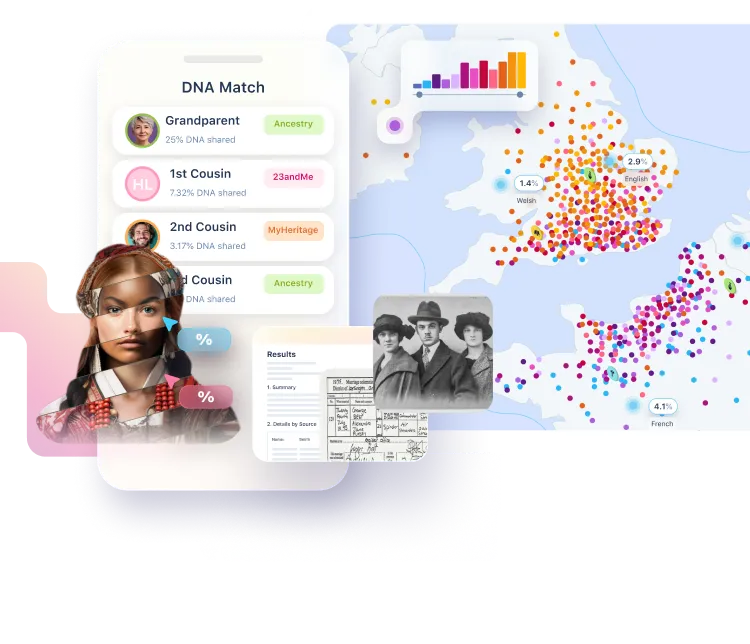
Find more DNA matches across all DNA tests
Combine your DNA data with your family tree to unlock the full power of YourRoots DNA Match. Connect with relatives across major testing services — Ancestry, 23andMe, MyHeritage, and more.
View your matches' maps and trees to identify shared ancestors, and soon you'll be able to add them directly to your own tree and map.
Ancestry DNA analysis that goes deeper than others
Unlock exclusive reports that reveal your deeper origins.
- Deep Ancestry Report — Analyze 130+ ethnicities, sub-regions, and 1,800+ communities in one detailed view.
- Global & Native American Reports — Developed with Stanford researchers to uncover hidden ancestries across all 22 chromosomes.
- Ancient DNA Series — Compare your DNA with 1,000+ ancient genomes from Viking, Celtic, and early American civilizations.
Sign up to explore more
Create a free account to navigate family trees, view ancestors, and discover connections.
Coming Soon
We're actively working on many new features for YourRoots. Features marked v2 are ones we're planning to launch soon.
Have a particular feature request? Let us know below!