
Sign up to explore more
Create a free account to navigate family trees, view ancestors, and discover connections.
Sign up to explore more
Create a free account to navigate family trees, view ancestors, and discover connections.
Schweitzer Family Genealogy & History
Discover the Global Legacy of the Schweitzer Surname
The Schweitzer surname has its origins in Germany, where it first appeared in historical records during a time when family names were becoming formalized. The name is associated with a rich lineage that ties modern descendants to their ancestral roots in Central Europe. This surname has played a significant role in the identity and history of many families, providing a foundation for understanding the Schweitzer family's evolution and migration patterns over the centuries.
Throughout its history, the Schweitzer name spread from Germany to surrounding regions, including Switzerland. The surname became notable through individuals like Albert Schweitzer, a renowned theologian and Nobel Peace Prize winner, and Anton Schweitzer, a German opera composer. As the Schweitzer family tree expanded, its branches reached the United States in the 18th century, marking a new chapter in its geographic and cultural evolution. In the modern era, notable figures such as Brian Schweitzer, former Governor of Montana, and Jeff Schweitzer, a scientist and author, have continued to highlight the surname's prominence.
YourRoots data confirms the Schweitzer surname's origins in Germany, aligning with historical records of its early presence in Central Europe. This dataset shows that the family began to expand into Switzerland and later the United States during the 18th century, reflecting the broader trends of migration and settlement. The YourRoots database provides valuable insights into the growth of the Schweitzer family tree, underscoring its global spread and the resilience of its lineage.
For those interested in exploring their connection to the Schweitzer genealogy, YourRoots offers comprehensive records that enrich the understanding of this family's history. By tracing the Schweitzer family tree through these records, researchers can uncover the interconnected stories that define the Schweitzer legacy, making it an invaluable resource for genealogy enthusiasts.
Find the Schweitzer Family Tree
Search more Schweitzer trees & genealogy records
Records
-
ASAnna Maria Schweitzer1605–1678Public Tree Person3 treesScore: AASAnna Maria Schweitzer1605–1678Public Tree Person3 treesScore: A
-
TSTheodore J. Schweitzer1872–1948Individual Tree PersonParents: Theodor Schweitzer & Anna SchweitzerScore: ATSTheodore J. Schweitzer1872–1948Individual Tree PersonParents: Theodor Schweitzer & Anna SchweitzerScore: A
-
ASAnna Catharina Kuhner - LeFevre - Schweitzer1685–1750Individual Tree PersonParents: Hannß Kühner & Mary BrockSpouse: Lorentz Schweitzer\SwisherChildren: Johann, Johanna, John, John, Lorentz, Wolffgang, Captain, Georg, Elizabeth, Jerg, AnnaScore: AASAnna Catharina Kuhner - LeFevre - Schweitzer1685–1750Individual Tree PersonParents: Hannß Kühner & Mary BrockSpouse: Lorentz Schweitzer\SwisherChildren: Johann, Johanna, John, John, Lorentz, Wolffgang, Captain, Georg, Elizabeth, Jerg, AnnaScore: A
-
RSRussell Benar Schweitzer1921–2000Individual Tree PersonParents: Raymond Sweitzer & Bessie NeintzenheltzerScore: ARSRussell Benar Schweitzer1921–2000Individual Tree PersonParents: Raymond Sweitzer & Bessie NeintzenheltzerScore: A
-
ESElizabeth Schweitzer1850–1926Individual Tree PersonParents: Markus Sr. & Mariana MitzelSpouse: Sebastian SrChildren: Conrad, Katharina, Sebastin, Rosalia, Markus, SteonlausScore: AESElizabeth Schweitzer1850–1926Individual Tree PersonParents: Markus Sr. & Mariana MitzelSpouse: Sebastian SrChildren: Conrad, Katharina, Sebastin, Rosalia, Markus, SteonlausScore: A
-
MSMilton Henry Schweitzer1885–1976Individual Tree PersonParents: George Schweitzer & Almeda SchlegelSpouse: Nellie NelsonChildren: RolandScore: AMSMilton Henry Schweitzer1885–1976Individual Tree PersonParents: George Schweitzer & Almeda SchlegelSpouse: Nellie NelsonChildren: RolandScore: A
-
MSMarion Matilda Schweitzer1893–1947Individual Tree PersonParents: George Schweitzer & Almeda SchlegelSpouse: Alva BradChildren: AlvaScore: AMSMarion Matilda Schweitzer1893–1947Individual Tree PersonParents: George Schweitzer & Almeda SchlegelSpouse: Alva BradChildren: AlvaScore: A
-
JSJohann Christopher Schweitzer1686–1755Individual Tree PersonSpouse: Katherine RuckleChildren: Peter, Martin, Tobias, Christina, Juliana, John, Michael, Margaret, Leonard, CatherineScore: AJSJohann Christopher Schweitzer1686–1755Individual Tree PersonSpouse: Katherine RuckleChildren: Peter, Martin, Tobias, Christina, Juliana, John, Michael, Margaret, Leonard, CatherineScore: A
-
GSGeorge William Schweitzer1913–1982Individual Tree PersonParents: Charles Schweitzer & Alice WebsterSpouse: Antonia CaparrosChildren: John, JohnScore: AGSGeorge William Schweitzer1913–1982Individual Tree PersonParents: Charles Schweitzer & Alice WebsterSpouse: Antonia CaparrosChildren: John, JohnScore: A
-
CSCharles A Schweitzer1875–1958Individual Tree PersonParents: Edward Schweitzer & Mary SchweitzerSpouse: Alice WebsterChildren: George, Charles, Edward, Alice, GeorgeScore: ACSCharles A Schweitzer1875–1958Individual Tree PersonParents: Edward Schweitzer & Mary SchweitzerSpouse: Alice WebsterChildren: George, Charles, Edward, Alice, GeorgeScore: A
-
JSJohann Antonius Schweitzer1707–1794Individual Tree PersonParents: Johann Schweitzer & Dorothea NoneSpouse: Nancy Ryan, Mary SparrowChildren: Christopher, Nathaniel, Martin, Tobias, Jeremiah, Philip, Joseph, Samuel, MaryScore: AJSJohann Antonius Schweitzer1707–1794Individual Tree PersonParents: Johann Schweitzer & Dorothea NoneSpouse: Nancy Ryan, Mary SparrowChildren: Christopher, Nathaniel, Martin, Tobias, Jeremiah, Philip, Joseph, Samuel, MaryScore: A
-
CSCharles Francis Schweitzer1907–1996Individual Tree PersonParents: Charles Schweitzer & Alice WebsterScore: ACSCharles Francis Schweitzer1907–1996Individual Tree PersonParents: Charles Schweitzer & Alice WebsterScore: A
-
GSGeorge Schweitzer1859–1931Individual Tree PersonParents: Theodor Schweitzer & Anna SchweitzerScore: AGSGeorge Schweitzer1859–1931Individual Tree PersonParents: Theodor Schweitzer & Anna SchweitzerScore: A
-
ESEmma Wilhelmina Schweitzer1892–1964Individual Tree PersonParents: Henry Fischer & Louisa MeyscheinScore: AESEmma Wilhelmina Schweitzer1892–1964Individual Tree PersonParents: Henry Fischer & Louisa MeyscheinScore: A
-
ESEdward Phillip Schweitzer1898–1979Individual Tree PersonParents: Edward Schweitzer & Elilia HagerSpouse: Vera HeathScore: AESEdward Phillip Schweitzer1898–1979Individual Tree PersonParents: Edward Schweitzer & Elilia HagerSpouse: Vera HeathScore: A
-
HSHans Setzer Schweitzer1578–1636Individual Tree PersonParents: Jerg Schweitzer & Margretha HellerSpouse: Maria DeiblinChildren: AnnaScore: AHSHans Setzer Schweitzer1578–1636Individual Tree PersonParents: Jerg Schweitzer & Margretha HellerSpouse: Maria DeiblinChildren: AnnaScore: A
-
ESEzra Nell Schweitzer1907–1980Individual Tree PersonParents: Ezra Gowen & Emma GowenSpouse: Eugene Schweitzer, Thomas Sr., Eugene SchweitzerChildren: Eugene, George, James, James, James, James, James, William, Infant, George, Betty, George, JosephScore: AESEzra Nell Schweitzer1907–1980Individual Tree PersonParents: Ezra Gowen & Emma GowenSpouse: Eugene Schweitzer, Thomas Sr., Eugene SchweitzerChildren: Eugene, George, James, James, James, James, James, William, Infant, George, Betty, George, JosephScore: A
-
CSCleve Schweitzer1925–2021Individual Tree PersonParents: Lee Schweitzer & Elma StutzmanSpouse: Luella SchweitzerScore: ACSCleve Schweitzer1925–2021Individual Tree PersonParents: Lee Schweitzer & Elma StutzmanSpouse: Luella SchweitzerScore: A
-
ASAnna WARNER Schweitzer1733–1801Individual Tree PersonSpouse: John Swisher, J SchweitzerChildren: Nancy, Jacob, Maria, LudwigScore: AASAnna WARNER Schweitzer1733–1801Individual Tree PersonSpouse: John Swisher, J SchweitzerChildren: Nancy, Jacob, Maria, LudwigScore: A
-
CSCarol A Schweitzer1941–2021Individual Tree PersonParents: Albert Schweitzer & Dorothy HallSpouse: Donald HilgerScore: ACSCarol A Schweitzer1941–2021Individual Tree PersonParents: Albert Schweitzer & Dorothy HallSpouse: Donald HilgerScore: A
Search more trees & records for
Schweitzer for free
Tracing Your Schweitzer Family Lineage
Origin of the Schweitzer Family: Where does the Schweitzer surname come from?
The Schweitzer surname first emerged in historical records in Germany during a time when family names were becoming more formalized. This early appearance marks a significant point in the genealogical lineage of the Schweitzer family, connecting modern descendants to their ancestral roots in Central Europe. The origins in Germany provide a foundation for understanding the family’s subsequent evolution and migration patterns across regions.
Genealogy and Early Family History of Schweitzer
Throughout its early history, the Schweitzer family predominantly flourished in Germany, where numerous branches of the family tree began to take shape. During the following centuries, members of the Schweitzer family also appeared in Switzerland, indicating early movements and social ties in these regions. This expansion reflects the dynamic nature of family trees as they grew and diversified, adapting to local circumstances and opportunities.
As time progressed, the Schweitzer family established itself in various locales, with significant presence noted in both Germany and Switzerland. These early families laid the groundwork for future generations, creating a rich tapestry of connections that would evolve over the centuries. The historic ties in these regions are essential for tracing the lineage and understanding the family's broader heritage.
Tracing the Schweitzer Family Tree Through the Centuries
The surname Schweitzer saw a considerable expansion in Germany during the late medieval and early modern periods, as families migrated and established new roots. By the 18th century, the family began to make its way to the United States, where the surname gained traction and further diversified in the New World. This transcontinental migration illustrates how the Schweitzer family adapted to new environments while maintaining their heritage.
In the following centuries, the Schweitzer name continued to spread globally, with significant records emerging in the United States. The growth of the surname in North America showcases the family's resilience and ability to flourish in new settings, thus enriching the genealogical narrative of the Schweitzer lineage. This global expansion underscores the broader historical trends of migration and settlement that shaped many family trees during this time.
Where to Find Schweitzer Genealogy Records Today
In modern times, the Schweitzer surname is found across various regions, with clusters emerging in North America and Europe, reflecting the family's historical migrations. The ongoing presence of the Schweitzer name in the 20th and 21st centuries highlights the enduring legacy of this lineage. For those interested in uncovering their own connections to the Schweitzer family, exploring the YourRoots database can provide valuable insights and records to help trace individual family trees.
Famous People with Schweitzer (and Their Family Tree)

Albert Schweitzer
Albert Schweitzer was a renowned German and French polymath, excelling as a theologian, organist, musicologist, writer, humanitarian, philosopher, and physician. Notably, he was awarded the 1952 Nobel Peace Prize for his philosophy of "Reverence for Life." Schweitzer founded the Hôpital Albert Schweitzer in Gabon, contributing significantly to humanitarian efforts. His profound engagement with the music of Johann Sebastian Bach influenced the Organ Reform Movement. Schweitzer's theological work challenged prevailing views of the historical Jesus and explored Pauline Christianity.
Born on January 14, 1875, in Kaysersberg, Alsace, Schweitzer was the son of Adèle (née Schillinger) and Louis Théophile Schweitzer, a Lutheran-Evangelical pastor. He grew up in Gunsbach, Alsace, in an environment that fostered religious tolerance and musical education.

Brian Schweitzer
Brian David Schweitzer, an American farmer and politician, served as the 23rd Governor of Montana from 2005 to 2013. Known for his progressive values and populist rhetoric, Schweitzer's administration was marked by his extensive use of the veto, famously using a branding iron to reject bills in 2011. Schweitzer held leadership roles as chair of the Western Governors Association and the Democratic Governors Association, and served as President of the Council of State Governments. He gained national attention for his folksy public persona and policy stances, including his advocacy for affordable prescription drugs.
Born in Havre, Montana, Schweitzer was the fourth of six children to Kathleen Helen (née McKernan) and Adam Schweitzer. His paternal grandparents were ethnic Germans from Kuchurhan, now in Ukraine, and his maternal grandparents were Irish. Schweitzer is a first cousin, once removed, of entertainer Lawrence Welk, as his paternal grandmother was Welk's aunt.

Wes Schweitzer
Weston Robert Schweitzer, born September 11, 1993, is an accomplished American football offensive guard known for his roles with the New England Patriots and previously with the Atlanta Falcons and Washington Football Team/Commanders in the NFL. A college football standout for the San Jose State Spartans, Schweitzer was a sixth-round draft pick by the Falcons in 2016. Highlights of his career include starting 16 games as a right guard in 2017 and earning second-team All-Mountain West Conference honors in college. His academic achievements are notable, having earned four academic all-conference honors and membership in the 2016 National Football Foundation Hampshire Honor Society.

Mary Higby Schweitzer
Mary Higby Schweitzer is a renowned American paleontologist based at North Carolina State University. She gained prominence for discovering soft tissue and blood cell remains in dinosaur fossils, including the famous Tyrannosaurus rex specimen MOR 1125. Her work in molecular paleontology and taphonomy has revolutionized our understanding of dinosaur physiology and evolution. Schweitzer's groundbreaking research has been recognized with prestigious awards, such as the Dr. Elizabeth 'Betsy' Nicholls Award for Excellence in Palaeontology. Her contributions to paleoproteomics, particularly the role of iron particles in soft tissue preservation, have been pivotal. Schweitzer's discoveries continue to influence the field, as evidenced by a species named in her honor, Avimaia schweitzerae.

Helene Bresslau Schweitzer
Helene Bresslau Schweitzer was a multifaceted German medical missionary, nurse, social worker, linguist, and feminist known for co-founding the Albert Schweitzer Hospital in Gabon with her husband Albert Schweitzer. Despite her significant contributions, her role in these efforts was often overlooked. An enthusiast of public medicine and sociology, Helene was dedicated to improving healthcare in Africa. Her educational pursuits included nursing and social work, showcasing her commitment to social welfare and healthcare advancement.
Helene was born into the ethnically Jewish Bresslau family on 25 January 1879 in Berlin. Her father, Harry Bresslau, was an academic who worked at the University of Strasbourg, eventually becoming chancellor. The family moved to Alsace for his career, influencing Helene’s education and multilingual capabilities.
Schweitzer Surname Meaning, Origin, and History
The surname "Schweitzer" is of German origin, and it is associated with a variety of notable individuals across diverse fields such as politics, science, and the arts. Prominent figures include Albert Schweitzer, a Nobel Peace Prize-winning theologian and physician, and Anton Schweitzer, a German opera composer from the 18th century.
VIEW MOREWhere to Find Genealogy Records for Schweitzer
We’ve analyzed YourRoots tree and records data to uncover where genealogists are finding key sources such as census, birth certificates, marriage records, and obituaries for the Schweitzer family. Explore our most popular genealogy record sources for the Schweitzer surname to learn more.
VIEW MOREAbout YourRoots
Explore your family tree geographically
Import your GEDCOM file to transform your family tree into an interactive global map. See your roots laid out visually and understand your true geographic heritage.
Powerful tools like "Trace Back To Me" instantly map your family's migration paths from a chosen ancestor all the way back to you.
Discover ancestors beyond "end-of-line" automatically
Import your family tree and let AI expand it for you. AI Ancestor Finder scans "end-of-line" ancestors to uncover their parents across hundreds of family lines at once. AI Deep Research analyzes selected ancestors and family clusters, suggesting relevant records and next steps.
Turn on Auto Research Mode to get new discoveries daily or weekly, so your tree keeps growing even while you're away.
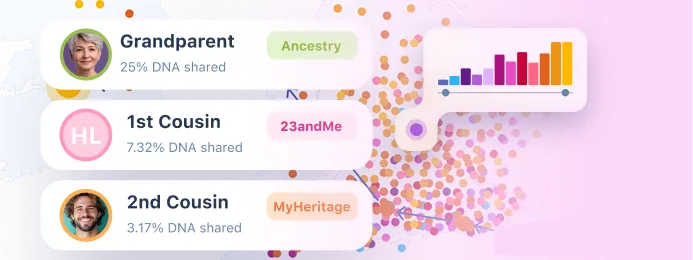
Find more DNA matches across all DNA tests
Combine your DNA data with your family tree to unlock the full power of YourRoots DNA Match. Connect with relatives across major testing services — Ancestry, 23andMe, MyHeritage, and more.
View your matches' maps and trees to identify shared ancestors, and soon you'll be able to add them directly to your own tree and map.
Ancestry DNA analysis that goes deeper than others
Unlock exclusive reports that reveal your deeper origins.
- Deep Ancestry Report — Analyze 130+ ethnicities, sub-regions, and 1,800+ communities in one detailed view.
- Global & Native American Reports — Developed with Stanford researchers to uncover hidden ancestries across all 22 chromosomes.
- Ancient DNA Series — Compare your DNA with 1,000+ ancient genomes from Viking, Celtic, and early American civilizations.
Sign up to explore more
Create a free account to navigate family trees, view ancestors, and discover connections.
Coming Soon
We're actively working on many new features for YourRoots. Features marked v2 are ones we're planning to launch soon.
Have a particular feature request? Let us know below!