
Sign up to explore more
Create a free account to navigate family trees, view ancestors, and discover connections.

Sign up to explore more
Create a free account to navigate family trees, view ancestors, and discover connections.
Shinn Family Genealogy & History
Discover the Global Legacy of the Shinn Surname
The Shinn surname first surfaced in England during the early 16th century, marking the beginning of a lineage deeply intertwined with the social and cultural shifts of the time. Stemming from a society on the cusp of transformation, the Shinn family tree reflects a history of adaptation and growth. This surname, with roots in early English life, provides a fascinating glimpse into the era's evolving social structures.
As the Shinn name became more established, it spread beyond England, particularly during the 17th century, when families sought new prospects. This geographical and cultural diffusion was further propelled by the significant migrations of the 18th century, notably to the United States. By the 19th century, the Shinn surname had woven itself into the fabric of American society, contributing to the diversity and richness of its cultural landscape.
YourRoots data corroborates the early appearance of the Shinn family in England and highlights its subsequent expansion across Europe and North America. As the Shinn genealogy records indicate, the family's history is a tapestry of migrations and settlements, illustrating the resilience and adaptability of its members. The YourRoots dataset enriches this narrative by providing detailed insights into the family's spread and the formation of distinct branches over time.
Today, Shinn genealogy continues to captivate researchers and family historians, with Shinn records available through YourRoots offering a valuable resource for those tracing their lineage. The ongoing interest in the Shinn family tree underscores its enduring legacy and the timeless appeal of exploring one's ancestral roots.
Find the Shinn Family Tree
Search more Shinn trees & genealogy records
Records
-
JSJohn Shinn1737–1766Individual Tree PersonParents: Joseph Shinn & Mary BuddChildren: Tacie, Job, RhodaScore: AJSJohn Shinn1737–1766Individual Tree PersonParents: Joseph Shinn & Mary BuddChildren: Tacie, Job, RhodaScore: A
-
OSOrpha Shinn1797–1862Individual Tree PersonParents: Clement Shinn & Mary ThompsonSpouse: Isaiah HarbertChildren: Sarah, William, Mary, Rhoda, Seth, Lucinda, Robert, BenjaminScore: AOSOrpha Shinn1797–1862Individual Tree PersonParents: Clement Shinn & Mary ThompsonSpouse: Isaiah HarbertChildren: Sarah, William, Mary, Rhoda, Seth, Lucinda, Robert, BenjaminScore: A
-
CSCarl Curtis Shinn1884–1961Individual Tree PersonParents: Joel Shinn & Sarah JobSpouse: Ethel McGrathChildren: Carl, Donald, ElmerScore: ACSCarl Curtis Shinn1884–1961Individual Tree PersonParents: Joel Shinn & Sarah JobSpouse: Ethel McGrathChildren: Carl, Donald, ElmerScore: A
-
PSPaul Frederick Shinn1920–1982Individual Tree PersonParents: Charles Shinn & Margaret Shinn)Score: APSPaul Frederick Shinn1920–1982Individual Tree PersonParents: Charles Shinn & Margaret Shinn)Score: A
-
RSRuth Shinn1919–2005Individual Tree PersonParents: David Shinn & Sun LeeSpouse: Paul WhangScore: ARSRuth Shinn1919–2005Individual Tree PersonParents: David Shinn & Sun LeeSpouse: Paul WhangScore: A
-
ASAbsolom Shinn1818–1861Individual Tree PersonParents: Moses Shinn & Sarah KyleChildren: Savilla, Harriet, Sarah, Henry, Paulina, Charles, James, Mary, GeorgeScore: AASAbsolom Shinn1818–1861Individual Tree PersonParents: Moses Shinn & Sarah KyleChildren: Savilla, Harriet, Sarah, Henry, Paulina, Charles, James, Mary, GeorgeScore: A
-
JSJames Don Shinn1942–1961Individual Tree PersonParents: Raymond Shinn & Myrtle RogersScore: AJSJames Don Shinn1942–1961Individual Tree PersonParents: Raymond Shinn & Myrtle RogersScore: A
-
MSMoses Shinn1779–1871Individual Tree PersonParents: Clement Shinn & Ruth BatesSpouse: Sarah KyleChildren: Justus, Hiram, Matilda, Maria, Merrick, Rezin, Sevilla, Absolom, SampsonScore: AMSMoses Shinn1779–1871Individual Tree PersonParents: Clement Shinn & Ruth BatesSpouse: Sarah KyleChildren: Justus, Hiram, Matilda, Maria, Merrick, Rezin, Sevilla, Absolom, SampsonScore: A
-
GSGeorge Shinn1778–1851Individual Tree PersonParents: George ShinnChildren: Robert, Allen, Francis, Greenbury, Moses, JosephScore: AGSGeorge Shinn1778–1851Individual Tree PersonParents: George ShinnChildren: Robert, Allen, Francis, Greenbury, Moses, JosephScore: A
-
JSJoseph Milton Shinn1809–1849Individual Tree PersonParents: Francis ShinnChildren: Elizabeth, William, John, Mary, CharlesScore: AJSJoseph Milton Shinn1809–1849Individual Tree PersonParents: Francis ShinnChildren: Elizabeth, William, John, Mary, CharlesScore: A
-
SSStacy Shinn1764–1800Individual Tree PersonParents: Restore Shinn & Mary BiddleSpouse: Annie EarlChildren: Sarah, JosephScore: ASSStacy Shinn1764–1800Individual Tree PersonParents: Restore Shinn & Mary BiddleSpouse: Annie EarlChildren: Sarah, JosephScore: A
-
CSC L Shinn1887–1973Individual Tree PersonParents: Albert Shinn & Sarena ShinnSpouse: Georgie ShinnScore: ACSC L Shinn1887–1973Individual Tree PersonParents: Albert Shinn & Sarena ShinnSpouse: Georgie ShinnScore: A
-
FSFrederick C Shinn1878–1960Individual Tree PersonParents: Jas Shinn & Angelica ShinnScore: AFSFrederick C Shinn1878–1960Individual Tree PersonParents: Jas Shinn & Angelica ShinnScore: A
-
JSJames Edwin Shinn1882–1925Individual Tree PersonParents: George Shinn & Della BurnsSpouse: Carolina AbbatticchioChildren: PaulineScore: AJSJames Edwin Shinn1882–1925Individual Tree PersonParents: George Shinn & Della BurnsSpouse: Carolina AbbatticchioChildren: PaulineScore: A
-
RSRebecca Shinn1760–1806Individual Tree PersonParents: Restore Shinn & Mary BiddleSpouse: Arthur VenableChildren: Thomas, Miriam, EstherScore: ARSRebecca Shinn1760–1806Individual Tree PersonParents: Restore Shinn & Mary BiddleSpouse: Arthur VenableChildren: Thomas, Miriam, EstherScore: A
-
TSThomas Atkenson Shinn1666–1695Individual Tree PersonParents: John Sr & Jane GarwoodSpouse: Mary ShinnChildren: SamuelScore: ATSThomas Atkenson Shinn1666–1695Individual Tree PersonParents: John Sr & Jane GarwoodSpouse: Mary ShinnChildren: SamuelScore: A
-
JSJob Shinn1749–1793Individual Tree PersonParents: William Shinn & Exercise CorliesScore: AJSJob Shinn1749–1793Individual Tree PersonParents: William Shinn & Exercise CorliesScore: A
-
HSHannah Shinn1698–1764Individual Tree PersonParents: James Shinn & Abigail LippincottSpouse: John AtkinsonChildren: Samuel, Elizabeth, SamuelScore: AHSHannah Shinn1698–1764Individual Tree PersonParents: James Shinn & Abigail LippincottSpouse: John AtkinsonChildren: Samuel, Elizabeth, SamuelScore: A
-
HSHyman Shinn1817–1890Individual Tree PersonParents: Daniel Virginia & Mary WhitemanSpouse: Ann BuskirkChildren: Benjamin, William, James, John, Oliver, ThomasScore: AHSHyman Shinn1817–1890Individual Tree PersonParents: Daniel Virginia & Mary WhitemanSpouse: Ann BuskirkChildren: Benjamin, William, James, John, Oliver, ThomasScore: A
-
ASAaron Shinn1803–1867Individual Tree PersonParents: Israel Shinn & Hannah HainesChildren: Mary, Hannah, Aaron, WilliamScore: AASAaron Shinn1803–1867Individual Tree PersonParents: Israel Shinn & Hannah HainesChildren: Mary, Hannah, Aaron, WilliamScore: A
Search more trees & records for
Shinn for free
Tracing Your Shinn Family Lineage
Origin of the Shinn Family: Where does the Shinn surname come from?
The Shinn surname first appeared in England during the early 16th century, marking the beginning of a rich familial lineage. This initial record connects to the roots of the Shinn family tree, establishing a foundation for generations to come. The historical context of England during this time suggests a society beginning to see changes in social structure and mobility, which likely influenced family dynamics and the dispersion of surnames.
Genealogy and Early Family History of Shinn
Throughout the subsequent centuries, the Shinn family began to spread, primarily remaining concentrated in England, particularly in the southeastern regions. During the 17th century, the family lines started to branch out, as individuals and families sought new opportunities. This expansion laid the groundwork for the development of distinct Shinn branches, each with its own unique genealogical narrative.
As the Shinn families established themselves, they began to build their family trees through marriages and migrations. The movement of Shinn descendants during this time often coincided with significant historical events, fostering connections that would influence future generations. This early family history reveals a tapestry of relationships that enriched the Shinn lineage over time.
Tracing the Shinn Family Tree Through the Centuries
The evolution of the Shinn surname across centuries showcases a remarkable geographical expansion, particularly as families migrated to the United States during the 18th century. By the early 19th century, the Shinn name had firmly established itself in American territories, where it flourished and diversified. This migration not only contributed to the growth of the Shinn family tree but also integrated the Shinn lineage into the broader narrative of American history and culture.
As the family continued to grow, its members spread to various regions across the United States and beyond, with notable concentrations in the northern and midwestern states during the late 19th and early 20th centuries. This global dissemination reflects the adaptability and resilience of the Shinn families, as they navigated the changes and challenges of their times. Each branch contributed to a shared identity while preserving unique histories and traditions.
Where to Find Shinn Genealogy Records Today
In modern times, the Shinn surname continues to be present across various regions, particularly in North America and parts of Europe, as families seek to trace their roots. The 20th and 21st centuries have seen a resurgence in interest in genealogy, with many descendants eager to connect with their Shinn ancestry. Readers are encouraged to explore the comprehensive Shinn genealogy records available in the YourRoots database to uncover their own family tree connections and discover the rich history that accompanies the Shinn surname.
Famous People with Shinn (and Their Family Tree)

Florence Scovel Shinn
Florence Scovel Shinn, born September 24, 1871, in Camden, New Jersey, was a renowned American artist, illustrator, and New Thought spiritual teacher. Best known for her influential book "The Game of Life and How to Play It" (1925), Shinn emphasized the power of positive thinking and verbal affirmations. Her other notable works include "Your Word is Your Wand" (1928) and "The Secret Door to Success" (1940). With a unique ability to blend humor and wisdom, Shinn's writings continue to inspire those seeking spiritual enlightenment and personal growth.
Florence Scovel Shinn was the daughter of Alden Cortlandt Scovel and Emily Hopkinson Scovel. Her family had notable historical ties, as her great-great-grandfather, Francis Hopkinson, was a signer of the United States Declaration of Independence and an early American composer. She was educated in Philadelphia, where she met her future husband, Everett Shinn, a prominent artist. Together, they lived in New York City before their divorce in 1912.

George Shinn
George Shinn, born on May 11, 1941, is a prominent American businessman known for his ownership of the Charlotte/New Orleans Hornets, Charlotte Knights, and Gastonia Rangers minor league teams. He gained recognition for purchasing the Hornets in 1987 for $32.5 million and later relocating the team to New Orleans. Shinn's entrepreneurial spirit is evident through his creation of Rutledge Education Systems and the George Shinn Foundation, which provides scholarships and supports community initiatives like Hoops for Homes. His accolades include the Horatio Alger Award and the American Red Cross Humanitarian of the Year.
Shinn was born in Kannapolis, North Carolina, and attended A. L. Brown High School. Details about his parents or family origins are not specified in the source text.

Everett Shinn
Everett Shinn, an influential American painter, was a prominent member of the Ashcan School, known for his urban realism and vivid depictions of street life and theater scenes. Born on November 6, 1876, Shinn began his career as a newspaper illustrator in Philadelphia, showcasing his exceptional talent for capturing animated movement. He transitioned to painting, becoming renowned for his pastel works and contributions to magazines like Harper's and Vanity Fair. Despite facing financial challenges during the Great Depression, Shinn's legacy endured through his participation in numerous exhibitions and his association with the Ashcan School's achievements. Shinn passed away on May 1, 1953, in New York City.
Everett Shinn was born in Woodstown, New Jersey, into a Quaker-dominated community. His parents, Isaiah Conklin Shinn and Josephine Ransley Shinn, were rural farmers. Shinn, named after author Edward Everett Hale, displayed a remarkable talent for drawing from a young age. He pursued education in mechanical drawing at the Spring Garden Institute and later at the Pennsylvania Academy of the Fine Arts, setting the foundation for his illustrious career in the arts.

Chris Shinn
Chris Shinn, born August 1, 1974, is an accomplished American singer, songwriter, and musician known for his tenure as the lead singer of the band Live from 2012 to 2016. Before joining Live, Shinn made a mark with Unified Theory, formerly known as Luma, where his exceptional voice and songwriting skills were praised. Unified Theory, which formed in 1998, released a self-titled debut album in 2000 and briefly reunited in 2010. Shinn's contribution to Live included performances during tours and on the band's 2014 album, The Turn. His career highlights showcase his versatility and impact on the rock music scene.
Chris Shinn is the son of George Shinn, the former owner of the Charlotte Hornets. This connection places Chris within a notable family background, linking him to a figure known for significant contributions to the sports industry.
Suzy Shinn
Suzanne Lyn Shinn, known professionally as Suzy Shinn, is a renowned American producer, songwriter, and engineer based in Los Angeles. With a background in music production and engineering from Berklee College of Music, Shinn has made significant contributions to the music industry. Her collaborations include high-profile artists such as Panic! at the Disco, Weezer, Fall Out Boy, Dua Lipa, and Katy Perry. Notably, she co-wrote and produced "Catch 22" by Illy featuring Anne-Marie, winning the 2018 APRA Urban Work of the Year. Shinn's versatility is further highlighted by her Splice sample pack release in 2019 and contributions to visual media, including music for the 2022 release of Zootopia+.
Shinn Surname Meaning, Origin, and History
The surname "Shinn" is associated with numerous individuals across various professions, primarily in America, including artists, politicians, and writers. It also appears in place names such as Shinn, Fremont, California, and Mount Shinn. The name has cultural references in fiction, such as characters in "The Music Man."
VIEW MOREWhere to Find Genealogy Records for Shinn
We’ve analyzed YourRoots tree and records data to uncover where genealogists are finding key sources such as census, birth certificates, marriage records, and obituaries for the Shinn family. Explore our most popular genealogy record sources for the Shinn surname to learn more.
VIEW MOREAbout YourRoots
Explore your family tree geographically
Import your GEDCOM file to transform your family tree into an interactive global map. See your roots laid out visually and understand your true geographic heritage.
Powerful tools like "Trace Back To Me" instantly map your family's migration paths from a chosen ancestor all the way back to you.
Discover ancestors beyond "end-of-line" automatically
Import your family tree and let AI expand it for you. AI Ancestor Finder scans "end-of-line" ancestors to uncover their parents across hundreds of family lines at once. AI Deep Research analyzes selected ancestors and family clusters, suggesting relevant records and next steps.
Turn on Auto Research Mode to get new discoveries daily or weekly, so your tree keeps growing even while you're away.
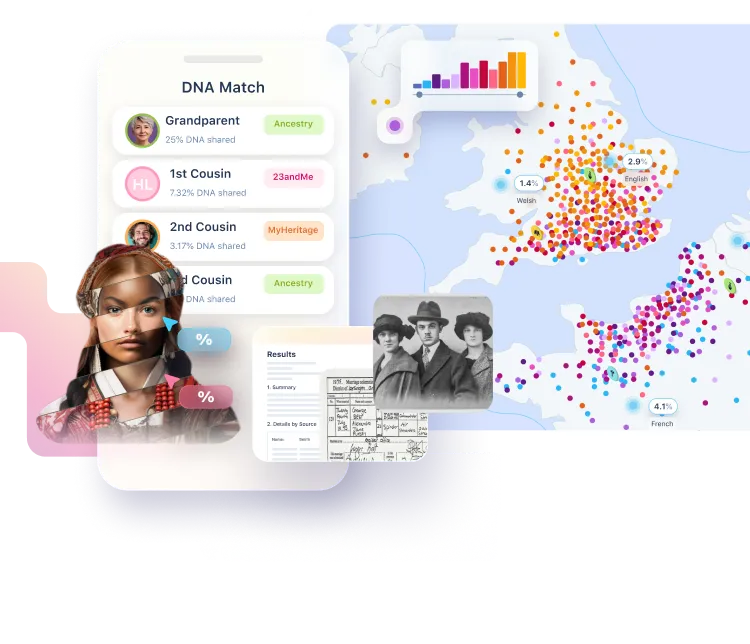
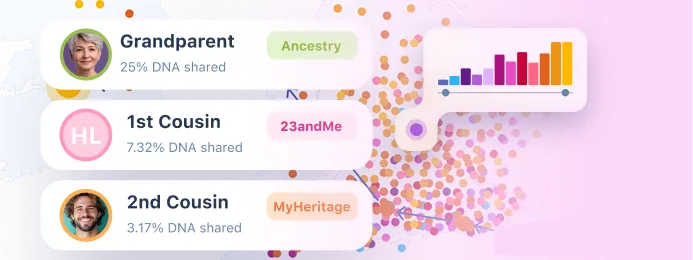
Find more DNA matches across all DNA tests
Combine your DNA data with your family tree to unlock the full power of YourRoots DNA Match. Connect with relatives across major testing services — Ancestry, 23andMe, MyHeritage, and more.
View your matches' maps and trees to identify shared ancestors, and soon you'll be able to add them directly to your own tree and map.
Ancestry DNA analysis that goes deeper than others
Unlock exclusive reports that reveal your deeper origins.
- Deep Ancestry Report — Analyze 130+ ethnicities, sub-regions, and 1,800+ communities in one detailed view.
- Global & Native American Reports — Developed with Stanford researchers to uncover hidden ancestries across all 22 chromosomes.
- Ancient DNA Series — Compare your DNA with 1,000+ ancient genomes from Viking, Celtic, and early American civilizations.
Sign up to explore more
Create a free account to navigate family trees, view ancestors, and discover connections.
Coming Soon
We're actively working on many new features for YourRoots. Features marked v2 are ones we're planning to launch soon.
Have a particular feature request? Let us know below!