
Sign up to explore more
Create a free account to navigate family trees, view ancestors, and discover connections.
Sign up to explore more
Create a free account to navigate family trees, view ancestors, and discover connections.
Unger Family Genealogy & History
Discover the Global Legacy of the Unger Surname
The Unger surname, meaning "Hungarian," has its roots in Germany, where it first appeared in historical records during the early 16th century. This period marked the beginning of the Unger family's genealogical journey, as families increasingly documented their lineages. The Unger name is associated with various notable individuals, including writers, artists, and professionals from different fields, reflecting the diverse achievements of those who bear this surname.
Throughout the centuries, the Unger family has expanded beyond Germany, establishing significant roots in regions such as England and the United States. The 17th century saw the family seeking new opportunities, leading to the diversification of family branches as members adapted to new environments while maintaining their shared heritage. By the 18th century, many Unger family members had migrated to the United States, enriching the family's history and expanding their network of descendants across continents.
YourRoots data aligns with the historical spread of the Unger surname, confirming its presence in Germany since the 16th century. The data highlights the family's expansion during the 19th century, with the United States becoming a major hub for the Unger family. This migration facilitated connections back to their European roots, demonstrating the family's resilience and adaptability as they established themselves in diverse regions, including Canada and Australia.
For those interested in tracing the Unger family tree, the YourRoots insights reveal the extensive migration patterns and connections of Unger genealogy records. This information provides a valuable resource for genealogy researchers, showcasing the enduring legacy of the Unger surname and its global presence across multiple generations.
Find the Unger Family Tree
Search more Unger trees & genealogy records
Records
-
CUCharles Gotlieb Unger1846–1907Public Tree Person3 treesScore: ACUCharles Gotlieb Unger1846–1907Public Tree Person3 treesScore: A
-
PUPauline E. Unger1908–1996Public Tree Person3 treesScore: APUPauline E. Unger1908–1996Public Tree Person3 treesScore: A
-
MUMatthias Unger1812–1821Individual Tree PersonParents: Hermann UngerScore: AMUMatthias Unger1812–1821Individual Tree PersonParents: Hermann UngerScore: A
-
BUBernard Unger1907–1966Individual Tree PersonParents: Morris Unger & Rose GrassenfeldSpouse: Mildred Satt, Dorris SinclairChildren: MarjorieScore: ABUBernard Unger1907–1966Individual Tree PersonParents: Morris Unger & Rose GrassenfeldSpouse: Mildred Satt, Dorris SinclairChildren: MarjorieScore: A
-
PUPearl Frances Unger1906–1984Individual Tree PersonParents: Ivan Unger & Icy HenrySpouse: Roscoe BarneyChildren: Gilbert, RobertScore: APUPearl Frances Unger1906–1984Individual Tree PersonParents: Ivan Unger & Icy HenrySpouse: Roscoe BarneyChildren: Gilbert, RobertScore: A
-
WUWarner Glenwood Unger1936–2012Individual Tree PersonParents: Walter Unger & Anna PalmerScore: AWUWarner Glenwood Unger1936–2012Individual Tree PersonParents: Walter Unger & Anna PalmerScore: A
-
BUBerkeley Edward Unger1915–1975Individual Tree PersonParents: Ivan Unger & Icy HenryScore: ABUBerkeley Edward Unger1915–1975Individual Tree PersonParents: Ivan Unger & Icy HenryScore: A
-
PUPhyllis Fern Unger1922–1998Individual Tree PersonParents: Chas Valienti & Maggie ValientiSpouse: Anthony Unger, Clayton ArensScore: APUPhyllis Fern Unger1922–1998Individual Tree PersonParents: Chas Valienti & Maggie ValientiSpouse: Anthony Unger, Clayton ArensScore: A
-
BUBeverly A. Unger1939–2002Individual Tree PersonParents: Arthur Unger & Helen UngerScore: ABUBeverly A. Unger1939–2002Individual Tree PersonParents: Arthur Unger & Helen UngerScore: A
-
JUJohn Edward Unger1940–2017Individual Tree PersonParents: LeRoy Unger & Margaret WoodScore: AJUJohn Edward Unger1940–2017Individual Tree PersonParents: LeRoy Unger & Margaret WoodScore: A
-
RURay H Unger1921–1941Individual Tree PersonParents: Ivan Unger & Icy HenryScore: ARURay H Unger1921–1941Individual Tree PersonParents: Ivan Unger & Icy HenryScore: A
-
MUMyrtle Unger1914–2002Individual Tree PersonParents: Robert Unger & Ethel TidlerSpouse: James Sr.Children: James, RobertScore: AMUMyrtle Unger1914–2002Individual Tree PersonParents: Robert Unger & Ethel TidlerSpouse: James Sr.Children: James, RobertScore: A
-
IUIna Matilda Unger1881–1961Individual Tree PersonParents: Chester Unger & Frances BarberySpouse: Daniel TrippChildren: James, Harold, Eltha, Samuel, Norman, LeonardScore: AIUIna Matilda Unger1881–1961Individual Tree PersonParents: Chester Unger & Frances BarberySpouse: Daniel TrippChildren: James, Harold, Eltha, Samuel, Norman, LeonardScore: A
-
OUOpal Martha Unger1926–1990Individual Tree PersonParents: Ivan Unger & Icy HenryScore: AOUOpal Martha Unger1926–1990Individual Tree PersonParents: Ivan Unger & Icy HenryScore: A
-
WUWayne Leo Unger1915–1999Individual Tree PersonParents: John Unger & Rosa StrawserSpouse: Stella LongScore: AWUWayne Leo Unger1915–1999Individual Tree PersonParents: John Unger & Rosa StrawserSpouse: Stella LongScore: A
-
AUAnna K. Unger1892–1945Individual Tree PersonParents: Josef Sr & Mary KratkySpouse: Anton UngerChildren: Anthony, Marie, Edward, ElsieScore: AAUAnna K. Unger1892–1945Individual Tree PersonParents: Josef Sr & Mary KratkySpouse: Anton UngerChildren: Anthony, Marie, Edward, ElsieScore: A
-
GUGustav Herman Unger1877–1965Individual Tree PersonParents: Wilhelm Unger & Christiane AdamSpouse: Amalie UngerChildren: Clara, Frieda, LilyScore: AGUGustav Herman Unger1877–1965Individual Tree PersonParents: Wilhelm Unger & Christiane AdamSpouse: Amalie UngerChildren: Clara, Frieda, LilyScore: A
-
MUMary Snow Unger1924–2007Individual Tree PersonParents: Ivan Unger & Icy HenryScore: AMUMary Snow Unger1924–2007Individual Tree PersonParents: Ivan Unger & Icy HenryScore: A
-
CUCatharine Unger1845–1923Individual Tree PersonParents: Aaron Unger & Elleonor PARKSSpouse: Lester Steadman, Simon HepferChildren: Elmer, Lowman, Charles, William, Agnes, Edith, SimonScore: ACUCatharine Unger1845–1923Individual Tree PersonParents: Aaron Unger & Elleonor PARKSSpouse: Lester Steadman, Simon HepferChildren: Elmer, Lowman, Charles, William, Agnes, Edith, SimonScore: A
-
AUAnthony Unger1922–2006Individual Tree PersonParents: Anton Unger & Anna UngerSpouse: Phyllis UngerScore: AAUAnthony Unger1922–2006Individual Tree PersonParents: Anton Unger & Anna UngerSpouse: Phyllis UngerScore: A
Search more trees & records for
Unger for free
Tracing Your Unger Family Lineage
Origin of the Unger Family: Where does the Unger surname come from?
The Unger surname is believed to have its earliest roots in Germany, where it first appeared in historical records during the early 16th century. This period marks the beginning of the Unger family's genealogical journey, as families began to document their lineages more systematically. The emergence of this surname in such a pivotal era highlights its connection to the foundational branches of family trees across generations.
Genealogy and Early Family History of Unger
Throughout the following centuries, the Unger family began to spread beyond Germany, establishing significant roots in various regions. During the 17th century, the family lines expanded, with notable concentrations in both England and Germany, as individuals sought new opportunities and environments. This movement allowed for the diversification of family branches, as different members adapted to their new surroundings while still maintaining their shared heritage.
The 18th century saw further growth of the Unger family as many members migrated to the United States, where they established new family trees in a land of opportunity. This migration not only enriched the family history of the Unger surname but also contributed to a more extensive network of relatives and descendants across continents. The evolving landscape of their genealogy reflects both the challenges and successes faced by the family as they sought to thrive in their new environments.
Tracing the Unger Family Tree Through the Centuries
As the centuries progressed, the Unger surname continued to expand significantly across various regions. In the early 19th century, the United States became a major hub for the Unger family, with many individuals settling there and further proliferating the surname. This trend of migration not only solidified the family's presence in North America but also facilitated connections back to their European roots, particularly in Germany and England, throughout the 19th and into the 20th century.
The global spread of the Unger surname is evident as it established itself in multiple countries, including Canada and Australia, during the late 19th and early 20th centuries. Such geographic diversity has enriched the genealogical tapestry of the Unger family, showcasing the enduring legacy of its members across the globe. As families continue to branch out, the history of the Unger surname remains a testament to resilience and adaptability through the ages.
Where to Find Unger Genealogy Records Today
In modern times, the Unger surname can be found in various regions across the world, reflecting its extensive migration patterns and family tree connections. In the 20th century, the United States remained a focal point for many Unger descendants, while families also established roots in Europe and other parts of the globe. Readers interested in tracing their own Unger genealogy records are
Famous People with Unger (and Their Family Tree)

Deborah Kara Unger
Deborah Kara Unger, born on May 12, 1966, is a renowned Canadian actress known for her diverse roles in both film and television. She gained prominence with her performances in films like "Crash" (1996), directed by David Cronenberg, and "The Game" (1997), alongside Michael Douglas. Unger has also appeared in notable movies such as "Highlander III: The Sorcerer" (1994), "Payback" (1999), and "Silent Hill" (2006). Her versatility as an actress is highlighted by her role in the award-winning film "The Hurricane" (1999) with Denzel Washington and her Genie Award-nominated performance in "Between Strangers" (2002).
Deborah Kara Unger was born in Vancouver, British Columbia, Canada. Her mother was a nuclear disposal specialist, and her father was a gynaecologist. She made history as the first Canadian to be accepted into Australia's prestigious National Institute of Dramatic Art, marking the beginning of her successful international career.

Billy Unger
William Brent Unger, formerly credited as Billy Unger, is a prominent American actor born on October 15, 1995, in Palm Beach County, Florida. He is best known for his role as Chase in Disney XD’s series Lab Rats and its spinoff, Lab Rats: Elite Force. Unger has showcased his versatility by guest-starring in popular shows like Kickin' It, Sonny with a Chance, and Desperate Housewives. His film appearances include National Treasure: Book of Secrets and You Again. Additionally, he contributed to the video game Uncharted 3: Drake's Deception as the voice of Young Nathan Drake, highlighting his broad range of talents in the entertainment industry.
William Brent Unger moved to Hollywood with his family in 2006. In 2015, he married Angela Moreno, and the couple has two sons, illustrating his personal life beyond the screen.

Brian Unger
Brian Douglas Unger, born in 1965 in Dayton, Ohio, is a renowned American actor, comedian, writer, producer, and commentator. He gained prominence as an original correspondent on The Daily Show from 1996 to 1998 and has appeared in various popular shows like Reno 911!, The Man Show, and It's Always Sunny in Philadelphia. Unger is known for his commentary on NPR's Day to Day, MSNBC's Countdown with Keith Olbermann, and hosting Discovery Channel's Some Assembly Required. Additionally, he has been a spokesman for brands like Yoo-hoo and BMW and is a commentator on The Young Turks. Unger currently hosts How the States Got Their Shapes on The History Channel.
Brian Unger was born to Richard ("Rich") Unger and Eleanor ("Ellie") Oprea and raised in Granville, Ohio. He is married to former child actor Nicholas Phillips, and they reside on a farm in Cherokee County, Georgia.

Craig Unger
Craig Unger, born March 25, 1949, is a distinguished American journalist and author known for his in-depth investigative reporting. He has held prominent roles such as deputy editor of The New York Observer and editor-in-chief of Boston magazine. Unger's work has been featured in prestigious publications like The New Yorker, Esquire, and Vanity Fair. He is renowned for his explorations into political families and figures, including the Bush and Romney families, as well as his critical examination of Donald Trump's connections with the Russian mafia and Vladimir Putin. Notable works include "House of Bush, House of Saud," "The Fall of the House of Bush," and "House of Trump, House of Putin."

Roberto Mangabeira Unger
Roberto Mangabeira Unger, born on March 24, 1947, is a prominent Brazilian philosopher and politician known for his extensive work in Western philosophy, legal theory, and social and political theory. A key figure in the Critical Legal Studies movement, he challenged traditional legal scholarship in the U.S. Unger's political career includes founding the Brazilian Democratic Movement Party and serving as Brazil's Minister of Strategic Affairs. His writings, such as "Politics: A Work in Constructive Social Theory," offer progressive alternatives and advocate for individual and collective empowerment, emphasizing the transformative potential of social and economic institutions.
Unger’s family background is rich in intellectual and political heritage. His maternal grandfather, Octávio Mangabeira, was a significant political figure in Brazil, serving as Minister of Foreign Affairs and later as Governor of Bahia. His parents were also intellectuals; his father, Artur Unger, was a German-born U.S. citizen, and his mother, Edyla Mangabeira, was a Brazilian poet and journalist. This diverse heritage influenced Unger's intellectual development and political activism.
Unger Surname Meaning, Origin, and History
The surname "Unger" originates from a term meaning "Hungarian." It is associated with various individuals across different fields, including literature, politics, sports, and the arts, spanning several countries such as Germany, Canada, and the United States.
VIEW MOREWhere to Find Genealogy Records for Unger
We’ve analyzed YourRoots tree and records data to uncover where genealogists are finding key sources such as census, birth certificates, marriage records, and obituaries for the Unger family. Explore our most popular genealogy record sources for the Unger surname to learn more.
VIEW MOREAbout YourRoots
Explore your family tree geographically
Import your GEDCOM file to transform your family tree into an interactive global map. See your roots laid out visually and understand your true geographic heritage.
Powerful tools like "Trace Back To Me" instantly map your family's migration paths from a chosen ancestor all the way back to you.
Discover ancestors beyond "end-of-line" automatically
Import your family tree and let AI expand it for you. AI Ancestor Finder scans "end-of-line" ancestors to uncover their parents across hundreds of family lines at once. AI Deep Research analyzes selected ancestors and family clusters, suggesting relevant records and next steps.
Turn on Auto Research Mode to get new discoveries daily or weekly, so your tree keeps growing even while you're away.
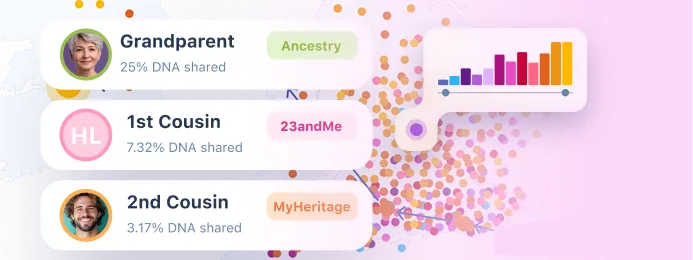
Find more DNA matches across all DNA tests
Combine your DNA data with your family tree to unlock the full power of YourRoots DNA Match. Connect with relatives across major testing services — Ancestry, 23andMe, MyHeritage, and more.
View your matches' maps and trees to identify shared ancestors, and soon you'll be able to add them directly to your own tree and map.
Ancestry DNA analysis that goes deeper than others
Unlock exclusive reports that reveal your deeper origins.
- Deep Ancestry Report — Analyze 130+ ethnicities, sub-regions, and 1,800+ communities in one detailed view.
- Global & Native American Reports — Developed with Stanford researchers to uncover hidden ancestries across all 22 chromosomes.
- Ancient DNA Series — Compare your DNA with 1,000+ ancient genomes from Viking, Celtic, and early American civilizations.
Sign up to explore more
Create a free account to navigate family trees, view ancestors, and discover connections.
Coming Soon
We're actively working on many new features for YourRoots. Features marked v2 are ones we're planning to launch soon.
Have a particular feature request? Let us know below!