
Sign up to explore more
Create a free account to navigate family trees, view ancestors, and discover connections.

Sign up to explore more
Create a free account to navigate family trees, view ancestors, and discover connections.
Vaux Family Genealogy & History
Discover the Global Legacy of the Vaux Surname
The Vaux surname traces its origins to France, with its earliest known appearances recorded in the 11th century. This surname, likely derived from a geographical location, signifies a rich genealogical narrative that connects families to their ancestral roots. Over time, the Vaux name has come to represent a diverse lineage, illustrating the history and evolution of families that have carried this name across various regions and countries.
The Vaux surname expanded significantly during the 12th century, particularly in England. By the 14th century, the Vaux family tree had established deep roots within the country, highlighting the socio-economic developments that allowed the family to flourish. This expansion continued into subsequent centuries, as the Vaux family adapted to and thrived in different regions, maintaining their identity while becoming an integral part of the local society.
YourRoots data supports the Vaux surname's early presence in France and its subsequent spread to England, confirming its prominence by the 11th century. The database chronicles the Vaux family's steady growth and migration, particularly during the medieval centuries, when the surname's presence became more pronounced. This aligns with historical accounts, showcasing the surname's expansion and its enduring legacy through the 15th century and beyond.
Today, Vaux genealogy records, as highlighted by YourRoots, reveal a global distribution of the surname, with substantial records in the United States and England. This continuity between historical sources and YourRoots records provides a comprehensive understanding for anyone interested in tracing the Vaux family tree. The insights offered by YourRoots enrich the exploration of Vaux genealogy, providing a valuable resource for researchers and descendants alike.
Find the Vaux Family Tree
Search more Vaux trees & genealogy records
Records
-
WVWilliam Thomas Vaux1370–1405Individual Tree PersonParents: Reynold Lucy & Margaret NoneSpouse: Alienor ArcedekneChildren: SirScore: AWVWilliam Thomas Vaux1370–1405Individual Tree PersonParents: Reynold Lucy & Margaret NoneSpouse: Alienor ArcedekneChildren: SirScore: A
-
WVWilliam VAUX1345–1401Individual Tree PersonParents: William VAUX & Joan NoneSpouse: Joan THIRNINGChildren: WilliamScore: AWVWilliam VAUX1345–1401Individual Tree PersonParents: William VAUX & Joan NoneSpouse: Joan THIRNINGChildren: WilliamScore: A
-
MVMarie Catherine de la Vaux1621–1688Individual Tree PersonParents: Alexandre DeLavaux & Louise AGPSpouse: Gilbert NivernaisChildren: Adrienne, Charles, Charlotte, Nicolas, Agathe, Catherine, Charles, Charles, Gabriel, Marie, MarieScore: AMVMarie Catherine de la Vaux1621–1688Individual Tree PersonParents: Alexandre DeLavaux & Louise AGPSpouse: Gilbert NivernaisChildren: Adrienne, Charles, Charlotte, Nicolas, Agathe, Catherine, Charles, Charles, Gabriel, Marie, MarieScore: A
-
WVWilliam VAUX1410–1460Individual Tree PersonParents: William VAUX & Eleanor DRAKELOWESpouse: Maud LUCYChildren: WilliamScore: AWVWilliam VAUX1410–1460Individual Tree PersonParents: William VAUX & Eleanor DRAKELOWESpouse: Maud LUCYChildren: WilliamScore: A
-
WVWilliam Vaux1365–1405Individual Tree PersonParents: William Vaux & Joan ThirningSpouse: Eleanor DrakeloveChildren: SirScore: AWVWilliam Vaux1365–1405Individual Tree PersonParents: William Vaux & Joan ThirningSpouse: Eleanor DrakeloveChildren: SirScore: A
-
TVThomas Vaux1511–1556Individual Tree PersonParents: Lord Vaux & Lady GreeneSpouse: Lady CheyneyChildren: JoaneScore: ATVThomas Vaux1511–1556Individual Tree PersonParents: Lord Vaux & Lady GreeneSpouse: Lady CheyneyChildren: JoaneScore: A
-
HVHorace Julian Le Vaux1892–1967Individual Tree PersonParents: George Vaux & Rosetta BrazierSpouse: Ann EmeryScore: AHVHorace Julian Le Vaux1892–1967Individual Tree PersonParents: George Vaux & Rosetta BrazierSpouse: Ann EmeryScore: A
-
MVMargaret de Vaux1331–1382Individual Tree PersonParents: William Vaux & Joan FitzJohnSpouse: John IChildren: AaronScore: AMVMargaret de Vaux1331–1382Individual Tree PersonParents: William Vaux & Joan FitzJohnSpouse: John IChildren: AaronScore: A
-
NVNicholas 1st Baron Vaux Of Harrowden Vaux1460–1523Individual Tree PersonParents: Sir IV & Katherina PedemontaniSpouse: Elizabeth FitzHugh, Anne GreeneChildren: Anna, MaudScore: ANVNicholas 1st Baron Vaux Of Harrowden Vaux1460–1523Individual Tree PersonParents: Sir IV & Katherina PedemontaniSpouse: Elizabeth FitzHugh, Anne GreeneChildren: Anna, MaudScore: A
-
WVWilliam Vaux1410–1460Individual Tree PersonParents: William Vaux & Eleanor DrakeloweSpouse: Lady LucyChildren: WilliamScore: AWVWilliam Vaux1410–1460Individual Tree PersonParents: William Vaux & Eleanor DrakeloweSpouse: Lady LucyChildren: WilliamScore: A
-
SVSimon I de Vaux1190–1233Individual Tree PersonParents: Geoffroy Joinville & Helvide DampierreSpouse: Beatrix d'Auxonne, Ermengarde Montesclair, Blanche Saone, Béatrice Bourgogne-ComteChildren: Geoffrey, jean,jéhans,boutefeux, SimonScore: ASVSimon I de Vaux1190–1233Individual Tree PersonParents: Geoffroy Joinville & Helvide DampierreSpouse: Beatrix d'Auxonne, Ermengarde Montesclair, Blanche Saone, Béatrice Bourgogne-ComteChildren: Geoffrey, jean,jéhans,boutefeux, SimonScore: A
-
3V3rd Lord William VAUX1535–1595Individual Tree PersonParents: Thomas Vaux & Elizabeth CheneyScore: A3V3rd Lord William VAUX1535–1595Individual Tree PersonParents: Thomas Vaux & Elizabeth CheneyScore: A
-
WVWilliam Thomas Vaux1370–1405Individual Tree PersonParents: William Vaux & Joan ThirningSpouse: Eleanor DrakeloweChildren: William, Eleanor, IsabelScore: AWVWilliam Thomas Vaux1370–1405Individual Tree PersonParents: William Vaux & Joan ThirningSpouse: Eleanor DrakeloweChildren: William, Eleanor, IsabelScore: A
-
EVElizabeth Vaux1586–1658Individual Tree PersonParents: Lord Walden & Katherine HowardSpouse: Sir Knollys, Edward Harrowden, William KnowlesChildren: Nicholas, Edward, NicholasScore: AEVElizabeth Vaux1586–1658Individual Tree PersonParents: Lord Walden & Katherine HowardSpouse: Sir Knollys, Edward Harrowden, William KnowlesChildren: Nicholas, Edward, NicholasScore: A
-
AVAnne VAUX1494–1547Individual Tree PersonParents: Nicholas VAUX, & Elizabeth FITZHUGHSpouse: Thomas LESTRANGEChildren: Elizabeth, Alice, Nicholas, Roger, Richard, Anne, Thomas, Catherine, William, Edmond, HenryScore: AAVAnne VAUX1494–1547Individual Tree PersonParents: Nicholas VAUX, & Elizabeth FITZHUGHSpouse: Thomas LESTRANGEChildren: Elizabeth, Alice, Nicholas, Roger, Richard, Anne, Thomas, Catherine, William, Edmond, HenryScore: A
-
RVRoger DE VAUX1200–1244Individual Tree PersonParents: Oliver VAUX & Petronilla CRAONSpouse: Clemence SCALESChildren: Nicolas, Robert, PetronillaScore: ARVRoger DE VAUX1200–1244Individual Tree PersonParents: Oliver VAUX & Petronilla CRAONSpouse: Clemence SCALESChildren: Nicolas, Robert, PetronillaScore: A
-
WVWilliam VAUX1435–1471Individual Tree PersonParents: William VAUX & Maud LUCYSpouse: Katherine PENYSONChildren: Nicholas, Joan, Elizabeth, EleanorScore: AWVWilliam VAUX1435–1471Individual Tree PersonParents: William VAUX & Maud LUCYSpouse: Katherine PENYSONChildren: Nicholas, Joan, Elizabeth, EleanorScore: A
-
JVJohannes 'Johann' de Vaux1520–1543Individual Tree PersonParents: John Vaux & Mary SkeltonSpouse: Margaret PalmerChildren: BeatriceScore: AJVJohannes 'Johann' de Vaux1520–1543Individual Tree PersonParents: John Vaux & Mary SkeltonSpouse: Margaret PalmerChildren: BeatriceScore: A
-
BVBeatrice de Vaux1345–1412Individual Tree PersonParents: William Direlton & Catherine VauxSpouse: Patrick HepburnChildren: Helen, Helen, Adam, Archibald, WilliamScore: ABVBeatrice de Vaux1345–1412Individual Tree PersonParents: William Direlton & Catherine VauxSpouse: Patrick HepburnChildren: Helen, Helen, Adam, Archibald, WilliamScore: A
-
SVSir William IV Vaux1400–1460Individual Tree PersonParents: William Vaux & Eleanor DrakeloveSpouse: Maud LucyChildren: SirScore: ASVSir William IV Vaux1400–1460Individual Tree PersonParents: William Vaux & Eleanor DrakeloveSpouse: Maud LucyChildren: SirScore: A
Search more trees & records for
Vaux for free
Tracing Your Vaux Family Lineage
Origin of the Vaux Family: Where does the Vaux surname come from?
The Vaux surname traces its earliest known appearances to France, where it is recorded in the context of the early 11th century. This initial emergence marks the beginning of a rich genealogical narrative, connecting families to their ancestral roots and indicating the potential for a diverse lineage. The origins in France set the stage for the evolution of family trees that would branch out into various regions and countries over the centuries.
Genealogy and Early Family History of Vaux
In the subsequent centuries, the Vaux family began to spread significantly, particularly in England, where it became notably established during the 12th century. By the 14th century, the name had solidified its presence, with families building branches of their family trees in key regions across the country. This expansion not only marks an increase in population but also highlights the socio-economic developments that allowed Vaux families to flourish and intertwine with other lineages.
As time progressed into the 15th century, the Vaux surname became increasingly prominent in England, reflecting the growth in family branches and connections. The presence of the Vaux family in various regions of England during this period illustrates how they adapted and thrived, maintaining their identity while contributing to the local tapestry of society. This evolution laid the groundwork for future generations to explore and expand their family histories.
Tracing the Vaux Family Tree Through the Centuries
The Vaux surname experienced remarkable expansion across regions in subsequent centuries, notably transitioning into the United States during the 19th century. The movement of families across the Atlantic contributed to a broader distribution of the surname, allowing descendants to establish new branches of their family trees in diverse locales. By the 20th century, the Vaux name had taken root not only in its original homeland but also across the ocean, reflecting the global nature of family connections.
As the Vaux family tree continued to evolve, it underscored the interconnectedness of genealogical lines across various countries and cultures. The surname's journey from France to England and ultimately to the Americas highlights the dynamic nature of family histories and migrations. This expansive growth over the centuries is a testament to the resilience and adaptability of the Vaux families as they navigated through societal changes.
Where to Find Vaux Genealogy Records Today
In modern centuries, the Vaux surname has continued to exhibit a global presence, with significant records found in the United States and England. The exploration of Vaux genealogy records in the 21st century reveals a rich tapestry of connections that descendants can uncover to deepen their understanding of family heritage. Readers are encouraged to delve into the YourRoots database to trace their own lineage and connect
Famous People with Vaux (and Their Family Tree)

Fort Vaux
Fort Vaux, located in Vaux-Devant-Damloup, Meuse, France, played a pivotal role in the Battle of Verdun during World War I. Constructed between 1881 and 1884, the fort was modernized with reinforced concrete and housed a garrison of 150 men. Under the leadership of Major Sylvain-Eugene Raynal, the French garrison displayed exceptional heroism, fending off German Stormtroops despite severe shortages of water, ammunition, and medical supplies. Fort Vaux eventually fell on 7 June 1916, but was recaptured by French forces on 2 November 1916. The fort remains a significant historical site, with its underground installations well-preserved for public visits.

Calvert Vaux
Calvert Vaux was a renowned English-American architect and landscape designer, celebrated for co-designing Central Park and Prospect Park alongside Frederick Law Olmsted. A key figure in the development of public parks in America, Vaux introduced innovative ideas that integrated naturalistic and curvilinear designs into urban environments. His career highlights include partnerships with Andrew Jackson Downing, where he contributed to projects like the Smithsonian Institution, and with Olmsted, where he influenced the creation of many park systems across New York. He also authored the influential pattern book "Villas and Cottages," setting standards for Victorian Gothic architecture.
Vaux was born in London to a physician and baptized at St Benet Gracechurch. He trained under the Gothic Revival movement leader, Lewis Nockalls Cottingham, before moving to the United States.

Henry Brougham, 1st Baron Brougham and Vaux
Henry Brougham, 1st Baron Brougham and Vaux, was a distinguished British statesman born on September 19, 1778, in Edinburgh. Known for his pivotal role as Lord High Chancellor of Great Britain, Brougham was instrumental in the passing of the Reform Act 1832 and the Slavery Abolition Act 1833. A prominent Whig politician, he served as a Member of Parliament and later as a peer. His commitment to liberal causes, legal reform, and education was evident through his involvement in founding the Edinburgh Review and University College London. As Lord Chancellor, he established the Central Criminal Court and advocated for free trade and parliamentary reform.
Henry Brougham was the eldest son of Henry Brougham, of Brougham Hall in Westmorland, and Eleanora, daughter of Reverend James Syme. The Brougham family had been influential in Cumberland for centuries, showcasing a deep-rooted heritage. His education at the Royal High School and the University of Edinburgh, where he studied natural science, mathematics, and law, laid the foundation for his illustrious career.

Anne Vaux
Anne Vaux (c. 1562 – in or after 1637) was a prominent Catholic recusant known for supporting Catholic priests during a tumultuous period in England. She provided safe houses, such as Whitewebbs in Enfield Chase, for priests and was closely linked to Father Henry Garnet, a Jesuit priest. Vaux was associated with the Gunpowder Plot, and although she suspected its existence, she was not directly involved. Her involvement in the plot's aftermath included attempts to communicate with Garnet, leading to her arrest. Vaux's later life was marked by her dedication to Catholic education, founding a school for boys from Catholic noble families.
Anne Vaux was the third daughter of William Vaux, 3rd Baron Vaux of Harrowden, and Elizabeth Beaumont. Her family origins are rooted in noble lineage, with her mother being the daughter of John Beaumont of Grace Dieu, Leicester. The Vaux family was known for its Catholic recusancy during a time of religious persecution in England.

Roland de Vaux
Roland Guérin de Vaux (1903–1971) was a renowned French Dominican priest and archaeologist, best known for directing the Catholic team that initially studied the Dead Sea Scrolls. As the director of the École Biblique in Jerusalem from 1945 to 1965, de Vaux led significant archaeological excavations at Qumran and other historical sites. His work with the Dead Sea Scrolls, along with his influential writings like "Archaeology and the Dead Sea Scrolls" and "Ancient Israel," positioned him as a pivotal figure in biblical archaeology. His editorial contributions to the Revue Biblique and The Jerusalem Bible further cemented his legacy in theological and historical scholarship.
Vaux Surname Meaning, Origin, and History
The surname "Vaux" has historical roots in both England and France, with notable individuals and families bearing the name across centuries. It is associated with various places in Belgium and France, including numerous communes and landmarks, reflecting its widespread geographical presence.
VIEW MOREWhere to Find Genealogy Records for Vaux
We’ve analyzed YourRoots tree and records data to uncover where genealogists are finding key sources such as census, birth certificates, marriage records, and obituaries for the Vaux family. Explore our most popular genealogy record sources for the Vaux surname to learn more.
VIEW MOREAbout YourRoots
Explore your family tree geographically
Import your GEDCOM file to transform your family tree into an interactive global map. See your roots laid out visually and understand your true geographic heritage.
Powerful tools like "Trace Back To Me" instantly map your family's migration paths from a chosen ancestor all the way back to you.
Discover ancestors beyond "end-of-line" automatically
Import your family tree and let AI expand it for you. AI Ancestor Finder scans "end-of-line" ancestors to uncover their parents across hundreds of family lines at once. AI Deep Research analyzes selected ancestors and family clusters, suggesting relevant records and next steps.
Turn on Auto Research Mode to get new discoveries daily or weekly, so your tree keeps growing even while you're away.
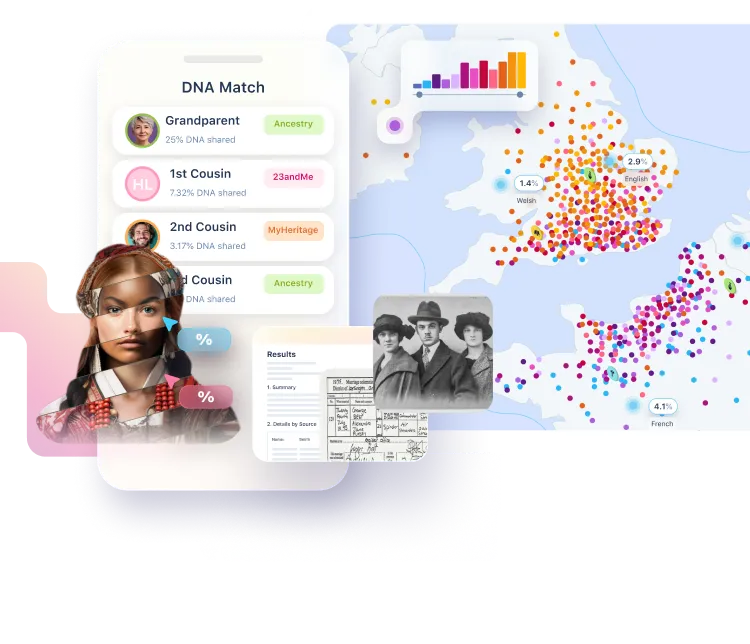
Find more DNA matches across all DNA tests
Combine your DNA data with your family tree to unlock the full power of YourRoots DNA Match. Connect with relatives across major testing services — Ancestry, 23andMe, MyHeritage, and more.
View your matches' maps and trees to identify shared ancestors, and soon you'll be able to add them directly to your own tree and map.
Ancestry DNA analysis that goes deeper than others
Unlock exclusive reports that reveal your deeper origins.
- Deep Ancestry Report — Analyze 130+ ethnicities, sub-regions, and 1,800+ communities in one detailed view.
- Global & Native American Reports — Developed with Stanford researchers to uncover hidden ancestries across all 22 chromosomes.
- Ancient DNA Series — Compare your DNA with 1,000+ ancient genomes from Viking, Celtic, and early American civilizations.
Sign up to explore more
Create a free account to navigate family trees, view ancestors, and discover connections.
Coming Soon
We're actively working on many new features for YourRoots. Features marked v2 are ones we're planning to launch soon.
Have a particular feature request? Let us know below!