
Sign up to explore more
Create a free account to navigate family trees, view ancestors, and discover connections.
Sign up to explore more
Create a free account to navigate family trees, view ancestors, and discover connections.
Wait Family Genealogy & History
Discover the Global Legacy of the Wait Surname
The surname "Wait," historically spelled as Wayghte or Wayte, originates from the Old High German term "wahten," meaning "to keep watch." It shares roots with several Teutonic languages, including German, Dutch, Swedish, and English, where it conveys the notion of a guard or watchman. Initially, in 11th century England, individuals often appended their occupations to their Christian names. Thus, a minstrel watchman named Richard became known as Richard le Wayte, with the name evolving over time into various forms such as Wayte, Waight, Wait, and Waite.
As the surname Wait became established in England during the 16th century, it signified a growing and diversifying lineage. By the 17th century, Wait families were primarily located in regions where community and agricultural life thrived, leading to the surname's expansion across England. As families migrated in the 18th century, notably to the Americas, the Wait family established new branches, integrating into American society and contributing to the Wait genealogy's broadening cultural footprint.
YourRoots data corroborates that the Wait surname first appeared in English records in the early 16th century, highlighting its deep historical roots. The Wait family tree expanded significantly in the 19th century, particularly in the United States, where descendants of the original English families settled. YourRoots provides a comprehensive view of how the Wait surname not only spread geographically but also connected with other surnames, enriching the genealogical tapestry for those tracing their lineage.
For genealogists and researchers, YourRoots offers valuable insights into the Wait genealogy. The dataset reveals a global distribution of the Wait surname, underscoring its enduring legacy and providing a rich resource for anyone delving into the Wait family tree. This continuity between historical records and modern genealogical data is essential for understanding and connecting with one's ancestral heritage.
Find the Wait Family Tree
Search more Wait trees & genealogy records
Records
-
MWMichael Logan Wait1946–1969Individual Tree PersonParents: Albert Jr. & Dorothea LangworthyScore: AMWMichael Logan Wait1946–1969Individual Tree PersonParents: Albert Jr. & Dorothea LangworthyScore: A
-
FWFrederick Roy Wait1897–1898Individual Tree PersonParents: Walter Wait & Annie KrachlerScore: AFWFrederick Roy Wait1897–1898Individual Tree PersonParents: Walter Wait & Annie KrachlerScore: A
-
RWRuth Wait1855–1902Individual Tree PersonParents: Silas Wait & Phylinda HarrisSpouse: Western HarrisChildren: Minnie, HartwellScore: ARWRuth Wait1855–1902Individual Tree PersonParents: Silas Wait & Phylinda HarrisSpouse: Western HarrisChildren: Minnie, HartwellScore: A
-
WWWalter Wait1864–1945Individual Tree PersonParents: William Wait & Mary SnookSpouse: Annie KrachlerChildren: Ivy, Harold, Edward, Mabel, Gertrude, Nellie, William, FrederickScore: AWWWalter Wait1864–1945Individual Tree PersonParents: William Wait & Mary SnookSpouse: Annie KrachlerChildren: Ivy, Harold, Edward, Mabel, Gertrude, Nellie, William, FrederickScore: A
-
GWGladys May Wait1904–1971Individual Tree PersonParents: Alfred Wait & Amy FischerSpouse: Irvine PrattScore: AGWGladys May Wait1904–1971Individual Tree PersonParents: Alfred Wait & Amy FischerSpouse: Irvine PrattScore: A
-
MWMark LeRoy Wait1877–1943Individual Tree PersonParents: Meigs Wait & Edith ClarkSpouse: Nettie HASKELLScore: AMWMark LeRoy Wait1877–1943Individual Tree PersonParents: Meigs Wait & Edith ClarkSpouse: Nettie HASKELLScore: A
-
RWRachambeau LaFayette Wait1845–1878Individual Tree PersonParents: Dr. Wait & Jane McCulloughSpouse: Rachel MillerChildren: Jonathan, Georgia, Hiram, Rochambeau, FrankScore: ARWRachambeau LaFayette Wait1845–1878Individual Tree PersonParents: Dr. Wait & Jane McCulloughSpouse: Rachel MillerChildren: Jonathan, Georgia, Hiram, Rochambeau, FrankScore: A
-
FWFloyd Elliot Wait1892–1962Individual Tree PersonParents: Edgar Wait & Nancy BakerSpouse: Irene ChristmanChildren: Katherine, FrederickScore: AFWFloyd Elliot Wait1892–1962Individual Tree PersonParents: Edgar Wait & Nancy BakerSpouse: Irene ChristmanChildren: Katherine, FrederickScore: A
-
LWLouise Wait1856–1908Individual Tree PersonParents: Dr. Wait & Jane McCulloughSpouse: James McCrackinChildren: Fleta, ElizabethScore: ALWLouise Wait1856–1908Individual Tree PersonParents: Dr. Wait & Jane McCulloughSpouse: James McCrackinChildren: Fleta, ElizabethScore: A
-
SWSarah Wait1823–1913Individual Tree PersonParents: Harry WAIT & Sophia WellsSpouse: James WalkerChildren: Elias, WilliamScore: ASWSarah Wait1823–1913Individual Tree PersonParents: Harry WAIT & Sophia WellsSpouse: James WalkerChildren: Elias, WilliamScore: A
-
EWEdward Walter Wait1895–1915Individual Tree PersonParents: Walter Wait & Annie KrachlerScore: AEWEdward Walter Wait1895–1915Individual Tree PersonParents: Walter Wait & Annie KrachlerScore: A
-
JWJacob Wait1831–1895Individual Tree PersonParents: Harry WAIT & Sophia WellsSpouse: Cordelia PowellChildren: Emma, Willet, Robert, Ella, Mattie, SilasScore: AJWJacob Wait1831–1895Individual Tree PersonParents: Harry WAIT & Sophia WellsSpouse: Cordelia PowellChildren: Emma, Willet, Robert, Ella, Mattie, SilasScore: A
-
VWVernon Mason Wait1883–1927Individual Tree PersonParents: Pierce Wait & Mary MatthewsScore: AVWVernon Mason Wait1883–1927Individual Tree PersonParents: Pierce Wait & Mary MatthewsScore: A
-
RWRuth Wait1875–1917Individual Tree PersonParents: Henry Wait & Anna McCoySpouse: Alexander GoodnowChildren: Alexander, HenryScore: ARWRuth Wait1875–1917Individual Tree PersonParents: Henry Wait & Anna McCoySpouse: Alexander GoodnowChildren: Alexander, HenryScore: A
-
EWElla A. Wait1863–1931Individual Tree PersonParents: Jacob Wait & Cordelia PowellSpouse: Walter WelshScore: AEWElla A. Wait1863–1931Individual Tree PersonParents: Jacob Wait & Cordelia PowellSpouse: Walter WelshScore: A
-
MWMary Jane Wait1846–1925Individual Tree PersonParents: John Thornton & Arvilla ThorntonSpouse: Lewis WaitScore: AMWMary Jane Wait1846–1925Individual Tree PersonParents: John Thornton & Arvilla ThorntonSpouse: Lewis WaitScore: A
-
RWRichard Wait1711–1790Individual Tree PersonParents: Thomas Jr. & Mary WaitSpouse: Elizabeth MarvinChildren: Richard, RemickScore: ARWRichard Wait1711–1790Individual Tree PersonParents: Thomas Jr. & Mary WaitSpouse: Elizabeth MarvinChildren: Richard, RemickScore: A
-
CWClarence A. Wait1868–1920Individual Tree PersonParents: Silas Wait & Phylinda HarrisSpouse: Carrie ToddChildren: Wilber, Gordon, Carrie, Leslie, HenryScore: ACWClarence A. Wait1868–1920Individual Tree PersonParents: Silas Wait & Phylinda HarrisSpouse: Carrie ToddChildren: Wilber, Gordon, Carrie, Leslie, HenryScore: A
-
SWSilas W. Wait1826–1892Individual Tree PersonParents: Silas Wait & Roxanna RowleySpouse: Phylinda HarrisChildren: Henry, Roxanna, Ruth, ClarenceScore: ASWSilas W. Wait1826–1892Individual Tree PersonParents: Silas Wait & Roxanna RowleySpouse: Phylinda HarrisChildren: Henry, Roxanna, Ruth, ClarenceScore: A
-
MWMeigs Harold Wait1836–1919Individual Tree PersonParents: Harry WAIT & Sophia WellsSpouse: Edith Clark, Caroline RobinsonChildren: Guy, Mark, Bert, Marion, Ernest, Daisy, William, Katherine, FrankScore: AMWMeigs Harold Wait1836–1919Individual Tree PersonParents: Harry WAIT & Sophia WellsSpouse: Edith Clark, Caroline RobinsonChildren: Guy, Mark, Bert, Marion, Ernest, Daisy, William, Katherine, FrankScore: A
Search more trees & records for
Wait for free
Tracing Your Wait Family Lineage
Origin of the Wait Family: Where does the Wait surname come from?
The Wait surname first appeared in records during the early 16th century in England, marking the beginning of a rich genealogical history. This early documentation connects the Wait family to the roots of English heritage, suggesting a lineage that has endured through the centuries. As families began to form and expand, the Wait surname laid the groundwork for branches that would develop into diverse family trees across various regions.
Genealogy and Early Family History of Wait
Throughout the 16th and 17th centuries, the Wait family began to establish itself in England, particularly in regions where agricultural and community life flourished. This period saw the first significant growth of the surname, as families spread and diversified, creating branches that would eventually extend beyond English borders. The Wait name became associated with various trades and occupations, contributing to the expansion of family lines over time.
As the 18th century approached, many Wait families began to migrate, seeking new opportunities and lands, particularly in the Americas. This migration led to a notable presence of the Wait surname in the United States and marked the establishment of new family branches that thrived in a different cultural context. By the end of the century, the Wait family had woven itself into the fabric of American society, establishing a legacy that would continue to grow.
Tracing the Wait Family Tree Through the Centuries
In the 19th century, the Wait surname experienced significant expansion, primarily in the United States, where many descendants of the original English families settled. This era saw the Wait family further branching out into various states, contributing to the diverse tapestry of American genealogy. As the family tree evolved, connections were made with other surnames, creating a network of relationships that highlighted the family's ongoing legacy.
By the 20th century, the Wait surname had established a global presence, with descendants tracing their roots back to the original families in England. The migration patterns of this period saw Wait families spread not only across the United States but also into other countries, reflecting the dynamics of global movement and settlement. The continued growth and evolution of the Wait family tree during this time solidified their place in the genealogical landscape.
Where to Find Wait Genealogy Records Today
In the 21st century, the Wait surname remains prominent, with numerous descendants continuing to explore their family histories. The global spread of the Wait name offers a rich tapestry of connections, inviting individuals to delve into their genealogical roots. Readers are encouraged to investigate the Wait genealogy records available in the YourRoots database to uncover and connect their own family stories to this enduring lineage.
Famous People with Wait (and Their Family Tree)
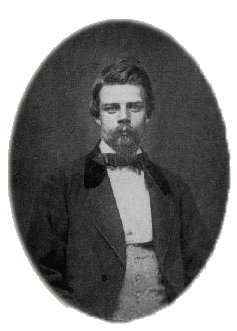
William Bell Wait
William Bell Wait (1839–1916) was a pioneering educator at the New York Institute for the Education of the Blind and the inventor of the New York Point system, a widely adopted writing system for the visually impaired in the United States before braille's universal adoption. Wait's notable career highlights include adapting New York Point for over 20 languages, creating a music notation system, and inventing devices like the Kleidograph and Stereograph to improve embossed material production. He received recognition such as the John Scott Medal from the Franklin Institute for his impactful inventions. Wait also founded the American Association of Instructors of the Blind and the Society for Providing Evangelical Religious Literature for the Blind.

John T. Wait
John Turner Wait, born on August 27, 1811, in New London, Connecticut, was a prominent U.S. Representative known for his significant contributions to Connecticut's political landscape. As a dedicated member of the Republican Party, he served in the U.S. Congress from 1876 to 1887, following a successful legal career that began in 1836. Wait held various influential positions, including state's attorney for New London County and speaker of the Connecticut House of Representatives in 1867. His tenure in the Connecticut Senate, where he served as president pro tempore in 1866, showcased his leadership abilities. Despite multiple unsuccessful bids for Lieutenant Governor, his legislative impact remains noteworthy.
John T. Wait moved to Norwich, Connecticut, with his mother after being born in New London. He was a first cousin of U.S. Chief Justice Morrison Waite, highlighting a notable family connection within the legal and political fields.

James R. Wait
James R. Wait, a distinguished Canadian electrical engineer and engineering physicist, was renowned for his pivotal contributions to electromagnetic propagation engineering, significantly impacting communication and geophysical exploration. Elected to the National Academy of Engineering in 1977, Wait's illustrious career included roles at the National Bureau of Standards and NOAA, focusing on radio-wave propagation theory. His academic journey led him to the University of Arizona as a professor, where he became a Regents’ Professor in 1988. Wait authored influential publications and books on electromagnetic wave theory, enhancing his stature in electronics and communication systems engineering.
James R. Wait was born in Ottawa, Ontario, Canada, in 1924. He married Gertrude L. Norman in 1951, and they had two children, Laura and George. The family lived across various locations, including Ottawa and Boulder, Colorado, before settling in Tucson, Arizona.
Ronald A. Wait
Ronald A. Wait was a prominent American politician and Republican member of the Illinois House of Representatives. Serving from 1983 to 1993 and again from 1995 to 2011, he represented the 64th and later the 69th district, encompassing Boone County and parts of Winnebago and McHenry counties. Known for his dedication to his constituents, Wait first won election in 1982. After a brief hiatus following a 1992 defeat, he returned to serve until 2011, when he retired to pursue a judicial role. Despite losing in a primary for the 17th Circuit Court judgeship, his political career remains notable for its longevity and impact in Illinois politics.

Samuel Wait
Samuel Wait was a prominent Baptist minister and educator, best known as the founding principal and first president of Wake Forest University, originally called Wake Forest Institute. He played a crucial role in the early development of the institution, leading it from 1834 to 1845. Wait's contributions to education extended beyond Wake Forest; he also served as president of Oxford Female College in Ohio. His leadership and commitment to higher education are commemorated through Wake Forest's Wait Chapel and a portrait in Reynolda Hall.
Born in 1789 in White Creek, New York, Samuel Wait was the son of Joseph Wait and Martha Smith. During his childhood, the family relocated to Middletown, Vermont, where Wait's formative years unfolded.
Wait Surname Meaning, Origin, and History
The surname "Wait" originates from the old High German word "wahten," meaning to keep watch, and is related to the concept of a guard or watchman across various Teutonic languages. It became a surname in England during the eleventh century when individuals often added their occupation to their Christian names, such as Richard the minstrel-watchman becoming Richard le Wayte, which later evolved into various spellings including Wait, Waite, and Weight.
VIEW MOREWhere to Find Genealogy Records for Wait
We’ve analyzed YourRoots tree and records data to uncover where genealogists are finding key sources such as census, birth certificates, marriage records, and obituaries for the Wait family. Explore our most popular genealogy record sources for the Wait surname to learn more.
VIEW MOREAbout YourRoots
Explore your family tree geographically
Import your GEDCOM file to transform your family tree into an interactive global map. See your roots laid out visually and understand your true geographic heritage.
Powerful tools like "Trace Back To Me" instantly map your family's migration paths from a chosen ancestor all the way back to you.
Discover ancestors beyond "end-of-line" automatically
Import your family tree and let AI expand it for you. AI Ancestor Finder scans "end-of-line" ancestors to uncover their parents across hundreds of family lines at once. AI Deep Research analyzes selected ancestors and family clusters, suggesting relevant records and next steps.
Turn on Auto Research Mode to get new discoveries daily or weekly, so your tree keeps growing even while you're away.
Find more DNA matches across all DNA tests
Combine your DNA data with your family tree to unlock the full power of YourRoots DNA Match. Connect with relatives across major testing services — Ancestry, 23andMe, MyHeritage, and more.
View your matches' maps and trees to identify shared ancestors, and soon you'll be able to add them directly to your own tree and map.
Ancestry DNA analysis that goes deeper than others
Unlock exclusive reports that reveal your deeper origins.
- Deep Ancestry Report — Analyze 130+ ethnicities, sub-regions, and 1,800+ communities in one detailed view.
- Global & Native American Reports — Developed with Stanford researchers to uncover hidden ancestries across all 22 chromosomes.
- Ancient DNA Series — Compare your DNA with 1,000+ ancient genomes from Viking, Celtic, and early American civilizations.
Sign up to explore more
Create a free account to navigate family trees, view ancestors, and discover connections.
Coming Soon
We're actively working on many new features for YourRoots. Features marked v2 are ones we're planning to launch soon.
Have a particular feature request? Let us know below!