
Sign up to explore more
Create a free account to navigate family trees, view ancestors, and discover connections.
Sign up to explore more
Create a free account to navigate family trees, view ancestors, and discover connections.
Waldo Family Genealogy & History
Discover the Global Legacy of the Waldo Surname
The surname Waldo finds its roots in England, first appearing during the early 16th century. It is believed to originate from the name of Peter Waldo, a notable figure who founded the Waldensians, a Christian sect. Over time, the Waldo surname has come to symbolize a rich heritage, reflecting the varied paths taken by its bearers through history. This name not only represents familial ties but also embodies resilience and adaptability as generations of the Waldo family navigated through social and political changes.
The Waldo family name spread significantly during the 16th and 17th centuries, establishing its presence across England. This period marked a time of growth and expansion as branches of the Waldo family tree began to take root. The 17th century saw many members of the Waldo family crossing the Atlantic, seeking new opportunities in the New World. By the 18th and 19th centuries, the Waldo surname had become well-established in the United States, contributing to various sectors including politics, education, and the arts.
YourRoots data enriches our understanding of the Waldo family tree by highlighting its early presence in England, consistent with historical records. From the 17th century onward, Waldo genealogy shows a pattern of migration that mirrors broader historical trends of transatlantic movement. The YourRoots dataset confirms the spread of the Waldo surname, aligning with the documented geographical and cultural evolution of the family throughout the centuries.
For those interested in tracing the Waldo genealogy, YourRoots offers a wealth of Waldo records that provide insights into the family's storied lineage. As these records show, the Waldo family tree is a testament to the journeys and transformations experienced by its members, offering a rich tapestry for genealogical exploration and connection.
Find the Waldo Family Tree
Search more Waldo trees & genealogy records
Records
-
ZWZachariah Waldo1701–1761Public Tree Person4 treesScore: AZWZachariah Waldo1701–1761Public Tree Person4 treesScore: A
-
TWThomas Craig Waldo1937–1937Individual Tree PersonParents: Donald Waldo & Margaret CrowleyScore: ATWThomas Craig Waldo1937–1937Individual Tree PersonParents: Donald Waldo & Margaret CrowleyScore: A
-
RWRuth Waldo1694–1740Individual Tree PersonParents: John Waldo & Rebecca AdamsSpouse: Isaac CraneChildren: RuthScore: ARWRuth Waldo1694–1740Individual Tree PersonParents: John Waldo & Rebecca AdamsSpouse: Isaac CraneChildren: RuthScore: A
-
NWNancy Rosanna Waldo1807–1882Individual Tree PersonParents: John Newland & Savina NewlandSpouse: Jeduthan WaldoChildren: JosephusScore: ANWNancy Rosanna Waldo1807–1882Individual Tree PersonParents: John Newland & Savina NewlandSpouse: Jeduthan WaldoChildren: JosephusScore: A
-
RWRobert Donald Waldo1940–2015Individual Tree PersonParents: Donald Waldo & Margaret CrowleySpouse: Elizabeth PickardScore: ARWRobert Donald Waldo1940–2015Individual Tree PersonParents: Donald Waldo & Margaret CrowleySpouse: Elizabeth PickardScore: A
-
CWCornelius Waldo1624–1700Individual Tree PersonParents: Thomas Leigh & Faith PeckeSpouse: Hannah Leigh*Children: Daniel, Rebecca, Son, ElizabethScore: ACWCornelius Waldo1624–1700Individual Tree PersonParents: Thomas Leigh & Faith PeckeSpouse: Hannah Leigh*Children: Daniel, Rebecca, Son, ElizabethScore: A
-
HWHannah Carlton Waldo1747–1825Individual Tree PersonParents: Lieutenant Carlton & Lydia CarltonSpouse: Daniel WaldoChildren: Diantha, Hannah, Roswell, Eunice, Shubael, Carlton, CarltonScore: AHWHannah Carlton Waldo1747–1825Individual Tree PersonParents: Lieutenant Carlton & Lydia CarltonSpouse: Daniel WaldoChildren: Diantha, Hannah, Roswell, Eunice, Shubael, Carlton, CarltonScore: A
-
RWRebecca Waldo1686–1727Individual Tree PersonParents: John Waldo & Rebecca AdamsSpouse: Nathaniel RuddChildren: Capt., Rebekah, ZebulonScore: ARWRebecca Waldo1686–1727Individual Tree PersonParents: John Waldo & Rebecca AdamsSpouse: Nathaniel RuddChildren: Capt., Rebekah, ZebulonScore: A
-
JWJohn D Waldo1920–2013Individual Tree PersonParents: Harry Waldo & Elsie WaldoSpouse: Irma MazzarellaScore: AJWJohn D Waldo1920–2013Individual Tree PersonParents: Harry Waldo & Elsie WaldoSpouse: Irma MazzarellaScore: A
-
LWLucille E. Waldo1903–1978Individual Tree PersonParents: Ed Waldo & Myrtle NeffSpouse: Roscoe ThompsonChildren: Raymond, PorterScore: ALWLucille E. Waldo1903–1978Individual Tree PersonParents: Ed Waldo & Myrtle NeffSpouse: Roscoe ThompsonChildren: Raymond, PorterScore: A
-
HWHorace Waldo1833–1898Individual Tree PersonParents: Horace Waldo & Sarah MontgomerySpouse: Julia LawrenceChildren: CorneliaScore: AHWHorace Waldo1833–1898Individual Tree PersonParents: Horace Waldo & Sarah MontgomerySpouse: Julia LawrenceChildren: CorneliaScore: A
-
GWGeorge W. Waldo1818–1900Individual Tree PersonParents: Robert Waldo & Mehitabel WhitmoreChildren: UriahScore: AGWGeorge W. Waldo1818–1900Individual Tree PersonParents: Robert Waldo & Mehitabel WhitmoreChildren: UriahScore: A
-
FWFlorence Alberta Waldo1925–1949Individual Tree PersonParents: Lula Ruth & Lucien WaldoSpouse: Carl LuthjohanScore: AFWFlorence Alberta Waldo1925–1949Individual Tree PersonParents: Lula Ruth & Lucien WaldoSpouse: Carl LuthjohanScore: A
-
LWLucille Mary Waldo1932–2014Individual Tree PersonParents: Andrew Capski & Mary CzapskiScore: ALWLucille Mary Waldo1932–2014Individual Tree PersonParents: Andrew Capski & Mary CzapskiScore: A
-
JWJohn Waldo1659–1700Individual Tree PersonParents: Dcn. Sr & Hannah CogswellSpouse: Rebecca AdamsChildren: Rebecca, EdwardScore: AJWJohn Waldo1659–1700Individual Tree PersonParents: Dcn. Sr & Hannah CogswellSpouse: Rebecca AdamsChildren: Rebecca, EdwardScore: A
-
LWLeon Waldo1919–1989Individual Tree PersonParents: Freeman Waldo & Cora RobinsonScore: ALWLeon Waldo1919–1989Individual Tree PersonParents: Freeman Waldo & Cora RobinsonScore: A
-
DWDaniel J Waldo1905–1985Individual Tree PersonParents: Nels Sr. & Hulda WaldoSpouse: Helen WaldoChildren: Paul, Glen, Michael, Dennis, James, JohnScore: ADWDaniel J Waldo1905–1985Individual Tree PersonParents: Nels Sr. & Hulda WaldoSpouse: Helen WaldoChildren: Paul, Glen, Michael, Dennis, James, JohnScore: A
-
CWCornelius Waldo1624–1701Individual Tree PersonParents: Thomas Waldo & Unknown unknownSpouse: Hannah CogswellChildren: Daniel, John, Martha, Cornelius, Deborah, Jonathan, Judith, Mary, Twin, ELIZABETH, Rebecca, John, DavidScore: ACWCornelius Waldo1624–1701Individual Tree PersonParents: Thomas Waldo & Unknown unknownSpouse: Hannah CogswellChildren: Daniel, John, Martha, Cornelius, Deborah, Jonathan, Judith, Mary, Twin, ELIZABETH, Rebecca, John, DavidScore: A
-
MWMary Brill Waldo1840–1930Individual Tree PersonParents: Isaiah Waldo & Lucy OlneySpouse: Orange WhiteChildren: George, FrankScore: AMWMary Brill Waldo1840–1930Individual Tree PersonParents: Isaiah Waldo & Lucy OlneySpouse: Orange WhiteChildren: George, FrankScore: A
-
HWHelen Ruth Waldo1922–2012Individual Tree PersonParents: Lula Ruth & Lucien WaldoSpouse: Richard Stahl, Russell DingsChildren: RobertScore: AHWHelen Ruth Waldo1922–2012Individual Tree PersonParents: Lula Ruth & Lucien WaldoSpouse: Richard Stahl, Russell DingsChildren: RobertScore: A
Search more trees & records for
Waldo for free
Tracing Your Waldo Family Lineage
Origin of the Waldo Family: Where does the Waldo surname come from?
The Waldo surname has its earliest known appearance in England during the early 16th century, marking the beginnings of a family lineage that would evolve over centuries. This initial record signifies a pivotal moment in genealogical history, as it offers a glimpse into the roots and origins of families bearing the Waldo name. The context of this time in England reflects a period of social and political change, laying the groundwork for future generations and their family trees.
Genealogy and Early Family History of Waldo
As the Waldo family began to establish itself, the surname spread throughout England in its early centuries, particularly during the 16th and 17th centuries. Key regions where the Waldo family lines emerged include various parts of England, where families began to branch out and solidify their presence. These early branches of the family tree set the stage for further expansion as descendants moved beyond their initial confines.
In the 17th century, the Waldo family saw significant growth, leading to a notable migration across the Atlantic. This movement marked the beginning of a new chapter for many Waldo descendants, as they sought new opportunities and established themselves in the New World.
Tracing the Waldo Family Tree Through the Centuries
The expansion of the Waldo surname continued into the 18th century, as families migrated not only within the United States but also to other regions, showcasing a global spread of the name. By the 19th century, the Waldo family had established a strong presence primarily in the United States, reinforcing their roots while adapting to new cultural landscapes. This evolution through various countries and regions illustrates the adaptability and resilience of the Waldo family tree over generations.
In the 20th century, the Waldo surname further diversified, with descendants settling in various parts of the world, contributing to the rich tapestry of global genealogy. The continuous movement and intermingling of Waldo families across different regions reflect the broader historical context and social dynamics of the time. As a result, the family tree of the Waldo surname is a testament to the journeys taken by its members, connecting them to a larger narrative of migration and familial evolution.
Where to Find Waldo Genealogy Records Today
In modern times, the Waldo surname has maintained its presence across many regions, particularly in the United States, where it found a significant home in the 20th and 21st centuries. The global spread of the Waldo name offers a wealth of opportunities for genealogical exploration, inviting individuals to trace their connections to this storied lineage. Readers are encouraged to explore the Waldo genealogy records available in the YourRoots database to uncover the
Famous People with Waldo (and Their Family Tree)

Janet Waldo
Janet Waldo, an iconic American radio and voice actress, is celebrated for her roles in animation and radio. She notably voiced Judy Jetson in Hanna-Barbera's The Jetsons and took on the voices of Penelope Pitstop, Josie from Josie and the Pussycats, and Princess in Battle of the Planets. Her radio career peaked with the titular role in Meet Corliss Archer. Waldo's extensive work in radio included appearances on popular shows like The Adventures of Ozzie and Harriet and The Red Skelton Show, marking her as a versatile talent in the entertainment industry.
Born in Yakima, Washington, Janet Waldo was the daughter of Jane Althea Blodgett, a Boston Conservatory-trained singer, and Benjamin Franklin Waldo, a distant cousin of Ralph Waldo Emerson. Janet had three older siblings, including Elisabeth, a renowned composer and authority on pre-Columbian music. This rich artistic heritage provided a nurturing environment for Janet's future success in the performing arts.

Peter Waldo
Peter Waldo, also known as Pierre Vaudès, was a pivotal figure in the Middle Ages, known for leading the Waldensians, a Christian spiritual movement regarded as Proto-Protestant. A wealthy clothier and merchant from Lyon, he initiated a reform by commissioning the Bible translation into the vernacular Romance language, marking the first such translation in Europe. Inspired by Saint Alexius, Waldo embraced poverty, sold his possessions, and preached about simplicity and poverty. His followers, referred to as the Poor of Lyons, or Waldensians, emphasized lay preaching and strict adherence to the Bible, making a significant impact on religious reform movements in Lombardy.

Daniel Waldo
Daniel Waldo, born on September 10, 1762, in Windham, Connecticut, was an esteemed American clergyman and Revolutionary War veteran. Rising to prominence, he became Chaplain of the House of Representatives at 94 and was renowned for being one of the last surviving Revolutionary War veterans featured in the 1864 book "The Last Men of the Revolution." Notably, Waldo was purportedly the only person to have voted in presidential elections for both George Washington and Abraham Lincoln. His life spanned over a century, living until 101 years of age, and he was honored with a memorial in the House after his death in Syracuse, New York.
Daniel Waldo's family roots trace back to Ipswich, England, with his earliest ancestor, Deacon Cornelius Waldo, arriving in the American colonies around 1654. This lineage highlights a deep family history intertwined with early American settlement and development. Waldo's ancestral background reflects a rich heritage contributing to his notable life and service.

Rhinelander Waldo
Rhinelander Waldo was a prominent figure in early 20th-century New York City, notable for his roles as the city's Fire Commissioner and Police Commissioner. Appointed by Mayor William Jay Gaynor, Waldo contributed significantly to the motorization of both departments. His tenure as Police Commissioner was marked by the establishment of the motor-cycle squad and anti-vice squads. Though his career was not without controversy, including his dismissal by Acting Mayor Ardolph Kline, Waldo's influence on public safety infrastructures was substantial. He also served in the military during and after the Spanish–American War and World War I, reaching the rank of colonel in the reserve.
Rhinelander Waldo was born into a notable family in New York City. His father, Francis William "Frank" Waldo, was a stockbroker, and his mother, Gertrude Rhinelander Waldo, was an American heiress known for commissioning the Rhinelander Mansion. His father passed away in 1878, the year following Waldo's birth. The family heritage included significant ties to New York's social and architectural history, with the Rhinelander Mansion becoming a landmark on Madison Avenue.

Dwight Waldo
Clifford Dwight Waldo, born September 28, 1913, in DeWitt, Nebraska, was a distinguished American political scientist renowned for his significant contributions to public administration. His work, including the seminal book "The Administrative State," challenged traditional views, emphasizing public administration as a political theory rather than a purely scientific discipline. Waldo's influential ideas, particularly on bureaucratic government theory, have shaped modern public administration. His academic career spanned prestigious institutions like Yale, UC Berkeley, and Syracuse University, where he mentored future scholars and organized the influential Minnowbrook Conference. His debates with Herbert A. Simon further cemented his status in the field.
Waldo Surname Meaning, Origin, and History
The surname "Waldo" has historical significance and is associated with various notable individuals across different fields in America, such as politics, education, and the arts, from the 18th century onwards. Additionally, Peter Waldo, a key historical figure from the 12th century, founded the Waldensians, a Christian sect.
VIEW MOREWhere to Find Genealogy Records for Waldo
We’ve analyzed YourRoots tree and records data to uncover where genealogists are finding key sources such as census, birth certificates, marriage records, and obituaries for the Waldo family. Explore our most popular genealogy record sources for the Waldo surname to learn more.
VIEW MOREAbout YourRoots
Explore your family tree geographically
Import your GEDCOM file to transform your family tree into an interactive global map. See your roots laid out visually and understand your true geographic heritage.
Powerful tools like "Trace Back To Me" instantly map your family's migration paths from a chosen ancestor all the way back to you.
Discover ancestors beyond "end-of-line" automatically
Import your family tree and let AI expand it for you. AI Ancestor Finder scans "end-of-line" ancestors to uncover their parents across hundreds of family lines at once. AI Deep Research analyzes selected ancestors and family clusters, suggesting relevant records and next steps.
Turn on Auto Research Mode to get new discoveries daily or weekly, so your tree keeps growing even while you're away.
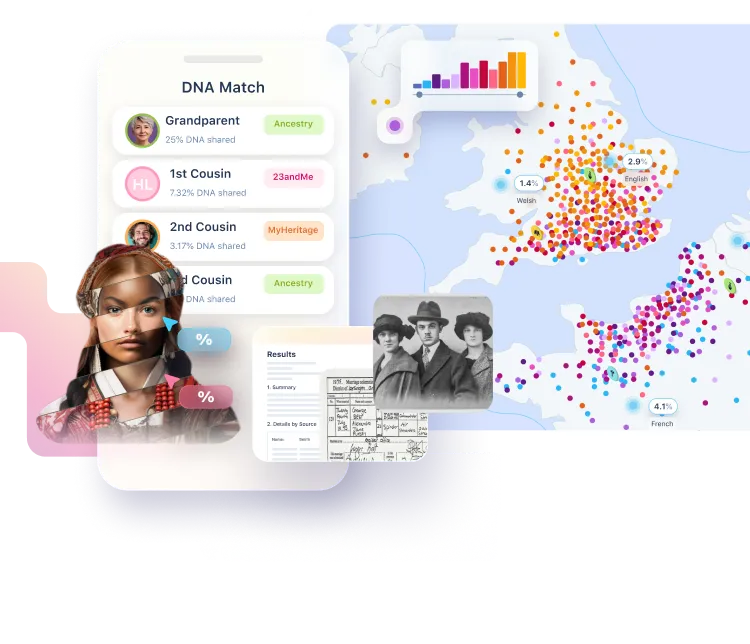
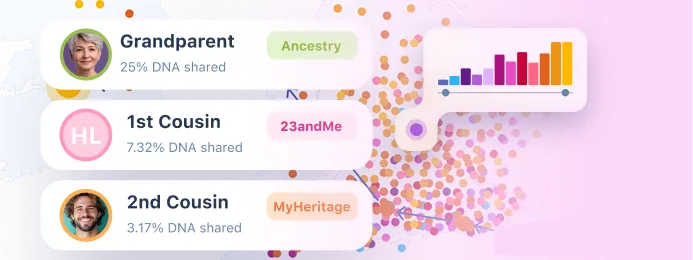
Find more DNA matches across all DNA tests
Combine your DNA data with your family tree to unlock the full power of YourRoots DNA Match. Connect with relatives across major testing services — Ancestry, 23andMe, MyHeritage, and more.
View your matches' maps and trees to identify shared ancestors, and soon you'll be able to add them directly to your own tree and map.
Ancestry DNA analysis that goes deeper than others
Unlock exclusive reports that reveal your deeper origins.
- Deep Ancestry Report — Analyze 130+ ethnicities, sub-regions, and 1,800+ communities in one detailed view.
- Global & Native American Reports — Developed with Stanford researchers to uncover hidden ancestries across all 22 chromosomes.
- Ancient DNA Series — Compare your DNA with 1,000+ ancient genomes from Viking, Celtic, and early American civilizations.
Sign up to explore more
Create a free account to navigate family trees, view ancestors, and discover connections.
Coming Soon
We're actively working on many new features for YourRoots. Features marked v2 are ones we're planning to launch soon.
Have a particular feature request? Let us know below!