
Import your family tree
to get weekly genealogy reports and discover parents of your “end-of-line” ancestors — FREE with AI Ancestor Finder.
SIGN UP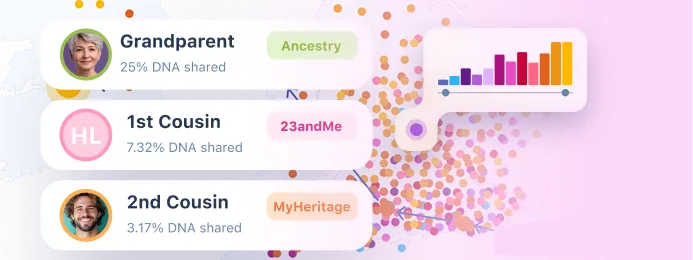
Import your family tree
to get weekly genealogy reports and discover parents of your “end-of-line” ancestors — FREE with AI Ancestor Finder.
SIGN UPWeeks Family Genealogy, Tree & Historical Records
Discover the Global Legacy and Lineage of the Weeks Surname
The Weeks surname, originating from England, carries multiple intriguing meanings. It is thought to derive from the Middle English personal name Wikke, linked to the Germanic element wig, meaning "battle" or "war." Alternatively, it may have originated from the English topographic name Wick, indicating residence near an outlying village or settlement, or from the Scandinavian Vik, denoting proximity to a small bay or inlet. These diverse origins contribute to its uncommon nature and rich historical context, making it a fascinating subject for those researching the Weeks family tree.
Over the centuries, the Weeks surname has evolved and spread geographically. Initially found in regions of England such as Somerset and Devonshire, the name extended beyond its origins as families began migrating. Notably, in the 17th century, bearers of the Weeks name ventured to the New World, establishing roots in North America. By the 19th and 20th centuries, the surname had reached Australia, Canada, and New Zealand, reflecting the widespread distribution of Weeks genealogy today.
Insights from the YourRoots dataset enhance our understanding of the Weeks family history. While specific early records are sparse, YourRoots indicates the surname's presence in England during the 16th century, with branches forming amid significant historical events. This data suggests a resilient family lineage, with the Weeks name adapting and expanding through various cultural and geographical landscapes over the centuries.
For genealogy enthusiasts, the YourRoots data provides a valuable resource for tracing the Weeks family tree. With records highlighting the family's spread across continents, researchers can delve into their ancestry, uncovering connections and stories that have shaped the Weeks legacy. This exploration offers a rich tapestry of insights for those invested in the history and expansion of the Weeks surname.
Find the Weeks Family Tree (YourRoots Tree Records)
Search more Weeks trees & genealogy records
Records
-
EWElmer Earl, "Jackie, Jackson" WeeksBirth: 1905 – 1974 Beloit, Lyon, Iowa, United StatesDeath: 1905 – 1974 Omaha, Douglas, Nebraska, United StatesFather: Luther "Lute", Anson JACKSONMother: Eloda Maria, Minor, Jackson, Welch Blake
-
CWClarissa A WeeksBirth: 1861 – 1936 Staunton, Macoupin, Illinois, United StatesDeath: 1861 – 1936 Lincoln, Lincoln, Kansas, United StatesFather: Robert Cicro, R.C. WeeksMother: Josephine W Smalley
-
EWEdward Augustus, Jr WeeksBirth: 1898 – 1989 Elizabeth, Union, New Jersey, USADeath: 1898 – 1989 Thompson, Windham, Connecticut, USAFather: Edward Augustus WeeksMother: Fredericka Davis Suydam
-
SWSelea Penn WeeksBirth: 1820 – 1863 North Carolina, United StatesDeath: 1820 – 1863 Marion, Alabama, United StatesFather: William Benjamin WeeksMother: Katherine "Katie" Scott
-
WWWilliam WeeksBirth: 1629 – 1689 Staines, Middlesex, EnglandDeath: 1629 – 1689 Edgartown, Dukes County, Massachusetts, United States of AmericaFather: Sir Robert WickesMother: Sarah (Enderly) Wickes
-
JWJohn WeeksBirth: 1655 – 1730 Edgartown, Dukes, Massachusetts, USADeath: 1655 – 1730 Falmouth, Barnstable, Massachusetts, USAFather: William WeeksMother: Mary Lynde
-
JWJohn Ruff WeeksBirth: 2012 – 2012 Hancock, Delaware, New York, United StatesDeath: 2012 – 2012 Farmington,Tioga,Pennsylvania,USAFather: John R. WeeksMother: Mary Ann, (Polly) Baxter
-
AWAgnes WeeksBirth: 1505 – 1571 Bengeworth, Worcestershire, EnglandDeath: 1505 – 1571 Stratford-upon-Avon, Stratford-on-Avon District, Warwickshire, EnglandFather: Sir John WeeksMother: Lady Alice, Maud, de, Bates (Weeks)
-
GWGeorgianna WeeksBirth: 1874 – 1905 Waterville, York Co, New BrunswickDeath: 1874 – 1905 New Brunswick, CanadaFather: George W WeeksMother: Sarah Maggie Lowe
-
RWRebecca WeeksBirth: 1760 – 1827 Carteret, North Carolina, United StatesDeath: 1760 – 1827 Sumter, Sumter, South Carolina, United StatesFather: Jabez WeeksMother: Mary Rhodes
-
JWJeanne Myrtle WeeksBirth: 1929 – 2013 Warren, Macomb, Michigan, USADeath: 1929 – 2013 Romeo, Macomb, Michigan, USAFather: Ora F WeeksMother: Hazel justice
-
JWJudith WeeksBirth: 1708 – 1708 Hinxhill, Kent, EnglandDeath: 1708 – 1708 Hinxhill, Kent, EnglandFather: Thomas WEEKS (Wicks)Mother: Mary Ingram
-
NWNellie E WeeksBirth: 1888 – 1954 Boston, Suffolk, Massachusetts, USADeath: 1888 – 1954 New Bedford, Bristol, Massachusetts, USAFather: Benjamin J WeeksMother: Edith Lavina Skeels
-
AWAbigail Bethia WeeksBirth: 1658 – 1696 Edgartown, Dukes, Massachusetts, United StatesDeath: 1658 – 1696 Falmouth, Barnstable, Massachusetts, United StatesFather: William Wickes, (Weeks), Sr.Mother: Mary "Polly" Lynde
-
SWSamuel WeeksBirth: 1643 – 1698 New Amsterdam, New York, New York, USADeath: 1643 – 1698 Cedarswamp, Nassau, New York, USAFather: Francis WickesMother: Elizabeth Luther
-
AWAmy WeeksBirth: 1699 – 1752 Phillipsburg, Westchester, New York, USADeath: 1699 – 1752 Phillipsburg, Westchester, New York, USAFather: Samuel WeeksMother: Ann Carpenter
-
EWEliza WeeksBirth: 1816 – 1891 Dublin, IrelandDeath: 1816 – 1891 Lansdown,Goulburn NSWFather: William WeeksMother: Martha
-
FWFreelove WeeksBirth: 1719 – 1788 Glen Cove, Queens, New York, USADeath: 1719 – 1788 Glen Cove, Queens, New York, USAFather: Samuel WeeksMother: Ann Carpenter
-
FWFrank Charles WeeksBirth: 1858 – 1951 Erie City, Erie, PennsylvaniaDeath: 1858 – 1951 Warren, Macomb, Michigan, USAFather: John Ruff WeeksMother: Julia Ann Weeks
-
IWIsabell Smith, Storm WeeksBirth: 1825 – 1916 Rutherford County, Tennessee, United States of AmericaDeath: 1825 – 1916 Shelby County, Illinois, United States of AmericaFather: Joseph DicksonMother: Eleanor Rankin
Search more trees & records for
Weeks for free
SIGNUP
Tracing Your Weeks Family Lineage
Origin of the Weeks Family: Where does the Weeks surname come from?
The Weeks surname has intriguing genealogical roots, although the earliest known appearance of the name is not easily pinpointed within the YourRoots records. This lack of early records does not obscure the family's potential origins; instead, it invites further exploration into how the name may have evolved. The absence of specific date references suggests that the Weeks family likely has a deep-seated heritage that may span several centuries and geographical regions.
Genealogy and Early Family History of Weeks
In the early centuries, families bearing the Weeks surname began to establish their presence in various regions, as indicated by the YourRoots database. Notably, during the 16th century, the Weeks family found roots in England, where they began to branch out and form distinct family lines. As time progressed into the 17th century, these families expanded, forging connections and building their family trees through marriages and migrations.
By the 18th century, the Weeks surname was seen in multiple areas across England, showcasing the family's growth and adaptability. The establishment of new branches often coincided with significant historical events, which shaped the lives of those who carried the surname. This dynamic evolution contributed to a rich tapestry of family histories woven throughout the centuries.
Tracing the Weeks Family Tree Through the Centuries
The expansion of the Weeks surname became more pronounced in the 19th century as families began to migrate beyond England's borders. During this time, the Weeks name began appearing in North America, where many families sought new opportunities and established roots. The 20th century saw an even broader dispersion, with the Weeks surname making its way to Australia, Canada, and other parts of the world, showcasing the family's global reach.
Throughout these centuries, the Weeks family tree has intertwined with diverse cultures and communities, contributing to a rich genealogical narrative. Each branch of the family has its own unique stories, reflecting the historical contexts in which they lived. This broader expansion illustrates the resilience and adaptability of the Weeks family across generations.
Where to Find Weeks Genealogy Records Today
In contemporary times, the Weeks surname can be traced across various regions, continuing to thrive in the 21st century. Families with this surname now inhabit countries like the United States, Canada, and Australia, each carrying forward their unique family stories. To uncover personal connections to the Weeks family lineage, readers are encouraged to explore the genealogy records available in the YourRoots database, where they can delve deeper into their own family tree.
Famous People with Weeks (and Their Family Tree)

Honeysuckle Weeks
Honeysuckle Susan Weeks is a renowned British actress best known for her role as Samantha Stewart in the BAFTA-winning series "Foyle's War." She has captivated audiences with her performances in various TV shows such as "The Inspector Lynley Mysteries," "Death in Paradise," and "Frankie Drake Mysteries." Her film credits include "Lorna Doone" and "The Wicker Tree." Weeks' stage presence is equally impressive, with notable roles in plays like "A Daughter's A Daughter" and "The Best Man." Her versatile talent across television, film, and theater has established her as a prominent figure in the entertainment industry.
Honeysuckle Weeks was born in Cardiff, Wales, to parents Robin and Susan Weeks. She grew up in West Sussex, England, alongside her siblings, Perdita and Rollo, who are also actors. Named after the honeysuckle plant, her early education included attending Great Ballard School and Roedean School, before studying English at Pembroke College, Oxford. Her familial ties to acting are evident, as both her sister and brother have pursued careers in the same field.

Perdita Weeks
Perdita Rose Weeks, a British actress born on December 25, 1985, is renowned for her role as Juliet Higgins in the CBS/NBC series Magnum P.I. Weeks has showcased her versatility through various roles, including Mary Boleyn in Showtime's The Tudors and Lydia Bennet in ITV's Lost in Austen. Her work spans across television, film, and radio, with notable performances in productions like Midsomer Murders, Sherlock Holmes and the Case of the Silk Stocking, and the horror films Prowl and As Above, So Below. Her career is marked by a blend of historical dramas and contemporary series, enhancing her visibility in the entertainment industry.
Perdita Weeks was born in South Glamorgan to parents Robin and Susan (née Wade) Weeks. She hails from a family of actors, being the younger sister of Honeysuckle Weeks and the older sister of Rollo Weeks. Her education includes attending Roedean School in East Sussex and studying art history at the Courtauld Institute in London.

Kevin Weeks
Kevin Weeks, born on March 21, 1956, is a former American mobster renowned for his role as a mob lieutenant to the infamous Whitey Bulger, leader of the Winter Hill Gang, an Irish-American crime family in Somerville, Massachusetts. Weeks, known for his involvement in organized crime, became a cooperating witness in 1999, contributing to the convictions of key figures like FBI agent John Connolly and Stephen Flemmi. Post-incarceration, Weeks authored the memoir "Brutal: My Life in Whitey Bulger's Irish Mob" and the novel "Where's Whitey?" with Phyllis Karas, further cementing his connection to Bulger's criminal legacy.
Kevin Weeks was born into a working-class family of Irish and Welsh descent in South Boston, Massachusetts. He was the fifth of six children in the Weeks family, which resided in the Old Colony Housing Project. His father, John Weeks Sr., originally from Brooklyn, New York, worked as a tire changer and later with the Boston Housing Authority, while also coaching boxing. Kevin's brothers, William and John Jr., achieved academic success, graduating from Harvard University and pursuing careers in politics.
Rollo Weeks
Rollo Percival Loring Weeks, born on 20 March 1987, is a British former actor known for his captivating performances in films such as "The Little Vampire" (2000) and "The Thief Lord" (2006). He gained early recognition with a Young Artist Award nomination for his role as vampire Rudolph Sackville-Bagg. Weeks expanded his film repertoire with appearances in "Girl With a Pearl Earring" (2003) and "The Queen of Sheba's Pearls" (2004). Transitioning from acting, Weeks became a notable figure in the hospitality industry and now works as a photographer and advertising cinematographer under the name Rollo Wade.
Born in Chichester to Welsh parents Robin and Susan Weeks, Rollo is the younger brother of actresses Honeysuckle Weeks and Perdita Weeks, highlighting a family with strong ties to the performing arts.

Brent Weeks
Brent Weeks is a renowned American fantasy writer, best known for his New York Times bestselling series, the Night Angel trilogy and the Lightbringer series. His debut novel, "The Way of Shadows," quickly propelled him to fame, with each book in the Lightbringer series also making the NYT list. Weeks's works, published by Orbit Books, have sold over 4 million copies worldwide and have been translated into more than 14 languages. Influenced by literary greats like Shakespeare and Tolkien, Weeks's novels have been celebrated for their rich storytelling and complex characters, with "The Black Prism" being recognized as one of the best Sci-Fi & Fantasy novels of the 2010s.
Weeks Surname Meaning, Origin, and History
The surname "Weeks" is of English origin and can be traced back to several derivations. It may originate from the Middle English personal name Wikke, meaning "battle" or "war," or from the Old English word "Wick," referring to someone living in a small, outlying village. Additionally, it could be an Anglicization of the Scandinavian habitational name "Vik," which means "small bay" or "inlet."
VIEW MOREAbout YourRoots
Explore your family tree geographically
Import your GEDCOM file to transform your family tree into an interactive global map. See your roots laid out visually and understand your true geographic heritage.
Powerful tools like “Trace Back To Me” instantly map your family’s migration paths from a chosen ancestor all the way back to you.
Discover ancestors beyond “end-of-line” automatically
Import your family tree and let AI expand it for you. AI Ancestor Finder scans “end-of-line” ancestors to uncover their parents across hundreds of family lines at once. AI Deep Research analyzes selected ancestors and family clusters, suggesting relevant records and next steps.
Turn on Auto Research Mode to get new discoveries daily or weekly, so your tree keeps growing even while you’re away.
Find more DNA matches across all DNA tests
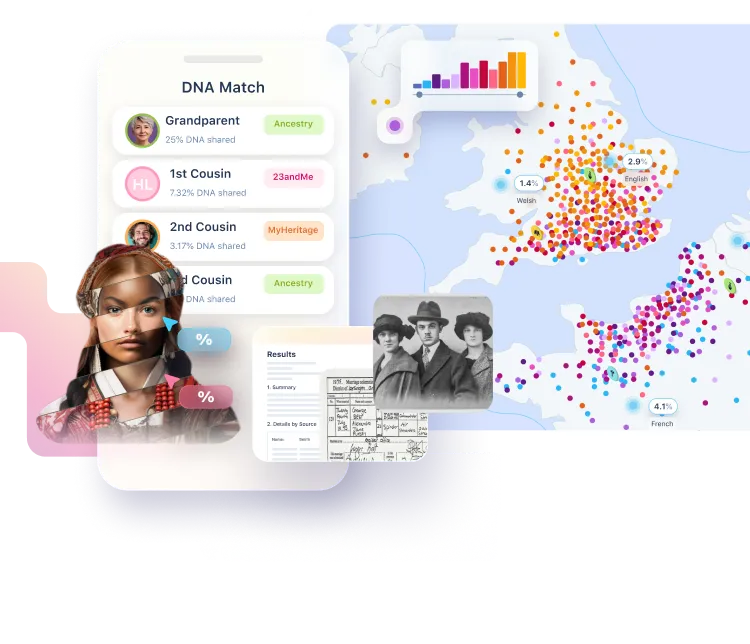
Combine your DNA data with your family tree to unlock the full power of YourRoots DNA Match. Connect with relatives across major testing services — Ancestry, 23andMe, MyHeritage, and more.
View your matches’ maps and trees to identify shared ancestors, and soon you’ll be able to add them directly to your own tree and map.
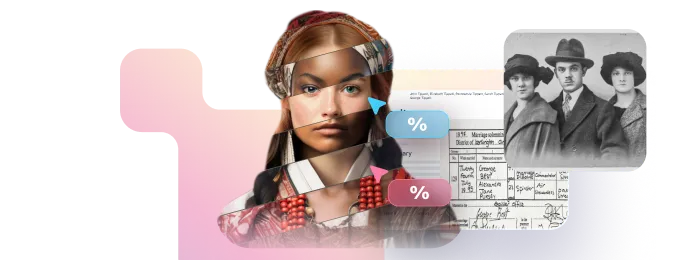
Ancestry DNA analysis that goes deeper than others
Unlock exclusive reports that reveal your deeper origins.
- Deep Ancestry Report — Analyze 130+ ethnicities, sub-regions, and 1,800+ communities in one detailed view.
- Global & Native American Reports — Developed with Stanford researchers to uncover hidden ancestries across all 22 chromosomes.
- Ancient DNA Series — Compare your DNA with 1,000+ ancient genomes from Viking, Celtic, and early American civilizations.