
Sign up to explore more
Create a free account to navigate family trees, view ancestors, and discover connections.
Sign up to explore more
Create a free account to navigate family trees, view ancestors, and discover connections.
Weir Family Genealogy & History
Discover the Global Legacy of the Weir Surname
The Weir surname first emerged in the early 15th century in Scotland, signifying its deep roots in Scottish heritage. As an integral part of family history, the name Weir is believed to have originated from the Old English word "wer," meaning "dam" or "enclosure," reflecting the geographical features of the landscapes where early bearers of the name likely lived. Over time, the surname became a significant identifier for families, embodying their legacy and lineage as they navigated the evolving societal landscapes of their time.
Throughout the centuries, the Weir family name spread and evolved, particularly flourishing in Scotland during the 16th and 17th centuries. As families branched out, distinct lines of the Weir surname emerged, each contributing unique narratives to the broader family tree. By the 18th century, the Weir name had firmly established itself within Scottish society, with families often linked to significant local events and histories. This period of expansion and consolidation laid the groundwork for the Weir family's later geographical spread.
YourRoots data enriches our understanding of the Weir genealogy by confirming the surname's presence in Scotland since the 15th century, aligning with historical records of its early origins. The dataset highlights the surname's growth during the 16th and 17th centuries, with families branching out and contributing to the diverse Weir family tree. The 19th century marked a period of significant migration, with many Weir descendants moving to the United States and establishing the surname's global presence. This migration and settlement have been well-documented, illustrating the adaptability and resilience of the Weir lineage.
Today, the Weir family tree is a testament to a rich genealogical history, with branches extending across continents. For those interested in Weir genealogy, YourRoots provides invaluable insights into the past and offers a comprehensive resource for tracing family connections and understanding the historical context of the Weir surname. Researchers and enthusiasts alike can delve into Weir records, uncovering the rich tapestry of stories and connections that define this enduring family legacy.
Find the Weir Family Tree
Search more Weir trees & genealogy records
Records
-
MWMonterville Weir1863–1924Public Tree PersonParents: Mary Haney3 treesScore: AMWMonterville Weir1863–1924Public Tree PersonParents: Mary Haney3 treesScore: A
-
SWStewart Gordon Weir1912–1993Individual Tree PersonParents: Thomas Weir & Blanche HarperSpouse: Ada BayneChildren: Gavin, Marlene, BettyScore: ASWStewart Gordon Weir1912–1993Individual Tree PersonParents: Thomas Weir & Blanche HarperSpouse: Ada BayneChildren: Gavin, Marlene, BettyScore: A
-
LWLillian Lockhart (Dolly) Weir1899–1997Individual Tree PersonParents: Gavin Weir & Ellen ValeSpouse: James AlexanderChildren: JamesScore: ALWLillian Lockhart (Dolly) Weir1899–1997Individual Tree PersonParents: Gavin Weir & Ellen ValeSpouse: James AlexanderChildren: JamesScore: A
-
AWAgnes Eloise Weir1910–1968Individual Tree PersonParents: Herman Weir & Nola McFadinSpouse: Turner BatsonChildren: Stephen, PhillipScore: AAWAgnes Eloise Weir1910–1968Individual Tree PersonParents: Herman Weir & Nola McFadinSpouse: Turner BatsonChildren: Stephen, PhillipScore: A
-
JWJoseph Cunningham Weir1854–1933Individual Tree PersonSpouse: Mary McCutcheonChildren: Harry, John, Florence, MaudScore: AJWJoseph Cunningham Weir1854–1933Individual Tree PersonSpouse: Mary McCutcheonChildren: Harry, John, Florence, MaudScore: A
-
JWJollie Ann Weir1938–1982Individual Tree PersonParents: Bealer Sr. & Cleo MartinScore: AJWJollie Ann Weir1938–1982Individual Tree PersonParents: Bealer Sr. & Cleo MartinScore: A
-
WWWellington John Weir1885–1953Individual Tree PersonParents: John Weir & Addie HuttonScore: AWWWellington John Weir1885–1953Individual Tree PersonParents: John Weir & Addie HuttonScore: A
-
JWJohn Weir1783–1869Individual Tree PersonParents: William Weir & Elizabeth LaidlawSpouse: Marion PateChildren: William, Elisabeth, Thomas, MargrateScore: AJWJohn Weir1783–1869Individual Tree PersonParents: William Weir & Elizabeth LaidlawSpouse: Marion PateChildren: William, Elisabeth, Thomas, MargrateScore: A
-
EWElizabeth Weir1868–1894Individual Tree PersonParents: James Weir & Rosina SmithScore: AEWElizabeth Weir1868–1894Individual Tree PersonParents: James Weir & Rosina SmithScore: A
-
TWTheo Weir1909–1965Individual Tree PersonParents: James Wier & Allie SteverlySpouse: Elsie MillerScore: ATWTheo Weir1909–1965Individual Tree PersonParents: James Wier & Allie SteverlySpouse: Elsie MillerScore: A
-
PWPenny Weir1876–1945Individual Tree PersonParents: George Weir & Elizabeth StewartSpouse: Thomas CudeChildren: ZenasScore: APWPenny Weir1876–1945Individual Tree PersonParents: George Weir & Elizabeth StewartSpouse: Thomas CudeChildren: ZenasScore: A
-
BWBurtle Weir1884–1966Individual Tree PersonParents: George Weir & Elizabeth StewartSpouse: John Blackwell, William SorrellChildren: Thomas, RoyScore: ABWBurtle Weir1884–1966Individual Tree PersonParents: George Weir & Elizabeth StewartSpouse: John Blackwell, William SorrellChildren: Thomas, RoyScore: A
-
HWHenry Weir1831–1901Individual Tree PersonParents: Alexander Sr. & Elizabeth KroutSpouse: Elizabeth LNUScore: AHWHenry Weir1831–1901Individual Tree PersonParents: Alexander Sr. & Elizabeth KroutSpouse: Elizabeth LNUScore: A
-
EWElsie W Weir1917–2001Individual Tree PersonParents: George Weir & Julia WeirScore: AEWElsie W Weir1917–2001Individual Tree PersonParents: George Weir & Julia WeirScore: A
-
GWGeorge Weir1752–1837Individual Tree PersonParents: David Weir & Marey MacPhersonSpouse: Mary WearChildren: JamesScore: AGWGeorge Weir1752–1837Individual Tree PersonParents: David Weir & Marey MacPhersonSpouse: Mary WearChildren: JamesScore: A
-
EWEllen Weir1869–1951Individual Tree PersonParents: Alexander Weir & Sarah HolmesSpouse: George HodgsonChildren: HarryScore: AEWEllen Weir1869–1951Individual Tree PersonParents: Alexander Weir & Sarah HolmesSpouse: George HodgsonChildren: HarryScore: A
-
HWHarry Wallace Weir1870–1931Individual Tree PersonParents: Edward Jr & Eliza JohnsonSpouse: Ruth GrundyScore: AHWHarry Wallace Weir1870–1931Individual Tree PersonParents: Edward Jr & Eliza JohnsonSpouse: Ruth GrundyScore: A
-
MWMartha Weir1888–1970Individual Tree PersonParents: Thomas Weir & Ellen WeirScore: AMWMartha Weir1888–1970Individual Tree PersonParents: Thomas Weir & Ellen WeirScore: A
-
MWMatthew Weir1869–1922Individual Tree PersonParents: Ninian Weir & Martha StaffordScore: AMWMatthew Weir1869–1922Individual Tree PersonParents: Ninian Weir & Martha StaffordScore: A
-
JWJohn Weir1867–1942Individual Tree PersonParents: James Weir & Margaret HowieSpouse: Elizabeth AndersonScore: AJWJohn Weir1867–1942Individual Tree PersonParents: James Weir & Margaret HowieSpouse: Elizabeth AndersonScore: A
Search more trees & records for
Weir for free
Tracing Your Weir Family Lineage
Origin of the Weir Family: Where does the Weir surname come from?
The Weir surname first appears in records during the early 15th century in Scotland, marking the beginnings of a rich family lineage. This initial documentation signifies the roots of the Weir family, connecting them to the historical tapestry of Scottish heritage. As families began to establish their identities, the Weir surname became a marker of their genealogy and familial connections in the evolving societal landscape of the time.
Genealogy and Early Family History of Weir
Throughout the following centuries, the Weir family expanded significantly within Scotland, particularly flourishing in various key regions. During the 16th century, the surname saw a notable increase in presence, as families began to branch out, creating distinct lines that contributed to the Weir family tree. The 17th century continued this trend, witnessing the growth of different Weir branches, each weaving its own narrative into the broader family history.
By the 18th century, the Weir surname had established itself firmly in Scottish society, with families often linked to significant events and local histories. This period marked a time of consolidation and expansion, as members of the Weir family continued to develop their connections both within Scotland and beyond. The genealogical footprint of the Weir family became increasingly complex, with numerous descendants forming their own paths while maintaining ties to their ancestral roots.
Tracing the Weir Family Tree Through the Centuries
As the Weir surname journeyed into the 19th century, families began to migrate, particularly to the United States, where the name gained prominence. This era marked a significant expansion of the Weir family tree, as descendants settled in various states, contributing to the growth of the surname’s global presence. The 20th century further diversified the Weir lineage, with families establishing connections in multiple countries, highlighting the adaptability and resilience of their heritage.
Throughout these centuries, the Weir surname has become a symbol of a rich genealogical history, with branches extending across continents. Each family line reflects a unique story, intertwined with the broader narrative of migration and settlement. The evolution of the Weir family tree illustrates the connections forged through time, place, and shared ancestry.
Where to Find Weir Genealogy Records Today
In contemporary times, the Weir surname can be found across various regions, with significant concentrations in both the United States and the United Kingdom. As families continue to explore their genealogical roots, the Weir lineage offers a tapestry of histories and connections waiting to be uncovered. Readers are encouraged to delve into the YourRoots database to trace their own Weir family connections and enrich their understanding of their heritage.
Famous People with Weir (and Their Family Tree)

Andy Weir
Andy Weir, an acclaimed American novelist, is renowned for his science fiction works, particularly "The Martian," which was adapted into a 2015 film by Ridley Scott. Weir's other notable works include "Project Hail Mary," a finalist for the 2022 Hugo Award for Best Novel, and "Artemis," set in a future lunar city. Weir's writing, praised for its scientific accuracy and engaging storytelling, began gaining attention with his short story "The Egg." He has collaborated on webcomics and contributed to the "Ready Player One" universe. His novels often explore themes of space exploration and human ingenuity, making him a prominent figure in contemporary science fiction literature.
Andy Weir was raised in Milpitas, California, as an only child. His father, John Weir, worked as a physicist at Sandia National Laboratories, while his mother was an electrical engineer. Weir's early exposure to science and technology likely influenced his interest in science fiction. His parents divorced when he was eight, and he grew up immersed in classic science fiction literature, which shaped his future writing career.

Peter Weir
Peter Lindsay Weir, born in 1944, is a renowned Australian retired film director celebrated for his diverse and groundbreaking contributions to cinema. Over a career spanning four decades, he directed classics such as "Picnic at Hanging Rock," "Dead Poets Society," and "The Truman Show," earning six Academy Award nominations. Notably, Weir was a pivotal figure in the Australian New Wave cinema movement and received the Academy Honorary Award in 2022 for lifetime achievement. His films, known for exploring isolation and crisis, made significant impacts across various genres and international markets.
Peter Weir was born in Sydney to Peggy (née Barnsley Sutton) and Lindsay Weir, a real estate agent. He attended The Scots College and Vaucluse Boys High School, later studying at the University of Sydney.

Bob Weir
Bob Weir, born Robert Hall Weir (né Parber), is a renowned American musician and songwriter, best known as a founding member of the iconic rock band, the Grateful Dead. Throughout his illustrious career, Weir played rhythm guitar and sang lead vocals on many of the band's rock and country songs. Following the Grateful Dead's disbandment in 1995, he continued to captivate audiences with bands like the Other Ones, RatDog, and Dead & Company, which he formed alongside John Mayer and other former Grateful Dead members. Inducted into the Rock and Roll Hall of Fame in 1994, Weir's contributions to music are celebrated worldwide.
Born in San Francisco on October 16, 1947, Bob Weir was adopted by Frederic Utter Weir and Eleanor (née Cramer) Weir after being given up for adoption by his biological parents, John Parber and Phyllis Inskeep. His biological heritage includes Italian, German, Irish, and English ancestry. Raised in Atherton, Weir discovered his passion for music at a young age, eventually leading him to become a pivotal figure in rock history.

Johnny Weir
Johnny Weir, born July 2, 1984, is an acclaimed American figure skater and television commentator. Known for his lyrical and classical skating style, Weir is a three-time U.S. National Champion (2004–2006), a two-time Olympian (2006, 2010), and the 2008 World bronze medalist. As the first American to win the Cup of Russia in 2007, he also became NBC's primary figure skating analyst alongside Tara Lipinski and Terry Gannon. Weir's fashion-forward costume designs and outspoken nature often stirred controversy within U.S. Figure Skating. He publicly addressed homophobia at the 2010 Olympics and came out in 2011, becoming an advocate for LGBTQ rights.
Johnny Weir was born in Coatesville, Pennsylvania, to John Weir, a nuclear power plant engineer, and Patti Weir, a nuclear power plant worker and home inspector. Of Norwegian heritage, he grew up in Quarryville, Pennsylvania, with his younger brother Brian. His father and he were both accomplished equestrians, a skill that later influenced his figure skating. The family lived in Connecticut and Delaware to support his skating training, showcasing their dedication to his burgeoning career.

Caroline Weir
Caroline Elspeth Lillias Weir, born 20 June 1995, is a prominent Scottish professional footballer known for her role as an attacking midfielder for Real Madrid CF in the Spanish Liga F and the Scotland national team. Weir started her career with Hibernian, moved to Arsenal, and then played for Bristol Academy, Liverpool, and Manchester City, where she won multiple titles, including two FA Women's Cups and two WSL Cups. Notably, she scored a memorable goal in the Manchester derby, nominated for the FIFA Puskas Award. Weir was the first Scottish player in Spain's top division and represented Scotland at UEFA Euro 2017, the 2019 FIFA World Cup, and Great Britain at the 2020 Olympics.
Weir Surname Meaning, Origin, and History
The surname "Weir" is associated with a wide range of notable individuals across various fields, including literature, sports, politics, and the arts. It is a surname that appears in both real and fictional contexts, with characters named Weir featured in several television series and films.
VIEW MOREWhere to Find Genealogy Records for Weir
We’ve analyzed YourRoots tree and records data to uncover where genealogists are finding key sources such as census, birth certificates, marriage records, and obituaries for the Weir family. Explore our most popular genealogy record sources for the Weir surname to learn more.
VIEW MOREAbout YourRoots
Explore your family tree geographically
Import your GEDCOM file to transform your family tree into an interactive global map. See your roots laid out visually and understand your true geographic heritage.
Powerful tools like "Trace Back To Me" instantly map your family's migration paths from a chosen ancestor all the way back to you.
Discover ancestors beyond "end-of-line" automatically
Import your family tree and let AI expand it for you. AI Ancestor Finder scans "end-of-line" ancestors to uncover their parents across hundreds of family lines at once. AI Deep Research analyzes selected ancestors and family clusters, suggesting relevant records and next steps.
Turn on Auto Research Mode to get new discoveries daily or weekly, so your tree keeps growing even while you're away.
Find more DNA matches across all DNA tests
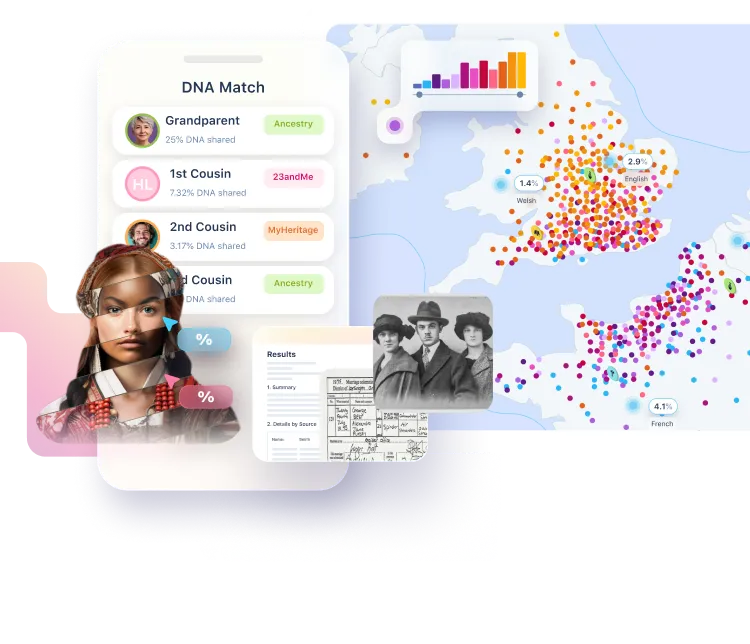
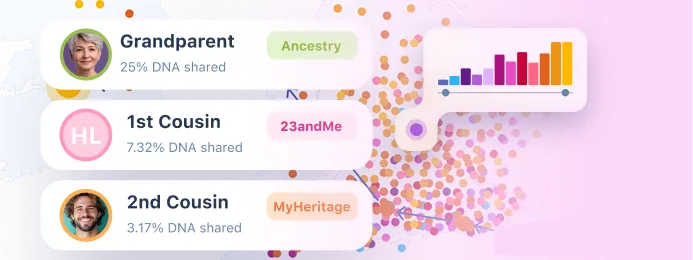
Combine your DNA data with your family tree to unlock the full power of YourRoots DNA Match. Connect with relatives across major testing services — Ancestry, 23andMe, MyHeritage, and more.
View your matches' maps and trees to identify shared ancestors, and soon you'll be able to add them directly to your own tree and map.
Ancestry DNA analysis that goes deeper than others
Unlock exclusive reports that reveal your deeper origins.
- Deep Ancestry Report — Analyze 130+ ethnicities, sub-regions, and 1,800+ communities in one detailed view.
- Global & Native American Reports — Developed with Stanford researchers to uncover hidden ancestries across all 22 chromosomes.
- Ancient DNA Series — Compare your DNA with 1,000+ ancient genomes from Viking, Celtic, and early American civilizations.
Sign up to explore more
Create a free account to navigate family trees, view ancestors, and discover connections.
Coming Soon
We're actively working on many new features for YourRoots. Features marked v2 are ones we're planning to launch soon.
Have a particular feature request? Let us know below!