
Sign up to explore more
Create a free account to navigate family trees, view ancestors, and discover connections.

Sign up to explore more
Create a free account to navigate family trees, view ancestors, and discover connections.
Wilbur Family Genealogy & History
Discover the Global Legacy of the Wilbur Surname
The Wilbur surname is a name of English and German origin, with its roots tracing back to the Germanic languages. The etymology of Wilbur is debated, but it is widely believed to derive from the Proto-Germanic elements "wil" meaning "wild," and "ebur" meaning "boar." An alternative theory suggests it comes from "willo," meaning "will" or "desire," and "burg," meaning "fortress." Over time, the name Wilbur has been associated with notable individuals across various fields, contributing to a rich tapestry of history and culture.
The Wilbur surname began its journey in England during the early 15th century, marking its initial presence in family records. As time progressed, the name spread within the British Isles, reaching Wales by the 17th century. This spread reflects the social and economic movements of families seeking new opportunities. By the 18th century, the Wilbur family migrated to the United States, where the name became further entrenched in the cultural fabric of the New World, expanding the Wilbur family tree significantly.
YourRoots data corroborates the early presence of the Wilbur surname in England and its subsequent migration to the United States. This historical movement is evident in the robust genealogical records that chart the family's growth from the British Isles to North America. The data enriches our understanding of the Wilbur genealogy, highlighting the family's adaptability and resilience through centuries of change and migration.
Today, Wilbur genealogy records are extensively documented, providing a valuable resource for those researching their ancestry. The YourRoots database serves as a key tool for tracing the Wilbur family tree, connecting modern descendants with their historical roots and offering insights into the familial ties that span continents and generations.
Find the Wilbur Family Tree
Search more Wilbur trees & genealogy records
Records
-
AWAlice Mayer WILBUR1907–1997Public Tree Person3 treesScore: AAWAlice Mayer WILBUR1907–1997Public Tree Person3 treesScore: A
-
DWDorothy Wilbur1617–1696Individual Tree PersonParents: Samuel Wilbore & Ann BradfordSpouse: Nathaniel Potter, John AlbroChildren: IchabodScore: ADWDorothy Wilbur1617–1696Individual Tree PersonParents: Samuel Wilbore & Ann BradfordSpouse: Nathaniel Potter, John AlbroChildren: IchabodScore: A
-
CWChristopher Wilbur1726–1821Individual Tree PersonParents: Benjamin Wilbor & Deborah GiffordSpouse: Sarah Vaughan, Sarah VaughanChildren: Phoebe, Sarah, Deborah, Elizabeth, Benjamin, Mary, John, Martha, David, Dinah, Lydia, JosephScore: ACWChristopher Wilbur1726–1821Individual Tree PersonParents: Benjamin Wilbor & Deborah GiffordSpouse: Sarah Vaughan, Sarah VaughanChildren: Phoebe, Sarah, Deborah, Elizabeth, Benjamin, Mary, John, Martha, David, Dinah, Lydia, JosephScore: A
-
MWMaude Evelyn Wilbur1870–1948Individual Tree PersonParents: Samuel Wilbur & Esther BoothChildren: MarieScore: AMWMaude Evelyn Wilbur1870–1948Individual Tree PersonParents: Samuel Wilbur & Esther BoothChildren: MarieScore: A
-
SWSamuel Wilbur1585–1656Individual Tree PersonParents: Nicholas Wilbore & Elizabeth Thickines\ThickinessSpouse: Ann WilberChildren: SamuelScore: ASWSamuel Wilbur1585–1656Individual Tree PersonParents: Nicholas Wilbore & Elizabeth Thickines\ThickinessSpouse: Ann WilberChildren: SamuelScore: A
-
BWBenjamin Planter Wilbur1705–1774Individual Tree PersonParents: Benjamin Wilbore & Mary *Spouse: Sarah *Children: David, Benjamin, Mary, Samuel, LydiaScore: ABWBenjamin Planter Wilbur1705–1774Individual Tree PersonParents: Benjamin Wilbore & Mary *Spouse: Sarah *Children: David, Benjamin, Mary, Samuel, LydiaScore: A
-
PWPreston Paul Wilbur1913–1985Individual Tree PersonParents: Herbert Wilbur & Blanche CoppSpouse: E BrewsterScore: APWPreston Paul Wilbur1913–1985Individual Tree PersonParents: Herbert Wilbur & Blanche CoppSpouse: E BrewsterScore: A
-
RWReuben Wilbur1784–1873Individual Tree PersonParents: Holden Wilbur & Ruth TisdaleSpouse: Mary BruceChildren: Asenath, Asa, Araminta, Mary, Orange, ReubenScore: ARWReuben Wilbur1784–1873Individual Tree PersonParents: Holden Wilbur & Ruth TisdaleSpouse: Mary BruceChildren: Asenath, Asa, Araminta, Mary, Orange, ReubenScore: A
-
EWEdward Lee Wilbur1856–1945Individual Tree PersonParents: Daniel Wilbur & Elizabeth WoodScore: AEWEdward Lee Wilbur1856–1945Individual Tree PersonParents: Daniel Wilbur & Elizabeth WoodScore: A
-
AWAlpheus Wilbur1834–1917Individual Tree PersonParents: Benjamin Wilbur & Sarah KinnearSpouse: Rebecca CannonChildren: Izelda, Stillman, William, Harbeda, AdeliaScore: AAWAlpheus Wilbur1834–1917Individual Tree PersonParents: Benjamin Wilbur & Sarah KinnearSpouse: Rebecca CannonChildren: Izelda, Stillman, William, Harbeda, AdeliaScore: A
-
LWLeona Kathleen Wilbur1917–2010Individual Tree PersonParents: Clarence Wilbur & Mary CochraneSpouse: Robert StewartChildren: Ronald, ElizabethScore: ALWLeona Kathleen Wilbur1917–2010Individual Tree PersonParents: Clarence Wilbur & Mary CochraneSpouse: Robert StewartChildren: Ronald, ElizabethScore: A
-
SWSarah Wilbur1748–1825Individual Tree PersonParents: Aaron Wilbur & Mary ChurchSpouse: Wesson SouleChildren: HiramScore: ASWSarah Wilbur1748–1825Individual Tree PersonParents: Aaron Wilbur & Mary ChurchSpouse: Wesson SouleChildren: HiramScore: A
-
FWFred Wilbur1873–1918Individual Tree PersonParents: Calvin Wilbur & Caroline BrownSpouse: Ethel DearbornChildren: FrankScore: AFWFred Wilbur1873–1918Individual Tree PersonParents: Calvin Wilbur & Caroline BrownSpouse: Ethel DearbornChildren: FrankScore: A
-
MWMartha Mary Wilbur1883–1976Individual Tree PersonParents: Wellington Wilbur & Sarah BennettSpouse: Edwin TingleyChildren: Wilfred, Annie, Edna, Edwin, WeldonScore: AMWMartha Mary Wilbur1883–1976Individual Tree PersonParents: Wellington Wilbur & Sarah BennettSpouse: Edwin TingleyChildren: Wilfred, Annie, Edna, Edwin, WeldonScore: A
-
BWBetty I. Wilbur1918–2006Individual Tree PersonParents: George Wilbur & Nelly YoungSpouse: Raymond VanceChildren: ErrolScore: ABWBetty I. Wilbur1918–2006Individual Tree PersonParents: George Wilbur & Nelly YoungSpouse: Raymond VanceChildren: ErrolScore: A
-
SWStephen King Wilbur1832–1905Individual Tree PersonParents: Melvin Wilbur & Eunice DennisChildren: Sarah, Hyrum, Stephen, Cynthia, Hannah, Harriet, Lucy, Elisha, Susan, Rufus, Cynthia, Waty, Willard, David, Semor, Ruth, Jane, Royal, Susannah, Phebe, Wealtha, William, Stephen, AmoaScore: ASWStephen King Wilbur1832–1905Individual Tree PersonParents: Melvin Wilbur & Eunice DennisChildren: Sarah, Hyrum, Stephen, Cynthia, Hannah, Harriet, Lucy, Elisha, Susan, Rufus, Cynthia, Waty, Willard, David, Semor, Ruth, Jane, Royal, Susannah, Phebe, Wealtha, William, Stephen, AmoaScore: A
-
BWBeatrice Mae Wilbur1897–1995Individual Tree PersonParents: Russel Wilbur & Emma HarmanSpouse: Howard CrawChildren: BeatriceScore: ABWBeatrice Mae Wilbur1897–1995Individual Tree PersonParents: Russel Wilbur & Emma HarmanSpouse: Howard CrawChildren: BeatriceScore: A
-
EWEdith Wilbur1904–1995Individual Tree PersonParents: Charles Wilbur & Lilla MerrillSpouse: Eugene RoheChildren: ElenoreScore: AEWEdith Wilbur1904–1995Individual Tree PersonParents: Charles Wilbur & Lilla MerrillSpouse: Eugene RoheChildren: ElenoreScore: A
-
TWThomas Wilbur1765–1858Individual Tree PersonParents: John WilburSpouse: Deborah TenneyChildren: KeziahScore: ATWThomas Wilbur1765–1858Individual Tree PersonParents: John WilburSpouse: Deborah TenneyChildren: KeziahScore: A
-
SWShadrack Wilbore \ Wilbur1631–1710Individual Tree PersonParents: Samuel Sr & Anne SmithSpouse: Mary DeanChildren: Sarah, RebeccaScore: ASWShadrack Wilbore \ Wilbur1631–1710Individual Tree PersonParents: Samuel Sr & Anne SmithSpouse: Mary DeanChildren: Sarah, RebeccaScore: A
Search more trees & records for
Wilbur for free
Tracing Your Wilbur Family Lineage
Origin of the Wilbur Family: Where does the Wilbur surname come from?
The earliest known appearance of the Wilbur surname can be traced back to England during the early 15th century. This initial record marks the beginnings of the family tree, linking modern descendants to their ancestral roots in the British Isles. As families began to establish themselves, the Wilbur name emerged, setting the stage for future generations to build their lineage.
Genealogy and Early Family History of Wilbur
In its formative centuries, the Wilbur family primarily flourished in England, particularly during the late 15th and into the 16th century. The name also began to appear in Wales during the 17th century, indicating a branching out of family lines and the establishment of new roots. As families navigated the social and economic changes of their times, they built complex family trees that reflected the evolving landscape of their lives.
By the 18th century, the Wilbur family began to migrate across the Atlantic, with significant growth noted in the United States. This movement led to the establishment of various branches, as families sought new opportunities and were shaped by the cultural dynamics of their new homeland. The migration not only diversified the family tree but also intertwined their stories with the broader American experience.
Tracing the Wilbur Family Tree Through the Centuries
Throughout the centuries, the Wilbur surname has expanded significantly, with notable presence in both the United Kingdom and the United States. In the 19th century, the name saw substantial growth in the United States, reflecting the migration patterns of many European families seeking a fresh start. Additionally, pockets of the Wilbur family can be found in various regions, including Canada and Australia, showcasing a global spread that aligns with historical patterns of emigration.
As the 20th century unfolded, the Wilbur name continued to evolve, adapting to modern times while still retaining its historical significance. Families bearing the Wilbur surname can be found in diverse communities, each with their own unique stories that contribute to the rich tapestry of the family history. This ongoing expansion emphasizes the importance of genealogy in understanding one’s heritage and connecting with distant relatives.
Where to Find Wilbur Genealogy Records Today
Today, the Wilbur surname is represented across various regions, particularly in the United States, where the name has established deep roots over the last few centuries. In the early 21st century, the Wilbur family continues to thrive, with descendants eager to explore their ancestry and family connections. Readers are encouraged to delve into the YourRoots database to uncover Wilbur genealogy records, allowing them to trace their own family tree and explore their heritage.
Famous People with Wilbur (and Their Family Tree)

Richard Wilbur
Richard Purdy Wilbur (1921–2017) was a distinguished American poet and literary translator renowned for his mastery of traditional forms and wit. A prominent poet of the World War II generation, Wilbur collaborated with Leonard Bernstein on the opera "Candide" and translated classic French dramas by Molière and Racine. He served as the U.S. Poet Laureate and received numerous accolades, including two Pulitzer Prizes for Poetry, the National Book Award, and the National Medal of Arts. A mentor to younger poets, Wilbur's legacy endures through his contributions to the American literary landscape.

George P. Wilbur
George Peter Wilbur (1941–2023) was a prominent American actor and professional stuntman, best known for his portrayal of Michael Myers in "Halloween 4: The Return of Michael Myers" and "Halloween: The Curse of Michael Myers." His extensive career as a stuntman spanned over 40 years, during which he contributed to more than 100 television and film projects. Wilbur's notable achievements include being a member of the Hollywood Stuntmen's Hall of Fame, reinforcing his legacy in the film industry.
Cornelia B. Wilbur
Cornelia Burwell Wilbur (August 26, 1908 – September 20, 1992) was a pioneering American psychiatrist renowned for her work on dissociative identity disorder (DID), most notably with patient Shirley Ardell Mason, the subject of the book and films titled "Sybil." An influential figure in psychiatry, Wilbur practiced in Omaha, New York City, and Weston, contributing to the field through her research, lectures, and advocacy for abuse prevention and increased female admission to medical schools. She was a professor at the University of Kentucky and authored numerous papers, leaving a lasting impact on psychiatric education and practice.

Ray Lyman Wilbur
Ray Lyman Wilbur was a prominent American medical doctor and academic leader, serving as the third president of Stanford University and the 31st United States Secretary of the Interior under President Herbert Hoover. Wilbur's career at Stanford spanned from 1896 to 1943, during which he modernized graduate education and founded the Stanford Graduate School of Business. As Interior Secretary, he addressed issues stemming from the Teapot Dome scandal and restructured the Bureau of Indian Affairs. A vocal critic of the New Deal, Wilbur championed "rugged individualism" post his tenure in government.
Ray Lyman Wilbur was born in Boonesboro, Iowa, to Dwight Locke Wilbur, an attorney and businessman, and Edna Maria Lyman. Raised alongside his brother Curtis D. Wilbur, who served as U.S. Secretary of the Navy, Ray Lyman Wilbur's family moved to Riverside, California, when he was twelve. He married Marguerite May Blake, with whom he had five children, including Dwight Locke Wilbur, who followed in his father's footsteps as President of the American Medical Association.
Goofy and Wilbur
Goofy, a beloved character from Walt Disney Productions, achieved a significant milestone with the 1939 release of "Goofy and Wilbur," where he starred in a solo role without Mickey Mouse or Donald Duck. This animated cartoon, produced by Walt Disney and released by RKO Radio Pictures, features Goofy embarking on a fishing adventure with his pet grasshopper, Wilbur. This film is noted for its humor, creativity, and the strong bond depicted between Goofy and Wilbur, earning acclaim for its character development and storytelling. The film's success helped cement Goofy's status as a standalone character in Disney's animated universe.
Wilbur Surname Meaning, Origin, and History
The surname "Wilbur" has English and German roots, with its etymology being somewhat disputed. The most accepted theory suggests it derives from the elements meaning "wild boar" in Proto-Germanic, while another theory proposes it combines the meanings of "will" or "desire" and "fortress." Notable individuals with this surname have made significant contributions in various fields, including psychiatry, government, and the arts.
VIEW MOREWhere to Find Genealogy Records for Wilbur
We’ve analyzed YourRoots tree and records data to uncover where genealogists are finding key sources such as census, birth certificates, marriage records, and obituaries for the Wilbur family. Explore our most popular genealogy record sources for the Wilbur surname to learn more.
VIEW MOREAbout YourRoots
Explore your family tree geographically
Import your GEDCOM file to transform your family tree into an interactive global map. See your roots laid out visually and understand your true geographic heritage.
Powerful tools like "Trace Back To Me" instantly map your family's migration paths from a chosen ancestor all the way back to you.
Discover ancestors beyond "end-of-line" automatically
Import your family tree and let AI expand it for you. AI Ancestor Finder scans "end-of-line" ancestors to uncover their parents across hundreds of family lines at once. AI Deep Research analyzes selected ancestors and family clusters, suggesting relevant records and next steps.
Turn on Auto Research Mode to get new discoveries daily or weekly, so your tree keeps growing even while you're away.
Find more DNA matches across all DNA tests
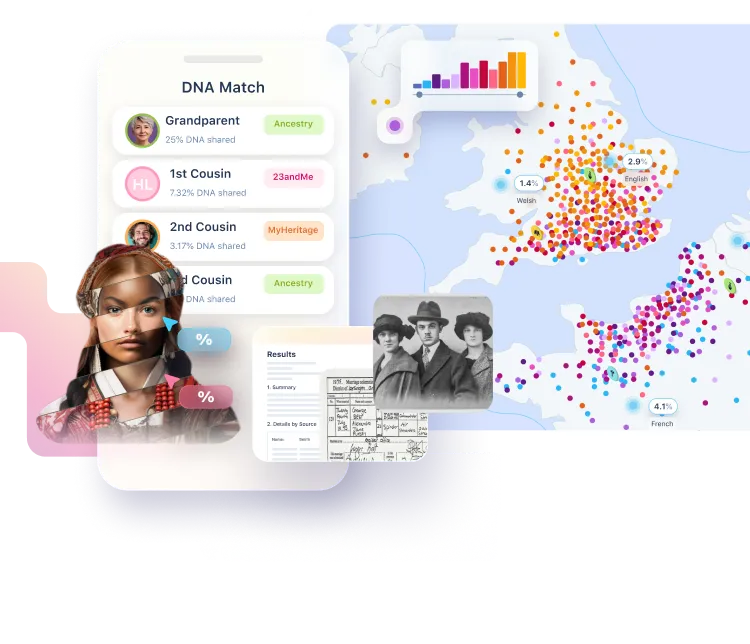
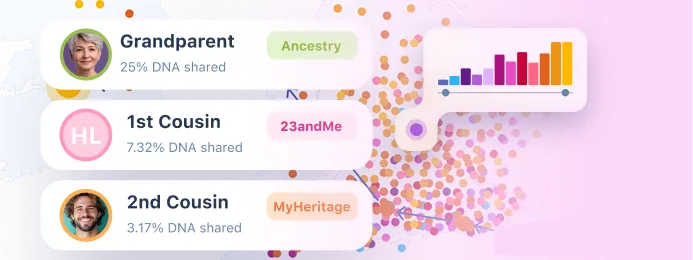
Combine your DNA data with your family tree to unlock the full power of YourRoots DNA Match. Connect with relatives across major testing services — Ancestry, 23andMe, MyHeritage, and more.
View your matches' maps and trees to identify shared ancestors, and soon you'll be able to add them directly to your own tree and map.
Ancestry DNA analysis that goes deeper than others
Unlock exclusive reports that reveal your deeper origins.
- Deep Ancestry Report — Analyze 130+ ethnicities, sub-regions, and 1,800+ communities in one detailed view.
- Global & Native American Reports — Developed with Stanford researchers to uncover hidden ancestries across all 22 chromosomes.
- Ancient DNA Series — Compare your DNA with 1,000+ ancient genomes from Viking, Celtic, and early American civilizations.
Sign up to explore more
Create a free account to navigate family trees, view ancestors, and discover connections.
Coming Soon
We're actively working on many new features for YourRoots. Features marked v2 are ones we're planning to launch soon.
Have a particular feature request? Let us know below!