Ancient DNA 101 | What It Is, How It Works & Analyzing Your Roots

1. Introduction: Ancient DNA, a Time Machine in Our Cells
Imagine holding a fragment of bone excavated from a cave floor, a relic from a person who lived 5,000 years ago. To the naked eye, it looks like dust and decay. But to geneticists, it is a time capsule. Inside the powdery remains are fragments of DNA, brittle and damaged, yet still carrying the code of life. With modern sequencing technologies, these fragments can be pieced together, revealing not only the biology of the long-dead individual but also sweeping patterns of migration, cultural exchange, and ancestry that shaped our world.
This field, known as ancient DNA research (aDNA), has moved from a fringe curiosity in the late 20th century to one of the most transformative scientific revolutions of the 21st. Ancient DNA is no longer just rewriting history textbooks; it is connecting the past to the present in ways that are deeply personal. For many people, the same technologies used in high-profile academic projects are now being folded into consumer ancestry tests, making it possible to match a cheek swab today with genomes from Bronze Age farmers, Viking warriors, or even Ice Age hunter-gatherers.
What was once an archaeologist’s dream, reading genetic history directly from ancient remains, has become a robust scientific discipline recognized at the highest level. In 2022, the Nobel Prize in Physiology or Medicine was awarded to Svante Pääbo for pioneering work in paleogenomics, cementing the field as not just a niche, but a cornerstone of how we understand human origins. And now, as consumer DNA testing matures, ancient DNA is beginning to flow out of labs and into everyday ancestry reports, making the deep past part of our personal identity.
2. The Landscape of Ancient DNA Research
At its core, ancient DNA (aDNA) refers to genetic material recovered from archaeological or historical remains: bones, teeth, hair, even sediments from caves. Unlike modern DNA, which is relatively intact, ancient DNA is highly fragmented, chemically damaged, and often contaminated with microbial DNA. Sequencing it is less like reading a book and more like trying to reconstruct a shredded manuscript with half the pages missing. Yet, when pieced together, these fragments open a direct line to our evolutionary past.
The field first came to life in the 1980s, when early attempts extracted DNA from Egyptian mummies and extinct animals. Many of these early studies were plagued by contamination. But by the late 1990s, clean-room protocols and high-throughput sequencing transformed what was possible. The breakthrough moment came in the 2000s with the sequencing of the Neanderthal genome, led by Svante Pääbo and his team at the Max Planck Institute. This revealed something extraordinary: humans alive today carry traces of Neanderthal DNA, proving interbreeding between modern humans and archaic hominins.
Today, ancient DNA research has scaled from single-genome case studies to global projects involving tens of thousands of samples. The Allen Ancient DNA Resource (AADR), maintained by Harvard’s David Reich Lab, now serves as the world’s largest public database of ancient genomes, covering individuals from the Ice Age to medieval times across every inhabited continent. These datasets, paired with cutting-edge computational tools, have made it possible to redraw maps of prehistoric migrations:
- The spread of Anatolian farmers into Europe during the Neolithic.
- The Steppe migrations that transformed Bronze Age Europe.
- The peopling of the Americas in multiple waves.
- The rise and fall of isolated lineages in Africa, Siberia, and Oceania.
The landscape of ancient DNA today is more than just academic curiosity. It is an interdisciplinary nexus where genetics, archaeology, anthropology, linguistics, and even history converge. Each new dataset reshapes long-standing debates: Was farming spread by cultural exchange or migration? How did Indo-European languages expand? What happened during the collapse of ancient civilizations?
Perhaps most strikingly, ancient DNA has moved beyond the ivory tower. Consumers can now encounter their genetic links to these deep histories through ancestry products that incorporate ancient samples. What was once the preserve of archaeogenetics conferences is now part of dinner-table conversations about family history.
3. Leading Universities and Labs in Ancient DNA
The rise of ancient DNA has been powered not just by better sequencing machines, but by a global network of research centers dedicated to pushing the field forward. A handful of universities and institutes now dominate the landscape, often working in close partnership with archaeologists and local museums. Together, these hubs have transformed ancient DNA from a niche experiment into a discipline that routinely makes the front page of Nature and Science.
Here are the powerhouses shaping ancient DNA today:
Global Leaders in Ancient DNA Research
These labs not only sequence DNA but also serve as training grounds for the next generation of scientists, creating a network that now spans hundreds of collaborations worldwide. Their work has redefined archaeology: where once pottery styles or burial patterns were the main evidence of past peoples, now a few milligrams of bone powder can reveal family trees, population movements, and even interactions with other species.
4. Top Scientists and Authors in Ancient DNA
Every scientific revolution has its pioneers and torchbearers. In the case of ancient DNA, the field is defined not just by technologies but by the vision of a handful of scientists who dared to pull genetic secrets from long-dead remains. Here are the leading figures:
Svante Pääbo (Max Planck Institute, Germany)
- Impact: Sequenced the Neanderthal genome (2010) and Denisovan genome (2012).
Demonstrated interbreeding between archaic hominins and modern humans, forever changing our understanding of human evolution. - Recognition: Awarded the 2022 Nobel Prize in Physiology or Medicine for founding paleogenomics.
- Public voice: Author of Neanderthal Man: In Search of Lost Genomes — a mix of memoir and science.
David Reich (Harvard Medical School, USA)
- Impact: Built the Allen Ancient DNA Resource (AADR), now the largest global database of ancient genomes. Published groundbreaking studies on Bronze Age migrations, Indo-European language spread, and ancient population turnovers.
- Public voice: Author of Who We Are and How We Got Here (2018), a widely cited popular science book.
- Industry link: Collaborates closely with computational biologists, making his lab the hub of ancient population genetics.
Eske Willerslev (University of Copenhagen, Denmark)
- Impact: Sequenced the first ancient human genome (a 4,000-year-old Saqqaq individual from Greenland, 2010). Produced continent-spanning studies of Native American, Siberian, and Eurasian populations. Advocated for ethical collaborations with Indigenous communities.
Ron Pinhasi (University College Dublin, Ireland)
- Impact: Developed the use of the petrous part of the temporal bone as the richest source of ancient DNA. Made thousands of high-quality genomes possible; studies focus on European and Near Eastern prehistory.
- Role: Acts as a bridge between archaeologists and geneticists.
Pontus Skoglund (Francis Crick Institute, UK)
- Impact: Developed statistical methods that expanded how ancient DNA datasets are interpreted.
- Recognition: Often seen as one of the next-generation leaders of the field.
Other Key Contributors
- Iosif Lazaridis (Harvard) – Population genetics of Eurasia, Bronze Age transformations.
- Nick Patterson (Broad Institute) – Computational pioneer; co-developer of f-statistics.
- Carles Lalueza-Fox (CSIC-UPF, Spain) – Ancient DNA of the Iberian Peninsula, Neanderthal introgression.
- Christina Warinner (MPI Jena/Harvard) – Specialist in ancient microbiomes and diets (DNA from dental calculus).
- Johannes Krause (MPI Jena) – Ancient pathogens (Yersinia pestis, tuberculosis), connecting genetics to disease history.
Together, this network of scientists has turned ancient DNA into a high-profile global discipline. Their work doesn’t just live in academic journals, it regularly makes international headlines, enters classrooms, and even inspires ancestry products that consumers can buy today.
5. Methodology: How Ancient DNA is Studied
If modern DNA sequencing is like scanning a brand-new book, ancient DNA is like piecing together a burnt library scroll. The science is meticulous, fragile, and surprisingly dramatic. Here’s how it works:
Step 1: Excavation and Sample Selection
The process begins at an archaeological dig. Not every bone or artifact yields DNA; centuries of heat, moisture, and microbial activity degrade it. Scientists have discovered that the petrous bone (the dense part of the skull near the ear) and teeth are the best reservoirs. These are carefully selected under sterile conditions, ensuring minimal contamination from modern handlers.
Step 2: Clean-Room Preparation
Once in the lab, samples are handled in ultra-clean rooms that look more like spacecraft labs than archaeology departments. Researchers wear full suits, masks, and gloves to prevent contamination from their own DNA. The bone or tooth is drilled or ground into powder, yielding just a few milligrams, enough to unlock thousands of years of genetic history.
Step 3: DNA Extraction and Library Preparation
From this powder, fragmented DNA molecules are chemically extracted. Ancient DNA fragments are usually only 30–70 base pairs long (compared to modern DNA’s millions), and they carry chemical damage patterns (like cytosine deamination). Specialized methods repair some of this damage or leave “damage signatures” intact as authenticity checks. The DNA fragments are then turned into sequencing libraries (barcoded molecules ready to be read by machines).
Step 4: Sequencing the Genome
Using next-generation sequencing platforms (like Illumina), millions of DNA fragments are read in parallel. This generates billions of short reads, which bioinformaticians align against a reference genome. Unlike modern genomes, coverage is often low, meaning many positions are missing and must be reconstructed statistically.
Step 5: Authentication and Contamination Checks
Before results can be trusted, scientists confirm the DNA is genuinely ancient:
- Damage patterns (C→T errors at fragment ends) are used as “fingerprints of authenticity.”
- Mitochondrial DNA contamination tests ensure modern DNA hasn’t overwhelmed the sample.
- Sex determination from X and Y chromosomes verifies results match the skeleton.
Step 6: Computational Analysis
Once authenticated, the genome is compared with other ancient and modern datasets. Common methods include:
- Principal Component Analysis (PCA): placing the ancient genome on a genetic map with modern populations.
- ADMIXTURE models: Estimating the proportion of ancestry (e.g., 40% Steppe, 60% Neolithic Farmer).
- f-statistics & qpAdm: Sophisticated tools to test population relationships and admixture.
- IBS/IBD matching: finding direct genetic overlap with ancient individuals. They measure how much DNA you directly share with an ancient genome. IBS captures simple sequence overlap regardless of ancestry, while IBD pinpoints regions inherited from a common ancestor.
The journey of ancient DNA begins at archaeological sites, where tiny fragments of bone or tooth are carefully sampled. These fragments are then transformed into genomes in the lab through extraction, sequencing, and authentication, producing millions of short DNA reads that can be pieced together like a puzzle. Finally, computational tools map those genomes onto global reference panels, allowing scientists to infer ancestry, migration patterns, and even connections to present-day populations.
6. Major Breakthroughs and Recent Developments
1. Meeting Our Archaic Relatives: Neanderthals and Denisovans
The first seismic shock came in 2010, when Svante Pääbo’s team sequenced the Neanderthal genome. The results showed that non-African humans today carry 1–2% Neanderthal DNA, proving interbreeding rather than extinction. Soon after, DNA from a single finger bone in Denisova Cave (Siberia) revealed an entirely new human group: the Denisovans, who contributed up to 5% of ancestry in populations of Oceania and Southeast Asia. These findings collapsed the neat tree of human evolution into a braided network of interbreeding species.
2. Farming and Migrations: The Neolithic and Bronze Age Revolutions
Ancient DNA has clarified one of archaeology’s longest debates: was farming spread by ideas or people? Genome-wide studies from Europe showed that Neolithic farming spread primarily through migration, as Anatolian farmers moved into Europe and mixed with local hunter-gatherers. Later, another revolution swept the continent: DNA from Bronze Age burials revealed the expansion of Steppe pastoralists (Yamnaya culture), who brought both new genetic ancestry and, likely, Indo-European languages.
3. The Peopling of the Americas
Ancient genomes from North and South America have revealed that the continent was populated in multiple migratory pulses from Siberia, beginning around 16,000 years ago. Some early groups disappeared, while others gave rise to present-day Indigenous populations. Recent finds, like the 9,000-year-old “Spirit Cave mummy” (Nevada, USA), have helped reconnect Indigenous communities with their ancestral past, showing how ancient DNA can be both a scientific and cultural bridge.
4. Africa: The Untold Story
For decades, Africa, the cradle of humanity, was underrepresented in aDNA studies due to poor preservation in hot climates. But advances in petrous bone sampling and improved methods are now yielding genomes from across the continent. These reveal a deeply complex history of population structure stretching back hundreds of thousands of years, with ancient groups contributing differently to today’s diverse African populations. This is one of the fastest-growing frontiers in the field.
5. Recent Advances in Technology
In the past five years, innovations have supercharged the field:
- Imputation techniques fill in missing ancient genotypes.
- Haplotype-based methods allow finer resolution of ancestry.
- High-throughput sequencing now makes it possible to process hundreds of samples simultaneously, lowering costs and accelerating discoveries.
7: Ancient DNA Meets the Consumer: DTC Products
Company Descriptions
Genomelink | YourRoots
Genomelink specializes in ancient DNA storytelling, providing curated reports that connect modern DNA with reference samples from the Allen Ancient DNA Resource. Popular reports such as Celtic Ancestry, Viking DNA, and Ancient American feature sample-level matches, PCA/t-SNE maps, and cultural context. The platform’s niche lies in blending scientific rigor with consumer-friendly narratives, making it one of the most comprehensive ancient DNA services available.
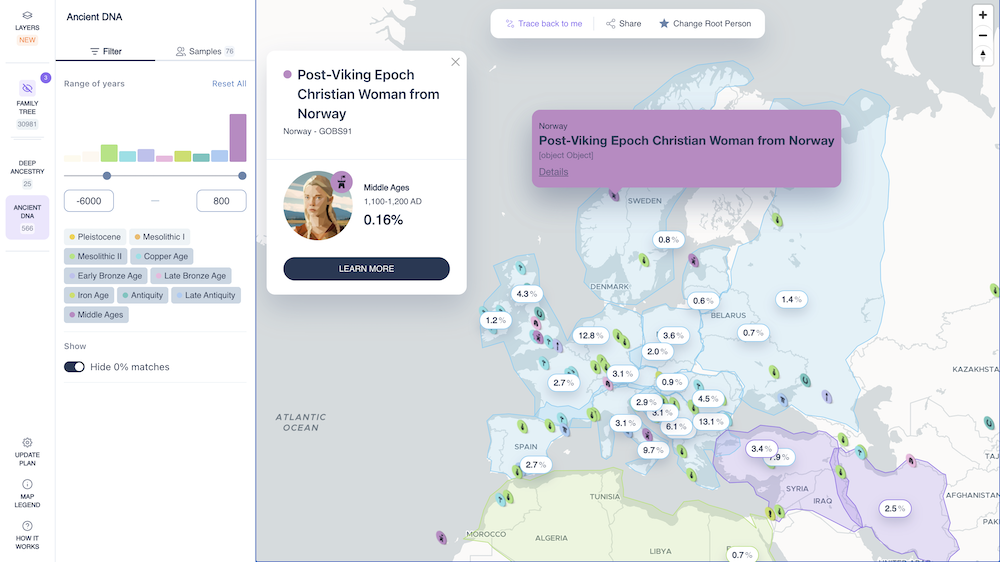
Building on this foundation, Genomelink recently introduced YourRoots — a genealogy tool that transforms your family tree into an interactive global map, allowing you to explore ancestral migration paths and compare them with the exact locations of your strongest ancient DNA matches.
MyTrueAncestry
One of the earliest companies to gamify ancient DNA, MyTrueAncestry lets users upload raw DNA files and receive matches to over 11,000 ancient individuals and civilizations. Its reports highlight direct IBS-based distances to Vikings, Romans, Gauls, or Scythians, often presented with maps and historical roleplay language. It appeals to hobbyists and enthusiasts who want an interactive, immersive connection to ancient peoples.
Illustrative DNA
A newer player, Illustrative DNA focuses on DIY analytics. Products like DeepAncestry and AdmixLab allow users to run their own admixture models using both modern and ancient reference populations. This makes it especially popular among advanced hobbyists and citizen scientists who enjoy experimenting with data rather than receiving polished reports. It’s positioned as the “laboratory for the public.”
MyHeritage – Ancient Origins
Launched in 2025, MyHeritage’s Ancient Origins extends its popular genealogy service into deep ancestry. It compares users to 150+ ancient civilizations, offering context up to 10,000 years. MyHeritage brings ancient DNA into the mainstream, leveraging its massive genealogy database to create family history + deep history narratives in one platform.
FamilyTreeDNA
Known for pioneering Y-DNA and mtDNA testing, FamilyTreeDNA provides deep paternal and maternal lineages that trace back tens of thousands of years. It has occasionally featured direct ancient matches (e.g., Ötzi the Iceman). Its strength lies in deep-time haplogroup tracking, appealing to those interested in ancient migrations through their direct maternal and paternal lines.
23andMe
The global giant of consumer genomics, 23andMe, is unique among big players in reporting Neanderthal ancestry percentage. It also recently added Historical Matches, which compare user genomes to ancient individuals. With its scale (millions of customers), 23andMe keeps archaic DNA in mainstream conversation—a casual but powerful way of linking the public to prehistory.
Living DNA
Positioned as the most detailed British Isles test, Living DNA provides fine-scale ancestry breakdowns within England, Scotland, Wales, and Ireland. While not explicitly “ancient DNA,” its regional maps are contextualized with Celtic, Anglo-Saxon, and Viking migrations, giving users a sense of deep time continuity.
AncestryDNA
With the largest consumer DNA database (>25 million users), AncestryDNA focuses on family matching and ethnicity estimates. While it doesn’t provide direct ancient DNA analysis, its raw data is compatible with platforms like Genomelink, MyTrueAncestry, and Illustrative DNA. In practice, it is the largest supplier of raw data for ancient DNA services, even if indirectly.
Nebula Genomics & Veritas Genetics
Both companies offer whole-genome sequencing (WGS). While their primary markets are health and wellness, their high-resolution raw data can be used with third-party ancient DNA platforms. They appeal to power users who want the most complete genomic dataset possible and are comfortable exploring with external tools.
Historical / Niche Players
- DNAPrint Genomics (defunct): Among the first to market “AncestryByDNA,” using ancestry-informative markers to estimate broad continental ancestry. Primitive by today’s standards, but historically important.
- African Ancestry: Focuses on connecting users to specific African ethnic groups using mtDNA and Y-DNA. While not “ancient DNA” in the archaeological sense, it provides deep-time and tribal-level lineage storytelling, filling an important niche.
8. Recognition and Mainstream Validation
Ancient DNA isn’t a fringe hobby—it’s a field with top-tier scientific recognition, blockbuster papers, and mainstream media coverage.
Scientific prizes & honors
- Nobel Prize (2022): Svante Pääbo was awarded the Nobel Prize in Physiology or Medicine “for discoveries concerning the genomes of extinct hominins and human evolution,” formalizing paleogenomics as a foundational discipline.
- Massry Prize (2021): Awarded to Pääbo and David Reich for advances that transformed ancient DNA from an artisanal exercise into an “industrial” science.
- Dan David Prize (2017): David Reich recognized for contributions to ancient DNA and the discovery of ancient admixture.
- Balzan Prize (2023): Eske Willerslev honored for research in human evolution; further underscores the field’s stature.
Scale & data infrastructure
- The Allen Ancient DNA Resource (AADR) documents the explosion from ~10 genome-wide aDNA individuals/year (2010–2014) to thousands per year since 2018, with global coverage expanding well beyond Europe—clear evidence of a mature, data-rich field.
Mainstream press & consumer recognition
Together, elite prizes, landmark Nature/Science papers, dedicated global datasets, and mainstream coverage establish ancient DNA as a rigorous, high-impact scientific domain that also resonates with consumers.
Recent coverage of ancient DNA in the news
- Reuters - DNA sequencing of ancient remains by Colombian scientists reveals unknown human lineage, Aug 25, 2025
- WIRED - What the DNA of Ancient Humans Reveals About Pandemics, Jun 23, 2022
9. Why This Is an Established (and Growing) Space
If you’re evaluating ancient DNA (aDNA) as a science or as a market, the signals of maturity are unmistakable. This isn’t hype—it's a discipline with reproducible methods, global datasets, elite prizes, and real consumer demand.
9.1 Scientific maturity: repeatable methods, shared playbooks
- Standardized wet lab workflows. Clean-room extraction, petrous/teeth sampling, UDG treatment, capture panels, and short-read sequencing are now routine rather than bespoke.
- Validated authenticity checks. Characteristic damage profiles, mtDNA contamination estimates, and X/Y-based sex checks are table stakes before any interpretation.
- Converging computational toolkits. PCA/ADMIXTURE for orientation; f-statistics, qpAdm/qpWave for admixture modeling; IBD/IBS and haplotype-based approaches for fine structure. Multiple labs use the same families of methods and cross-validate results.
9.2 Data scale and infrastructure
- Many thousands of ancient genomes exist today, spanning Ice Age to Medieval across Europe, Africa, the Americas, and Asia.
- Centralized, citable resources (e.g., open reference panels and curated metadata) let independent groups re-run analyses and extend them—critical for replication and trust.
9.3 Cross-disciplinary corroboration
- Archaeology (material culture), linguistics (phylogenies), stable isotopes (diet/mobility), and historical sources increasingly agree with genetic inferences. When lines of evidence triangulate, narratives harden from “interesting” to “established.”
9.4 Recognized at the highest levels
- The field’s pioneers have been honored with top scientific awards, and its landmark papers routinely appear in Nature and Science. That’s the academic equivalent of investment-grade credit.
9.5 Talent and institutional depth
- Multiple, independent centers of excellence (Harvard, Max Planck, Copenhagen, Crick Institute, Tartu, UCD, Oxford/Cambridge, CSIC-UPF) train new cohorts yearly. This redundancy reduces single-lab bias and accelerates innovation.
9.6 Consumer pull and market validation
- DTC genetics now reaches tens of millions of customers. Ancient-DNA-inflected offerings—from archaic-admixture widgets (e.g., Neanderthal %), to curated ancient-match reports, to regional deep dives—have become sticky features that drive engagement, upgrades, and shareable moments.
- A niche of specialist providers focuses squarely on ancient DNA narratives (upload→match→story), proving willingness to pay for deeper historical context.
9.7 Technology tailwinds
- Per-sample cost curves continue to fall; capture panels improve coverage; imputation and haplotype methods increase resolution at low coverage; sedimentary and microbiome DNA open new dimensions (pathogens, diet, environments).
- Cloud-native pipelines and reproducible notebooks democratize analyses that used to require bespoke HPC clusters.
9.8 Governance, ethics, and community norms
- Clearer ethical frameworks and consent practices—especially in collaboration with Indigenous and local communities—are now an integral part of study design and publication.
- Journals and consortia enforce data deposition, code availability, and provenance, making results auditable.
9.9 Limits (and why stating them builds trust)
- Preservation remains uneven (tropics, older time frames) and sample ascertainment can bias narratives. Low coverage requires careful modeling; cultural labels never equal genetic essences. Mature players say this up front, which is precisely how established fields behave.
9.10 What that means
- Readers/consumers: You can expect scientifically grounded stories about deep ancestry, not just pretty maps. Look for reports that cite datasets and methods.
- Builders/operators: The moat is in curation, QA, UX, and pedagogy—not just in raw data. Differentiation comes from credible references, transparent modeling, and intuitive visuals (PCA/t-SNE maps, timelines, match tables, reliability scores).
- Investors/partners: This is a compounding data business: every ethically sourced sample and every better-curated panel increases resolution and LTV across multiple products (ancestry, education, heritage tourism, genealogy tools).
10. Conclusion
Ancient DNA began as a daring idea and became a reliable way to read history, from the marrow of a tooth to the maps of migration that shaped us. In a few decades, careful lab work, open datasets, and shared methods turned scattered bones into a coherent story about who moved, mixed, and made the world we live in. That’s why a Nobel Prize sits at the heart of this field and why its findings keep landing in Nature, Science, and on our phones.
What makes it powerful isn’t just the science; it’s the connection. The same techniques that revealed Neanderthal DNA in modern people now help a curious reader see echoes of farmers, herders, sailors, and city-builders in their own genome. The companies listed here vary in style; some scholarly, some playful, but they all ride on a foundation that’s become solid: careful sampling, transparent analysis, and respect for the people behind the remains.
As coverage expands beyond Europe, as partnerships with communities deepen, and as tools get clearer and fairer, the picture will sharpen. Until then, keep one idea close: ancestry isn’t a fixed label, it’s a long conversation across time. Ancient DNA just gives us a better way to listen.