YourRoots Logo
Sign up free
banner

Sign up to explore more

Create a free account to navigate family trees, view ancestors, and discover connections.

Sign up free

John Hicks 1700 – 1750 – Genealogical Records

Birth Date: Sep 1700

Birth Location: Prince George, Prince George, Virginia, United States

Death Date: 24 Apr 1750 or 1761?

Death Location: Anson County, North Carolina, Colonial Era

Father: Captain (Hix)

Mother: Esther Luten

Spouse(s):

Children(s):

John Hicks was born in 1700 in Prince George, Prince George, Virginia, United States, the child of Captain Robert Hicks (Hix) and Esther Frances Luten. John Hicks passed away in 1750 in Anson County, North Carolina, Colonial Era.

Find more search results for John Hicks
JH

Reliability Score

This score reflects the reliability of the source family tree. A high rating indicates a trustworthy source with strong data consistency.

Reliability Score:
C
Criteria:
  • A 3 criteria (Strong)
  • B 2 criteria (Medium)
  • C 1 criteria (Basic)
  • N/A 0 criteria (Insufficient)

This tree's reliability score:

  • Record available
  • Descendant's record available
  • Star tree owner

Biography

  • John Hicks was born in 1700 in Prince George, Prince George, Virginia, United States, the child of Captain Robert Hicks (Hix) and Esther Frances Luten.
  • John Hicks passed away in 1750 in Anson County, North Carolina, Colonial Era.

Immediate Family

Parents

Spouses(s)

Children(s)

John Hicks's Ancestors

Self
John Hicks
1700 – 1750
Birth Place: Prince George, Prince George, Virginia, United States
Parents
Captain Robert Hicks (Hix)
1670 – 1738
Southwark, Surrey, England
Esther (Frances) Luten
1673 – 1744
Charles City, Charles, Virginia, American Colonies
Grandparents
Great-Grandparents
2nd-Great-Grandparents

John Hicks's Timeline

2 Records

1700
Sep 1700
Birth of John Hicks in Prince George, Prince George, Virginia, United States
Prince George, Prince George, Virginia, United States
1750
24 Apr 1750 or 1761?
Age 50
Death of John Hicks in Anson County, North Carolina, Colonial Era
Anson County, North Carolina, Colonial Era

Sources

    Genealogy Event 1
    Event Type: Birth
    Event Date: Sep 1700
    Event Place: Prince George, Prince George, Virginia, United States

    Genealogy Event 2
    Event Type: Death
    Event Date: 24 Apr 1750 or 1761?
    Event Place: Anson County, North Carolina, Colonial Era

About YourRoots

Family Tree Map

Explore your family tree geographically

Import your GEDCOM file to transform your family tree into an interactive global map. See your roots laid out visually and understand your true geographic heritage.

Powerful tools like “Trace Back To Me” instantly map your family’s migration paths from a chosen ancestor all the way back to you.

LEARN MORE
AI Genealogy Research

Discover ancestors beyond “end-of-line” automatically

Import your family tree and let AI expand it for you. AI Ancestor Finder scans “end-of-line” ancestors to uncover their parents across hundreds of family lines at once. AI Deep Research analyzes selected ancestors and family clusters, suggesting relevant records and next steps.

Turn on Auto Research Mode to get new discoveries daily or weekly, so your tree keeps growing even while you’re away.

LEARN MORE
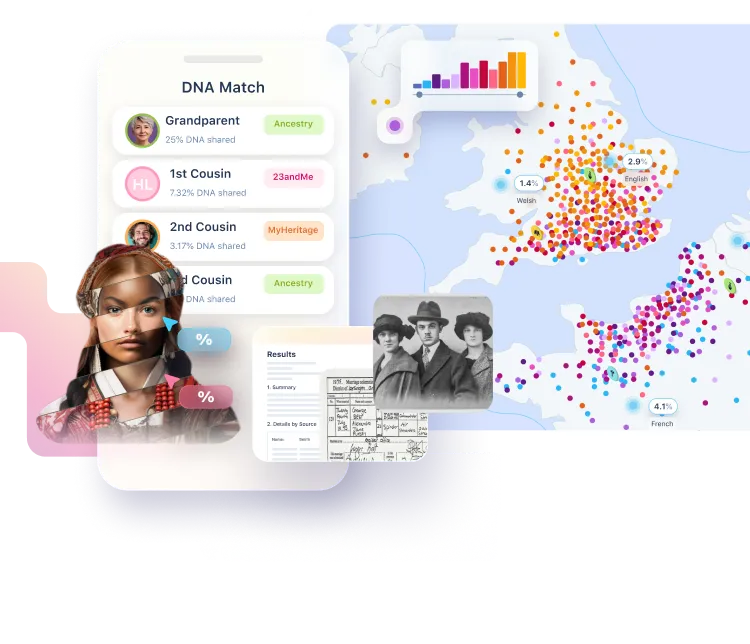
DNA Match

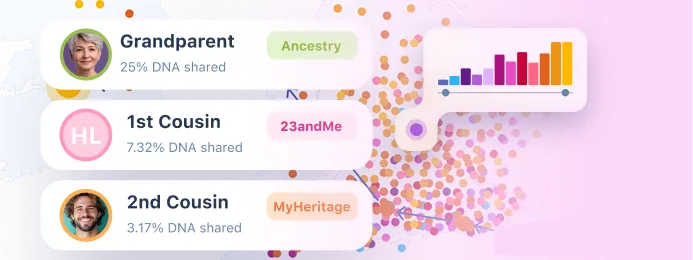
Find more DNA matches across all DNA tests

Combine your DNA data with your family tree to unlock the full power of YourRoots DNA Match. Connect with relatives across major testing services — Ancestry, 23andMe, MyHeritage, and more.

View your matches’ maps and trees to identify shared ancestors, and soon you’ll be able to add them directly to your own tree and map.

LEARN MORE
Ancestry Reports

Ancestry DNA analysis that goes deeper than others

Unlock exclusive reports that reveal your deeper origins.

  • Deep Ancestry Report — Analyze 130+ ethnicities, sub-regions, and 1,800+ communities in one detailed view.
  • Global & Native American Reports — Developed with Stanford researchers to uncover hidden ancestries across all 22 chromosomes.
  • Ancient DNA Series — Compare your DNA with 1,000+ ancient genomes from Viking, Celtic, and early American civilizations.
LEARN MORE